Iraq's Ancient Pottery Struggles to Outlive Modern Plastic

Pottery has deep roots in Iraq, where ancient civilizations turned to clay to build their homes, shape their cooking utensils, and even make their ovens. | AFP
TT

Iraq's Ancient Pottery Struggles to Outlive Modern Plastic

Pottery has deep roots in Iraq, where ancient civilizations turned to clay to build their homes, shape their cooking utensils, and even make their ovens. | AFP

Adel al-Kawwaz expertly spins the potter's wheel, shaping the wet clay into a smooth jug. His family is famous for this millennia-old Iraqi craft, but Kawwaz is struggling to keep it alive.

For thousands of years, clay utensils for storing food and cooking were found in virtually every home in Sumer, the earliest known civilization in modern-day southern Iraq.

Kawwaz's own family drew their name from the jug, or "kawz" in Arabic, which they have produced for more than 200 years from clay found at a lake by Najaf.

"Making clay vases is a craft that my family had become famous for," says 45-year-old Kawwaz wistfully.

Pottery has deep roots in Iraq, where ancient civilizations turned to clay to build their homes, shape their cooking utensils, and even make their ovens.

Cuneiform, one of the earliest forms of writing invented by the Sumerians, was also carved into clay tablets.

But now, with a flood of more modern products, demand for the handmade clay items has dried up, says Kawwaz.

- Once ubiquitous, now forgotten -

His family's jugs were shaped from Najaf mud, dried in the shade, then baked at high temperatures for no less than 15 hours.

In Iraq, one of the hottest countries on earth, they were indispensable.

"These vases were used to keep water cool or preserve food. They were placed in the shade or hung in another high location," he says.

Some Iraqis even used them to store jewelry.

"Those that practiced pottery would make a lot of money because they were common items in ancient Iraqi households," says Kawwaz.

They were surprisingly handy during the era of Saddam Hussein, when many families struggled financially, as well as in the 1990s, when international sanctions hit Iraq.

With household appliances extremely rare or unaffordable for most of the population, Iraqis once again relied on clay.

"The income of most families did not allow them to buy a refrigerator or freezer to keep their water cold, so most used clay cauldrons," he says.

Back then, his family sold their large jugs in bulk -- sometimes thousands per week across every Iraqi province.

But times have changed.

"We sell very few now -- the numbers in an entire year don't hit 100 or 200 jugs," says Kawwaz.

Farmers who once used the large containers are opting for cheaper goods, made either elsewhere in Iraq or imported.

"They buy plastic bags imported from China, so now we rarely sell clay pots," says Kawwaz in his studio, itself made of mud and covered in palm leaves.

He makes the vases by special request only, but admits it's hardly worth it.

Small jugs cost just 2,500 dinars or around $2, while the larger cauldrons that hold several dozen liters (gallons) are sold at 15,000 dinars.

- Battle of the bread -

Despite the prevalence of electric and gas cookers, Um Haydar prefers her trusty clay oven.

On her rooftop terrace in Old Najaf, she uses it to bake her own traditional bread every morning.

"The taste of bread made in a traditional oven is so different from bread baked in an electric or gas oven," says Um Haydar, as the searing oven near her radiates an enticing smell.

Well into her sixties, the Iraqi woman is dressed in a traditional black robe that covers her from head to toe.

Like her mother and grandmother before her, she has stuck to tradition when it comes to the clay oven, with one exception -- she didn't build it herself.

But some Iraqis, like Haydar al-Kaabi, insist on the full Sumerian experience.

On the edge of the Najaf Sea, Kaabi begins mixing together ingredients to make his own oven.

"To the clay, you have to add reeds, red sand, and synthetic wool fibers. You let the mixture rest for two days so the clay becomes compact," he explains to AFP.

Despite the drop in sales, this potter is upbeat.

"Even if we sell less, even if the craftsmen are fewer and fewer, we're fighting to keep the artisanal heritage of our fathers and grandfathers alive," he says.

"And of course, there are still Iraqis who only eat good bread," he says with a wink.


Why Israel Fears Military Rapprochement Between Egypt and Türkiye

Egyptian Abdel Fattah al-Sisi meets Turkish Recep Tayyip Erdogan on the sidelines of the D-8 Organization for Economic Cooperation summit in Egypt’s New Administrative Capital in December 2024. (Egyptian Presidency)
TT

Why Israel Fears Military Rapprochement Between Egypt and Türkiye

Egyptian Abdel Fattah al-Sisi meets Turkish Recep Tayyip Erdogan on the sidelines of the D-8 Organization for Economic Cooperation summit in Egypt’s New Administrative Capital in December 2024. (Egyptian Presidency)

The growing rapprochement between Egypt and Türkiye is raising concern in Israel, particularly as military cooperation expands through joint training and exercises between two of the region’s largest and most strategically significant armed forces.

Those concerns resurfaced after international military drills involving Egyptian and Turkish forces concluded in the Libyan city of Sirte.

Experts who spoke to Asharq Al-Awsat said the unease stems from several factors, including the two countries’ military weight and their growing alignment on regional issues and defense manufacturing.

They expect the rapprochement could evolve into a regional alliance with expanding influence, while ruling out any imminent military confrontation.

Israeli concerns

The Israeli newspaper Maariv published an article by retired general Yitzhak Brik warning that Tel Aviv could face a “difficult war” against a potential Egyptian-Turkish alliance as both countries strengthen their military capabilities.

Brik warned that strategic cooperation between Cairo and Ankara could extend to joint military production and defense integration.

Any military rapprochement between Egypt and Türkiye, he said, could reshape deterrence dynamics in the region and pose new security challenges for Israel, requiring a comprehensive reassessment of its military doctrine and defense strategies.

Israeli channel i24NEWS reported on April 18 that talks between Egypt and Türkiye were accelerating, noting that in-depth discussions had been referred to Turkish parliamentary committees on security, defense, and intelligence.

Turkish President Recep Tayyip Erdogan visited Cairo in February, where several agreements were signed, including in the defense sector. During a joint press conference, Egyptian President Abdel Fattah al-Sisi said the two countries share converging views on regional and international issues, particularly Gaza, Sudan, Libya and the Horn of Africa.

Israel has also expressed reservations about the possibility of Ankara participating in international stabilization forces in Gaza, after Türkiye became involved in mediation and guarantees for implementing a ceasefire agreement in October. Media reports have also pointed to the possibility of a future military confrontation between Israel and Türkiye following tensions linked to Iran.

‘Cold peace’

Egyptian military and strategic expert Samir Ragheb said Türkiye’s direct presence in the region, combined with its rapprochement with Egypt, reinforces what he described as a “cold peace” with Israel.

He told Asharq Al-Awsat that Cairo and Ankara command the region’s two largest armies and maintain strong ties with key regional powers, something Israel views with concern.

One of the most sensitive issues for Israel, he said, is cooperation in drone manufacturing.

Both Egypt and Türkiye have significant capabilities in this field, and joint production could meet their domestic needs while positioning them as strong competitors to Israeli drones in regional markets, particularly as negative perceptions of Israeli products grow due to ongoing conflicts, making Egyptian-Turkish alternatives more appealing.

Coordination between Egypt and Türkiye spans a broad geographic arc from Somalia to Syria, including Libya. This, Ragheb said, adds to Israeli concerns, particularly as Türkiye seeks to expand its footprint in Africa through Egypt, the continent’s main gateway.

Turkish affairs researcher Taha Ouda Oglu told Asharq Al-Awsat that cooperation between Egypt and Türkiye on Gaza, Libya and Africa is further raising Israeli concerns.

Rising military cooperation

Military cooperation between Egypt and Türkiye has accelerated in recent months. In late 2025, for the first time in 13 years, Egyptian forces took part in joint naval exercises on Turkish soil, involving Turkish frigates, attack boats, a submarine and F-16 fighter jets, alongside Egyptian naval units.

Türkiye’s Defense Ministry said on Thursday that the “Flintlock 2026” exercises, which were in Sirte from April 13 to 30, had concluded. The drills, which included Egyptian forces, aimed to enhance military cooperation and combat readiness through integrated land, air and naval scenarios.

In September, Turkish Foreign Minister Hakan Fidan said in a televised interview that Ankara is seeking to strengthen cooperation with Egypt in defense industries and joint security, noting that regional threats are driving deeper discussions on security as ties develop.

Egypt and Türkiye also signed an agreement in late August to locally produce the “Turkha” drone in Egypt, a step aimed at localizing drone technology and boosting domestic defense industries. The aircraft features advanced surveillance and reconnaissance systems and vertical takeoff and landing capabilities.

Ragheb ruled out the possibility of Israel waging a military confrontation against either Egypt or Türkiye, saying Israeli military doctrine does not allow for fighting on multiple fronts simultaneously against major powers.

He added that the United States would be unlikely to support Israel in a war against countries the size of Egypt or Türkiye, noting both nations rely on deterrence through strength rather than rhetoric.

He said the rapprochement, while not directed against Israel, could evolve into a broader regional alliance that may include major countries, such as Pakistan.

Oglu said military cooperation between Egypt and Türkiye is likely to deepen further and expand across multiple arenas, increasing their influence in the region, without leading to a direct confrontation with Israel.


Sudanese Schoolchildren Race to Make Up for Years Lost to War

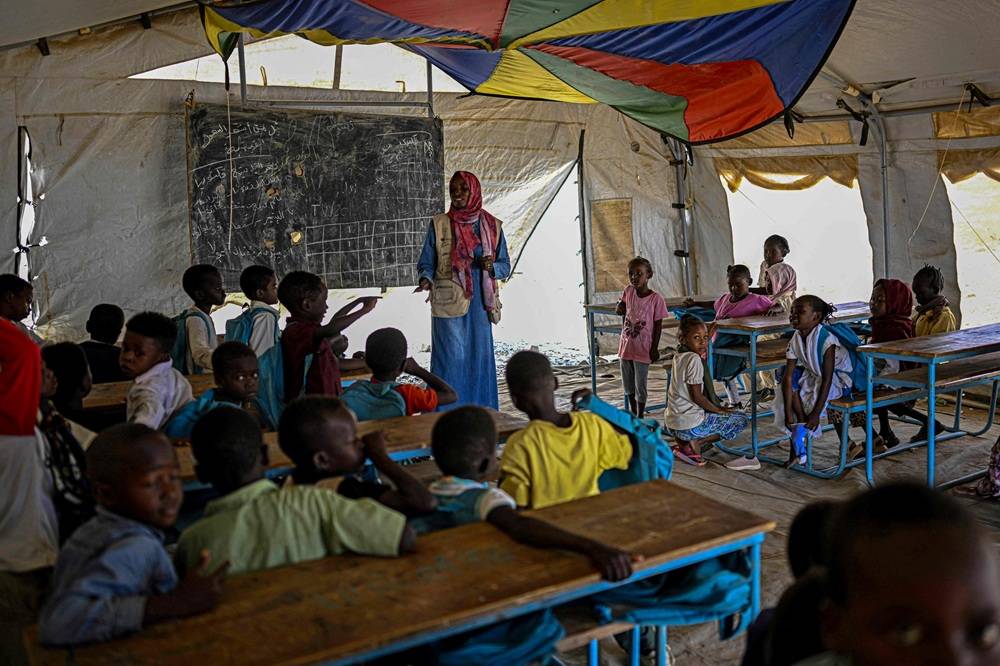
Displaced Sudanese students attend a class at an elementary school run by the Sudanese Coalition for Education in partnership with the United Nations International Children's Emergency Fund (UNICEF), south of Port Sudan, on April 26, 2026. (AFP)
TT

Sudanese Schoolchildren Race to Make Up for Years Lost to War

Displaced Sudanese students attend a class at an elementary school run by the Sudanese Coalition for Education in partnership with the United Nations International Children's Emergency Fund (UNICEF), south of Port Sudan, on April 26, 2026. (AFP)

Sudanese 13-year-old Afrah wants to become a surgeon, and nothing will stop her, not even the war that has ravaged her country and forced millions of children out of school.

Quiet and determined, she kept learning on her own for months, uprooted by the now three-year conflict between Sudan's army and the paramilitary Rapid Support Forces (RSF).

"I would study my lessons again and again," she told AFP at a displacement camp in Port Sudan, where she is again receiving an education thanks to UNICEF and local organization SCEFA.

Afrah is one of more than 25 million minors in Sudan, or half the total population, of whom eight million are currently out of school, according to the UN children's agency.

At the Al-Hishan camp, tents arranged in a square function as an elementary school for more than 1,000 children -- nearly a third of whom required an accelerated curriculum to make up for lost time.

Laughter fills the camp now, but most of the children arrived traumatized by horrors including starvation and rocket fire.

Their drawings, educators said, were at first dominated by war: depictions of the tanks, weapons and death they saw as their families fled.

"They come here scared, exhausted, isolated, but over time you see their drawings change," UNICEF spokesperson Mira Nasser told AFP.

"They start to adapt and process."

In one tent, children repeated hand-washing instructions after a social worker, while in another, they recited a poem in choral unison.

Elsewhere, a teacher -- herself displaced and living at the camp -- explained chemical and physical reactions to her class, as her three-year-old son pulled at her skirt.

"These children's future is at stake, and education is itself a form of protection," Nasser said.

"Here they can at least get a sense of normalcy, even in a displacement site. They can resume their education, they can play, they can make friends."

Displaced Sudanese students attend a class at an elementary school run by the Sudanese Coalition for Education in partnership with the United Nations International Children's Emergency Fund (UNICEF), south of Port Sudan, on April 26, 2026. (AFP)

- DIY operation -

Awatef al-Ghaly, a 48-year-old Arabic teacher who was displaced from North Darfur, remembered her first days at the site, when thousands of families were left listless with their kids in tow.

"There were 60 teachers here. We just got to work," she told AFP, at the same empty plot where they started, in the shadow of the Red Sea mountains.

They lined the students up by grade, threw together a schedule and started going through old lessons.

Soad Awadallah, 52, taught English for four decades in South Darfur before arriving in Port Sudan.

"It took a lot of patience, we had the kids all sat on the ground at first," she said, gesturing towards the rows of desks that now fill the tents, a welcome addition even if students have to squeeze in four to a bench.

According to Nasser, because of the time that students lost, ranging from months to years, "some even forgot how to read and write".

But their determination was indomitable, and the makeshift school recently graduated its first class from elementary to middle school, Ghaly said with pride.

"Even when things were difficult, in the heat of summer with bugs everywhere, the kids wanted to learn," she said.

Before the final exam, "some of them would follow us teachers home begging for more review sessions".

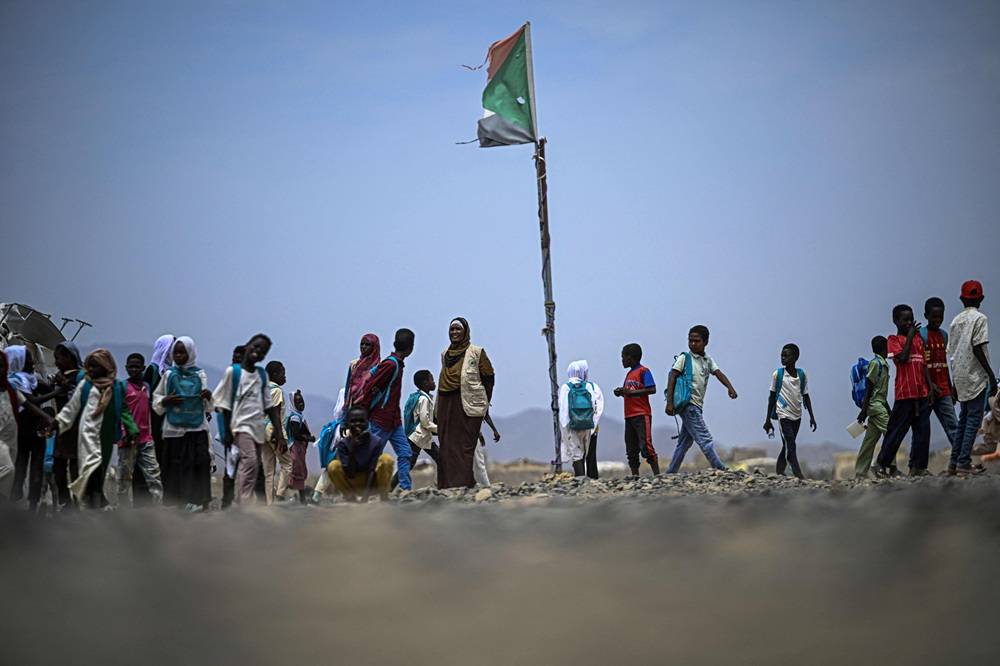
Sudanese students leave a school operated by the Sudanese Coalition for Education for All, in partnership with the United Nations International Children's Emergency Fund (UNICEF), south of Port Sudan on April 26, 2026. (AFP)

- 'Want to help people' -

Fatma, 16, wants to become a psychiatrist to help those hurt by the fighting in Sudan.

"This war has destroyed people emotionally... My father was in the main market in Khartoum when the RSF went through killing people. He ran away, and he still feels that pain," she told AFP.

"When I sit with the social worker, I feel better. I want to help people like that."

One little girl, who came up to an AFP journalist's hip, was missing her right arm, amputated after she was wounded in the capital Khartoum.

She high-fived with her left hand.

Across Sudan, five million children are internally displaced, according to UNICEF. Millions are going hungry, including over 825,000 children under five suffering severe acute malnutrition.

The use of child soldiers has been reported across the country, and rampant sexual violence against minors has prevented many from returning to school even in areas now safe from the fighting.

Many just want to go home.

"I miss my friends and my family, I miss my school in Khartoum -- it was full of trees," 14-year-old Ibrahim said.

But he has a goal. "I want to become a petroleum engineer," he told AFP, as the sound of children playing outside filled the tent.

During recess, dozens of pupils dashed around their teachers, laughing, playing and making hearts at AFP's cameras.

One boy named Rizeq, clad in a red Manchester United jersey, steeled himself and walked up to the adults.

His voice a little shaky but his chest puffed out, he said: "I want more English classes in the evening."


Timeline of Decades of Conflict Between Israel and Hezbollah

 Mourners carry coffins during a funeral ceremony of four Hezbollah fighters and two civilians, amid a temporary ceasefire between Lebanon and Israel, in the village of Maaroub, southern Lebanon, April 26, 2026. (Reuters)
Mourners carry coffins during a funeral ceremony of four Hezbollah fighters and two civilians, amid a temporary ceasefire between Lebanon and Israel, in the village of Maaroub, southern Lebanon, April 26, 2026. (Reuters)
TT

Timeline of Decades of Conflict Between Israel and Hezbollah

 Mourners carry coffins during a funeral ceremony of four Hezbollah fighters and two civilians, amid a temporary ceasefire between Lebanon and Israel, in the village of Maaroub, southern Lebanon, April 26, 2026. (Reuters)
Mourners carry coffins during a funeral ceremony of four Hezbollah fighters and two civilians, amid a temporary ceasefire between Lebanon and Israel, in the village of Maaroub, southern Lebanon, April 26, 2026. (Reuters)

The ongoing war between Israel and the Lebanese armed group Hezbollah is far from the first conflict between them. The two have an enmity that goes back more than four decades, with outbursts of fighting or outright war punctuated by periods of tense calm.

Here is a timeline of some significant events in the hostilities between the two:

1982: Israel invades Lebanon in an offensive against the Palestine Liberation Organization and allied groups. Hezbollah is formed, with Iranian backing and based on the Iran's revolution model, to fight Israel’s ensuing occupation of southern Lebanon. It launches a guerrilla war against Israel.

1992: Hezbollah leader Abbas Mousawi is killed by an Israeli helicopter attack. His successor is Hassan Nasrallah, who will lead the group for the next three decades.

1996: Israel launches an offensive aiming to push Hezbollah north of the Litani River, some 30 kilometers (20 miles) from the border. Israeli artillery shelling on a United Nations compound housing hundreds of displaced people in Qana kills at least 100 civilians and wounds scores more.

2000: After a long war of attrition, Israel withdraws its forces from southern Lebanon, which is heralded around the Arab world as a major victory for Hezbollah.

2006: Hezbollah fighters ambush an Israeli patrol, killing three Israeli soldiers and taking two hostage in a cross-border raid, sparking a monthlong war between Hezbollah and Israel that ends in a draw. Israeli bombardment razes villages and residential blocks in southern Lebanon and Beirut's southern suburbs, a scorched-earth approach that is dubbed the “Dahiyeh Doctrine.”

2008: Imad Mughniyeh, Hezbollah’s military chief, is killed when a bomb planted in his car exploded in Damascus. The assassination is blamed on Israel.

2012: Hezbollah enters the Syrian civil war in support of then-President Bashar Assad. In the years that follow, Israel begins periodically carrying out airstrikes in Syria targeting Iranian and Hezbollah facilities and officials or weapons shipments that it said were bound for Hezbollah. Israel still avoided carrying out strikes on Hezbollah on Lebanese territory during this period.

OCT. 8, 2023: One day after the Hamas-led attack in southern Israel sparks the war in Gaza, Hezbollah fires missiles across the border. Israel responds with airstrikes and shelling and the two enter into a low-level conflict that initially remains mainly confined to the border area.

SEPT. 17, 2024: Israel launches an attack in Lebanon using remotely-triggered explosive-laden pagers issued to Hezbollah fighters and civilian employees. A day later, a similar attack targets walkie-talkies. The attacks kill dozens of people and maim thousands, most of them Hezbollah members but also including women and children.

SEPT. 27, 2024: Hassan Nasrallah is killed in a series of massive airstrikes in Beirut's southern suburbs.

NOV. 27, 2024: A US-brokered ceasefire nominally ends the Israel-Hezbollah war. Israel continues to carry out regular strikes in Lebanon that it says aim to stop Hezbollah from rebuilding.

MARCH 2, 2026: Two days after Israel and the US attacked Iran, triggering a wide-reaching war in the Middle East, Hezbollah launches missiles toward Israel. It says the salvo is in retaliation for the killing of Iranian Supreme Leader Ali Khamenei and for “repeated Israeli aggressions” in Lebanon.