


Manchester United Cannot Turn Back Clock – the Era of One-Club Rule Is Over

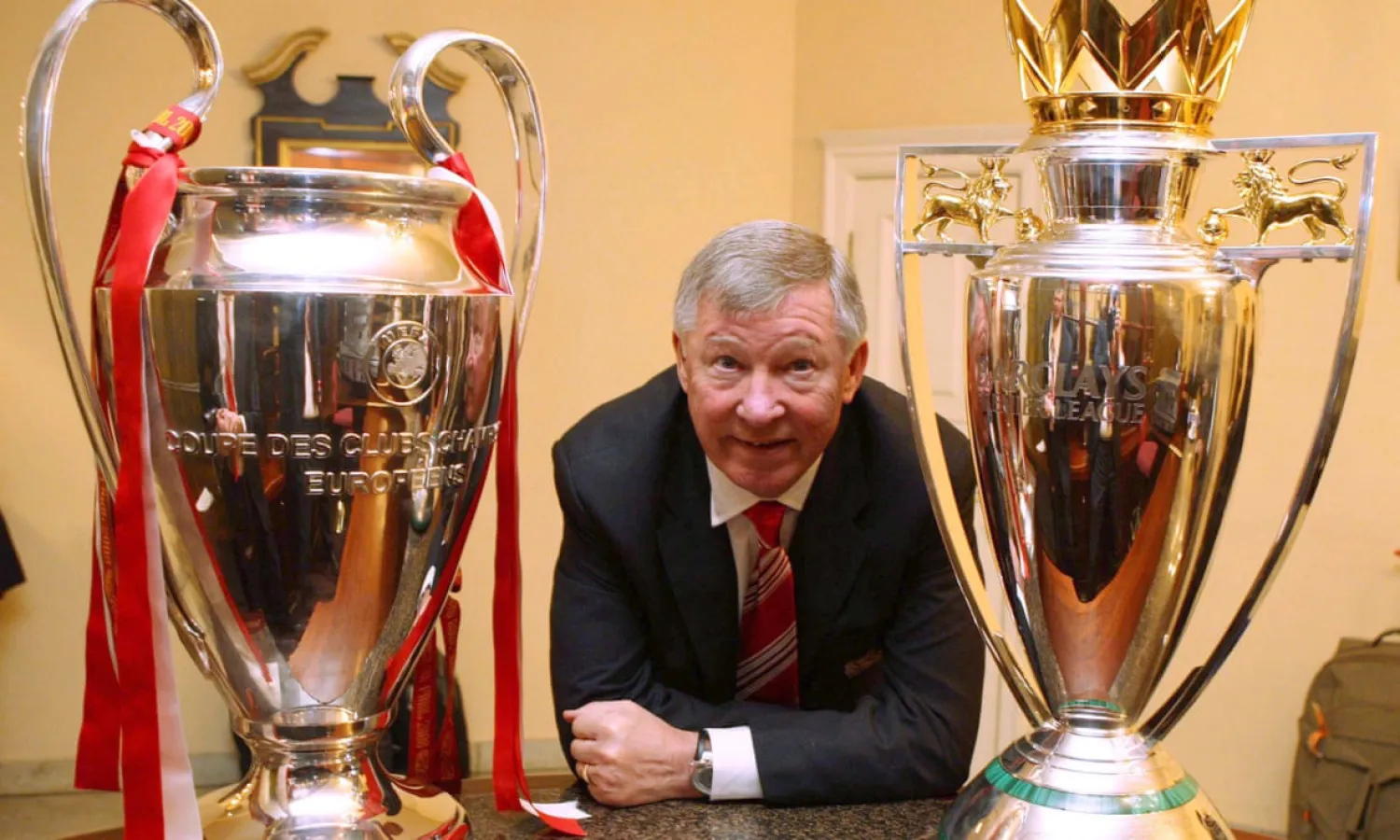
Sir Alex Ferguson is flanked by the Champions League trophy (left) and the Premier League trophy after Manchester United’s outstanding 2007-2008 season. Photograph: John Peters/Man Utd via Getty Images
TT

Manchester United Cannot Turn Back Clock – the Era of One-Club Rule Is Over

Sir Alex Ferguson is flanked by the Champions League trophy (left) and the Premier League trophy after Manchester United’s outstanding 2007-2008 season. Photograph: John Peters/Man Utd via Getty Images

A football journalist should never welcome the departure of a leading manager, particularly one as notable and quotable as José Mourinho.

The guy has been good copy over the last decade and a bit, and remained so right up to the end. Although Manchester United trail forlornly in Manchester City’s wake in most aspects of football relating to the pitch, if you could pick up points for entertaining press conferences or providing pithy replies to questions rather than attempting to defuse them the situation could well be reversed.

It was the football that caught up with Mourinho. He was found on the pitch, exposed as one-dimensional, stubborn and unimaginative, and though English football has undoubtedly lost one of its outstanding performers and truest claims to fame – many would argue the Premier League got properly going only when Chelsea arrived to get up the noses of Manchester United and Arsenal – the fact is life was getting pretty repetitive around Old Trafford and not in a good way.

United have been a stuck record since Sir Alex Ferguson stepped aside. Although Mourinho at least tried to give the impression he was either bigger than the club or better than it deserved – possibly not the smartest way to court popularity – United still ended up pulling the rug from under him in a manner similar to their brusque treatment of David Moyes and Louis van Gaal, despite backing their latest manager with expensive signings.

The only complaint Mourinho could have on that score was that United were not quite matching City in the expenditure stakes, though presumably he took the job fully cognisant of the fact a combination of Pep Guardiola’s charisma and Abu Dhabi wealth would make the neighbors much more of a threat than the noisy nuisance they proved for Ferguson.

Mourinho and Ed Woodward had been at odds all season over United’s spending and recruitment strategy, and it should not have been too difficult to foresee the upcoming transfer window potentially causing a problem when the club’s record signing had spent his last few games on the bench.

If Paul Pogba was intended as a statement signing, proof United could still attract and afford the best talent around, it ended up making the wrong sort of statement. Should Pogba leave, the statement will still be wrong but stronger. This is because, as Mourinho admitted a month ago, United are experiencing nothing but difficulty in attracting and accommodating the players they want and need.

There are wealthier clubs around, clubs that can promise a less rocky path to Champions League football, clubs with stadiums that are not full of put-upon supporters wincing at the present dross while eulogizing about the good old days, and clubs with infinitely better prospects of winning something major quite soon.

United are no longer a trophy-winning machine, no longer the sort of club that sell themselves to a player before his agent even picks up the phone. As the club have gradually fallen away in the last five years so others have risen or reinvented themselves. In the past a club such as United, or Liverpool before them, could take advantage of complete dominance by judiciously adding a striker from Tottenham here or a center-half from Leeds there, simultaneously strengthening themselves, weakening their rivals and usually making the player’s dreams come true in the process.

The era of one-club domination seems now to be over. Not even City, with all their riches, are likely to find themselves in as powerful a position as Liverpool in the 80s or United for the two decades afterwards. City may give the impression they are on their way to invincibility but they were rumbled by Liverpool and Wigan last season, have just been knocked off the top of the table through defeat at Chelsea and there is reason to suppose, given the surprising result when Guardiola was suspended for a single game against Lyon earlier in the season, that they will have a succession problem of their own to contend with when their manager moves on.

To his credit, Mourinho made this very point just before he was moved out. He said it was a little unfair for his best efforts to be compared with the impossibly illustrious past, because the two situations were quite different. United were once in a position of complete dominance, so that practically every wish could be realized, and now they are not, because no one is.

It is a good thing for English football that Premier League-generated wealth is now shared more evenly and democratically, so no one club can easily get too far ahead, though perhaps someone could pass the message along to all those clamoring for regime change or radical reform at United to bring the product back up to scratch.

The task of the next permanent manager, apparently, will be to restore United to the supremacy they enjoyed under Ferguson. Good luck with that because it may never happen. It is not part of the natural order of things that United should sit a mile or two above everyone else in the league, though goodness knows how many managers the club will get through before the penny drops.

While on the whole it is unlikely United will spend 28 years in the title wilderness, like Liverpool, it is even more improbable to envisage the Premier League elite permitting a return to the situation that pertained 10 or 15 years ago. The clock cannot be turned back, as Mourinho knew. The best United can hope for is someone may come along with an idea for a different story.

(The Guardian)


‘Don’t Jump in Them’: Olympic Athletes’ Medals Break During Celebrations

Gold medalists team USA celebrate during the medal ceremony after the Team Event Free Skating of the Figure Skating competitions at the Milano Cortina 2026 Winter Olympic Games, in Milan, Italy, 08 February 2026. (EPA)
TT

‘Don’t Jump in Them’: Olympic Athletes’ Medals Break During Celebrations

Gold medalists team USA celebrate during the medal ceremony after the Team Event Free Skating of the Figure Skating competitions at the Milano Cortina 2026 Winter Olympic Games, in Milan, Italy, 08 February 2026. (EPA)

Handle with care. That's the message from gold medalist Breezy Johnson at the Milan Cortina Winter Olympics after she and other athletes found their medals broke within hours.

Olympic organizers are investigating with "maximum attention" after a spate of medals have fallen off their ribbons during celebrations on the opening weekend of the Games.

"Don’t jump in them. I was jumping in excitement, and it broke," women's downhill ski gold medalist Johnson said after her win Sunday. "I’m sure somebody will fix it. It’s not crazy broken, but a little broken."

TV footage broadcast in Germany captured the moment biathlete Justus Strelow realized the mixed relay bronze he'd won Sunday had fallen off the ribbon around his neck and clattered to the floor as he danced along to a song with teammates.

His German teammates cheered as Strelow tried without success to reattach the medal before realizing a smaller piece, seemingly the clasp, had broken off and was still on the floor.

US figure skater Alysa Liu posted a clip on social media of her team event gold medal, detached from its official ribbon.

"My medal don’t need the ribbon," Liu wrote early Monday.

Andrea Francisi, the chief games operations officer for the Milan Cortina organizing committee, said it was working on a solution.

"We are aware of the situation, we have seen the images. Obviously we are trying to understand in detail if there is a problem," Francisi said Monday.

"But obviously we are paying maximum attention to this matter, as the medal is the dream of the athletes, so we want that obviously in the moment they are given it that everything is absolutely perfect, because we really consider it to be the most important moment. So we are working on it."

It isn't the first time the quality of Olympic medals has come under scrutiny.

Following the 2024 Summer Olympics in Paris, some medals had to be replaced after athletes complained they were starting to tarnish or corrode, giving them a mottled look likened to crocodile skin.


African Players in Europe: Ouattara Fires Another Winner for Bees

Football - Premier League - Newcastle United v Brentford - St James' Park, Newcastle, Britain - February 7, 2026 Brentford's Dango Ouattara celebrates scoring their third goal with Brentford's Rico Henry. (Reuters)
TT

African Players in Europe: Ouattara Fires Another Winner for Bees

Football - Premier League - Newcastle United v Brentford - St James' Park, Newcastle, Britain - February 7, 2026 Brentford's Dango Ouattara celebrates scoring their third goal with Brentford's Rico Henry. (Reuters)

Burkina Faso striker Dango Ouattara was the Brentford match-winner for the second straight weekend when they triumphed 3-2 at Newcastle United.

The 23-year-old struck in the 85th minute of a seesaw Premier League struggle in northeast England. The Bees trailed and led before securing three points to go seventh in the table.

Last weekend, Ouattara dented the title hopes of third-placed Aston Villa by scoring the only goal at Villa Park.

AFP Sport highlights African headline-makers in the major European leagues:

ENGLAND

DANGO OUATTARA (Brentford)

With the match at Newcastle locked at 2-2, the Burkinabe sealed victory for the visitors at St James' Park by driving a left-footed shot past Magpies goalkeeper Nick Pope to give the Bees a first win on Tyneside since 1934. Ouattara also provided the cross that led to Vitaly Janelt's headed equalizer after Brentford had fallen 1-0 behind.

BRYAN MBEUMO (Manchester Utd)

The Cameroon forward helped the Red Devils extend their perfect record under caretaker manager Michael Carrick to four games by scoring the opening goal in a 2-0 win over Tottenham after Spurs had been reduced to 10 men by captain Cristian Romero's red card.

ISMAILA SARR (Crystal Palace)

The Eagles ended their 12-match winless run with a 1-0 victory at bitter rivals Brighton thanks to Senegal international Sarr's 61st-minute goal when played in by substitute Evann Guessand, the Ivory Coast forward making an immediate impact on his Palace debut after joining on loan from Aston Villa during the January transfer window.

ITALY

LAMECK BANDA (Lecce)

Banda scored direct from a 90th-minute free-kick outside the area to give lowly Leece a precious 2-1 Serie A victory at home against mid-table Udinese. It was the third league goal this season for the 25-year-old Zambia winger. Leece lie 17th, one place and three points above the relegation zone.

GERMANY

SERHOU GUIRASSY (Borussia Dortmund)

Guirassy produced a moment of quality just when Dortmund needed it against Wolfsburg. Felix Nmecha's silky exchange with Fabio Silva allowed the Guinean to sweep in an 87th-minute winner for his ninth Bundesliga goal of the season. The 29-year-old has scored or assisted in four of his last five games.

RANSFORD KOENIGSDOERFFER (Hamburg)

A first-half thunderbolt from Ghana striker Koenigsdoerffer put Hamburg on track for a 2-0 victory at Heidenheim. It was their first away win of the season. Nigerian winger Philip Otele, making his Hamburg debut, split the defense with a clever pass to Koenigsdoerffer, who hit a shot low and hard to open the scoring in first-half stoppage time.

FRANCE

ISSA SOUMARE (Le Havre)

An opportunist goal by Soumare on 54 minutes gave Le Havre a 2-1 home win over Strasbourg in Ligue 1. The Senegalese received the ball just inside the area and stroked it into the far corner of the net as he fell.


Olympic Town Warms up as Climate Change Puts Winter Games on Thin Ice

 Milano Cortina 2026 Olympics - Alpine Skiing - Men's Team Combined Downhill - Stelvio Ski Centre, Bormio, Italy - February 09, 2026. Alexis Monney of Switzerland in action during the Men's Team Combined Downhill. (Reuters)
Milano Cortina 2026 Olympics - Alpine Skiing - Men's Team Combined Downhill - Stelvio Ski Centre, Bormio, Italy - February 09, 2026. Alexis Monney of Switzerland in action during the Men's Team Combined Downhill. (Reuters)
TT

Olympic Town Warms up as Climate Change Puts Winter Games on Thin Ice

 Milano Cortina 2026 Olympics - Alpine Skiing - Men's Team Combined Downhill - Stelvio Ski Centre, Bormio, Italy - February 09, 2026. Alexis Monney of Switzerland in action during the Men's Team Combined Downhill. (Reuters)
Milano Cortina 2026 Olympics - Alpine Skiing - Men's Team Combined Downhill - Stelvio Ski Centre, Bormio, Italy - February 09, 2026. Alexis Monney of Switzerland in action during the Men's Team Combined Downhill. (Reuters)

Olympic fans came to Cortina with heavy winter coats and gloves. Those coats were unzipped Sunday and gloves pocketed as snow melted from rooftops — signs of a warming world.

“I definitely thought we’d be wearing all the layers,” said Jay Tucker, who came from Virginia to cheer on Team USA and bought hand warmers and heated socks in preparation. “I don’t even have gloves on.”

The timing of winter, the amount of snowfall and temperatures are all less reliable and less predictable because Earth is warming at a record rate, said Shel Winkley, a Climate Central meteorologist. This poses a growing and significant challenge for organizers of winter sports; The International Olympic Committee said last week it could move up the start date for future Winter Games to January from February because of rising temperatures.

While the beginning of the 2026 Olympic Winter Games in Cortina truly had a wintry feel, as the town was blanketed in heavy snow, the temperature reached about 40 degrees Fahrenheit (4.5 degrees Celsius) Sunday afternoon. It felt hotter in the sun.

This type of February “warmth” for Cortina is made at least three times more likely due to climate change, Winkley said. In the 70 years since Cortina first held the Winter Games, February temperatures there have climbed 6.4 degrees Fahrenheit (3.6 degrees Celsius), he added.

For the Milan Cortina Games, there's an added layer of complexity. It’s the most spread-out Winter Games in history, so Olympic venues are in localities with very different weather conditions. Bormio and Livigno, for example, are less than an hour apart by car, but they are separated by a high mountain pass that can divide the two places climatically.

The organizing committee is working closely with four regional and provincial public weather agencies. It has positioned weather sensors at strategic points for the competitions, including close to the ski jumping ramps, along the Alpine skiing tracks and at the biathlon shooting range.

Where automatic stations cannot collect everything of interest, the committee has observers — “scientists of the snow”— from the agencies ready to collect data, according to Matteo Pasotti, a weather specialist for the organizing committee.

The hope? Clear skies, light winds and low temperatures on race days to ensure good visibility and preserve the snow layer.

The reality: “It’s actually pretty warm out. We expected it to be a lot colder,” said Karli Poliziani, an American who lives in Milan. Poliziani was in Cortina with her father, who considered going out Sunday in just a sweatshirt.

And forecasts indicate that more days with above-average temperatures lie ahead for the Olympic competitions, Pasotti said.

Weather plays a critical role in the smooth running and safety of winter sports competitions, according to Filippo Bazzanella, head of sport services and planning for the organizing committee. High temperatures can impact the snow layer on Alpine skiing courses and visibility is essential. Humidity and high temperatures can affect the quality of the ice at indoor arenas and sliding centers, too.

Visibility and wind are the two factors most likely to cause changes to the competition schedule, Bazzanella added. Wind can be a safety issue or a fairness one, such as in the biathlon where slight variations can disrupt the athletes' precise shooting.

American alpine skier Jackie Wiles said many races this year have been challenging because of the weather.

“I feel like we’re pretty good about keeping our heads in the game because a lot of people are going to get taken out by that immediately,” she said at a team press conference last week. “Having that mindset of: it’s going to be what it’s going to be, and we still have to go out there and fight like hell regardless.”
