


Egypt in Shuttle Diplomacy for Gaza Truce

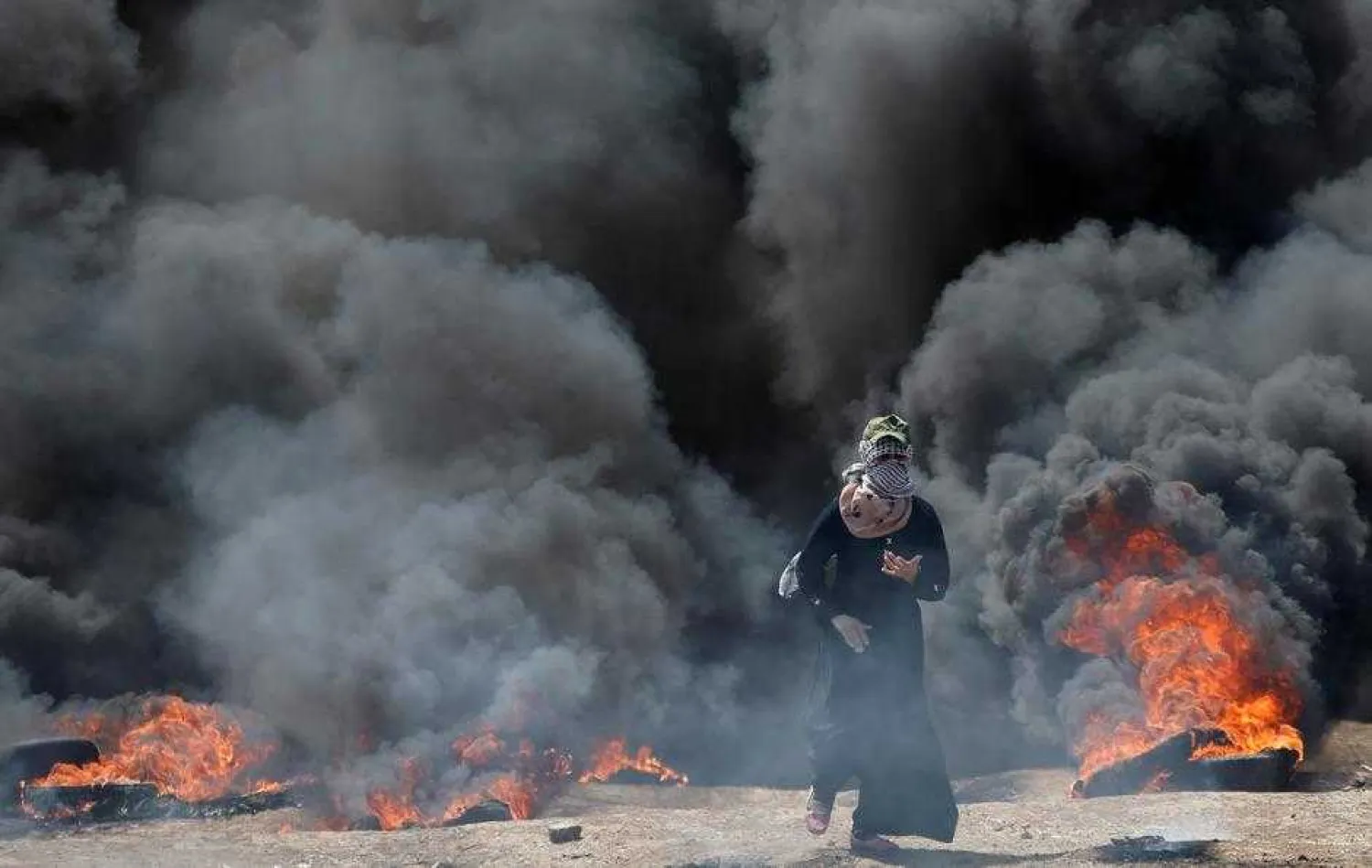
A female Palestinian demonstrator gestures during a protest against US embassy move to Jerusalem and ahead of the 70th anniversary of Nakba, at the Israel-Gaza border, east of Gaza City. Reuters file photo
TT

Egypt in Shuttle Diplomacy for Gaza Truce

A female Palestinian demonstrator gestures during a protest against US embassy move to Jerusalem and ahead of the 70th anniversary of Nakba, at the Israel-Gaza border, east of Gaza City. Reuters file photo

Hamas has informed Israel that it rejects an escalation in the fighting in the Gaza Strip, but urged it to refrain from tightening the noose on the enclave.

Hamas leaders told Egyptian mediators during a meeting they held in Gaza on Tuesday that the movement had no interest in a flare-up, yet they demanded that Israel abides by its obligations as part of understandings reached between the two sides a few months ago, Israeli sources said.

Hamas also told Egyptian intelligence officials that they want Israel to allow money into Gaza without extortion, expand the fishing area, solve electricity problems and allow more goods to flow into the Strip.

The movement’s officials reiterated that they would not accept Gaza’s people to suffer any further.

The Egyptian security delegation led by deputy chief of Egyptian intelligence Amr Hanafi met with head of Hamas political bureau Ismail Haniyeh, Hamas leader in Gaza Yahya al-Senwar and his deputy Khalil al-Hayya.

The delegation has been involved in shuttle diplomacy to consolidate a truce deal.

Israel has demanded that all forms of violence, including incendiary balloons be stopped and that any transfer of funds be subject to the previously enforced monitoring mechanism.

In a gesture of goodwill, and in recognition of the efforts of the Egyptian delegation, Hamas canceled a demonstration scheduled for Tuesday in the Zikim area.

Egypt’s mediation comes amid intermittent Israeli attacks in Gaza in response to the continued launch of burning balloons.

Hamas resorted to launching incendiary balloons and kites after disagreements led to the suspension of the Qatari grant and brought previously reached understandings on a truce in the enclave to a standstill.

Israel’s air force has attacked several Hamas sites in northern Gaza Strip, the latest of which was at dawn Tuesday.

“Hamas is primarily responsible for everything that happens in the Strip and what comes out of it,” the Israeli military spokesman said in response to the launching of improvised explosive devices carried by balloons from the enclave.

Earlier, a round of sirens was triggered when an explosive device detonated near Shaar Hanegev regional council, without causing any damage. Israeli media reported that the device was attached to a cluster of 15 balloons.

Egypt wants Israel and Hamas to reach an agreement by March 30, when Palestinians commemorate Land Day.

Gaza demonstrations on the border with Israel known as the return marches began on March 30 last year.

The committee responsible for the demonstrations is preparing a million man march on the anniversary of the return marches. 


Israeli Fire Kills Four Palestinians in Gaza, Medics Say

Palestinians inspect a vehicle targeted by an Israeli strike in Maghazi camp for Palestinian refugees in the central Gaza Strip on April 4, 2026. (AFP)
TT

Israeli Fire Kills Four Palestinians in Gaza, Medics Say

Palestinians inspect a vehicle targeted by an Israeli strike in Maghazi camp for Palestinian refugees in the central Gaza Strip on April 4, 2026. (AFP)

An Israeli airstrike ‌killed four Palestinians in the northern Gaza Strip on Sunday, local health authorities said, in the latest violence to overshadow a fragile ceasefire amid a new push by mediators to bolster the agreement.

Medics said the airstrike targeted a group of people in Jaffa Street, near the Darraj neighborhood in Gaza City, killing four people and wounding others.

The Israeli military did not immediately comment on ‌the incident.

Palestinian ‌group Hamas and Israel have ‌traded blame ⁠for violations of ⁠the ceasefire agreed last October, which halted two years of full-blown war.

The Gaza health ministry says Israeli fire has killed at least 700 people since the ceasefire began. Israel says four soldiers have been killed by gunmen in Gaza ⁠over the same period.

A Hamas delegation met ‌Egyptian, Qatari and ‌Turkish mediators in Cairo last week to give its initial ‌response to a disarmament proposal presented to the ‌group last month, two Egyptian sources and a Palestinian official said.

The group has told mediators it will not discuss giving up arms without guarantees that Israel ‌will fully quit Gaza as laid out in a disarmament plan from ⁠US President ⁠Donald Trump's "Board of Peace", three sources told Reuters on Thursday.

Hamas' disarmament is a sticking point in talks to implement Trump's plan for the Palestinian enclave and cement the ceasefire.

Hamas' October 7, 2023, attacks on Israel killed 1,200 people, according to Israeli tallies.

Israel's ensuing two-year campaign killed more than 72,000 Palestinians, most of them civilians, according to Gazan health authorities, and has spread famine, demolished most buildings, and displaced most of the territory's population, in many cases numerous times.


Easter in Jerusalem Disrupted by War and Restrictions at Holy Sepulchre

 Members of the clergy make their way to the Church of the Holy Sepulchre for prayers on Palm Sunday, following restrictions on gatherings in large groups, amid the US-Israel conflict with Iran, in Jerusalem's Old City April 5, 2026. (Reuters)
Members of the clergy make their way to the Church of the Holy Sepulchre for prayers on Palm Sunday, following restrictions on gatherings in large groups, amid the US-Israel conflict with Iran, in Jerusalem's Old City April 5, 2026. (Reuters)
TT

Easter in Jerusalem Disrupted by War and Restrictions at Holy Sepulchre

 Members of the clergy make their way to the Church of the Holy Sepulchre for prayers on Palm Sunday, following restrictions on gatherings in large groups, amid the US-Israel conflict with Iran, in Jerusalem's Old City April 5, 2026. (Reuters)
Members of the clergy make their way to the Church of the Holy Sepulchre for prayers on Palm Sunday, following restrictions on gatherings in large groups, amid the US-Israel conflict with Iran, in Jerusalem's Old City April 5, 2026. (Reuters)

In the usually lively alleyways of Jerusalem's Old City, silence reigned on Easter Sunday, with the holiday overshadowed by war and restrictions on access to the Holy Sepulchre, where the faithful commemorate Christ's crucifixion and resurrection.

On routes approaching the church, police at checkpoints screened a small number of worshippers allowed near the site.

All shops in the area were closed, heightening the sense of emptiness.

"Happy Easter," said the Latin Patriarch of Jerusalem, Cardinal Pierbattista Pizzaballa, shortly after dawn as he entered the church surrounded by a modest group of clergy, according to AFP journalists at the site.

Outside, a few Catholics and Orthodox Christians tried to reach the church but were kept at a distance by security forces.

"How can you tell me I cannot go to church, it is unacceptable," said one Catholic from Tel Aviv who had attended Easter worship at the site in previous years.

Security has been stepped up in the Old City, located in annexed east Jerusalem and home to sites sacred to Jews, Christians and Muslims.

Israel has also imposed restrictions on large gatherings as a security precaution due to the constant threat of strikes during the ongoing Middle East war.

On Palm Sunday, Cardinal Pizzaballa was prevented by Israeli police from entering the Holy Sepulchre for mass, provoking outrage, before Prime Minister Benjamin Netanyahu ordered he be allowed in.

Since the start of the war on February 28, debris from Iranian missiles or interceptors has fallen in the Old City, including near the Holy Sepulchre, Al-Aqsa Mosque, and in the Jewish Quarter.

Most Palestinian Christians belong to the Orthodox faith, which celebrates Easter on April 12.

But for many other Christians, the curbs on worship have stripped the Easter celebrations of substance.

"It's very hard for all of us because it's our holiday... It's really hard to want to pray but to come here and find nothing. Everything is closed," said Christina Toderas, 44, from Romania.

Like many other worshippers, she had resigned herself to watching the mass at the Holy Sepulchre on television.

Father Bernard Poggi, who was preparing to attend mass in another church near the holy site, said he understood the security measures but added that "it seems to be more and more that there's an unevenness in how the laws are put into practice".

Inside the Holy Sepulchre, the celebrations were being held behind closed doors in front of a very small congregation, far removed from the crowds that usually gather.

Around the Old City, where hymns and processions usually dominate at Easter, only whispers could be heard among the faithful moving discreetly through its passages.


Hamas, Mediators in Renewed Push to Break Gaza Ceasefire Deadlock

Egyptian Foreign Minister Badr Abdelatty (R) meets with Bulgarian diplomat and US-appointed High Representative for Gaza and Director General of the Board of Peace, Nikolay Mladenov, at the New Administrative Capital, east of Cairo, Egypt, 01 April 2026. (EPA)
TT

Hamas, Mediators in Renewed Push to Break Gaza Ceasefire Deadlock

Egyptian Foreign Minister Badr Abdelatty (R) meets with Bulgarian diplomat and US-appointed High Representative for Gaza and Director General of the Board of Peace, Nikolay Mladenov, at the New Administrative Capital, east of Cairo, Egypt, 01 April 2026. (EPA)

A renewed push is underway to revive Gaza ceasefire talks, with mediators stepping in after meetings in Cairo to revive the process as the impasse has deepened since the outbreak of the Iran war.

Talks due to resume in Cairo in the coming days aim to break the deadlock and advance unresolved issues, including activating the technocratic committee, while increasing pressure on Israel and preventing it from entrenching a fait accompli, experts told Asharq Al-Awsat.

Egypt’s Al Qahera News TV, citing unnamed sources on Saturday, said Cairo hosted discussions over the past two days involving mediators and Nickolay Mladenov, high representative for Gaza of the US-led Board of Peace, to advance ceasefire efforts.

Egyptian Foreign Minister Badr Abdelatty met Mladenov on April 1.

The sources said a “positive atmosphere” prevailed, with all parties committing to implementing all elements of US President Donald Trump’s Gaza plan.

However, they noted Hamas insists on implementing all outcomes of the Sharm el-Sheikh summit alongside Trump’s plan. They added that Hamas and other Palestinian factions had reaffirmed their commitment to completing all phases of the ceasefire, with agreement to continue talks in Cairo next week.

Hamas said on Friday its delegation met Egyptian officials, Palestinian factions, and Mladenov, in the presence of mediators from Egypt, Qatar, and Türkiye, stressing the need to complete the first phase of the agreement in full.

The group reiterated its commitment, along with other factions, to all stages of the ceasefire, adding it had been invited to resume talks in Cairo in the coming days.

Tarek Fahmy, a political science professor and analyst of Palestinian and Israeli affairs, said Cairo is keen to keep the agreement alive to prevent Israel from consolidating control over Gaza amid the Iran war.

He said mediators are working to break the stalemate and move discussions forward on outstanding issues, including the launch of the technocratic committee.

Palestinian political analyst Nizar Nazzal said Hamas believes Israel is unlikely to implement the second phase. He said the group is seeking to shift the pressure on Israel by signaling its readiness to implement the full agreement, in a bid to break the deadlock.

A Palestinian source close to Hamas and other factions told Asharq Al-Awsat that a delegation led by Khalil al-Hayya met Mladenov and discussed the proposed framework, including weapons and the integration of employees into police and civil institutions.

The source said Hamas’ position in Cairo was clear: Israeli withdrawal, deployment of stabilization forces, and formation of a police force must come before any steps on disarmament, warning that any alternative risks a major security vacuum.

The disarmament of Hamas is central to what has been dubbed the “Mladenov plan,” outlined at the UN Security Council in late March.

According to details published by international and regional media, the plan includes dismantling tunnels and relinquishing weapons in stages over eight months, with full Israeli withdrawal contingent on verification that Gaza is free of weapons.

Israel says it will not withdraw from Gaza unless Hamas is disarmed first.
