


Fatah: Efforts Underway with Egypt to Rein in Hamas Crackdown on Protests

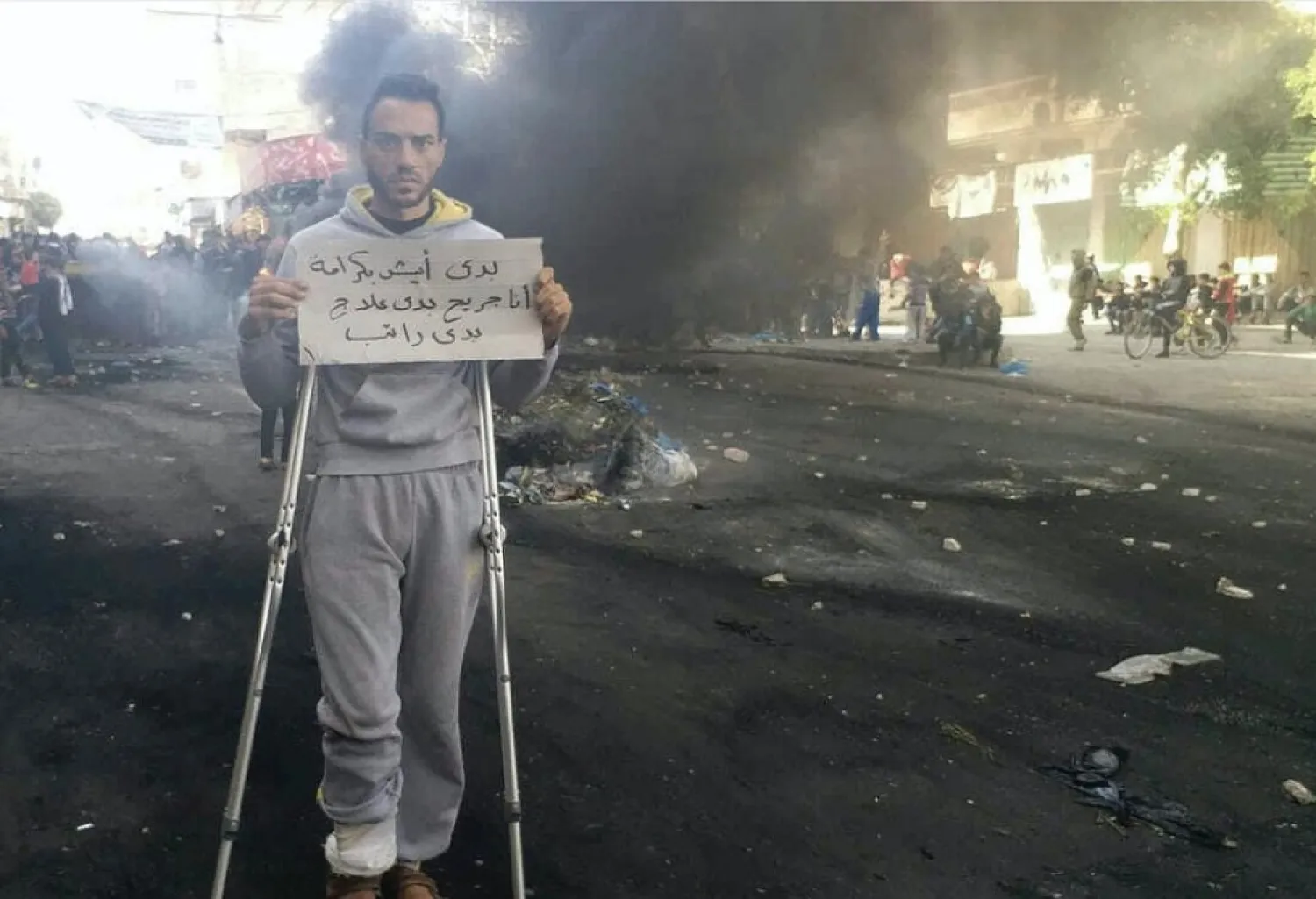
A protester holds a sign that reads, ‘I want to live in dignity; I'm wounded and need treatment and a salary,’ during a protest in central Gaza last week. (Osama al-Kahlout via AP)
TT

Fatah: Efforts Underway with Egypt to Rein in Hamas Crackdown on Protests

A protester holds a sign that reads, ‘I want to live in dignity; I'm wounded and need treatment and a salary,’ during a protest in central Gaza last week. (Osama al-Kahlout via AP)

Fatah deputy chief Mahmoud al-Aloul revealed on Tuesday that intense local and regional efforts are underway to rein in the Hamas movement’s violent crackdown on protests in the Gaza Strip.

He said talks are underway with Egypt to that end. He also accused Hamas of seeking to create crises between Palestinians and spark an internal conflict in order to approve the “Deal of the Century” peace proposal that is being prepared by the US administration.

He made his remarks as Hamas intensified its crackdown and arrests against popular activists who had taken to the streets of Gaza to protest against new taxes and price hikes.

Hamas has resorted to excessive use of force in order stifle sedition, arresting several members of Fatah and the Palestinian left. Official reports said that they were subject to torture during investigations.

Since the eruption of the protests, the Independent Commission for Human Rights has documented a number of rights violations as Hamas’ security agencies attempted to disperse protesters by force, citing a number of injuries among the demonstrators.

Some 25 rallies have taken place since their eruption on March 14. Hamas has also arrested over 1,000 people taking part in the rallies. Some 300 remain in detention. Twenty-three journalists were also detained.

Fatah, meanwhile, accused Hamas of attempting to assassinate its spokesman in Gaza, Atef Abou Seif, after he was severely beaten in the Strip. Hamas has denied the charge and condemned the attack.

Abu Seif has suffered from several broken bones and is receiving medical treatment in Ramallah

Fatah stressed that it will not remain silent over Hamas’ “crimes” for very long. It did not disclose what measures it intends to take against the movement.

Observers believe it would resort to legal measures if necessary.

In addition, the Popular Front’s politburo revealed that Hamas has arrested several of its members. Democratic Front politburo members Taysir Khaled compared Hamas’ security agencies to the Gestapo, while Muslim and Christian clerics joined in in condemning the movement’s practices.

The Palestinian government held Hamas completely responsible for the dangerous deterioration, while the Palestinian Liberation Organization (PLO) executive committee condemned the movement’s “barbaric” crackdown on peaceful youth protests.

It said that such practices are alien to Palestinian culture, calling on the de facto forces in Gaza to cease this behavior immediately, return to reason and implement the reconciliation to end the Palestinian rift.

Hamas has yet to officially respond to any of the mounting backlash against it.

Prominent movement member in the West Bank, Hassan Youssef, did however, propose an end to political arrests, saying he rejects the “use of force against any Palestinian over their right to freedom of expression.”

Other Hamas members have distanced themselves from the movement’s practices.

Hamas seized control of Gaza in 2007 from the forces of Palestinian President Mahmoud Abbas. Israel imposed a blockade, a step meant to prevent Hamas from arming. The blockade, and three wars with Israel, have ravaged Gaza's economy but done nothing to loosen Hamas' grip on power.

Unemployment is over 50 percent and much higher for young university graduates. Tap water is undrinkable, electricity is limited and travel abroad severely restricted. Hamas' cash-strapped government recently raised taxes on basic goods like bread, beans and cigarettes.

Protesters accuse Hamas of corruption and imposing the hefty taxes to enrich itself. They used social media to organize protests last week with the slogan "We want to live!"

This is not the first time people have taken to the streets against Hamas. Two years ago, protesters demonstrated against the chronic power cuts on a cold January day before Hamas violently dispersed them. This time around, the sporadic rallies have continued for several days, despite a similarly violent response.


Drone Attack by RSF in Sudan Kills 24, Including 8 Children, Doctors’ Group Says

Displaced Sudanese wait to receive humanitarian aid at the Abu al-Naga displacement camp in the Gedaref State, some 420km east of the capital Khartoum on February 6, 2026. (AFP)
TT

Drone Attack by RSF in Sudan Kills 24, Including 8 Children, Doctors’ Group Says

Displaced Sudanese wait to receive humanitarian aid at the Abu al-Naga displacement camp in the Gedaref State, some 420km east of the capital Khartoum on February 6, 2026. (AFP)

A drone attack by a notorious paramilitary group hit a vehicle carrying displaced families in central Sudan Saturday, killing at least 24 people, including eight children, a doctors’ group said.

The attack by the Rapid Support Forces occurred close to the city of Rahad in North Kordofan province, said the Sudan Doctors Network, which tracks the country’s ongoing war.

The vehicle transported displaced people who fled fighting in the Dubeiker area of North Kordofan, the doctors’ group said in a statement. Among the dead children were two infants, the group said.

The doctors’ group urged the international community and rights organizations to “take immediate action to protect civilians and hold the RSF leadership directly accountable for these violations.”

There was no immediate comment from the RSF, which has been at war against the Sudanese military for control of the country for about three years.

Sudan plunged into chaos in April 2023 when a power struggle between the military and the RSF exploded into open fighting in the capital, Khartoum, and elsewhere in the country.

The devastating war has killed more than 40,000 people, according to UN figures, but aid groups say that is an undercount and the true number could be many times higher.

It created the world’s largest humanitarian crisis with over 14 million people forced to flee their homes. It fueled disease outbreaks and pushed parts of the country into famine.


Israeli Army Allows Settlers to Spend Night Near Gaza

Israeli settlers walk toward the border with Gaza on Thursday (AFP). 
TT

Israeli Army Allows Settlers to Spend Night Near Gaza

Israeli settlers walk toward the border with Gaza on Thursday (AFP). 

The Israeli army on Friday escorted about 1,500 Jewish settlers out of an area near the Gaza Strip after allowing them to spend a single night along the border, while arresting several who insisted on staying inside occupied Palestinian territory.

An army spokesperson said such actions endanger the settlers’ lives in a combat zone and divert soldiers from their primary mission of safeguarding state security. He added, however, that the army was dealing with the group with restraint to prevent friction and internal clashes.

The settlers, affiliated with the Nachala movement, arrived on Thursday night in the northern part of the Gaza border area, which is under Israeli military control and known as the “Yellow Line.” They dispersed across seven locations according to what the army described as a plan resembling military-style deployment.

Members of the group attempted to breach the border and reach areas where Jewish settlements once stood before Israel withdrew from Gaza in 2005 under the disengagement plan led by then prime minister Ariel Sharon. The settlers said they were carrying out an operation modeled on an attack by Hamas, claiming they were “more capable” of launching such an action.

They asserted that their stated purpose was to plant trees in Gaza as a prelude to future steps involving renewed settlement activity. At the same time, they brought tents with the apparent intention of establishing an outpost.

Israeli forces blocked their advance and prevented them from crossing the border, leading to hours of maneuvering as settlers tried to evade soldiers, who repeatedly halted them.

After prolonged standoffs, a local military commander reached an arrangement allowing the group to remain overnight at the border area, on the condition that they would leave the following day. Those who refused and attempted to stay inside Gaza were detained and handed over to police, who opened investigations on charges of obstructing security forces and diverting them from their duties.

The settlers vowed to return repeatedly until they succeeded in reviving the settlement project.

The Nachala movement was founded in 2005, as Israeli-Palestinian negotiations resumed toward a two-state solution. It promotes the slogan “One state for one people” and seeks to expand Jewish settlement across what it describes as historic Israel. The group has raised funds in Israel and the United States and has been involved in establishing dozens of settlement outposts in the West Bank, many of which have since been retroactively legalized by the current government.


Paris Urges Baghdad to Avoid Being Dragged in Regional Escalation

 Iraqi Foreign Minister Fuad Hussein (R) shake hands as he receives French Foreign Minister Jean-Noel Barrot (L) upon his arrival for an official visit to Baghdad on February 5, 2026. (AFP)
Iraqi Foreign Minister Fuad Hussein (R) shake hands as he receives French Foreign Minister Jean-Noel Barrot (L) upon his arrival for an official visit to Baghdad on February 5, 2026. (AFP)
TT

Paris Urges Baghdad to Avoid Being Dragged in Regional Escalation

 Iraqi Foreign Minister Fuad Hussein (R) shake hands as he receives French Foreign Minister Jean-Noel Barrot (L) upon his arrival for an official visit to Baghdad on February 5, 2026. (AFP)
Iraqi Foreign Minister Fuad Hussein (R) shake hands as he receives French Foreign Minister Jean-Noel Barrot (L) upon his arrival for an official visit to Baghdad on February 5, 2026. (AFP)

French diplomatic sources said Paris has warned of the risks posed by the involvement of Iraqi armed factions in any potential regional escalation, stressing that Iraq should not be drawn into conflicts that do not serve its national interests at a time of mounting regional tensions.

The sources told Asharq Al-Awsat on Friday that the warning was among the messages delivered by French Foreign Minister Jean-Noel Barrot during his visit to Baghdad on Thursday, where he held talks with Prime Minister Mohammed Shia al-Sudani and Foreign Minister Fuad Hussein. The trip marked Barrot’s second official visit to Iraq in less than a year.

According to the sources, the French minister underscored that the stability and security achieved in Iraq “with great patience and effort” should not be jeopardized under any circumstances.

He cautioned that the involvement of non-state armed groups in regional confrontations could undermine Iraq’s recovery and threaten the security of both the country and the wider region.

The stance echoed remarks Barrot made to news agencies in Baghdad on Thursday, in which he said France’s priority in the region remains the fight against ISIS and preventing its resurgence.

Any security deterioration, whether in Iraq or in camps and prisons in northeastern Syria, would benefit the group, he warned.

Barrot said France is working with its partners to ensure continued security at these sites, adding that a collapse there “would not serve anyone’s interests.”

He praised Iraq’s efforts to receive detainees linked to ISIS, calling it a crucial step in international efforts to address one of the most sensitive post-conflict files.

For his part, Hussein reiterated Baghdad’s commitment to continued cooperation with the international coalition against terrorism, emphasizing Iraq’s determination to safeguard internal stability and steer clear of regional power struggles.

Iraqi foreign policy is based on balance and building relations with all partners to shield the country from regional tensions, he stressed.

The talks also addressed Iran, amid fears of escalation and its potential repercussions for Iraq.

Barrot urged the need for Tehran to respond to a US proposal for negotiations and to make substantive concessions on its nuclear program, ballistic arsenal, and destabilizing regional activities, while ending repressive policies.

Iraq, he said, must stay out of any regional confrontation.

Paris and Baghdad are also aligned on Syria, supporting a peaceful, inclusive political transition involving all components of Syrian society, alongside continued efforts to combat ISIS and prevent its return to liberated areas, he added.

French sources said Paris’ core message was to shield Iraq from being pulled into any regional escalation and to preserve its stability.