


Saudi Aramco Announces Construction of Jafura Unconventional Gas Plant

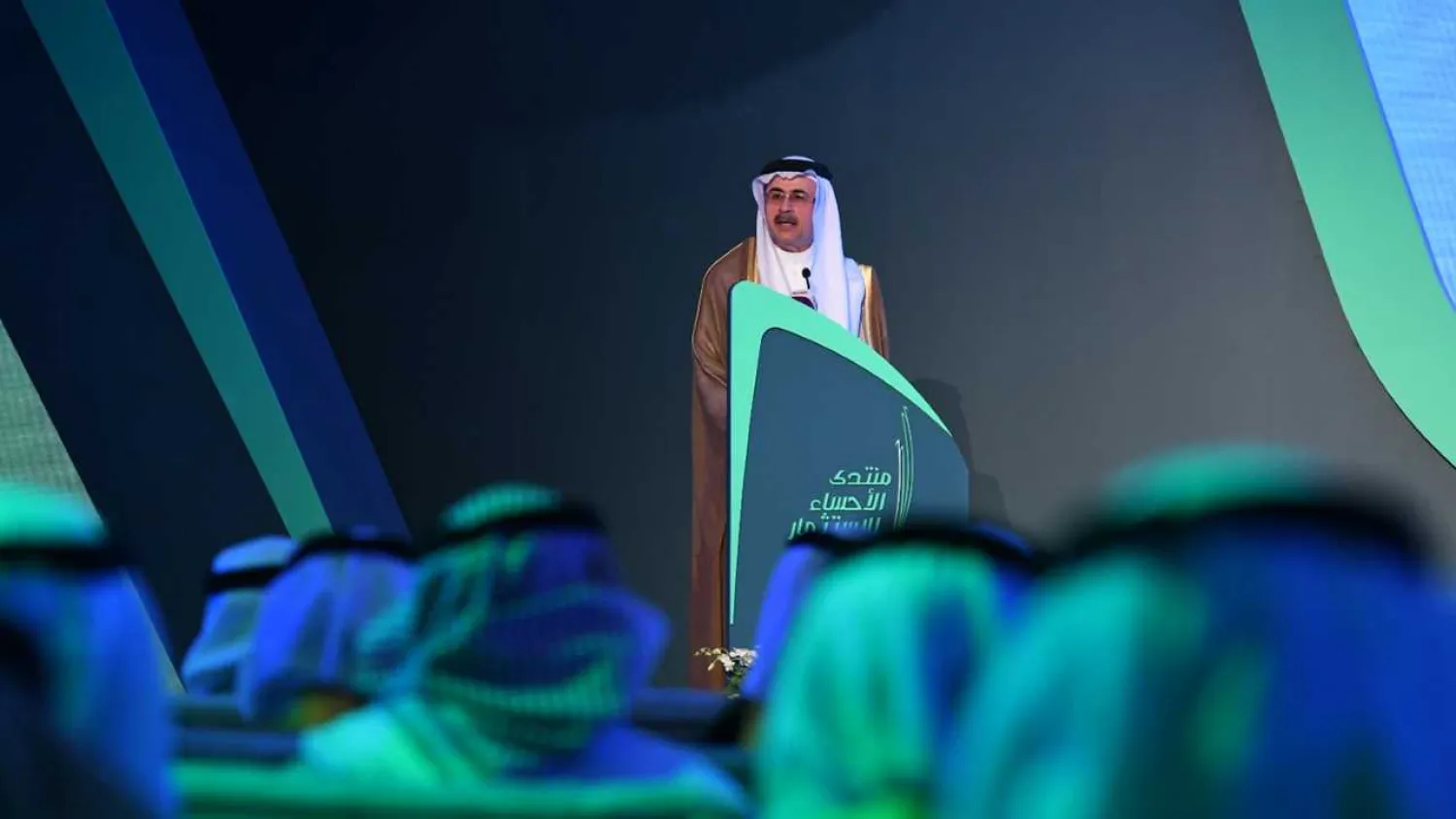
Saudi Aramco President and CEO, Amin Nasser speaking at al-Hasa Investment Forum (Aramco)
TT

Saudi Aramco Announces Construction of Jafura Unconventional Gas Plant

Saudi Aramco President and CEO, Amin Nasser speaking at al-Hasa Investment Forum (Aramco)

Saudi Aramco plans to start a new phase of the Jafura gas plant construction next year which will increase the company’s production to 3 billion standard cubic feet of unconventional gas, announced Saudi Aramco President and CEO Amin Nasser.

Nasser was speaking on Wednesday at the two-day al-Ahsa Investment Forum organized by al-Ahsa Chamber of Commerce and Industry.

“The plant is part of Saudi Aramco's plan to produce 3 billion standard cubic feet of unconventional gas over the next decade,” he said.

The Forum kicked off under the patronage of Emir of Eastern Province Prince Saud bin Naif bin Abdulaziz, with the attendance of al- Ahsa Governor and Head of the Higher Committee organizing the event Prince Badr bin Muhammad, and Minister of Energy and Mineral Resources Khalid al-Falih.

On the localization of industries and services, Nasser also announced that the company has launched the construction of the King Salman Energy Park (SPARK), located between al-Ahsa and Dammam.

He explained that this mega project and pioneering park will be an ideal environment for attracting local and global investments and for creating more jobs for the Saudi people.

Aramco’s CEO noted that the company plans to establish a large and modern driving school for women in al-Mubarraz to train thousands of female candidate drivers annually.

It will be managed by qualified Saudi women, and it will train both Saudi Aramco female employees and Saudi women in general.

Minister Falih noted that al-Ahsa has become a center for oil and petrochemical industries, saying it will provide many opportunities for the private sector to invest in supply chains and become a vital center and logistics platform.

He added that the forum comes in line with the major transformations taking place in the Kingdom under Vision 2030.

In its fifth edition, al-Ahsa forum seeks promising investment opportunities in the city, Falih said, stressing the important role the private sector plays in achieving the vision’s objectives.

He also discussed the economic and geographical advantages of the region, its vast natural resources and its role in supporting the economic development of the Kingdom.

In a televised speech, Minister of Trade and Investment Majid al-Qasabi praised the successful strategic partnership between al-Ahsa Chamber and Aramco in organizing the Forum.

He stated that at this stage, it is required to explore and identify the enormous investment opportunities highlighted by Vision 2030.

The Minister also warned that both the public and private sectors face great challenges, calling for joint efforts to achieve the ambitions and aspirations of the next phase.

He pointed out that the region has many investment opportunities.

Al-Ahsa Chamber of Commerce and Industry President Abdullatif al-Arfaj announced that al-Ahsa's gross domestic product (GDP) is about 26 percent of the total local production of the Eastern Region and about 16 percent of the Kingdom's GDP.

He also indicated that the number of institutions and companies in al-Ahsa has grown significantly, reaching some 36,000 establishments in various sectors.



European Development Bank Unveils 5 Bn Euros for War-hit Economies

A Lebanese man walks past destruction at the site of an Israeli airstrike the day before that targeted a building in Beirut on April 9, 2026. (Photo by Ibrahim AMRO / AFP)
TT

European Development Bank Unveils 5 Bn Euros for War-hit Economies

A Lebanese man walks past destruction at the site of an Israeli airstrike the day before that targeted a building in Beirut on April 9, 2026. (Photo by Ibrahim AMRO / AFP)

The European development bank said Thursday it was unlocking five billion euros ($5.9 bn) to help shore up economies hit by the Middle East war.

The European Bank for Reconstruction and Development (EBRD) said it will "deploy EUR5 billion in 2026 in economies impacted by Middle East conflict".

The funds would be focused on Iraq, Jordan, Lebanon, the West Bank and Gaza "and affected neighboring economies" including Egypt, Türkiye, Armenia and Azerbaijan, the bank said in a statement.

"The economic and social impact of the conflict is already being felt across many of the bank's economies in the form of disrupted trade routes, energy and commodity shocks, weakened investor confidence and broader costs to the population," it added.

Established in 1991 to help former Soviet bloc nations embrace free-market economies, the bank later extended its reach to the Middle East and Africa.

"In a time of rising uncertainty, we are stepping up where others may pull back," said EBRD president Odile Renaud Basso.

"We are here to support economies, clients and people in our countries of operation in tough times," she added.

The bank said "the volume of conflict response investment will be demand driven due to the fast-changing nature of the situation".

The funds will provide immediate relief "by supporting economic activity" and "fostering financial sector stabilization".

EBRD will aim to strengthen energy security and aid state-owned enterprises to "ensure the uninterrupted provision of essential goods and services".

On Thursday it had approved "a project to support Lebanon's retail chain," it said, adding it also aimed to safeguard access to jobs, finance and essential services.

Since starting operations in the southern and eastern Mediterranean in 2012, the EBRD has invested more than EUR26.5 billion in 489 projects in the region.

In Türkiye alone, the lender has committed more than 23 billion euros since 2009.


Saudia to Partially Resume Flights To, From Dubai, Abu Dhabi, and Amman on Saturday

One of Saudia’s aircraft (company website)
TT

Saudia to Partially Resume Flights To, From Dubai, Abu Dhabi, and Amman on Saturday

One of Saudia’s aircraft (company website)

Saudia announced on Thursday the partial resumption of its operations to and from Dubai, Abu Dhabi, and Amman starting Saturday, April 11.

In a post on its official account on the social media platform X, the airline said the resumption will be carried out through the operation of exceptional daily flights to and from those destinations.

Saudia advised passengers to check the status of their flights before heading to the airport, noting that further updates will be published through its official channels.


IMF Expects to Provide Vulnerable Economies Hit by Iran War Up to $50 bn

FILED - 24 October 2024, US, Washington: The logo of the International Monetary Fund (IMF) is pictured on the facade of the conference building on Pennsylvania Street. Photo: Soeren Stache/dpa
TT

IMF Expects to Provide Vulnerable Economies Hit by Iran War Up to $50 bn

FILED - 24 October 2024, US, Washington: The logo of the International Monetary Fund (IMF) is pictured on the facade of the conference building on Pennsylvania Street. Photo: Soeren Stache/dpa

The International Monetary Fund expects to have to provide up to $50 billion in immediate financial assistance to countries affected by the Middle East war, its managing director said on Thursday, with the crisis likely to have lasting economic effects.

"Given the spillovers of the Middle East war, we expect near-term demand for IMF balance-of-payments support to rise to somewhere between $20 billion and $50 billion, with the lower bound prevailing if the ceasefire holds," Kristalina Georgieva said, according to prepared remarks shared with AFP.

She added that food insecurity due to transport and supply chain disruptions caused by the war was expected to affect at least 45 million people.

"Even in a best case, there will be no neat and clean return to the status quo ante," she said, as a fragile ceasefire appeared to hold on Thursday.

The IMF will pare its global growth forecast for 2026 based on the impact of the crisis, with spiraling energy costs hitting some vulnerable economies harder than others.

Georgieva said that even in the Fund's "most hopeful scenario," infrastructure damage, supply disruptions and a loss of market confidence among other "scarring effects" meant growth would be less than expected.

She highlighted the "asymmetric" effects of the crisis, hitting low-income energy importers with limited fiscal space much harder than others.

"Spare a thought for the Pacific Island nations at the end of a long supply chain, wondering if fuel will still reach them in the wake of such a severe disruption," she said.