

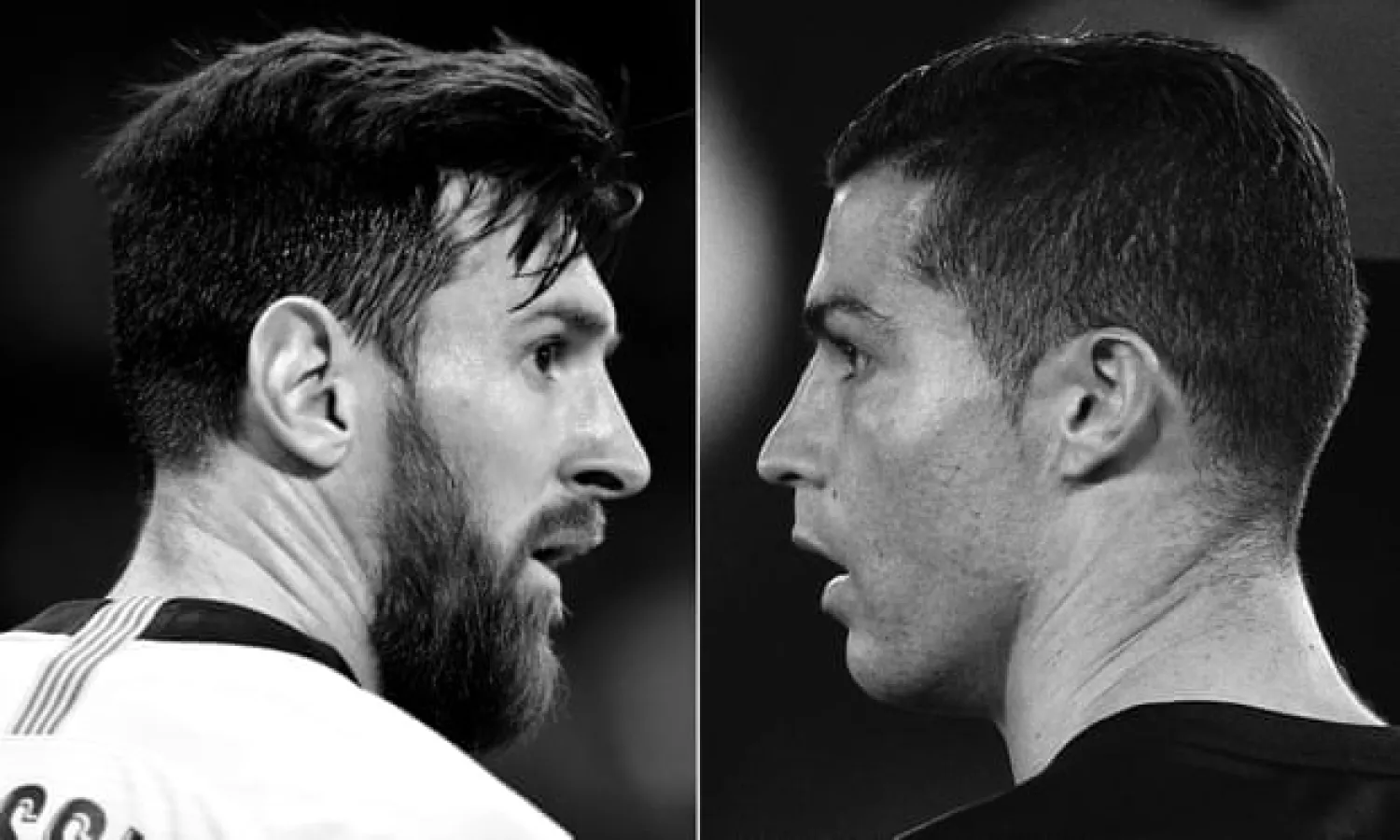

Catch Them While You Can: Messi, Ronaldo Will Not Be Around for Ever

 Lionel Messi will be 32 in June and Ronaldo, right, is 34. Composite: Getty Images; Fifa via Getty Images
Lionel Messi will be 32 in June and Ronaldo, right, is 34. Composite: Getty Images; Fifa via Getty Images
TT

Catch Them While You Can: Messi, Ronaldo Will Not Be Around for Ever

 Lionel Messi will be 32 in June and Ronaldo, right, is 34. Composite: Getty Images; Fifa via Getty Images
Lionel Messi will be 32 in June and Ronaldo, right, is 34. Composite: Getty Images; Fifa via Getty Images

To a 70s kid the sense of awe even to meet anyone who had seen Pelé or Eusébio or Johan Cruyff play was overwhelming. Just imagine that … watching such players in the flesh … in front of their own eyes. Some people of my parents’ generation had attended the 1966 World Cup in England, so every now and again a football conversation would turn in the direction of the greats and these lucky souls would not be able to contain their welling satisfaction as they piped up: “I saw Pelé play.”

It was jaw-dropping stuff. For us kids Pelé’s legend mainly existed in books and magazines, short clips on a football programme every now and again, or a montage every four years when it was World Cup time. The mystique about his genius shimmered in a particular way because so much was left to our imagination. Names like Garrincha, Puskas, Di Stéfano somehow felt more fantastical than real.

The other day, as Lionel Messi seduced a stadium full of Real Betis fans with an explosively beautiful hat-trick, coming so soon after Cristiano Ronaldo carried Juventus onwards in the Champions League fuelled by his own theatrical charge, it was only natural to think about how lucky we are to love football at the same point in history that these two are playing, especially as so much is accessible, in real time, to be watched by anyone anywhere.

Even so, the idea of seeing them play, not through a screen but with the naked eye, retains that elemental magic that made anyone who had seen Pelé on the pitch seem like a special person. The clock is ticking. Messi and Ronaldo have been the centre of football’s universe for around 15 years and, however much their brilliance seems superhuman, however convincingly they appear to play in a different zone of time and space from anyone else, well, it is not realistically going to go on forever.

It is a scary and somehow discomforting thought. What will the football landscape look like without them? How will we manage? It feels like a necessity to savour the spells they continue to cast. Ronaldo is 34. Messi will be 32 in June. The compulsion to go and see them while you can, if you have not already, is powerful.

A group of eagle-eyed parents recently provided their offspring with the opportunity of a lifetime when they spotted one of the Champions League sponsors offering a mascot experience for the quarter-finals. Two English boys were selected to attend Juventus v Atlético Madrid, and one for Lyon v Barcelona. The cost for this chance to brush ridiculously close to greatness was €350 (£303). It might sound on the steep side but it turned out to be bargain. Two face-value prime tickets for parent and child, at €220 each, already more than pays back the outlay.

The mascots in Turin met up at 4.30pm on the day of the match, got a training session and snacks at a nearby sport centre, went to their dressing room to be handed their kit to keep (you had to supply your own black boots; Adidas was requested but black tape was available to mask any non-official manufacturer).

Then came the big moment, to meet the players in the tunnel and march hand in hand into the spotlight. Apparently the player each mascot is appointed is random, but when Ronaldo noticed a kid with CR7 shaved into his hairstyle, there was a last moment switch as to which mascot got the best gig. While most of the other mascots were Italian a girl flew in from Indonesia who did not really seem to know what was going on but her father was very happy.

The boy who travelled to Lyon against Barcelona, a nervous eight-year-old from London, had the ridiculous luck to land Messi as his hand to hold. “I was more excited than him to be honest,” his father said.

I remember a considerably less glitzy experience in my youthful attempt to pay homage to Arrigo Sacchi’s legendary Milan team, the most glamorous thing in football at the age when it was suddenly possible to go off on footballing travels. Clapping eyes on Milan’s Dutch trio, Marco van Basten, Ruud Gullit and Frank Rijkaard, with the masterful defender Franco Baresi patrolling behind, felt like an obligation, a pilgrimage.

After travelling by rail to Italy, 29 September 1991 was the date of destiny, having secured a ticket outside San Siro for Milan v Genoa. What happened next made the moment memorable if not in the ideal way. A biblical storm broke. Three minutes and 12 seconds into a second half that resembled more of a water sport than football, with Milan leading 1-0, the referee called it off. Some 69,909 spectators were infuriated and had little option but to wade off.

There were some kerfuffles outside at the Piazzale Axum, the area where the buses and trams ferry supporters to and from the stadium. Everywhere was ankle deep in water. L’Unita newspaper the following day would describe San Siro forlornly as a “barca”, a boat.

It is funny the details that stick in the mind for decades. Some pathetically made espadrilles disintegrated in this sudden urban lake, so I ended up walking away from my dream visit to watch the team I most admired in the world, barefoot. It might not have gone entirely to plan but still, I had seen Van Basten, Gullit, Rijkaard, Baresi et al.

It is not an uncommon sentiment to ponder how or when it might be possible to see Messi or Ronaldo, to be able to go through life and say: “I saw him play.” It is strange to ponder how the game may feel in the probably not too distant future when they are no longer the protagonists, no longer on stage and under the lights, no longer active players.

Messi has been in Barcelona’s first team since 2005. Ronaldo became the world’s most expensive teenager, a leap to propel him into the international consciousness, in 2003. Any football lover on the planet under the age of roughly 21 will not remember a time when football’s constellation did not revolve around these two most luminous stars. And maybe, when all is said and done, that is what has made this era so extraordinary. People craw or wince at the who is better or who is your favourite nonsense.

But what brilliant luck to have these two somehow pushing themselves as well as each other. It would not have been the same had there been a Messi era and a Ronaldo era without them constantly overlapping.

Catch it, catch as much of it as you possibly can.

The Guardian Sport


Chelsea Injuries up 44% After Club World Cup but Report Says Event Has Had ‘Minimal’ Impact

Chelsea's Reece James, center, lifts the trophy following the Club World Cup final soccer match between Chelsea and PSG at MetLife Stadium in East Rutherford, N.J., Sunday, July 13, 2025. (AP)
TT

Chelsea Injuries up 44% After Club World Cup but Report Says Event Has Had ‘Minimal’ Impact

Chelsea's Reece James, center, lifts the trophy following the Club World Cup final soccer match between Chelsea and PSG at MetLife Stadium in East Rutherford, N.J., Sunday, July 13, 2025. (AP)

Chelsea suffered a 44% spike in injuries after competing in the supersized Club World Cup this year, according to findings published on Tuesday.

But the newly expanded tournament has so far had a “minimal impact” on injuries overall, the latest edition of the Men’s European Football Injury Index found.

There was fierce opposition to FIFA's new flagship club event when it was confirmed in 2023 that it would increase from seven to 32 teams, with players' unions warning of physical and mental burnout of players due to an ever expanding match schedule. But FIFA pressed ahead and staged the tournament in the United States in June-July.

Chelsea went on to win the inaugural competition, receiving the trophy from US President Donald Trump at MetLife Stadium and taking home prize money of around $125 million. But, according to the Index, from June-October, Chelsea picked up more injuries — 23 — than any of the nine clubs from Europe's top leagues that participated in the Club World Cup.

They included star player Cole Palmer, and was a 44% increase on the same period last year.

While Chelsea, which played 64 games over the entire 2024-25 season, saw an increase in injuries, the Index, produced by global insurance firm Howden, found that overall there was a decrease.

“In principle you would expect this increased workload to lead to an increase in the number of injuries sustained, as a possible rise in overall injury severity,” the Index report said, but added: “The data would suggest a minimal impact on overall injury figures.”

Despite the figures, the authors of the report accept it was too early to assess the full impact of the Club World Cup, with the findings only going up to October.

“We would expect to see the impact to spike in that sort of November to February period,” said James Burrows, Head of Sport at Howden. “What we’ve seen previously is that’s where the impact is seen from summer tournaments."

Manchester City has sustained 22 since the tournament, which is the highest among the nine teams from Europe's top leagues — England, Spain, Italy, Germany and France.

Those teams have recorded 146 injuries from June-October, which is down on the previous year's figure of 174.

From August-October that number is 121, the lowest for that three-month period in the previous six years of the Index.


Sunderland Worst Hit by Losing Players to African Cup of Nations 

14 December 2025, United Kingdom, London: Sunderland's Habib Diarra (L) and Leeds United's Gabriel Gudmundsson battle for the ball during the English Premier League soccer match between Brentford and Leeds United at the Gtech Community Stadium. (dpa)
TT

Sunderland Worst Hit by Losing Players to African Cup of Nations 

14 December 2025, United Kingdom, London: Sunderland's Habib Diarra (L) and Leeds United's Gabriel Gudmundsson battle for the ball during the English Premier League soccer match between Brentford and Leeds United at the Gtech Community Stadium. (dpa)

Premier League Sunderland will have to do without six players over the next few weeks and are the club worst hit as the Africa Cup of Nations takes its toll on European clubs competing over the holiday season.

Sunderland, eighth in the standings, had four of their African internationals in action when they beat Newcastle United on Sunday, but like 14 other English top-flight clubs will now lose those players to international duty.

The timing of the African championship, kicking off in Morocco on Sunday and running through to January 18, has long been an irritant for coaches, with leagues in Belgium, France, Germany, Italy, Netherlands, Portugal, and Spain also affected.

Hosting the tournament in the middle of the season impacts around 58% of the players at the Cup of Nations, though the Confederation of African Football did try to mitigate the impact by moving the start to before Christmas, so it is completed before the next round of Champions League matches.

The impact on European clubs was also lessened by allowing them to release players seven days, rather than the mandatory 14 days, before the tournament, meaning they could play for their clubs last weekend.

Sunderland's Congolese Arthur Masuaku and Noah Sadiki, plus full back Reinildo (Mozambique), midfielder Habib Diarra (Mali), and attackers Chemsdine Talbi (Morocco) and Bertrand Traore (Burkina Faso) have now departed for Morocco.

Ironically, Mohamed Salah’s absence from Liverpool to play for Egypt should lower the temperature at the club after his recent outburst against manager Arne Slot, but Manchester United will lose three players in Noussair Mazraoui, Bryan Mbeumo and Amad Diallo, who scored in Monday’s 4-4 draw with Bournemouth.

France is again the country with the most players heading to the Cup of Nations, and with 51 from Ligue 1 clubs. But their absence is much less impactful than previously as Ligue 1 broke after the weekend’s fixtures and does not resume until January 2, by which time the Cup of Nations will be into its knockout stage.

There are 21 players from Serie A clubs, 18 from the Bundesliga, and 15 from LaLiga teams among the 24 squads at the tournament in Morocco.


Rodgers Takes Charge of Saudi Team Al-Qadsiah After Departure from Celtic 

Then-Celtic head coach Brendan Rodgers greets supporters after a Europa League soccer match between Red Star and Celtic at Rajko Mitic Stadium in Belgrade, Serbia, Sept. 24, 2025. (AP)
TT

Rodgers Takes Charge of Saudi Team Al-Qadsiah After Departure from Celtic 

Then-Celtic head coach Brendan Rodgers greets supporters after a Europa League soccer match between Red Star and Celtic at Rajko Mitic Stadium in Belgrade, Serbia, Sept. 24, 2025. (AP)

Brendan Rodgers has returned to football as the coach of Saudi Arabian club Al-Qadsiah, six weeks after resigning from Scottish champion Celtic.

Al-Qadsiah, whose squad includes Italian striker Mateo Retegui and former Real Madrid defender Fernandez Nacho, is in fifth place in the Saudi Pro League in its first season after promotion.

Rodgers departed Celtic on Oct. 27 and has opted to continue his managerial career outside Britain for the first time, having previously coached Liverpool, Leicester and Swansea.

In its statement announcing the hiring of Rodgers on Tuesday, Al-Qadsiah described him as a “world-renowned coach” and said his arrival “reflects the club’s ambitious vision and its rapidly growing sporting project.”

Aramco, the state-owned Saudi oil giant, bought Al-Qadsiah in 2023 in a move that has helped to transform the club’s status.

“This is a landmark moment for the club,” Al-Qadsiah chief executive James Bisgrove said. “The caliber of his experience and track record of winning reflects our ambition and long-term vision to establish Al-Qadsiah as one of Asia’s leading clubs.”

Rodgers is coming off winning back-to-back Scottish league titles with Celtic, where he won 11 major trophies across his two spells. He also won the FA Cup with Leicester.

Al-Qadsiah's last two coaches were former Liverpool striker Robbie Fowler and former Spain midfielder Michel.
