


Saudi Measures Revive Yemeni Rial

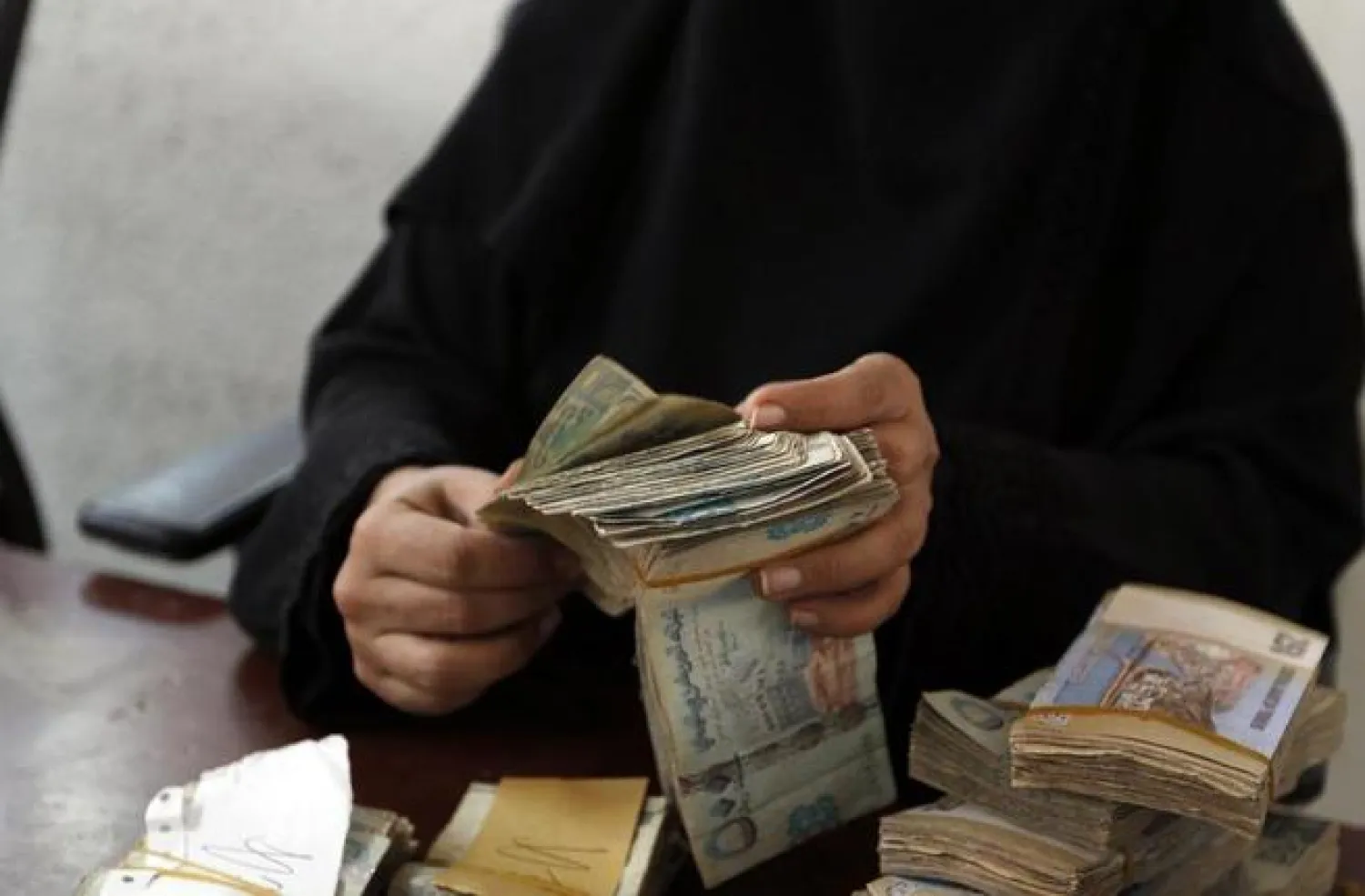
A Yemeni woman holds onto YER (AFP/FILE)
TT

Saudi Measures Revive Yemeni Rial

A Yemeni woman holds onto YER (AFP/FILE)

Saudi Arabia continues to shore up Yemen’s faltering economy, helping it cope with slumping national currency that is being driven even deeper into the ground as Iran-allied Houthi insurgents pursue their war agenda.

The trading rates on the Yemeni rial against the dollar saw significant improvement across the country due to Saudi assistance, Yemeni bankers told Asharq Al-Awsat.

Next to a valuable $2 billion deposit, Saudi Arabia has offered the Central Bank of Yemen (CBY) a $200 million dollar grant. Not only that, but the kingdom has been providing the war-torn country’s power plants with their supply of oil derivatives worth $60 million on a monthly basis.

Part of a series of initiatives undertaken by the Kingdom to aid Yemen through its hardship, each of CBY, the Yemeni Finance Ministry, the Saudi Arabian Monetary Authority, Saudi National Commercial Bank (NCB) and the joint forces commander signed a salary-transfer agreement in Riyadh. The budgetary support provided by Saudi Arabia to Yemen will see funds being transferred to CBY in Aden in Saudi Riyals after which salaries are disbursed in Yemeni currency.

CBY, in an effort to get the national economy back on its feet, has stressed the need for all traders to comply with its measures. Instructions confirm that the credits of traders and banks who fail to refinance within a specified period will be canceled.

It is worth noting that the rial has been recording a gradual recovery ever since CBY Hafez Mead took the helm from Mohammed Zammam, by virtue of a presidential decree.

Under Mead’s leadership, currency prices are improving slowly, despite the Bank's official rate for exchange remaining unchanged at 440 rials for a dollar.

Banks in Sanaa, a Houthi stronghold, have been bearing the brunt of the group’s arbitrary extortion, unwarranted levying and appropriation of cash reserves.

A Houthi-imposed ban against dealing with the government-run CBY in Aden, is held largely accountable for not only sinking the country’s economy, but also destabilizing currency exchange rates.



More Indian-flagged LPG Ships Exit the Gulf

FILE PHOTO: A map showing the Strait of Hormuz and a 3D printed oil pipeline are seen in this illustration taken March 23, 2026. REUTERS/Dado Ruvic/Illustration/File Photo/File Photo
TT

More Indian-flagged LPG Ships Exit the Gulf

FILE PHOTO: A map showing the Strait of Hormuz and a 3D printed oil pipeline are seen in this illustration taken March 23, 2026. REUTERS/Dado Ruvic/Illustration/File Photo/File Photo

Two more Indian-flagged liquefied petroleum gas tankers, Green Asha and Green Sanvi, have exited the Gulf carrying the fuel for the South Asian nation, according to ship tracking data on LSEG and Kpler.

A third vessel, Jag Vikram, is still in the west of the Strait of Hormuz, the data showed. The US-Israeli war against Iran has all but ⁠halted shipping through the ⁠strait, but Iran says "non-hostile vessels" may transit the waterway if they coordinate with Iranian authorities.

Green Asha and Green Sanvi have crossed the Gulf area and are in the eastern Strait of Hormuz, ⁠the data showed, taking the total number of Indian-flagged LPG carriers that have traversed the Strait to eight. India is gradually moving its stranded LPG cargoes out from the strait, with Shivalik, Nanda Devi, Pine Gas, Jag Vasant, BW Elm and BW Tyr already reaching India.

India, the world's second-largest LPG importer, is battling its worst gas ⁠crisis ⁠in decades, with the government cutting supplies for industries to shield households from any shortage of cooking gas.

The country consumed 33.15 million metric tons of LPG, or cooking gas, last year, with imports accounting for about 60% of demand. About 90% of those imports came from the Middle East. India is also loading LPG onto its empty vessels stranded in the Gulf.


IEA Hails Saudi Arabia’s ‘Rapid Response’ to Strait of Hormuz Crisis

This photograph shows the entrance to the International Energy Agency (IEA) headquarters in Paris on March 11, 2026. (AFP)
TT

IEA Hails Saudi Arabia’s ‘Rapid Response’ to Strait of Hormuz Crisis

This photograph shows the entrance to the International Energy Agency (IEA) headquarters in Paris on March 11, 2026. (AFP)

Countries must resist the urge to hoard oil and fuel during the energy crisis triggered by the US-Israeli war on Iran, head of the International Energy Agency Fatih Birol warned on Sunday, with supplies expected to dwindle further if the Strait of Hormuz remains closed.

Birol praised Saudi Arabia for its rapid response to the crisis, after it rerouted over two-thirds of its oil exports through a pipeline to the Red Sea, bypassing the strait.

“I urge all countries not to impose bans or restrictions on exports,” Birol told the Financial Times. “It is the worst time when you look at the global oil markets. Their trade partners, their allies and their neighbors will suffer as a result.”

While he was careful not to name China directly, Birol’s comments appear to be aimed at Beijing.

China is the only major country to have banned the export of petrol, diesel and jet fuel in response to the five-week-old war, although India has imposed extra duties on exports.

Birol said “major countries in Asia who hold major refineries” should rethink any ban.

“If those countries continue to restrict or totally ban exports, the impact on the Asian markets will be dramatic.”

His plea for countries to avoid bans may also be pointed at the US, where rumors of a potential ban on refined fuel exports are circulating as gasoline prices pass $4 a gallon and California faces the threat of jet fuel shortages.

While the US supported a G7 call for no export bans, its energy secretary Chris Wright has so far only ruled out a ban on crude oil exports.

Birol said some countries are already hoarding energy, undermining the impact of the IEA’s move to release 400 million barrels of crude and fuel from emergency reserves in an effort to stabilize markets during the current conflict.

“Unfortunately, we see that some countries are adding to their existing stocks during our coordinated oil stock release,” he said. “They are stocking up. This is not helpful. In my view this is a time for all countries to prove they are a responsible member of the international community.”

Saudi response

Birol praised Saudi Arabia for its rapid response to the crisis, after it rerouted over two-thirds of its oil exports through a pipeline to the Red Sea, bypassing the strait.

He said he had been reassured by the “highest authorities in Saudi Arabia” that this key pipeline is “well protected.”

Birol, who as head of the IEA has been at the heart of discussions over how to respond to the crisis, warned that “in April, we will lose twice the amount of crude oil and [refined] products we lost in March” if the Hormuz Strait does not reopen to shipping.

In normal times, one-fifth of the world’s oil and liquefied natural gas flows through the waterway, which has been all but closed by Iranian threats to fire upon shipping.

“We are following all the key energy assets in the region on a daily or hourly basis,” he said, referring to oil and gas fields, pipelines, refineries and LNG terminals. “Currently there are 72 energy assets damaged and one-third are severely or very severely damaged,” he added.

Birol also said the current crisis would redraw the world’s energy system, as did previous crises in the 1970s and the one triggered by Russia’s full-scale invasion of Ukraine in 2022.

He predicted that the current crisis would trigger another nuclear revival, a boom in electric vehicles and a push for more renewables, as well as prompting some countries to burn more coal. But he said the gas industry, which had presented itself as a reliable supplier, would have to “work hard to regain its reputation” after two energy shocks in four years.


JMMC Holds 65th Meeting via Videoconference, Discusses Energy Security and Market Stability

General view of Saudi Aramco's Ras Tanura oil refinery and oil terminal in Saudi Arabia May 21, 2018. REUTERS/Ahmed Jadallah
TT

JMMC Holds 65th Meeting via Videoconference, Discusses Energy Security and Market Stability

General view of Saudi Aramco's Ras Tanura oil refinery and oil terminal in Saudi Arabia May 21, 2018. REUTERS/Ahmed Jadallah

The Joint Ministerial Monitoring Committee (JMMC), comprising Saudi Arabia, Russia, Iraq, UAE, Kuwait, Kazakhstan, Nigeria, Algeria and Venezuela holds its 65th Meeting via videoconference.

The JMMC reviewed current market conditions and emphasized the essential role of the Declaration of Cooperation (DoC) in supporting the stability of global energy markets, according to SPA.

In this context, the committee highlighted the critical importance of safeguarding international maritime routes to ensure the uninterrupted flow of energy.

It also expressed concern regarding attacks on energy infrastructure, noting that restoring damaged energy assets to full capacity is both costly and takes a long time, thereby affecting overall supply availability.

Accordingly, the committee stressed that any actions undermining energy supply security, whether through attacks on infrastructure or disruption of international maritime routes, increase market volatility and weaken the collective efforts under the DoC to support market stability for the benefit of producers, consumers, and the global economy.

In this regard, the committee commended the DoC countries that took the initiative to ensure the continued availability of supplies, particularly through the use of alternative export routes, which have contributed to reducing market volatility.

The JMMC will continue to closely monitor market conditions and retains the authority to convene additional meetings or request an OPEC and non-OPEC Ministerial Meeting, as established at the 38th ONOMM held on December 5 2024.

The next meeting of the JMMC (66th) is scheduled for June 7, 2026.