

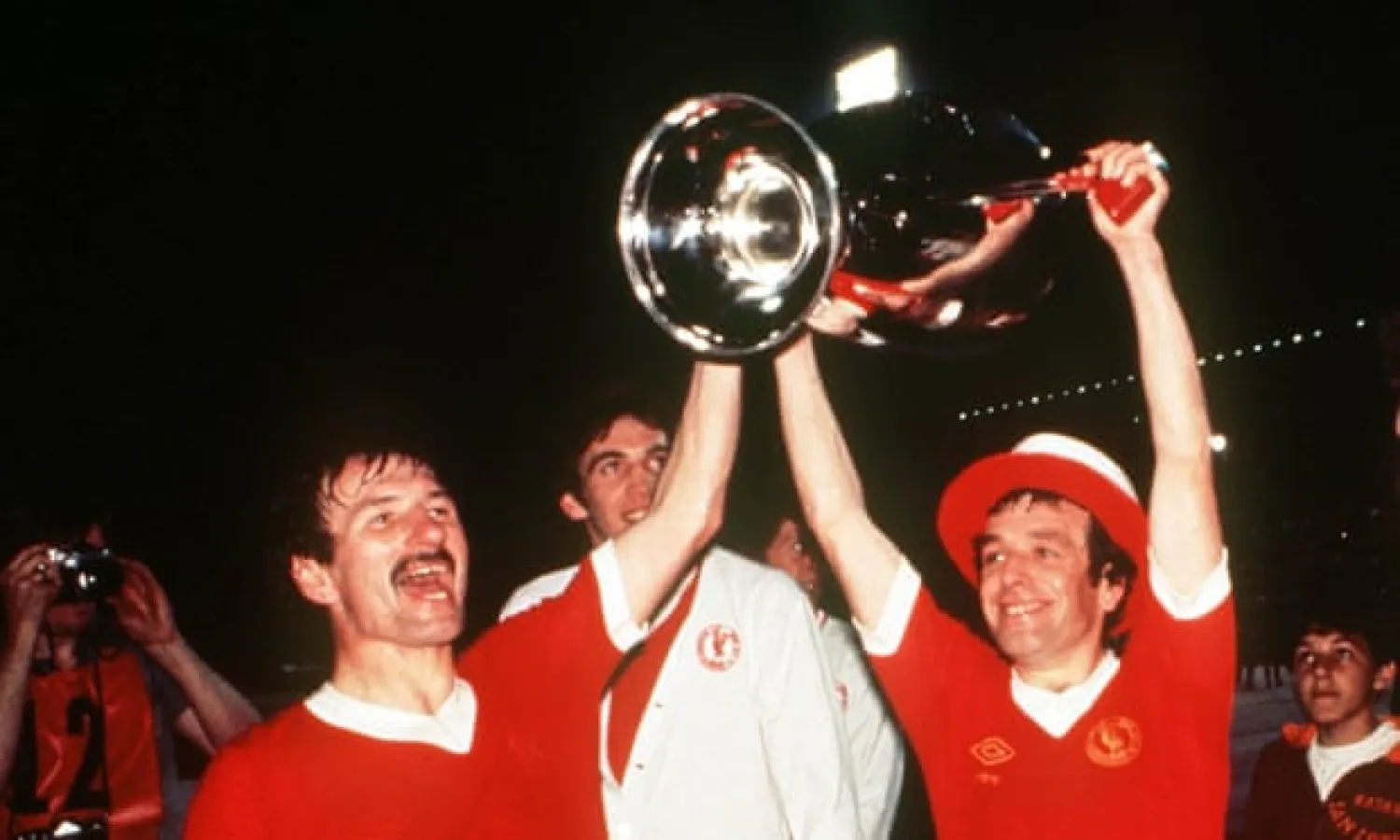

Liverpool’s European Cup Triumph Made Tommy Smith’s Career Complete

 Tommy Smith (left) celebrates with Ian Callaghan after Liverpool beat Borussia Mönchengladbach in the 1977 European Cup final. Photograph: Colorsport/Rex/Shutterstock
Tommy Smith (left) celebrates with Ian Callaghan after Liverpool beat Borussia Mönchengladbach in the 1977 European Cup final. Photograph: Colorsport/Rex/Shutterstock
TT

Liverpool’s European Cup Triumph Made Tommy Smith’s Career Complete

 Tommy Smith (left) celebrates with Ian Callaghan after Liverpool beat Borussia Mönchengladbach in the 1977 European Cup final. Photograph: Colorsport/Rex/Shutterstock
Tommy Smith (left) celebrates with Ian Callaghan after Liverpool beat Borussia Mönchengladbach in the 1977 European Cup final. Photograph: Colorsport/Rex/Shutterstock

Coincidentally, but pleasingly, Liverpool’s most recent match programme featured a photograph and short tribute to Tommy Smith, who has died at the age of 74.

The photograph captured the ‘Anfield Iron’ in his moment of glory, meeting Steve Heighway’s corner with an unstoppable near-post header to put Liverpool ahead in the 1977 European Cup final against Borussia Mönchengladbach. It was far from typical of Smith to score goals with his head, or to score goals at all, and there was a note of surprise in Barry Davies’s memorable commentary once the ball flew into the net so quickly it was hard for television viewers to keep up.

“It’s Tommy Smith! What a way to end a career.”

Smith’s career did not end with Liverpool’s first European Cup triumph in Rome. The player was then 32 and had announced he planned to retire; predictably he found the game that had been his life difficult to give up and played another season for Liverpool before joining John Toshack for a short while at Swansea. If one player personified Liverpool as they rose to new heights under Bill Shankly it was Smith, who was born and raised in the shadow of Anfield and was taken to the club at the age of 15 by his mother who asked the manager to look after him.

Shankly certainly did that, fast-tracking him and handing him his debut three years later, though Smith was never the sort of player to need much looking after. He was a tough, uncompromising competitor in an era when every team seemed to have a hard man at the back.

But if Smith intimidated opponents it was because he appeared genuinely indestructible; he never needed to ‘put himself about’ to let others know he was around. Variously he was described of being made of iron or granite – always quick with an aphorism Shankly would famously say: “Tommy Smith wasn’t born, he was quarried” – and even Norman Hunter acknowledged that being tackled by Smith had similarities with running into a brick wall.

Rather cruelly the strain on his body caught up with Smith in later life when he encountered mobility problems and needed to use crutches to climb the stairs into press boxes at Anfield and Goodison, where his earthy opinions would enliven many an afternoon as he completed his duties as a columnist for the Liverpool Echo; but even though he would talk himself into trouble on occasions his reputation as a player was unassailable. “He was fearless,” Bob Paisley said admiringly. “Tommy hated losing and was prepared to put himself through all manner of pain and suffering to avoid it.”

Ron Yeats was the defensive colossus brought down from Scotland by Shankly, who called a press conference to invite local journalists to “take a walk round my new centre-half”, though Smith went on to take over the captaincy and make many more appearances, 638 in all, to become an integral part of the winning machine Shankly built and Paisley inherited.

Being local meant he was immensely popular, even if his international career amounted to a solitary cap against Wales in 1971, and he remained sturdy enough to take advantage of the injury to Phil Thompson in the 1976-77 season and write his name into Liverpool legend.

After winning in Rome he said his career, which included four league titles, was now complete. “My biggest disappointments in the game were the European Cup semi-final defeat by Inter Milan in 1965 and the FA Cup final defeat by Arsenal in 1971. We wiped out the Arsenal one by beating Newcastle at Wembley three years later, and now this makes up for everything connected with the Inter game. It’s been a long wait, but it was worth it now.”

Of the goal Smith remembered having a quick chat with Kevin Keegan about where to position themselves for Heighway’s corner. “I knew the defenders were keeping an eye on Kev,” he said. “I’m not the fastest person in the world but I can steal a yard on anyone.

“The defender [Christian Kulik] didn’t know whether to wait for Kev to move or go with me and when the cross came in it was at a perfect height so I went for it. As soon as I hit it I knew it was on target. I can count the number of headers I have scored on the fingers of one hand and I’ve certainly never scored one like that in a game like that. It has to be the greatest feeling I’ve had in my whole life.”

The Guardian Sport


Tottenham Hotspur Sack Head Coach Thomas Frank

(FILES) Tottenham Hotspur's Danish head coach Thomas Frank gestures on the touchline during the English Premier League football match between Burnley and Tottenham Hotspur at Turf Moor in Burnley, north-west England on January 24, 2026. (Photo by Oli SCARFF / AFP)/
TT

Tottenham Hotspur Sack Head Coach Thomas Frank

(FILES) Tottenham Hotspur's Danish head coach Thomas Frank gestures on the touchline during the English Premier League football match between Burnley and Tottenham Hotspur at Turf Moor in Burnley, north-west England on January 24, 2026. (Photo by Oli SCARFF / AFP)/

Thomas Frank was fired by Tottenham on Wednesday after only eight months in charge and with his team just five points above the relegation zone in the Premier League.

Despite leading Spurs to the round of 16 in the Champions League, Frank has overseen a desperate domestic campaign. A 2-1 loss to Newcastle on Tuesday means Spurs are still to win in the league in 2026.

“The Club has taken the decision to make a change in the Men’s Head Coach position and Thomas Frank will leave today,” Tottenham said in a statement. “Thomas was appointed in June 2025, and we have been determined to give him the time and support needed to build for the future together.

“However, results and performances have led the Board to conclude that a change at this point in the season is necessary.”

Frank’s exit means Spurs are on the lookout for a sixth head coach in less than seven years since Mauricio Pochettino departed in 2019.


Marseille Coach De Zerbi Leaves After Humiliating 5-0 Loss to PSG 

Marseille's Italian coach Roberto De Zerbi looks on from the technical area during the French Cup round of 32 football match between FC Bayeux and Olympique de Marseille (OM) at the Michel-d'Ornano Stadium in Caen on January 13, 2026. (AFP) 
TT

Marseille Coach De Zerbi Leaves After Humiliating 5-0 Loss to PSG 

Marseille's Italian coach Roberto De Zerbi looks on from the technical area during the French Cup round of 32 football match between FC Bayeux and Olympique de Marseille (OM) at the Michel-d'Ornano Stadium in Caen on January 13, 2026. (AFP) 

Marseille coach Roberto De Zerbi is leaving the French league club in the wake of a 5-0 thrashing at the hands of PSG in French soccer biggest game.

The nine-time French champions said on Wednesday that they have ended “their collaboration by mutual agreement.”

The heavy loss Sunday at the Parc des Princes restored defending champion PSG’s two-point lead over Lens after 21 rounds, with Marseille in fourth place after the humiliating defeat.

De Zerbi's exit followed another embarrassing 3-0 loss at Club Brugge two weeks ago that resulted in Marseille exiting the Champions League.

De Zerbi, who had apologized to Marseille fans after the loss against bitter rival PSG, joined Marseille in 2024 after two seasons in charge at Brighton. After tightening things up tactically in Marseille during his first season, his recent choices had left many observers puzzled.

“Following consultations involving all stakeholders in the club’s leadership — the owner, president, director of football and head coach — it was decided to opt for a change at the head of the first team,” Marseille said. “This was a collective and difficult decision, taken after thorough consideration, in the best interests of the club and in order to address the sporting challenges of the end of the season.”

De Zerbi led Marseille to a second-place finish last season. Marseille did not immediately announce a replacement for De Zerbi ahead of Saturday's league match against Strasbourg.

Since American owner Frank McCourt bought Marseille in 2016, the former powerhouse of French soccer has failed to find any form of stability, with a succession of coaches and crises that sometimes turned violent.

Marseille dominated domestic soccer in the late 1980s and early 1990s. It was the only French team to win the Champions League before PSG claimed the trophy last year. It hasn’t won its own league title since 2010.


Olympic Fans Hunt for Plushies of Mascots Milo and Tina as They Fly off Shelves 

Fans take selfies with the Olympic mascot Tina at the finish area of an alpine ski, slalom portion of a women's team combined race, at the 2026 Winter Olympics, in Cortina d'Ampezzo, Italy, Tuesday, Feb. 10, 2026. (AP)
TT

Olympic Fans Hunt for Plushies of Mascots Milo and Tina as They Fly off Shelves 

Fans take selfies with the Olympic mascot Tina at the finish area of an alpine ski, slalom portion of a women's team combined race, at the 2026 Winter Olympics, in Cortina d'Ampezzo, Italy, Tuesday, Feb. 10, 2026. (AP)

For fans of the Milan Cortina Olympic mascots, the eponymous Milo and Tina, it's been nearly impossible to find a plush toy of the stoat siblings in Milan and Cortina d’Ampezzo.

Many of the official Olympics stores in the host cities are already sold out, less than a week into the Winter Games.

“I think the only way to get them is to actually win a medal,” Julia Peeler joked Tuesday in central Milan, where Tina and Milo characters posed for photos with fans.

The 38-year-old from South Carolina is on the hunt for the plushies for her niece. She's already bought some mascot pins, but she won't wear them on her lanyard. Peeler wants to avoid anyone trying to swap for them in a pin trade, a popular Olympic pastime.

Tina, short for Cortina, is the lighter-colored stoat and represents the Olympic Winter Games. Her younger brother Milo, short for Milano, is the face of the Paralympic Winter Games.

Milo was born without one paw but learned to use his tail and turn his difference into a strength, according to the Olympics website. A stoat is a small mustelid, like a weasel or an otter.

The animals adorn merchandise ranging from coffee mugs to T-shirts, but the plush toys are the most popular.

They're priced from 18 to 58 euros (about $21 to $69) and many of the major official stores in Milan, including the largest one at the iconic Duomo Cathedral, and Cortina have been cleaned out. They appeared to be sold out online Tuesday night.

Winning athletes are gifted the plush toys when they receive their gold, silver and bronze medals atop the podium.

Broadcast system engineer Jennifer Suarez got lucky Tuesday at the media center in Milan. She's been collecting mascot toys since the 2010 Vancouver Games and has been asking shops when they would restock.

“We were lucky we were just in time,” she said, clutching a tiny Tina. “They are gone right now.”

Friends Michelle Chen and Brenda Zhang were among the dozens of fans Tuesday who took photos with the characters at the fan zone in central Milan.

“They’re just so lovable and they’re always super excited at the Games, they are cheering on the crowd,” Chen, 29, said after they snapped their shots. “We just are so excited to meet them.”

The San Franciscan women are in Milan for the Olympics and their friend who is “obsessed” with the stoats asked for a plush Tina as a gift.

“They’re just so cute, and stoats are such a unique animal to be the Olympic mascot,” Zhang, 28, said.

Annie-Laurie Atkins, Peeler's friend, loves that Milo is the mascot for Paralympians.

“The Paralympics are really special to me,” she said Tuesday. “I have a lot of friends that are disabled and so having a character that also represents that is just incredible.”
