


Arsenal’s Long Road to Baku Leads to Defining Moment of Their Season

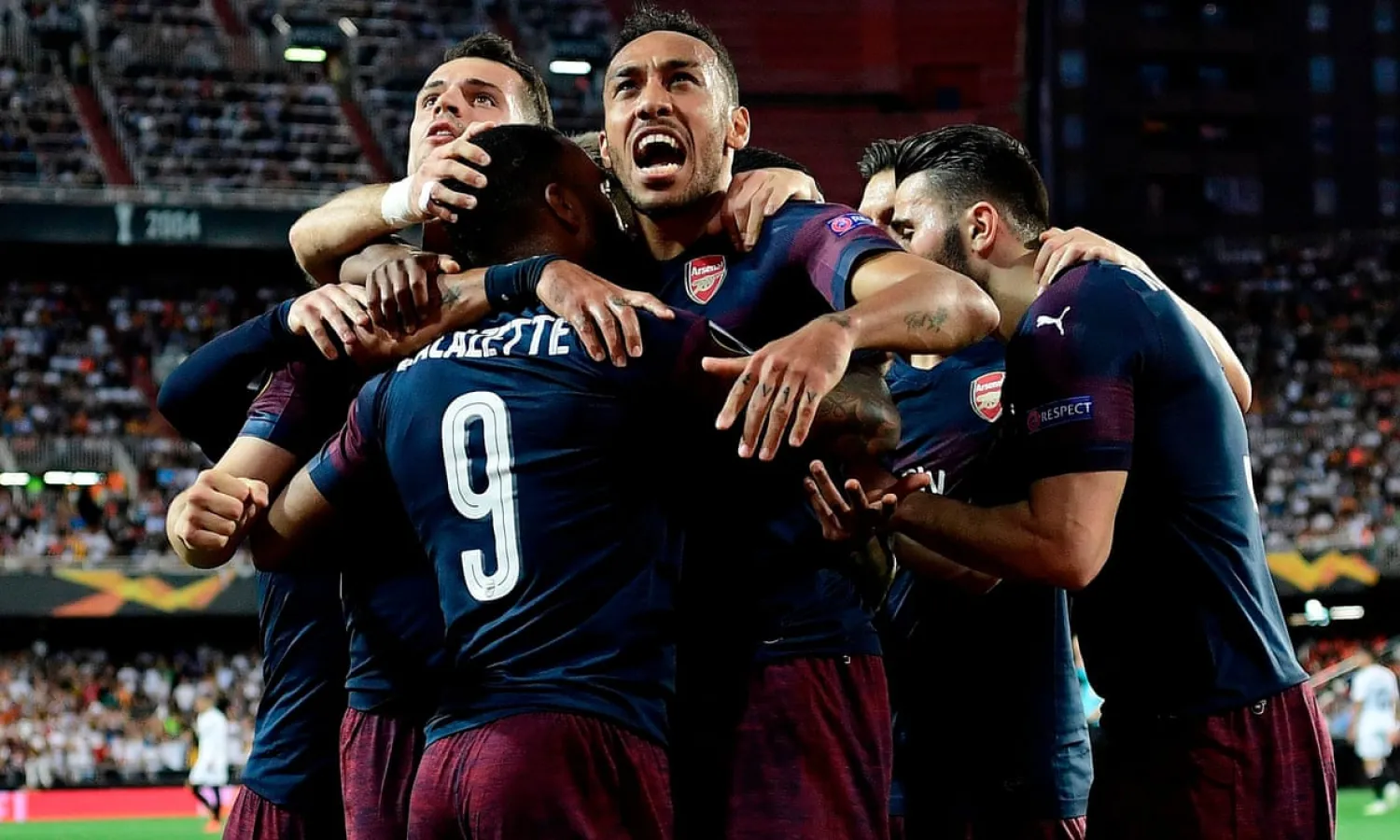
Pierre-Emerick Aubameyang (center), who scored a hat-trick during the 4-2 win at Valencia in the semi-final, leads Arsenal’s celebrations. Photograph: Javier Soriano/AFP/Getty Images
TT

Arsenal’s Long Road to Baku Leads to Defining Moment of Their Season

Pierre-Emerick Aubameyang (center), who scored a hat-trick during the 4-2 win at Valencia in the semi-final, leads Arsenal’s celebrations. Photograph: Javier Soriano/AFP/Getty Images

Last May, in a sequence of pow-wows to determine the chosen candidate to replace Arsène Wenger, Arsenal’s executive team thrashed their way through the shortlist one by one analyzing a series of criteria: style of football, an eye for promoting youth, man-management in the player-power age, and so on. Critical, though, in all of this was one overriding thought. How quickly can this manager get the club back into the Champions League? It did not really matter how they got there, or what it looked like along the way but the mission Arsenal were desperate to accomplish was crystal clear.

Hiring a man whose CV screams Europa League specialist enhanced those odds. Hands were duly shaken with a proven expert in one of the two available routes into the Champions League. He might have come from left field in the debate about who was best to follow Wenger – “where’s Unai Emery come from?” tweeted a bewildered Ian Wright as the news broke – but there was a certain logic at work.

That logic made sense as Emery took this strangely erratic team, a bunch whose form has crumbled in the Premier League, back to his old stamping ground in Valencia. Arsenal were electric going forward – rapid, clinical and supercharged. The strike force of Pierre-Emerick Aubameyang and Alexandre Lacazette put in Champions League performances as they swept their team into the Europa League final. It is Emery’s fourth final in this competition. He has won three.

“That’s what the club saw in him as a coach,” said Lacazette. “He came to take the team to the next step and he did because we reach the final in his first season.” Well, the final represents more like half a step. Progress will be tangible only if they clamber on to the winners’ podium with big smiles in the very early hours of 30 May. So here we are. The interminably long road to Baku (which actually started in Baku in the opening group game at FK Qarabag in a match Arsenal started with a forward line of Danny Welbeck supported by Emile Smith Rowe) boils down to the defining moment of the season.

Win and the campaign has been a successful one by their main criterion. Lose and the problems run deeper. This final is actually a pivotal point for something bigger, something that stretches beyond a contest against Chelsea.

Arsenal have aspirations to try to re-establish themselves higher up the football ladder, as a more robust challenger for the top four, a more competitive contender for the Premier League title, even the rose-tinted hope to become a team capable of a genuine tilt at the senior European title. They know they are off that pace and the best way to build momentum is to get back into the Champions League.

The squad Emery inherited is still in need of surgery, and the operation to attack the transfer market is complicated. Arsenal are expected to announce a heavy loss with the next financial results, their model shows no interest in personal investment from the owner, and logistically they lost their head of recruitment when the enigmatic talent spotter Sven Mislintat left, and they are unable to appoint a director of football, with their former midfielder Edu the favorite, until July. These are hardly ideal circumstances to rebuild with efficiency. Yet again so much boils down to their capacity to qualify for the Champions League and the double boost, in status and finance, that brings.

Last October Arsenal and Emery were still finding each other out – to an extent they still are – as Raúl Sanllehí and Vinai Venkatesham sat down to elaborate on how a return to Europe’s top table is so vital to the club’s model. “We need to regain that positioning, that privilege, to be seen as a Champions League club,” Sanllehí said. “From there the wheel starts rolling again. That is what is going to give us the speed, also to be attractive to better players, to generate more money, it is the virtuous circle. The better we do, the more money will be generated, the better players are going to come, the better we are going to do.”

Tempting as it is to obsess over the bigger picture, the body language of Arsenal’s players and fans at Mestalla emphasized how much it meant to win their semi-final, to play with joy and ambition in their boots. Sport in essence has to be about trying to lift silverware for victory’s sake more than the consequence of a golden ticket.

Lacazette tried to get to the heart of it. “We know it was a great opportunity to go to the Champions League and that is really important,” he said. “But as well it is about trophies. The club needs to win a trophy, the players as well. Above all we have got the chance to win a trophy.”

(The Guardian)


Algeria Hope to Turn Talent into Results on World Cup Return

Algeria's Riyad Mahrez celebrates after scoring his side's second goal during the Africa Cup of Nations group E match between Algeria and Sudan in Rabat, Morocco, Wednesday, Dec. 24, 2025. (AP)
TT

Algeria Hope to Turn Talent into Results on World Cup Return

Algeria's Riyad Mahrez celebrates after scoring his side's second goal during the Africa Cup of Nations group E match between Algeria and Sudan in Rabat, Morocco, Wednesday, Dec. 24, 2025. (AP)

Algeria return to ‌the World Cup for the first time since 2014 carrying the familiar mix of promise, pressure and unpredictability that has long defined one of Africa's most gifted footballing nations.

Drawn in Group J alongside holders Argentina, Austria and tournament debutants Jordan, the Desert Foxes face a stern test of whether their gifted squad can finally deliver on the biggest stage.

The years since Algeria's 2019 Africa Cup of Nations triumph have brought more frustration than fulfilment.

Failure to qualify for the 2022 World Cup after ‌a dramatic playoff ‌defeat by Cameroon still lingers, while the ‌2025 ⁠Nations Cup ended ⁠in disappointment despite a perfect group-stage campaign. Algeria looked among the favorites before a quarter-final loss to Nigeria revived doubts over their ability to deliver in decisive moments.

Captain Riyad Mahrez remains the team's creative focal point.

The former Manchester City winger, now playing in Saudi Arabia, still dictates Algeria's rhythm with his composure ⁠and technical quality, but the side are increasingly ‌looking to a younger generation ‌to ease the burden.

Wolfsburg striker Mohamed Amoura has emerged as one of ‌Algeria's main attacking threats, offering pace and directness alongside ‌Mahrez's craft.

Manchester City defender Rayan Ait-Nouri brings energy and attacking thrust from left back, while young winger Adil Boulbina has added to the growing sense of long-term promise around the squad.

Yet uncertainty continues to ‌shadow Algeria.

Coach Vladimir Petkovic has struggled at times to mould the side's attacking talent into a ⁠cohesive unit, ⁠while defensive inconsistency has repeatedly undermined their progress in major tournaments.

A goalkeeping crisis has added to the concerns.

Anthony Mandrea has been ruled out, while Luca Zidane and Melvin Mastil have both been called up despite injury problems, prompting Algeria to turn to Oussama Benbot despite his recent international retirement.

Benbot stepped away from the national team after being an unused substitute at the Nations Cup in Morocco earlier this year, but the USM Alger goalkeeper has been recalled to the squad.

His reputation has risen after helping his club to win the African Confederation Cup with a shootout victory over Egypt's Zamalek in May.


Forward Al‑Tamari Headlines Jordan’s First World Cup Squad

Football - World Cup - AFC Qualifiers - Third Round - Group B - South Korea v Jordan - Suwon World Cup Stadium, Suwon, South Korea - March 25, 2025 Jordan coach Jamal Sellami before the match. (Reuters)
TT

Forward Al‑Tamari Headlines Jordan’s First World Cup Squad

Football - World Cup - AFC Qualifiers - Third Round - Group B - South Korea v Jordan - Suwon World Cup Stadium, Suwon, South Korea - March 25, 2025 Jordan coach Jamal Sellami before the match. (Reuters)

Jordan coach Jamal Sellami

has announced his 26-man squad for the World Cup in North America, the country’s first appearance in the tournament.

Sellami

will rely on Stade Rennais forward Mousa Al-Tamari to lead the team in a ‌tough Group ‌J.

The Jordan Football Association ‌posted ⁠a video on ⁠Instagram of the Moroccan coach unveiling the squad.

Jordan will play a friendly against Colombia on June 8.

They will begin their World Cup ⁠campaign against Austria on ‌June 17 ‌in San Francisco, before facing Algeria ‌on June 23, and defending ‌champions Argentina five days later.

Jordan squad:

Goalkeepers: Yazeed Abu Laila – Abdullah Al-Fakhouri – Noor Bani Attieh.

Defenders: Abdullah Nasib – ‌Saad Al-Rosan – Yazan Al-Arab – Saleem Obeid – Mohammad Abu ⁠Al-Nadi – ⁠Hossam Abu Al-Dahab – Ehsan Haddad – Anas Bani – Muhannad Abu Taha – Mohammad Abu Hasheesh.

Midfielders: Noor Al-Rawabdeh – Nizar Al-Rashdan – Ibrahim Saadeh – Rajaei Ayed – Amer Jamous – Mohammad Al-Daoud – Mahmoud Al-Mardi.

Forwards: Mousa Al-Tamari – Ouda Al-Fakhouri – Mohammad Abu Zraiq – Ali Azaizeh – Ibrahim Sabra – Ali Olwan.


From Rocafonda to the World Cup: Lamine Yamal’s Meteoric Rise

Football - Euro 2024 - Quarter-final - Spain v Germany - Stuttgart Arena, Stuttgart, Germany - July 5, 2024 Spain's Lamine Yamal celebrates after Dani Olmo scores their first goal. (Reuters)
TT

From Rocafonda to the World Cup: Lamine Yamal’s Meteoric Rise

Football - Euro 2024 - Quarter-final - Spain v Germany - Stuttgart Arena, Stuttgart, Germany - July 5, 2024 Spain's Lamine Yamal celebrates after Dani Olmo scores their first goal. (Reuters)

Lionel Messi and Cristiano Ronaldo will play at a record sixth World Cup in 2026, but years from now the tournament may instead be remembered as Lamine Yamal's first.

From the concrete square in Mataro the Spanish 18-year-old used to play in, to the biggest stages in world football, his rise has been dazzling.

His uncle Abdul Nasraoui used to keep a small replica World Cup trophy in his bakery in the humble neighborhood of Rocafonda, a 20-mile (32-kilometer) crawl up the Catalan coast from Barcelona, telling people it was for when his nephew wins it.

Abdul had the trophy before Yamal even debuted for Spain, because he knew something special was coming. Many claim they did, in Rocafonda, but importantly for Barca it was Jordi Roura who got there first.

Alerted to Yamal by a scout, Barcelona's then youth football chief Roura and close colleague Aureli Altimira pounced. In the chaos of a trial match, Lamine stood out.

"We were there with Aureli and at the beginning we saw him and he looked a bit odd, kind of scrawny, he moved a bit strangely, and we said, 'hmm let's see...'," Roura tells AFP.

"Then once they start playing, it's difficult, right? Because imagine 20 kids of seven, eight years old, all chasing the ball.

"Even so, Lamine would sometimes do something where you'd go, 'Damn!'. Instead of just running after the ball, sometimes he would find space, wait, look for his left foot, execute really quickly."

One attribute, honed on the square where if your feet aren't fast enough to swerve defenders you can end up on the concrete, marked out little Lamine.

"Dribbling might be the most innate technical action, right?" says Roura. "It's hard to train a dribbler. He had that. He would feint, do things which made you say 'wow'.

"We thought this kid had something special, even if he looked a bit slight, and decided to sign him."

Negotiations were quick with Lamine's father Mounir Nasraoui from Morocco, and his mother Sheila Ebana, from Equatorial Guinea.

He was a quiet, even shy child, who loved to play football and spent a lot of time with his paternal grandmother, Fatima.

She was the first of the family to move to Spain, arriving on a ferry from Tangier in 1990 and slowly bringing across her children in the following years.

Fatima settled in Rocafonda and remains there, although Mounir, after being stabbed during an altercation in 2024, has since relocated to the upmarket Barcelona neighborhood of Sarria.

After Lamine's parents split up when he was three, he also lived with his mother in Roca del Valles, north of Mataro, but Rocafonda was always home.

It is represented in his goal celebration, using his hands to show the numbers 304, the last digits of the neighborhood's postcode.

Now even in the more well-to-do parts of Mataro the number appears.

Rocafonda is north-east of the elegant center, a neighborhood with a negative reputation for crime and poverty, although now it is famous for being where Lamine came from.

Glance down the right street and you can catch a narrow glimpse of sweet Mediterranean blue.

The winger and his father are spotted less frequently there now, but the games go on, with players duking it out in front of a mural of Lamine, painted in 2025.

"With all these great players... they're capable of doing the same, or more than they did when they were children, and that's very difficult, very rare, and that's why they're the chosen ones," said Roura.

"(Lamine) enjoys playing, and I think that even when he was very little, when the challenge was greater, when a game was harder, that's when he liked it the most, you know?"

- 'No limits' -

Not everyone has the accuracy of the neighborhood's "idol" and an "example" as youngsters sitting and waiting for a chance to play describe him.

The ball is lashed high over the fence that divides the concrete pitch from the road, to howls of frustration.

The kids call to a passer-by, before one player zips past on an electric scooter to retrieve it.

But for the interception, it may have rolled down the road and past the bar run by Lamine's uncle, "Familia LY 304", since he gave up his bakery.

Over the past three years Abdul has answered plenty of questions about Lamine, but with concerns over the winger's fitness heading into the World Cup, he doesn't feel like speaking for now.

On a shelf behind the bar, sits his replica trophy. Abdul's dream, just three years after Lamine made his professional debut aged just 15, could come true remarkably quickly.

"When you see the resume he already has at 18, it's scary, so what this kid can achieve has no limits," added Roura.

Yamal was still studying for his exams during Spain's run to Euro 2024 glory, where he captured the world's attention with a sensational strike against France.

That moment is memorialized on one wall of the bar, along with others from the winger's short yet glittering career for club and country, along with two framed shirts.

Nearly three decades after arriving from Morocco, Abdul is still happy working. He sits and eats a few mouthfuls of vegetables before a shout comes from the kitchen and he is on his feet again, bringing dishes, olive oil and bread to customers.

"Ojala -- I hope -- ojala," he says on the prospect of Lamine bringing the real thing back to Rocafonda. "If we win the World Cup, then I'll talk."
