
Suspected Militants Back in Dock Over Murder of Two Scandinavian Hikers

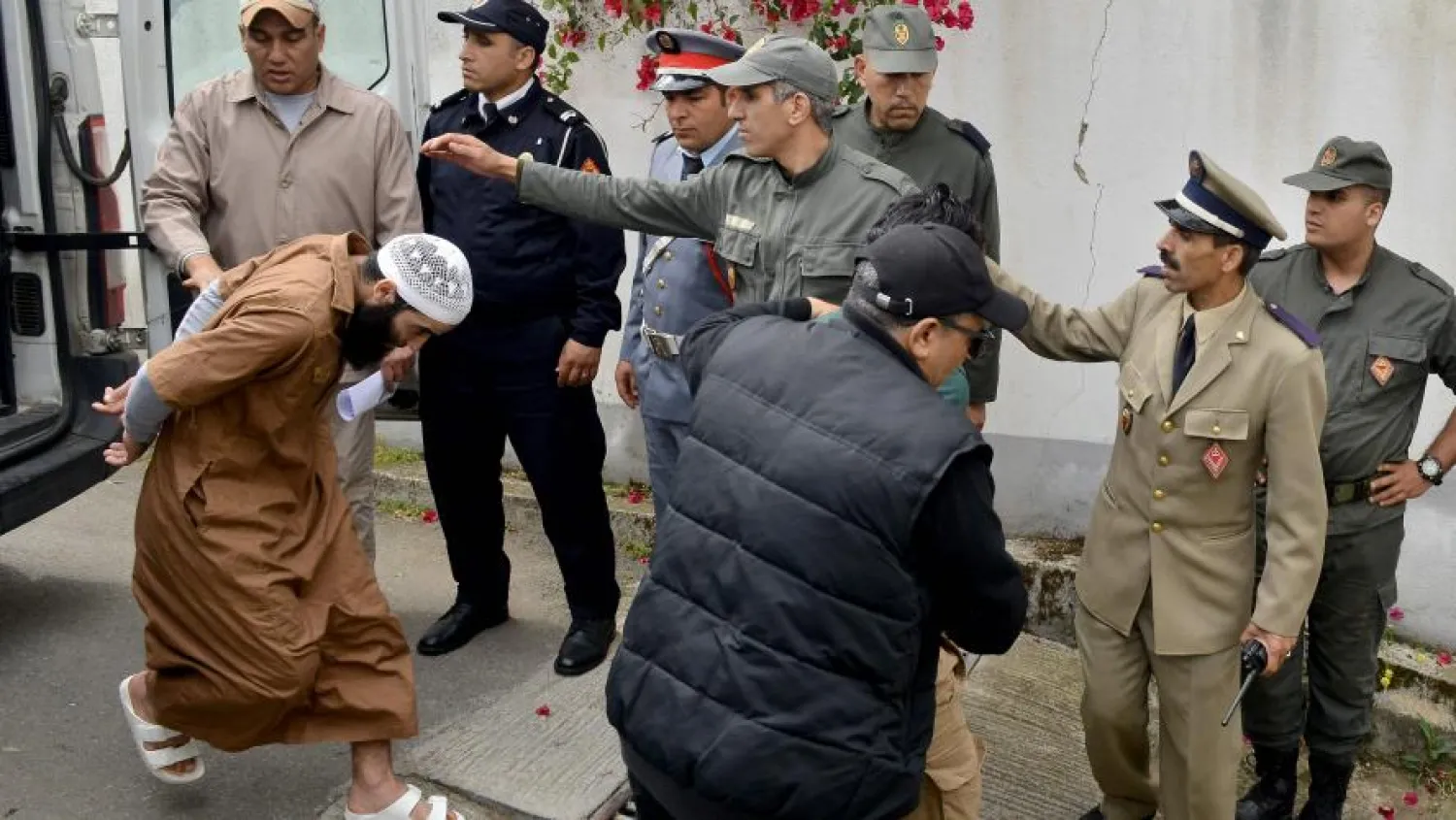
Suspects, charged in connection with the murder of two Scandinavian hikers, arrive for their trial at a Moroccan court | AFP
TT

Suspected Militants Back in Dock Over Murder of Two Scandinavian Hikers

Suspects, charged in connection with the murder of two Scandinavian hikers, arrive for their trial at a Moroccan court | AFP

A street vendor, a plumber, and a carpenter are among two dozen militant suspects who return to a Moroccan court Thursday, charged in connection with the brutal murder of two Scandinavian hikers.

Danish student Louisa Vesterager Jespersen, 24, and 28-year-old Norwegian Maren Ueland had their throats slit before they were beheaded in December at an isolated site in the High Atlas mountains.

The main suspects are all from the Marrakech region near the site of the killings, which shocked the North African country.

Abdessamad Ejjoud, a 25-year-old street vendor, is the alleged leader of the group. He had been jailed for trying to join ISIS in Syria but was released in 2015.

Younes Ouaziyad, 27, and Rachid Afatti, 33, have been named as the other two key suspects. The others have been accused of links to the killers and of forming part of a "terrorist cell".

The three main defendants accused of direct involvement, who allegedly pledged allegiance to ISIS, could face the death penalty.

A total of 24 defendants were to appear in the criminal court in Sale, near Rabat, to face charges including promoting terrorism, forming a terrorist cell, and premeditated murder.

An opening hearing was held on May 2 but immediately postponed for two weeks after defense lawyers requested more time to prepare their case.

A Spanish-Swiss convert to Islam is among the suspects on trial, accused of teaching the main accused how to use encrypted communications and how to fire a gun.

Nature lovers Jespersen and Ueland shared an apartment and went to Norway's Bo University where they were studying to be guides.

They had traveled together to Morocco for their Christmas holidays.

Their lives were cut short in the foothills of Toubkal, the highest summit in North Africa, some 80 kilometers from the city of Marrakesh, a tourist magnet.

According to the charge sheet, the assailants traveled to the High Atlas mountains on December 12 on a mission to kill tourists.

Several potential targets were passed over because the foreigners were accompanied by guides or local residents.

It was four days before they selected their targets, who were camped at an isolated site. Two of them carried out the killings while the third filmed them on a telephone, according to the prosecution.

After the bodies were discovered, the Moroccan authorities were initially cautious, referring to a "criminal act" and wounds to the victims' necks.

But that all changed when the video surfaced showing a victim being beheaded, while one of the killers refers to "enemies of Allah" says the attacks were in revenge for the killings of militants in Syria.

A separate video in the initial aftermath of the murder showed the alleged killers pledging allegiance to ISIS leader Abu Bakr al-Baghdadi.

Investigators said the "cell" was inspired by ISIS ideology, but Morocco's anti-terror chief insisted the accused had no contact with the militant group in conflict zones.

ISIS has never claimed responsibility for the double-murder.

Police quickly arrested the first suspect in the suburbs of Marrakesh, and three others were arrested a few days later when they tried to leave the city by bus.

A lawyer for one of the victim's families told AFP he would seek the death penalty for the murders.

A de facto suspension on executions has been in place in Morocco since 1993.

A second Swiss citizen arrested after the double-murder was tried separately and jailed in mid-April for 10 years on charges including "forming a terrorist group".

The main trial is expected to run for months before it reaches a verdict.


Syria to Start Currency Swap on January 1st, Central Bank Governor Says

Syrian pounds are pictured inside an exchange currency shop in Azaz, Syria February 3, 2020. Picture taken February 3, 2020. REUTERS/Khalil Ashawi/File Photo
TT

Syria to Start Currency Swap on January 1st, Central Bank Governor Says

Syrian pounds are pictured inside an exchange currency shop in Azaz, Syria February 3, 2020. Picture taken February 3, 2020. REUTERS/Khalil Ashawi/File Photo

Syria will start swapping old banknotes for new ones under a ​plan to replace Assad-era notes starting from January 1, 2026, Central Bank Governor Abdelkader Husrieh said on Thursday.

Husrieh announced the introduction of the new Syrian currency, saying the decree "sets January ‌1, 2026, ‌as the start date ‌for ⁠the ​exchange ‌process". Sources familiar with the matter told Reuters in August that the country will issue new banknotes, removing two zeros from its currency in an attempt to restore ⁠public confidence in the severely devalued pound.

The ‌step is intended ‍to strengthen ‍the Syrian pound after its purchasing ‍power collapsed to record lows following a 14-year conflict that ended with President Bashar al-Assad's ouster in December.

Husrieh ​said the operation will take place through a smooth and orderly ⁠swap - a move bankers hope will ease fears that the new currency could fuel inflation and further erode the purchasing power of Syrians already reeling from high prices.

He added that a press conference will soon outline the exact regulations and mechanisms.


Türkiye Begins Black Box Analysis of Jet Crash That Killed Libyan Military Chief and 7 Others

Libyan national flags fly at half-mast in Tripoli on December 24, 2025, after the head of Libya's armed forces and his four aides died in a plane crash in Türkiye. (AFP)
TT

Türkiye Begins Black Box Analysis of Jet Crash That Killed Libyan Military Chief and 7 Others

Libyan national flags fly at half-mast in Tripoli on December 24, 2025, after the head of Libya's armed forces and his four aides died in a plane crash in Türkiye. (AFP)

The technical analysis of the recovered black boxes from a jet crash that killed eight people, including western Libya’s military chief, began as the investigation proceeded in cooperation with Libyan authorities, the Turkish Ministry of Defense said Thursday.

The private jet with Gen. Muhammad Ali Ahmad al-Haddad, four other military officials and three crew members crashed on Tuesday after taking off from Türkiye’s capital, Ankara, killing everyone on board. Libyan officials said the cause of the crash was a technical malfunction on the plane.

The high-level Libyan delegation was on its way back to Tripoli after holding defense talks in Ankara aimed at boosting military cooperation between the two countries.

The wreckage was scattered across an area covering 3 square kilometers (more than a square mile), complicating recovery efforts, according to the Turkish Interior Minister Ali Yerlikaya.

A 22-person delegation, including five family members, arrived from Libya early on Wednesday to assist in the investigation.


Lebanese President: We are Determined to Hold Parliamentary Elections on Time

President Joseph Aoun between Prime Minister Nawaf Salam and Speaker Nabih Berri (Lebanese Presidency file photo)
TT

Lebanese President: We are Determined to Hold Parliamentary Elections on Time

President Joseph Aoun between Prime Minister Nawaf Salam and Speaker Nabih Berri (Lebanese Presidency file photo)

Lebanese President Joseph Aoun reiterated on Thursday that the country’s parliamentary elections are a constitutional obligation that must be carried out on time.

Lebanon’s state-run National News Agency quoted Aoun as saying that he, alongside Prime Minister Nawaf Salam and Parliament Speaker Nabih Berri, is determined to hold the elections on schedule.

Aoun also emphasized that diplomatic efforts have continued unabated to keep the specter of war at bay, noting that "things are heading in a positive direction".

The agency also cited Berri reaffirming that the elections will take place as planned, with "no delays, no extensions".

The Lebanese parliamentary elections are scheduled for May next year.