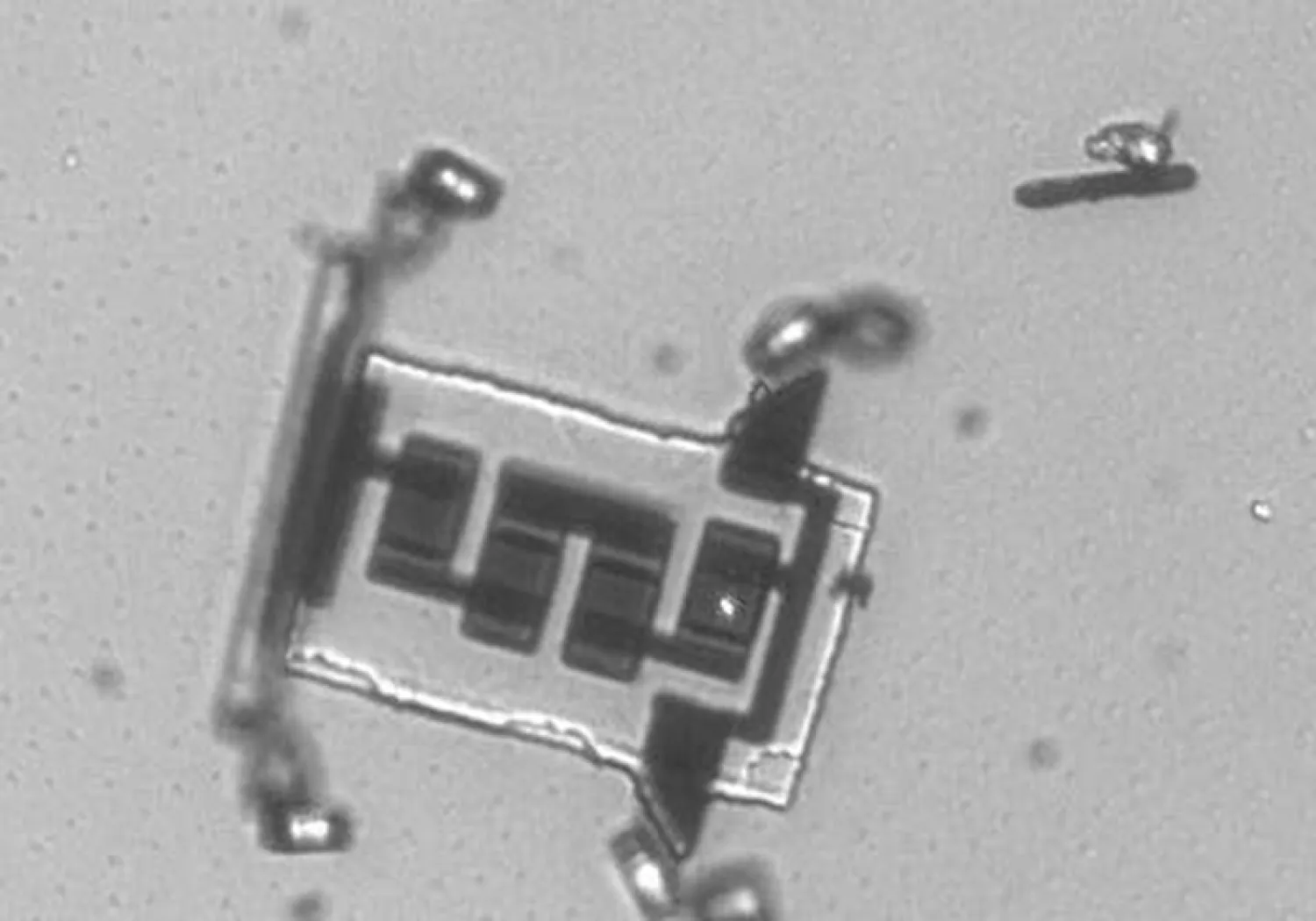

The Microbots Are on Their Way

A microbot alongside a paramecium. Researchers envision using the tiny crawlers to measure signals in the brain. | Credit Marc Miskin, University of Pennsylvania and Cornell University
TT

The Microbots Are on Their Way

A microbot alongside a paramecium. Researchers envision using the tiny crawlers to measure signals in the brain. | Credit Marc Miskin, University of Pennsylvania and Cornell University

Like Frankenstein, Marc Miskin’s robots initially lie motionless. Then their limbs jerk to life.

But these robots are the size of a speck of dust. Thousands fit side-by-side on a single silicon wafer similar to those used for computer chips, and, like Frankenstein coming to life, they pull themselves free and start crawling.

“We can take your favorite piece of silicon electronics, put legs on it and then build a million of them,” said Dr. Miskin, a professor of electrical and systems engineering at the University of Pennsylvania. “That's the vision.”

He imagines a wealth of uses for these microbots, which are about the size of a cell. They could crawl into cellphone batteries and clean and rejuvenate them. They might be a boon to neural scientists, burrowing into the brain to measure nerve signals. Millions of them in a petri dish could be used to test ideas in networking and communications.

The research, presented at a meeting of the American Physical Society in Boston in March, is the latest step in the vision that physicist Richard Feynman laid out in 1959 in a lecture, “There’s Plenty of Room at the Bottom,” about how information could be packed into atomic-scale structures and molecular machines could transform technology.

Over the past 50 years, Feynman’s predictions about information storage have largely come to fruition. “But the second goal — the miniaturization of machines — we’re really just getting started,” Dr. Miskin said.

The new robots take advantage of the same basic technology as computer chips. “What we’re doing is stealing from 60 years of silicon,” said Paul McEuen, a physicist at Cornell University. “It’s no big deal to make a silicon chip 100 microns on a side. What didn’t exist is basically the exoskeleton for the robot arms, the actuators.”

While working in the laboratories of Dr. McEuen and Itai Cohen, another Cornell physicist, Dr. Miskin developed a technique to put layers of platinum and titanium on a silicon wafer. When an electrical voltage is applied, the platinum contracts while the titanium remains rigid, and the flat surface bends. The bending became the motor that moves the limbs of the robots, each about a hundred atoms thick.

The idea is not new. Researchers like Kris Pister of the University of California, Berkeley, have for decades talked of “smart dust,” minuscule sensors that could report on conditions in the environment. But in developing practical versions, the smart dust became larger, more like smart gravel, in order to fit in batteries.

Dr. Miskin worked around the power conundrum by leaving out the batteries. Instead, he powers the robots by shining lasers on tiny solar panels on their backs.

“I think it’s really cool,” Dr. Pister said of the work by Dr. Miskin, Dr. McEuen and their collaborators. “They made a super-small robot you can control by shining light on it and that could have all sorts of interesting applications.”

Because the robots are made using conventional silicon technology, incorporating sensors to measure temperature or electrical pulses should be straightforward.

Dr. Miskin said his electrical engineering colleagues are often incredulous when they find out that the robots run on a fraction of a volt and consume only 10 billionths of a watt: “‘You mean you can take my thing and put legs on it?’ ‘Yeah, absolutely.' ‘And then you can have it piloted and compute and do all this other stuff?’ People get really excited.”

Challenges remain. For robots injected into the brain, lasers would not work as the power source. (Dr. Miskin said magnetic fields might be an alternative.) He wants to make other robots swim rather than crawl. (For tiny machines, swimming can be arduous as water becomes viscous, like honey.).

Still, Dr. Miskin expects that he can demonstrate practical microbots within a few years.

“It really boils down to how much innovation do you have to do?” he said. “And what I love about this project is for a lot of the functional things, the answer is none. You take the parts that exist and you put them together.”

(The New York Times)


China Approves First Two Level-3 Autonomous Driving Cars from State-owned Automakers

People pass by the entrance to Volkswagen (China) Technology Company, a 3 billion euros ($3.5 billion) R&D center in Hefei in eastern China's Anhui province, on Feb. 25, 2025. (AP Photo/Ken Moritsugu)
TT

China Approves First Two Level-3 Autonomous Driving Cars from State-owned Automakers

People pass by the entrance to Volkswagen (China) Technology Company, a 3 billion euros ($3.5 billion) R&D center in Hefei in eastern China's Anhui province, on Feb. 25, 2025. (AP Photo/Ken Moritsugu)

China's industry regulator on Monday approved two Chinese cars with level-3 autonomous driving capabilities, marking the first time such vehicles have been cleared by the national regulator as legitimate products ready for mass adoption.

The Ministry of Industry and Information Technology approved the two electric sedans from state-owned automakers Changan Auto and BAIC Motor in its latest automobile product entry category, said Reuters.

The two models are allowed to activate conditional autonomous driving in designated areas of Chongqing and Beijing with speed limits of 50km/h and 80km/h, respectively, the ministry said in a statement. The automakers will conduct trial operation with the cars on the specific roads via their ride-hailing units, it added.

The auto industry has defined five levels of autonomous driving, from cruise control at level one to fully self-driving cars at level five, and level three allows drivers to take their eyes and hands off the road in certain situations.

The move underscored China's ambition to lead the development and adoption of autonomous driving, a technology poised to disrupt the auto industry globally. Last year, China lined up nine automakers for public tests to advance the adoption of self-driving cars.

Chinese regulators earlier this year had sharpened scrutiny of the assisted driving technologies following an accident involving a Xiaomi SU7 sedan in March. That incident killed three occupants when their car crashed seconds after the driver took control from the assisted-driving system.

But government officials are pressing Chinese automakers to rapidly deploy even more advanced systems. In their level-3 push, Chinese regulators also are upping the regulatory ante by holding automakers and parts suppliers liable if their systems fail and cause an accident.

Autonomous driving developers such as Pony AI and WeRide have been testing their level-4 cars with licenses granted by local governments across China.

Tesla's Full Self-Driving, a level-2 driver assistance system, has been partially approved in China since February and falls short of its capabilities in the United States.


Elm Company Named Strategic Partner for International Data and AI Conference

Elm Company Named Strategic Partner for International Data and AI Conference
TT

Elm Company Named Strategic Partner for International Data and AI Conference

Elm Company Named Strategic Partner for International Data and AI Conference

The Saudi Data and Artificial Intelligence Authority (SDAIA) announced a strategic partnership with Elm Company for the International Conference on Data and AI Capacity Building (ICAN 2026), enhancing collaboration to empower the data and artificial intelligence ecosystem and promote innovation in education and human capacity development.

This partnership comes as part of preparations for ICAN 2026, organized by SDAIA from January 28 to 29 at King Saud University in Riyadh, with the participation of a select group of specialists and experts from around the world, SPA reported.

The step represents a qualitative addition that contributes to enriching the conference’s knowledge content and expanding partnerships with leading national entities.

Elm Company brings extensive experience in designing digital solutions and building technical capabilities, reinforcing its role as a strategic partner in supporting the conference. It contributes by developing training tracks and digital empowerment programs, participating in the technology exhibition, and presenting qualitative initiatives that help empower national competencies in the fields of data and artificial intelligence.


Foxconn to Invest $510 Million in Kaohsiung Headquarters in Taiwan

Construction is scheduled to start in 2027, with completion targeted for 2033. Reuters
TT

Foxconn to Invest $510 Million in Kaohsiung Headquarters in Taiwan

Construction is scheduled to start in 2027, with completion targeted for 2033. Reuters

Foxconn, the world’s largest contract electronics maker, said on Friday it will invest T$15.9 billion ($509.94 million) to build its Kaohsiung headquarters in southern Taiwan.

That would include a mixed-use commercial and office building and a residential tower, it said. Construction is scheduled to start in 2027, with completion targeted for 2033.

Foxconn said the headquarters will serve as an important hub linking its operations across southern Taiwan, and once completed will house its smart-city team, software R&D teams, battery-cell R&D teams, EV technology development center and AI application software teams.

The Kaohsiung city government said Foxconn’s investments in the city have totaled T$25 billion ($801.8 million) over the past three years.