


Switch 2 Sales Boost Nintendo Results but Chip Shortage Looms

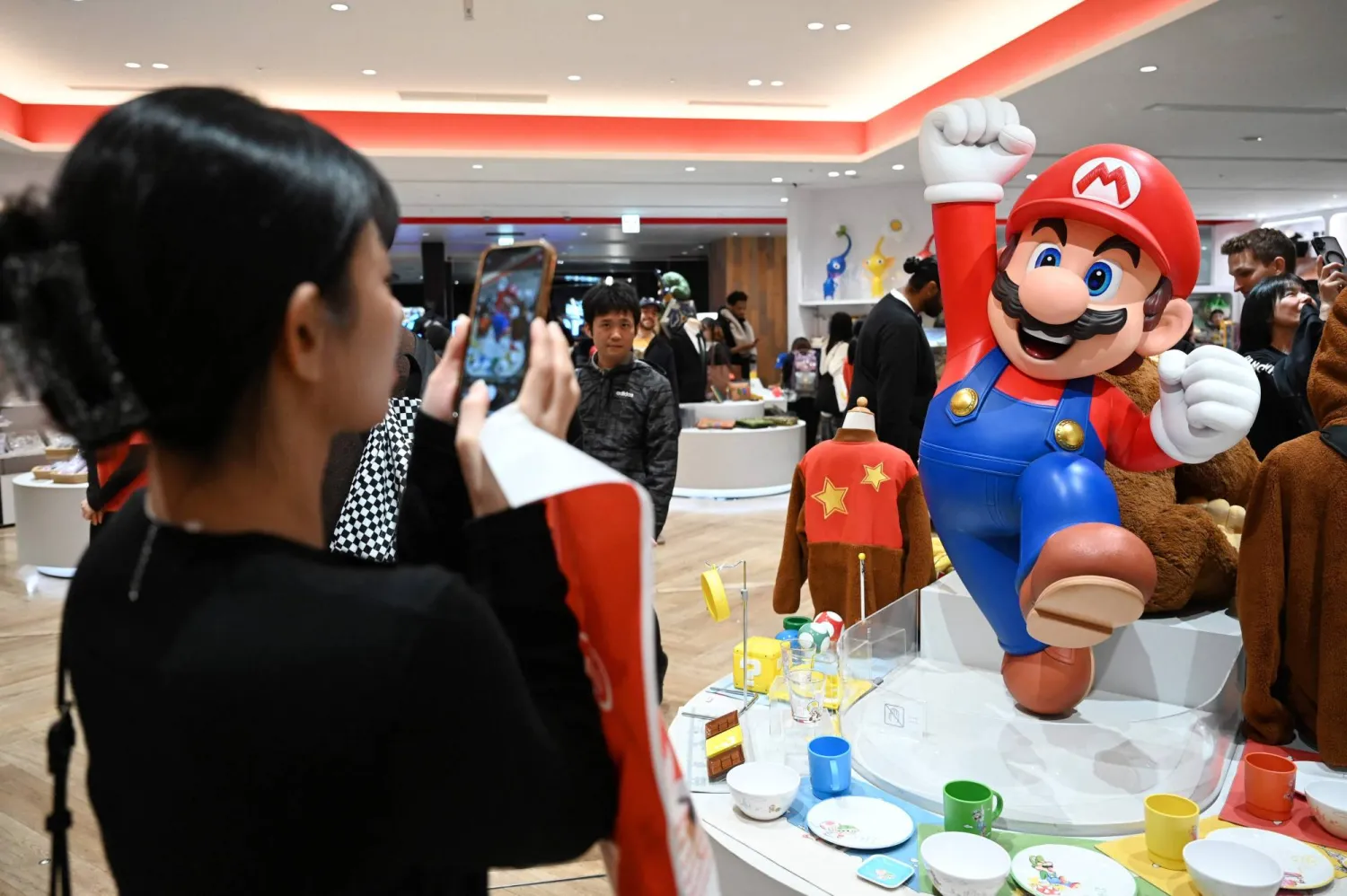
This photo taken on November 4, 2025 shows a woman taking photos of a Super Mario figure at the Nintendo Tokyo store in Tokyo. (AFP)
TT

Switch 2 Sales Boost Nintendo Results but Chip Shortage Looms

This photo taken on November 4, 2025 shows a woman taking photos of a Super Mario figure at the Nintendo Tokyo store in Tokyo. (AFP)

The runaway success of the Switch 2 console drove up Nintendo's net profit by more than 50 percent in the nine months to December, the Japanese video game giant said Tuesday.

But a global memory chip shortage, created by frenzied demand for artificial intelligence hardware, could push up manufacturing costs.

The Switch 2 became the world's fastest-selling games console after launching to a fan frenzy last summer.

It is the successor to the original Switch, which soared in popularity during the pandemic when games such as "Animal Crossing" struck a chord during long lockdowns.

Both are hybrid devices that can be connected to a TV or used on-the-go.

In April-December, net profit jumped 51.3 percent year-on-year to 358.9 billion yen ($2.3 billion), and revenue nearly doubled on-year to 1.9 trillion yen, Nintendo said.

But the firm kept its annual unit sales target for the Switch 2 steady at 19 million, and also held its full-year net profit forecast of 350 billion yen.

"Nintendo Switch 2 got off to a good start following its launch on June 5 and unit sales continued to grow through the holiday season," the company said.

Nearly 17.4 million Switch 2 devices were sold in the nine-month period, it added.

"Maintaining momentum is certainly a big focus for Nintendo," Krysta Yang of the Nintendo-focused Kit and Krysta Podcast told AFP.

A lack of heavy-hitting first-party new games for the Switch 2 in coming months risks hindering growth, although third-party titles such as "Resident Evil Requiem" should help fill the gap, she said.

Nintendo said Tuesday it planned to release "Mario Tennis Fever" this month and "Pokemon Pokopia" in March.

While the firm is diversifying into hit movies and theme parks, consoles remain the core of its business.

The Switch 1 has now sold 155.37 million units -- overtaking the Nintendo DS console to be its best-selling hardware of all time.

But soaring prices for memory chips, used in gaming consoles as well as phones, laptops and other electronics, will likely be a headwind for the company.

Their prices have been pushed up as chipmakers focus on producing the advanced memory chips in huge demand to power AI data centers.

"Nintendo and other console manufacturers are publicly keeping quiet about the impact of the shortage," gaming industry consultant Serkan Toto told AFP.

But "users can forget the past when consoles always became cheaper in tandem with component costs falling over time", with price hikes potentially on the way in 2026, he said.

Yang said she thought a price increase for the Switch 2 "is not out of the question" but added that Nintendo "would likely exhaust all other options" before doing so.




Oracle Reportedly Plans Thousands of Job Cuts as Data Center Costs Rise

FILE PHOTO: Oracle logo is seen in this illustration created on September 9, 2025. REUTERS/Dado Ruvic/Illustration/File Photo
TT

Oracle Reportedly Plans Thousands of Job Cuts as Data Center Costs Rise

FILE PHOTO: Oracle logo is seen in this illustration created on September 9, 2025. REUTERS/Dado Ruvic/Illustration/File Photo

Enterprise software company Oracle is planning thousands of job cuts as it faces a cash crunch from a massive AI data center expansion effort, Bloomberg News reported on Thursday.

Long a smaller contender in the cloud market, over the past year Oracle has emerged as a major player in the business of renting computing power thanks, in part, to its $300 billion deal with OpenAI.

But investors have grown worried about ⁠how it would ⁠fund the data center expansion needed to serve OpenAI and other customers, including Elon Musk's xAI and Meta.

The software company, chaired by billionaire Larry Ellison, in February outlined plans to raise $45 billion to $50 billion this year in ⁠order to expand its cloud infrastructure, fueling investor concerns about its rising debt load.

The layoffs will impact divisions across Oracle and may be implemented as soon as this month, the Bloomberg report said, citing people familiar with the matter.

Some cuts will be aimed at job categories that the company expects will shrink due to AI.

The planned reductions are expected to be ⁠wider-reaching than Oracle's ⁠typical rolling job cuts, according to Bloomberg.

This week, Oracle announced internally that it would be reviewing many of the open job listings in its cloud division, effectively slowing down or freezing the hiring process, the report added.

Oracle declined to comment when contacted by Reuters.

The company had about 162,000 full-time employees as of May 31, 2025, according to its annual filing with the US Securities and Exchange Commission.


UK's Nothing Splashes Color on New Phones to Shake Up 'Boring' Tech

Carl Pei, CEO of Nothing, poses for pictures at Nothing headquarters in Kings Cross, in London, Britain, February 26, 2026. REUTERS/Jaimi Joy
TT

UK's Nothing Splashes Color on New Phones to Shake Up 'Boring' Tech

Carl Pei, CEO of Nothing, poses for pictures at Nothing headquarters in Kings Cross, in London, Britain, February 26, 2026. REUTERS/Jaimi Joy

Nothing, the smartphone maker founded in London by Carl Pei, launched new mid-tier handsets and headphones on Thursday, adding new colors to its white, black and grey palette to appeal to digitally adept younger customers.

Pei, a Swedish national who previously co-founded Chinese brand OnePlus, started Nothing in 2020 with the aim of making consumer technology less monotonous. He said smartphones had become "kind of boring", with only incremental improvements in batteries, screens and cameras.

The Phone (4a), available in pink and blue as well as black and white, and Phone (4a) Pro, ⁠available in pink, ⁠black and silver, will retail at 349 pounds or 349 euros, and 499 pounds or 479 euros, respectively.

Both phones feature improved cameras and the company's signature glyph interface, a system of LED lights on the back.

Headphone (a) has up to five days of battery life and integrated physical controls in the ear cups, the company said. It will be available in pink, ⁠yellow, black and white, priced at 149 pounds, $199 and 159 euros.

"We're giving our portfolio a splash of color and secondly we're advancing some of our AI initiatives," Reuters quoted Pei as saying.

"We started Nothing to break that monotony and make tech more fun," he said in an interview.

Nothing's first phone in 2022 stood out in a sea of similar Android devices with its transparent design and distinctive backlit glyph features.

Pei said the company was building scale and capability so it could launch more novel AI-focused products.

"We cannot just create audio products and smartphones because those are basically already solved problems," he ⁠said.

"I think ⁠we need to usher in a new wave of human-computer interaction. That will be the next step for us."

The company, which raised $200 million at a $1.3 billion valuation last year, plans to spin off its India-focused, budget-oriented devices brand called CMF.

Pei said Nothing was considering listing that business, but had not made a firm decision. "India has one of the most active capital markets in the world," he said.

He said Nothing itself would be IPO-ready by the end of 2028, though the target was "more like an internal call to arms to just get our act together, build all the structures we need".

"Whether we pull the trigger or not really depends on the market conditions and our plans at that time," he said.


Google to Open German Center for 'AI Development'

Google has launched a massive AI investment drive in Germany. Tobias SCHWARZ / AFP
TT

Google to Open German Center for 'AI Development'

Google has launched a massive AI investment drive in Germany. Tobias SCHWARZ / AFP

Google will open an AI center in Berlin on Thursday, the latest sign of Europe's deepening reliance on US firms in cutting edge technologies despite the continent's stated aim to catch up with its rivals.

Germany's ministry for digital affairs told AFP the center will bring together cloud computing and data infrastructure, "AI development" operations as well as a space for cooperation between start-ups and research centers.

Europe is struggling to gain ground in the battle for AI dominance with the United States and China, which are pumping vast sums into the field and producing the most advanced models underpinning the technology.

The Google project is part of a 5.5 billion euro ($6.4 billion) investment drive into Europe's top economy announced by the US tech titan in November, planned to include a new data center.

The firm said at the time it would renovate its Berlin office to add three floors equipped with meeting rooms, a new conference room and a demo space but made no mention of an AI center in the capital.

Chancellor Friedrich Merz's coalition has signaled it wants to make progress in the area as part of efforts to revive the struggling economy, and there have been a flurry of announcements related to AI recently.

"I want technological leadership to once again become the core of our economic model," said Finance Minister Lars Klingbeil last month at the opening of an industrial AI hub, spearheaded by German telecoms giant Deutsche Telekom and US chip juggernaut Nvidia.

- 'Enormous challenges' -

But while efforts are being made to build up infrastructure and data storage capacities, the "challenges are enormous" for Germany, said Janis Hecker of the digital business association Bitkom.

The government still "underestimates the importance of these technologies for value creation, but also for sovereignty and the defense of our values", he said.

The United States builds more computing capacity each year than Germany has in total, the group says.

According to its calculations, one-thousandth of the proposed central government budget for 2026 is dedicated to AI, and only a fraction of a massive pot of funding to modernize the country's infrastructure is dedicated to cutting-edge technologies.

Against this backdrop, Google's investments in Germany are a "big win", Bitkom believes.

But such investments add to concerns about Europe's technological dependencies on the United States at a time of strained ties under the administration of US President Donald Trump.

Even when American tech giants are not the main players in a project, they often still play a vital role in areas from providing cloud infrastructure to cutting-edge semiconductors.

At a summit on so-called "digital sovereignty" in November, Merz and French President Emmanuel Macron backed the idea of favoring European firms in a bid to develop regional champions.

"Sovereignty does not mean self-sufficiency, but strategic capacity for action," says Barbara Engels of the IW Institute.

She also welcomed Google's projects but said that "we must use this infrastructure while developing our own capabilities".

Antonio Krueger, head of the German Research Centre for Artificial Intelligence (DFKI), believes it makes no sense to try to overtake China and the United States in areas such as producing the most advanced AI models.

Instead, Europe should leverage its advantages in industry, he said, adding that data collected by companies can by use to train smaller AI models to "solve very specific tasks".

In this area, "the race is still wide open," he said.