



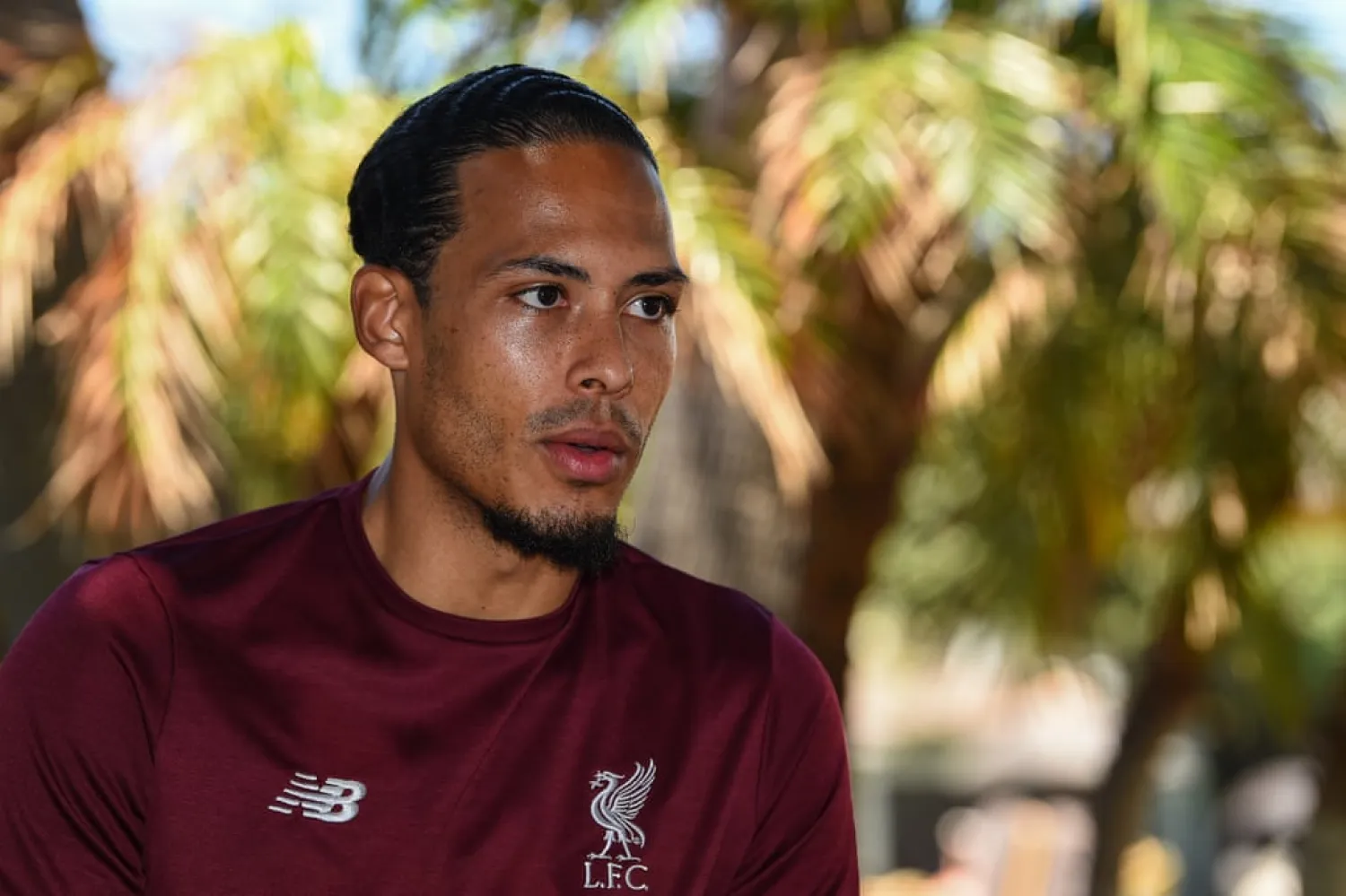

In the dappled shade, away from the glare of the Spanish sun, Virgil van Dijk thinks about words such as tension and nerves with a little smile. This is meant to be the hardest time, with the days moving slowly between the end of the regular season and Liverpool’s Champions League final against Tottenham in Madrid next Saturday night.
Van Dijk was named PFA player of the season by his fellow professionals, after his imperious form at the heart of Liverpool’s defence helped ensure his club lost just one match in a league campaign that earned them 97 points. They still finished a point behind Manchester City, and their wait to win the league title rolls over into a 30th year.
Victory over Spurs, and becoming champions of Europe for a sixth time, would seal a remarkable season for Van Dijk and Liverpool with a heady gloss. Defeat, and yet more disappointment after losing the final last year, would be crushing. The contrast between the two outcomes is so deep that even a man as composed as Van Dijk must be churning on the inside?
“No,” the 27-year-old insists. “I’m never nervous any more.”
That “any more” is significant because it is striking to hear Van Dijk reflect on the doubts that once undermined him. In the Netherlands he was regarded as a relatively limited player by numerous coaches who did not imagine his rise to become, arguably, the best defender in the world. The road has been long and difficult but, out of adversity, Van Dijk is as calm during a fevered match as he is off the pitch.
“With experience,” he says, “the nervousness is not there. When I made my debut for Liverpool against Everton [in January 2018] I was more excited than nervous. I surprised myself that day with my calm.”
Apart from scoring the winning goal in front of the Kop, Van Dijk put an immediate dent in the pressure that could have consumed him after he arrived at Anfield as the world’s most expensive defender. The £75m paid to Southampton now looks like prudent housekeeping. Van Dijk has transformed Liverpool’s previously flaky defence so markedly that they conceded the fewest number of goals, 22, in the league last season.
“It’s more excitement than nerves these days,” he continues. “Even before the Champions League final last year [against Real Madrid] I was not nervous at all. I was very relaxed. I was like: ‘Let’s go, let’s do this.’”
At Liverpool’s training camp near Estepona on the Costa del Sol, Van Dijk shakes his head cheerfully. “I don’t know what it is. It’s just something I’ve learned over the years and it’s something I’m very happy about. If you’re nervous you think: ‘I don’t want to make mistakes or give the ball away.’ But you limit your own qualities then. Over the years I’ve developed the mindset that there are many more important things in life.”
Van Dijk remembers dreaming about playing in a Champions League final when he was a boy in Breda with a Dutch father and a mother from Suriname. Yet on the Cruyff Courts, small pitches made of artificial grass, Van Dijk was not a glittering link in the conveyor belt of Dutch footballers following Johan Cruyff – who played and coached the game so beautifully.
He found a different route to the gifted young players from Ajax whom he now captains with the Netherlands and who came so close to reaching the Champions League final themselves. Van Dijk is also different to Trent Alexander-Arnold, his Liverpool teammate playing a second Champions League final at the age of 20. When Van Dijk was 20 he was struggling to make the first team at Groningen, having never cracked it at the academy of Willem II. He had even worked as a dishwasher two nights a week.
Was his resolve forged during that difficult time? “Yeah. I think it’s a very good example to never give up. Keep working for your dreams. Every step of my career was hard work. I’ve given everything I’ve got but I’ve still got more to come in every aspect of my game. Maybe they were right at the time. Maybe it was meant to be that they didn’t want to take a chance with me. As a young player in the academy for a mid-table club the next step is one of the top four teams. That was my plan as well – but it didn’t happen.”
Marc Overmars was offered a chance to sign Van Dijk for Ajax but he rejected the defender. “These things happen,” Van Dijk says diplomatically. “They chose Mike van der Hoorn who plays for Swansea now. He did very well at the time. It’s easy to say now: ‘What if?’”
Van Dijk was not serene then. “No. I wanted things very quickly. When I went to Groningen I started in the under-23s and I was on the bench. I was like: ‘What’s going on here?’ I went to the manager Dick Lukkien and I was arguing with him back and forth, saying: ‘How is this possible?’ But I learned so much from that period. I grew as a human being.
“It was the first time I was on my own and I had to learn to deal with not getting my way. I went to training on a bicycle. It was the same the next season. Luckily, I kept working hard, kept improving, and I’m still in contact with Dick who is the head coach of FC Emmen now. He’s a fantastic coach and got the best out of me. He pushed me because he knew I could be a bit lazy. He knew my mentality then was to do just enough to win challenges. He kept pushing me and made me angry at times. It was tough but it worked. Before the end of the season I made my debut in the first team. I’m so grateful to Dick.”
In 2011 Van Dijk spent two weeks in hospital after his appendix burst and he developed severe peritonitis. His life was briefly in danger. “I don’t want to talk about it,” he says quietly. Yet Van Dijk is gracious and, after a pause, he does talk. “It wasn’t simple. It was a period that I looked after myself for the first time in my life. I couldn’t cook. I lived with another player and if you’re that young you think it’s easy. We just had training. We’re not going to try and cook. We’re going somewhere to eat. After I ate so much rubbish, the appendix was affected. I kept eating bad things. The appendix burst, and it was a very tough time. I learned so much about food and that we should value every situation we are in.”
He could not walk for 10 days and apparently signed a will to leave the little he had to his mother. “When something like that happens you think a lot and today I appreciate everything we’ve got. I know that life is much more than football. We have family and it’s all about being happy and healthy.”
Van Dijk played 62 games for Groningen but his career took off when he moved to Celtic. He laughs when asked about the change of culture in Glasgow. “It was massive. I spoke quite good English but the Scottish accent is totally different. I remember in the beginning people were talking and I was just nodding and saying yes. But going to Celtic was fantastic for me even if it was the same situation I had in Holland. [Bigger] clubs doubted my ability because they thought the standard was not so high in Scotland. I kept working hard and I always believed in myself. And the fans at Celtic are amazing. They live and die for their club. That’s something I love – real fans, real passion. It’s why I also made the decision to come to Liverpool.”
He might be immune to nerves but, earlier this month, Van Dijk could not control his racing mind or the adrenaline coursing through him all night after Liverpool beat Barcelona 4-0 to reach the Champions League final. “I could not sleep much – maybe two hours. It was totally crazy. From the moment we arrived at the stadium you had the feeling it could be something special. When Divock Origi scored that early goal you could feel the belief. Everything was perfect that night. It wasn’t like we had luck. We totally deserved it because anyone would say a team 3-0 down against Barcelona is not going to do it. Messi’s going to score – and if they scored one it was almost impossible. But we did it.”
Van Dijk grins as he relives the most glorious memory of his career. “It was nuts. You can’t really describe it. Hopefully we can finish it off now and make an even bigger memory.”
Spurs produced an even more dramatic comeback against Ajax the following night. They were 3-0 behind on aggregate when a Lucas Moura hat-trick, capped by a winning goal in the 96th minute, left Van Dijk’s young teammates in the Dutch national side crumpled on the turf. “I couldn’t believe it either but I told them later they could be very proud of themselves. If you’re very critical you can say Ajax gave it away in the second half because they didn’t play their own game. But they were outstanding this whole campaign and put Ajax and Dutch football back on the map.”
Spurs were almost dead and buried in the group stage, with one point from three games, and came through an astonishing quarter-final where they knocked out Manchester City. Their fans can be excused for churning out the old cliche about their name being on the cup while benefiting from the fact that Liverpool are surely under more pressure to win a trophy.
“Liverpool is always about pressure,” he responds, “but we have to enjoy it. We have a good chance of winning but this is a massive game for them as well. They’ve shown that they also never give up. We need to be ready.”
Liverpool beat Spurs 2-1 in both league games this season but their most recent encounter at Anfield was fraught with tension. At 1-1, with five minutes left, Van Dijk had to deal with the twin threat of Son Heung-min and Moussa Sissoko bearing down on goal. Sissoko had the ball but the dynamic Son was screaming down the right into space. With magisterial judgment, Van Dijk concentrated on closing down Son while allowing Sissoko to power forward. With his option of passing to Son blocked by Van Dijk, Sissoko shifted on to his weaker left foot. Knowing he had negated the presence of the more deadly Son, Van Dijk ran at the Spurs midfielder. Sissoko rushed and shot wildly over the bar. Liverpool breathed again and a few minutes later Anfield went ballistic when a Toby Alderweireld own goal won them the match.
“It worked out,” Van Dijk says of the decisions that meant he prevented a goal without even making a tackle. “But it would not have looked so smart if Sissoko had scored. But as a centre-back you get better with experience.” Such moments meant Van Dijk was voted player of the season. “I was very proud to win the PFA trophy because usually an attacker or a midfielder wins it. In later years I will look back and be even more proud.”
As for his own vote, Van Dijk was split. “I was thinking Raheem Sterling and Bernardo Silva. Bernardo is outstanding and he’s a great guy. I chatted with him a couple of times. He’s going to be very important for City the next few years. But Raheem made a big step and that’s why I voted for him. I could’ve voted for another four or five players at City because they were outstanding. But they could’ve voted for four or five of our players too. Maybe Trent, Sadio [Mané], Gini [Wijnaldum] …”
He has been with his wife, Rike, “since the Groningen days [when he was 20]. The growth we’ve been through since then is great and we now have two little girls. You can’t deny that fatherhood changes you. There are always tough moments but when you go home to your wife and kids it’s all gone. For example when we lost to Barcelona you feel bad – but you go home and you think how far I’ve got. I deal with those aspects very well.”
Van Dijk does a lot of charity work, which he asks the football writers on Merseyside to play down. “I’d rather just be normal. When I can help people, I will definitely help. Rike is very keen so we do it now and then. Low-key is better. We work with the foundation in Liverpool. We’re helping families. We’re also ambassadors of an orphanage in Nepal. Sometimes it’s small things. Signing boots, inviting someone to a game in our box. Something very small for us is a very big gesture to others. We appreciate that but we like people not to think we’re better than them. We’re all the same.”
There cannot be equality at the end of a Champions League final and for the losers the pain will be harsh. Will it feel especially hard for Liverpool if their stupendous season leaves them without a trophy? “It’s going to hurt if you lose – but it’s not the end of the world. The only thing we can do is to give everything and have no regrets if they’re the better team. We’re not thinking about losing or how we’re going to overcome this barrier of losing the Premier League by one point, then losing the Champions League. That’s not worth thinking about. I’m thinking about playing to our best ability with all our talent and experience.
“I read that if we win the Champions League our next two [out of three] games are the Community Shield and European Super Cup. We can win three cups in three games. It’s something we strive for. We were close in the Premier League – but now we have a chance to win the Champions League, the big one. We’re going to give it everything we’ve got.”
The Guardian Sport


