


Özil, Emery Clearly Do Not Have a Connection but Will Arsenal Act?

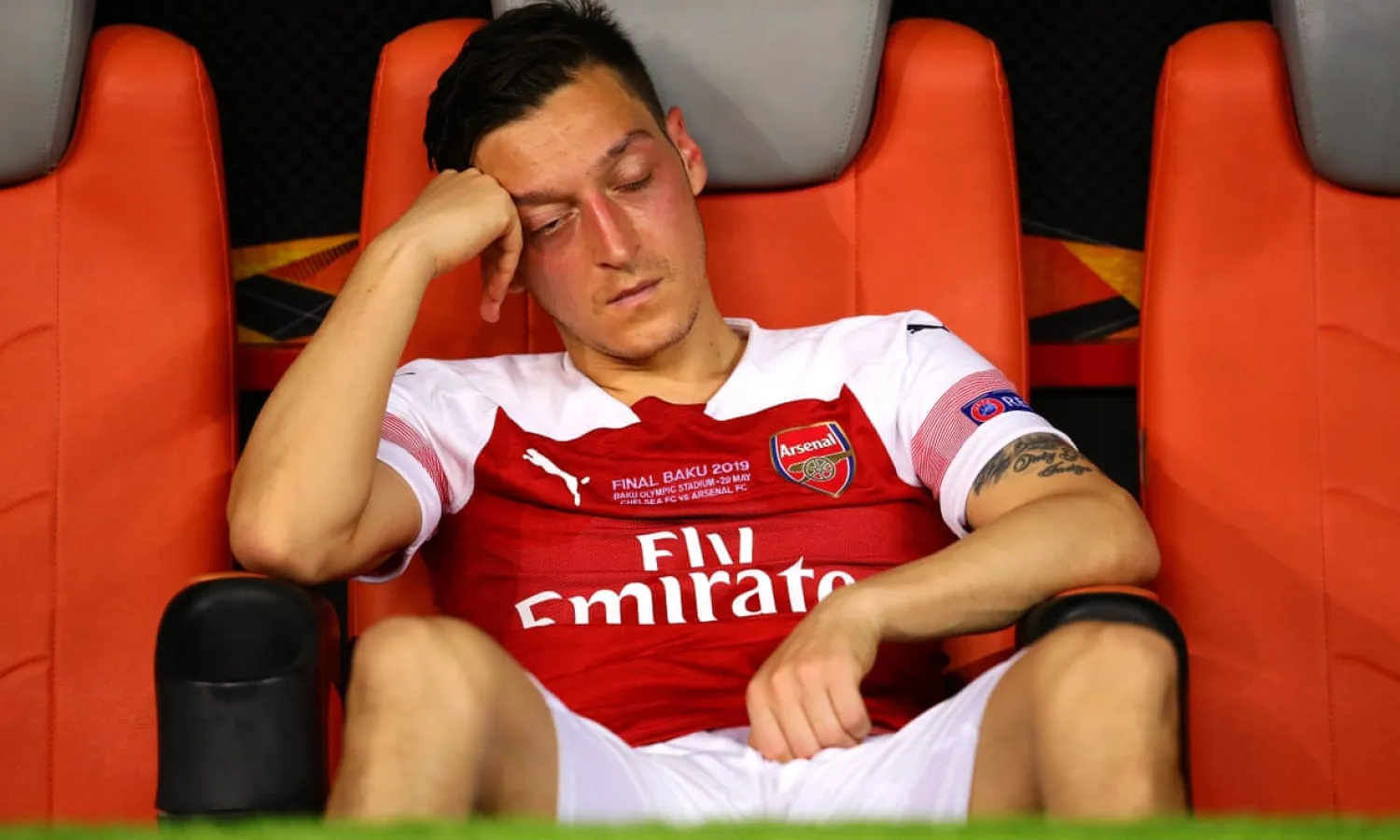
Mesut Özil sits in Arsenal’s dugout after being substituted by Unai Emery during their Europa League final defeat by Chelsea. Photograph: Chris Brunskill/Fantasista/Getty Images
TT

Özil, Emery Clearly Do Not Have a Connection but Will Arsenal Act?

Mesut Özil sits in Arsenal’s dugout after being substituted by Unai Emery during their Europa League final defeat by Chelsea. Photograph: Chris Brunskill/Fantasista/Getty Images

As Mesut Özil trudged, head bowed, around the pitch at the end of it all in Baku it was pertinent to wonder what has become of him and where it all goes from here. He is the lost playmaker. His once proud joy in the assist, his once delicate ability to be the subtle architect of a game, has dwindled to the point where it is really worth revisiting a highlights reel from previous years to remember how – even with that idiosyncratic languid style which means he seldom looks keen for a battle – his gifts had so much more presence.

If being replaced on the night by a teenager who spent most of this season playing for Arsenal Under-23s yet managed to involve himself in the game more in a cameo felt like an indignity, the greater affront should be a broader question. What has happened to Özil? Why do the passes not come any more? What has dulled his vision? The questions were put into even sharper focus as the Chelsea player in his role demanded and dominated the final. Eden Hazard has earned the opposite journey Özil made a few years ago, from the Premier League to Real Madrid.

When Arsenal signed Özil in 2013 he arrived as a game-changer on and off the pitch. In many ways he turned out to be just that – a symbol that the club wanted to compete for eye-catching talent, reflective of refreshed ambition which led to Alexis Sánchez joining a year later. For a while the pair were outstanding together.

Everything took a turn when Ivan Gazidis felt panicked into handing Özil a gargantuan new deal in January 2018 to avoid losing both their grandest stars at the same time with contracts running down, as has happened in damaging fashion this season with Aaron Ramsey. Of course Gazidis walked out a few months later but his parting gift has turned out to be something Arsenal do not know what to do with. It is a major problem going forward.

This is a deal, worth £350,000 per week, Arsenal cannot afford while they are not getting enough return on their bucks. Özil has been involved in nine goals this season, delivering either the strike or assist. In the previous three campaigns the numbers were 19, 26 and 28. It is quite the reduction. He has made a mere three assists in 2018-19, and that with two skilled marksmen in front of him in Pierre-Emerick Aubameyang and Alexandre Lacazette who have scored regularly.

And here is the extra problem: Arsenal’s highest earner and their current head coach evidently do not have a connection that works for either of them. One year into a difficult job but with little exciting evidence of improvement or new direction, and with Champions League qualification – the main aim of the season – unachieved, a recently divided fanbase has started to question whether Unai Emery is the right man.

It is easy to slip into those thoughts in a modern football culture where Maurizio Sarri’s position is far from secure despite finishing third and winning the Europa League –two aims Emery had a month ago before watching his team flail in both.

Some wags on the internet have started to call Emery “Bruce Rioja”. It is a clever pun, and the inference is a comparison with an Arsenal manager who took over from a powerful and successful predecessor and, despite his best efforts, was ousted after one season. Bruce Rioch was the fall guy in 1996 when the star player of the day, Ian Wright, could not connect with him and Arsenal decided to go down a different road by appointing Arsène Wenger. Those were different times, though. Back then Arsenal had an ambitious board ready to be dynamic and take difficult decisions.

It does not look as if it will be healthy for Arsenal to go into next season with Emery trying to make the best of it while Özil hangs around picking up such a high proportion of the wage bill. But it would be a surprise if there turns out to be enough conviction from on high to do something about that one way or the other, to clean a slate somehow.

Emery had tried quite hard to inspire Özil when he arrived in London. That seemed particularly important because the player had gone through a personal crisis in his career, scapegoated for Germany’s woeful World Cup. Özil felt pushed to step away from the international stage with grievances about racist undertones in how he felt perceived as a German with Turkish heritage. Emery tried to put the metaphorical arm around him, told him he was valued at Arsenal, that he wanted to see him enjoy his best football. Özil was given a share of the captaincy and the No 10 shirt, symbols to make him feel valued. But then reality set in.

These two men exist at different ends of the spectrum when it comes to the idea of hard work being central to football. It began to grate on both of them. After a period when Özil was dropped and hard words were said as one last throw of the motivational dice, he was reintegrated into the side. But he has seldom sparked in the Emery era. His Baku non-event of a performance typified that.

He is 30 now. The Özil question matters profoundly to Arsenal. But it comes with no simple answers.

(The Guardian)


Milano Cortina Finds Fix for Medal Defects, Repairs Offered

Silver medalist Eric Perrot, of France, from left, gold medalist Johan-Olav Botn, of Norway, and bronze medalist Sturla Holm Laegreid, of Norway, pose after the men's 20-kilometer individual biathlon race at the 2026 Winter Olympics in Anterselva, Italy, Tuesday, Feb. 10, 2026. (AP)
TT

Milano Cortina Finds Fix for Medal Defects, Repairs Offered

Silver medalist Eric Perrot, of France, from left, gold medalist Johan-Olav Botn, of Norway, and bronze medalist Sturla Holm Laegreid, of Norway, pose after the men's 20-kilometer individual biathlon race at the 2026 Winter Olympics in Anterselva, Italy, Tuesday, Feb. 10, 2026. (AP)

A fix has been found to stop Milano Cortina Olympic medals from coming apart, and athletes will be able to return any damaged ones for repair, local organizers said on Tuesday.

The problems with the cherished medals have been one of the talking points of the opening days of competition at a Games that have otherwise run smoothly.

Local organizers investigated the medals mishaps with the Italian State Mint, which is responsible for producing them.

"A solution was identified and a targeted ‌intervention was ‌implemented," Milano Cortina 2026 Communications Director Luca Casassa ‌said, ⁠adding that ‌only a limited number of medals had suffered defects.

Athletes whose medals were affected could return them "so that they can be promptly repaired," he added.

"Milano Cortina 2026 confirms its commitment to ensuring that the medals, which symbolize the highest achievement in every athlete's career, meet the highest standards of quality and attention to detail."

PROBLEM WITH THE CLASP

Organizers did not specify what the problem was. ⁠However, a source close to the situation had suggested on Monday that the issue may stem ‌from the medal's clasp and ribbon, which is ‍fitted with a breakaway mechanism ‍required by law to avoid the risk of strangulation or other ‍injury.

That tallied with the experience of US Alpine skier Jacqueline Wiles, who won a bronze in the women's team combined on Tuesday and became the latest competitor to suffer a medal mishap.

Wiles said some boisterous celebrations were to blame.

"Some arms were swinging and I was jumping. And it got out of hand a little quickly. But that's OK. They ⁠fixed it already," she said.

A spokesperson for her team said the problem was with the clasp on her medal and she had been given a replacement.

Local organizers were very pleased with operations at the Games, spread over a wide area of northern Italy from Milan to a series of venues in the Alps.

"What we have found in these first four days is really encouraging, the stadiums and the competitions are often sold out, fan zones are full of people who are in a party mood and want to enjoy the Games' atmosphere," Casassa said.

"The feedback that we are getting ‌from the real protagonists, the athletes, at the moment is extremely positive," he added.


Soccer Returns to Gaza Pitch Scarred by War and Loss

Palestinians play soccer on a pitch, near buildings destroyed during the two-year Israeli offensive, in Gaza City. REUTERS/Mahmoud Issa
TT

Soccer Returns to Gaza Pitch Scarred by War and Loss

Palestinians play soccer on a pitch, near buildings destroyed during the two-year Israeli offensive, in Gaza City. REUTERS/Mahmoud Issa

On a worn-out five-a-side pitch in a wasteland of ruined buildings and rubble, Jabalia Youth took on Al-Sadaqa in the Gaza Strip's first organized soccer tournament in more than two years.

The match ended in a draw, as did a second fixture featuring Beit Hanoun vs Al-Shujaiya. But the spectators were hardly disappointed, cheering and shaking the chain-link fence next to the Palestine Pitch in the ruins of Gaza City's Tal al-Hawa district.

Boys climbed a broken concrete wall or peered through holes in the ruins to get a look. Someone was banging on a drum, Reuters reported.

Youssef Jendiya, 21, one of the Jabalia Youth players from a part of Gaza largely depopulated and bulldozed by Israeli forces, described his feeling at being back on the pitch: "Confused. Happy, sad, joyful, happy."

"People search for water in the morning: food, bread. Life is a little difficult. But there is a little left of the day, when you can come and play soccer and express some of the joy inside you," he said.

"You come to the stadium missing many of your teammates... killed, injured, or those who travelled for treatment. So the joy is incomplete."

Four months since a ceasefire ended major fighting in Gaza, there has been almost no reconstruction. Israeli forces have ordered all residents out of nearly two-thirds of the strip, jamming more than 2 million people into a sliver of ruins along the coast, most in makeshift tents or damaged buildings.

The former site of Gaza City's 9,000-seat Yarmouk Stadium, which Israeli forces levelled during the war and used as a detention centre, now houses displaced families in white tents, crowded in the brown dirt of what was once the pitch.

For this week's tournament the Football Association managed to clear the rubble from a collapsed wall off a half-sized pitch, put up a fence and sweep the debris off the old artificial turf.

By coming out, the teams were "delivering a message", said Amjad Abu Awda, 31, a player for Beit Hanoun. "That no matter what happened in terms of destruction and genocidal war, we continue with playing, and with life. Life must continue."


Malinin Made History with His Olympic Backflip, but Some Say the Glory Was Owed to a Black Skater

Milano Cortina 2026 Olympics - Figure Skating - Team Event - Men Single Skating - Free Skating - Milano Ice Skating Arena, Milan, Italy - February 08, 2026. Ilia Malinin of United States performs during the men's single free skating. (Reuters)
TT

Malinin Made History with His Olympic Backflip, but Some Say the Glory Was Owed to a Black Skater

Milano Cortina 2026 Olympics - Figure Skating - Team Event - Men Single Skating - Free Skating - Milano Ice Skating Arena, Milan, Italy - February 08, 2026. Ilia Malinin of United States performs during the men's single free skating. (Reuters)

Ilia Malinin, the US figure skater, became the first person to legally land a backflip on one skate in the Olympics although one trailblazing woman pulled it off when the move was still forbidden.

The 21-year-old from Virginia delivered a crucial free skate on Sunday night for the winning American team, filled with his trademark quadruple jumps, and punctuated the gold medal-clinching performance with his dramatic backflip.

It’s a move known today as “the Bonaly flip” — named for France’s Surya Bonaly.

Nevertheless, it is Malinin getting showered with praise, prompting many on social media to lament the way his achievement has eclipsed that of Bonaly, who is Black, and wondering if that is due to the color of her skin.

Ari Lu, 49, was among those on TikTok saying the figure skating world owed Bonaly an apology. Where Malinin is praised for his athleticism, Bonaly was judged, she told The Associated Press in a text message on Monday.

“Something a Black person used to be derided for is now celebrated when done by a white person,” said Lu, who is Black herself. She added that critiques of Bonaly at the time appeared related to her appearance rather than her skills.

A ban, and a backflip to end a career

The first person to pull off a backflip at the Olympics was former US champion Terry Kubicka, in 1976, and he landed on two skates. The International Skating Union swiftly banned the backflip, considering it too dangerous.

Over 20 years later, at the 1998 Nagano Games, France’s Surya Bonaly flouted the rules and executed a backflip, this time landing on a single blade — an exclamation point to mark her final performance as a professional figure skater. The crowd cheered, and one television commentator exclaimed, “I think she's done that because she wants to, because it's not allowed. So good on her.”

Bonaly knew the move meant judges would dock her points, but she did it anyway. The moment would cement her legacy as a Black athlete in a sport that historically has lacked diversity.

New rules allow for the backflip's return

For decades, Bonaly’s thrilling move could only be witnessed at exhibitions. That changed two years ago, when the ISU lifted its ban in a bid to make the sport more exciting and popular among younger fans.

Malinin, who is known for his high-flying jumps, soon put the backflip into his choreographed sequences for competitions. And on Sunday it was a part of a gold medal-winning free skate.

Bonaly, for her part, ended her professional career with a 10th place finish. Some argue the punishment of Bonaly back then and praise of Malinin today underscores a double standard that still exists in the figure skating world.

In a telephone interview from Minnesota, Bonaly told the AP on Monday that it was great to see someone do the backflip on Olympic ice, because skating needs to be taken to an upper level.

Regarding the criticism she received during her career, Bonaly said she was “born too early,” arriving on the Olympic scene at a time when people weren't used to seeing something different or didn’t have open minds.

“I broke ice for other skaters,” Bonaly said. “Now everything is different. People welcome anyone as long as they are good and that is what life is about.”

Bonaly's legacy

Before Bonaly there was Mabel Fairbanks, whose Olympic dreams were dashed by racist exclusion from US Figure Skating in the 1930s, and also Debi Thomas, the first African American to win a medal at the Winter Olympics. They and others have paved the road for more representation in the sport.

But there are still few professional Black figure skaters, and none competing for the US this year; popular skater Starr Andrews failed to make the team, finishing seventh at nationals. The team does include five Asian American skaters.

Malinin’s teammate, Amber Glenn, said that while she thinks backflips are fun and is interested in learning how to do one after she’s done competing, the three-time and reigning US champion does not plan to do them any time soon.

“I want to learn one once I’m done competing,” the 26-year-old Glenn said. “But the thought of practicing it on a warmup or in training, it just scares me.”

Both the ISU and the International Olympic Committee have apparently begun to embrace Bonaly's backflip, sometimes posting it to social media in conjunction with Bonaly's own account.

“Backflips on ice? No problem for figure skating icon Surya Bonaly!” says one from last May.

Another from November 2024 says: “Surya Bonaly’s backflip has been a topic of discussion, awe, and admiration for over two decades and continues to inspire young skaters to never give up on their dreams.”
