

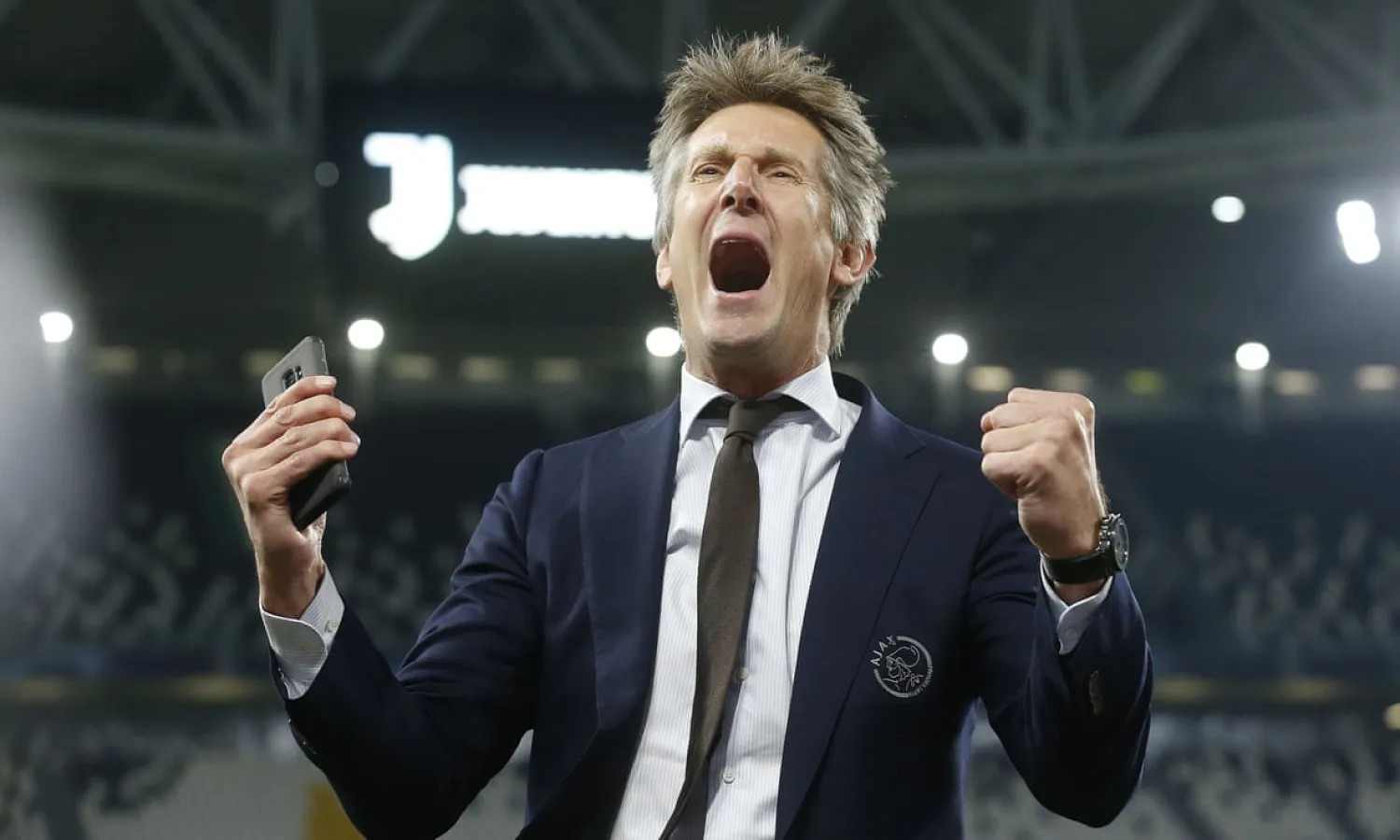

Edwin Van Der Sar: ‘We Reached a Level of Football Nobody Really Expected’

Edwin van der Sar celebrates after the win at Juventus that helped vindicate the approach he and Ajax have taken. Photograph: Hollandse Hoogte/Rex/Shutterstock
TT

Edwin Van Der Sar: ‘We Reached a Level of Football Nobody Really Expected’

Edwin van der Sar celebrates after the win at Juventus that helped vindicate the approach he and Ajax have taken. Photograph: Hollandse Hoogte/Rex/Shutterstock

Last season, as Ajax’s future balanced on a gossamer thread, the club’s hierarchy called in seven of their most talented youngsters for a special talk and presentation. Off the pace in the Eredivisie, without any European football to spice up the season, Edwin van der Sar and Marc Overmars, the CEO and director of football, hatched a plan to try to keep their finest prospects from seeking greener grass.

André Onana, Matthijs De Ligt, Donny van de Beek, Frenkie de Jong, Justin Kluivert, Kasper Dolberg and David Neres came to the meeting. They were shown a video, made just for them, where they were each compared to an iconic player from the club’s past who played in their position. The message was unequivocal. Van der Sar picks up the story. “We said: ‘If you want to be a legend of Ajax you need to win something big’. In my eyes it was really inspirational.”

With the exception of Kluivert, who perhaps had his own reasons for branching out to create his own path, everyone absorbed the message. “They had faith in the club,” he adds proudly. “We needed to talk to the younger players: ‘Wait for us. Believe in us. We are going to make sure there is a team that is going to challenge.’ It has worked miracles for us.” The defining moments in the life of a team tend to happen on the pitch but Ajax would not currently be in the Champions League semi-finals, having already swatted aside Real Madrid and Juventus in swashbuckling style, without this injection of inspiration off the pitch.

That ideal of forming a successful team round its youth is classically Ajax. Still, it feels extraordinary they have created a contemporary example of something generally far too idealistic in today’s globalized and lavishly funded game. It is not realistic forever but Van der Sar intends to sustain it for as long as possible. “Marc and myself have been players. We have flown the nest at a certain point to find another challenge and we know that is going to happen. That’s not a problem as long as they give two, three, four good years of service to the club, win the league, play amazing football. Then you can go. Also, for the young players from the academy to have a path to the first team we need to open up spaces. If you have no spaces then talent underneath is suffocated.”

That desire for a continuous production line, whether it is youngsters plucked from the Netherlands or further afield, remains paramount. Van der Sar reels through the notable graduates from each decade from the 1970s to today. It is a hell of a list. “Those are waves that happen at Ajax and now it is down to us to make sure we are more on the crest of the wave than the trough.”

Van der Sar is, by his own admission, quite a relaxed person so he has generally kept remarkably calm about the ride his club are on this season. He appreciates, though, that Ajax’s European revival has a global impact in reminding people that sporting values can outpunch big money. “If you have a love for sport, everybody knows the success of Madrid in the 60s, Ajax in the 70s, Bayern Munich and so on. In the last 20 years many things have changed in the world of football, mainly on the TV and commercial side. A lot of clubs have lost the perspective of what is a football club. For us at Ajax it is all about football. We have TV rights and a shirt sponsor but [in commercial terms] we are a country of eight or nine million so to compare to the top five leagues around us it is small change.”

Together with Overmars, the two veterans of the last Ajax team to conquer the Champions League in 1995 used lessons from their old squad to shape the team that this week continues its quest to reach this year’s final via a tie against Tottenham. A key to unlocking the current team came with the decision last summer to buy two older players to bring experience and guidance. Daley Blind and Dusan Tadic were both immediately influential. Van der Sar admits it was out of character but logical.

“Economic-wise it was not the best idea,” he says. “We were maybe a bit reluctant to put money into older players and we thought we could solve things with our academy. But going back to our experience, in ’95 we had a very young and talented team with Edgar Davids, Clarence Seedorf, Overmars, Frank and Ronald de Boer, Patrick Kluivert – but we also had Frank Rijkaard and Danny Blind. They had played in World Cups and won Champions Leagues. We reflected a bit on the old success from ’95. We wanted to combine the abundance of young talent with experience.”

Another vital move came when Van der Sar and Overmars had an important conversation with the coach, Erik ten Hag. Criticism was fierce in his early days at the club and he was instructed about playing with a style that reflects Ajax panache, cutting out the sideways passes to be adventurous and expressive. “That was a firm message he got from us,” Van der Sar says. Ajax have not looked back since. Crucially the feeling of being catapulted to a whole new level came at the Bernabéu. “We reached a level of football that nobody really expected from the outside world.”

Van der Sar’s new life began the year before he retired at the end of a glittering career when he took a phone call from Johan Cruyff. Not long afterwards Dennis Bergkamp called. They wanted to sound out a former Ajax man with unusual credentials – on top of his football experiences, with multiple trophies, spells abroad with Juventus and Manchester United, and 130 Oranje caps, he was already planning an MA in sports business.

“Johan Cruyff told me normally it’s a lawyer or businessman who knows about balance sheets who can become CEO. But, he said, you have come from the university of football, the university of life, what a player must learn: setbacks, success, pressure, winning finals, losing finals, making a mistake in the 89th minute, making a save in the 91st minute. I did a masters in sports management after I retired but it was still a leap of faith that I needed to take, that Ajax needed to take.” The old homegrown goalkeeper returned initially as a marketing director and in 2016 was promoted to the role of CEO.

Thinking ahead is essential but it would be mad not to relish what is happening in front of his eyes at the same time. “My idea is not to sell seven players from this team, to stay competitive and reach these levels again next season,” he says. “But this season is not finished yet. We still have an exciting month ahead with the possibility of three nice prizes.” Ambition, forged through that mix of history and future, is pumping again at Ajax.

(The Guardian)


Algeria’s Luca Zidane Doubt for World Cup After Jaw Fracture

Luca Zidane. (AFP)
Luca Zidane. (AFP)
TT

Algeria’s Luca Zidane Doubt for World Cup After Jaw Fracture

Luca Zidane. (AFP)
Luca Zidane. (AFP)

Algeria goalkeeper Luca Zidane is a doubt for the World Cup after suffering a jaw and chin fracture while playing for his club Granada in Spain's second tier.

The son of former France great Zinedine Zidane was taken off with a concussion after colliding with an opponent during his team's 4-2 home defeat by Almeria on Sunday.

The 27-year-old is expected to miss the rest of the season and could be out for even longer if he needs surgery.

"The player, in consultation with the club's medical staff, will decide in the coming hours on the course of treatment to be followed," said the club in a statement late Monday.

Luca Zidane is Algeria's first-choice goalkeeper and their back-up options Anthony Mandrea and Melvin Mastil are also currently out injured.

Algeria's World Cup campaign begins on June 16 against reigning champions Argentina.


A Bird Leaves Nothing Behind: The Lesson Behind Japan’s World Cup Stadium Cleanups

Japan supporters clean the stands at the end of the World Cup group E football match between Germany and Japan, at the Khalifa International Stadium in Doha, Qatar, Wednesday, Nov. 23, 2022. (AP)
TT

A Bird Leaves Nothing Behind: The Lesson Behind Japan’s World Cup Stadium Cleanups

Japan supporters clean the stands at the end of the World Cup group E football match between Germany and Japan, at the Khalifa International Stadium in Doha, Qatar, Wednesday, Nov. 23, 2022. (AP)

If there's one country guaranteed to clean up at the World Cup, it's Japan.

Literally.

Scenes of Japanese football fans sweeping stadiums and picking up trash after a match first drew public attention in France in 1998 — Japan's first appearance in the World Cup.

The tradition has continued every four years. It happened at the World Cup in Qatar in 2022, and it's certain to continue when Japan opens play in June with group games in Arlington, Texas, and Monterrey, Mexico.

The cleanup astonishes non-Japanese who might be accustomed to leaving stadiums and stepping over half-eaten food, shredded paper wrappers, and cups — empty or with liquid dribbling out.

At the World Cup in Russia in 2018, Japanese players famously cleaned the dressing room after a loss and left a thank-you note in Russian. In 2022, fans left thank-you notes on rubbish bags written in Arabic, English and Japanese.

Why do Japanese behave this way? It's not that complicated. Beginning in elementary school, students are socialized to behave this way — in the classroom, in the school yard or on a playing field.

“Japanese sports fans at world events who clean up the stadium are behaving much the same way they did when they learned how to enjoy sports as school boys and girls,” Koichi Nakano, who teaches politics and history at Sophia University, told The Associated Press.

There is a phrase in Japanese that explains it.

“Tatsu tori ato wo nigosazu.”

The literal translation is: “A bird leaves nothing behind.”

Rendered in English the message is: “Return it the way you found it.”

Many Japanese elementary schools don’t have janitors, so the clean-up work is left to students. Office workers often dedicate time to sprucing up their areas.

Also, there are relatively few trash containers in public spaces in Japan, so people take their waste home with them. This keeps the sidewalks cleaner, saves the cost of emptying trash cans, and keeps away vermin.

“The way most ordinary soccer fans experience soccer at school is no different from other sports, and the emphasis is not just on physical education but also on moral education as well,” Nakano added.

Collective vs. the individual

Raised in Germany, Barbara Holthus is the deputy director of the German Institute for Japanese Studies in Tokyo. A sociologist, she agrees it's prudent not to put Japanese on a pedestal. Japan, like any country, has its own challenges and shortcomings.

“An academically sound explanation is that people in Japan just happen to be socialized different,” she told The AP. “If you grew up with a certain way of how things are being done, you apply that to even cleaning up a stadium afterwards.”

At work here is also the Japanese concept of “meiwaku,” which implies not causing trouble or annoying others. From the Japanese point of view, leaving rubbish piled up in a stadium would be a bother to others.

Japan is a relatively crowded place, and greater Tokyo alone has about 35 million people, almost the population of the entire state of California. People need to get along.

“Japanese learn early on that you don't want to inconvenience other people,” Holthus said.

She said the focus is often on the collective, compared with the West where the emphasis is on the individual and individual rights.

“You don’t want to bother people. It goes to all areas of life in Japan,” Holthus added. “We are raised (in the West) that we don’t have to clean up after ourselves in public spaces because there is going to be some kind of public service doing that.”

And because Japanese people have received widespread praise for the clean-up, the behavior has been reinforced.

“Now that the media has latched onto the story and lavished praise on Japanese fans, they have made it a point of pride to display those values and norms,” Jeff Kingston, who teaches history at Temple University in Japan, wrote in an email.

A Japanese tradition

The clean-up tradition is not limited to football’s marquee tournament. The same thing happened last year at the Under-20 World Cup in Chile as Japanese fans cleaned up after a match. And even more recently last month at Wembley Stadium in London where Japan defeated England 1-0 in an international friendly.

“It’s one of our traditions,” said Toshi Yoshizawa, who was leading the cleanup in Chile. “We grew up with the teaching that we should leave a place cleaner than when we arrived.”

William Kelly, an emeritus professor of anthropology at Yale University and a specialist on Japan, said the tradition is linked to football more than other sports. He speculated it's tied to the establishment of Japan's professional football league more than 30 years ago.

“It (the J-League) was trying to distinguish itself from baseball by emphasizing teams’ community embeddedness and commitment,” Kelly wrote in an email. “Soccer fans felt, and feel, more a part of the club and its stadium.”


Riyadh to Host Joshua vs. Prenga Showdown in July

Boxing - Jake Paul v Anthony Joshua - Kaseya Center, Miami, Florida, US - December 19, 2025 Anthony Joshua after winning his fight against Jake Paul. (Reuters)
TT

Riyadh to Host Joshua vs. Prenga Showdown in July

Boxing - Jake Paul v Anthony Joshua - Kaseya Center, Miami, Florida, US - December 19, 2025 Anthony Joshua after winning his fight against Jake Paul. (Reuters)

Chairman of the Board of Directors of Saudi Arabia’s General Entertainment Authority Turki Alalshikh announced the return of British boxer Anthony Joshua to the ring in “The Comeback,” scheduled for July 25 in Riyadh.

The 36-year-old Joshua will fight Kristian Prenga, an Albanian with 20 victories and one loss.

Joshua’s last fight was a knockout victory over YouTuber Jake Paul on Dec. 19. Ten days later, he was injured in a car crash in Nigeria that killed two of his friends.

“It’s no secret I’ve taken some time to consolidate and rebuild to be ready for stepping back into the ring,” Joshua said in a Matchroom statement, “and today is the next step on that journey.”

In the statement, Joshua said the fight with Prenga is the first in a “multi-fight deal."

The event forms part of the Kingdom’s continued hosting of major international boxing matches, further cementing Riyadh’s status as a premier destination for global sports and entertainment.

The bout will be broadcast live worldwide on DAZN.
