

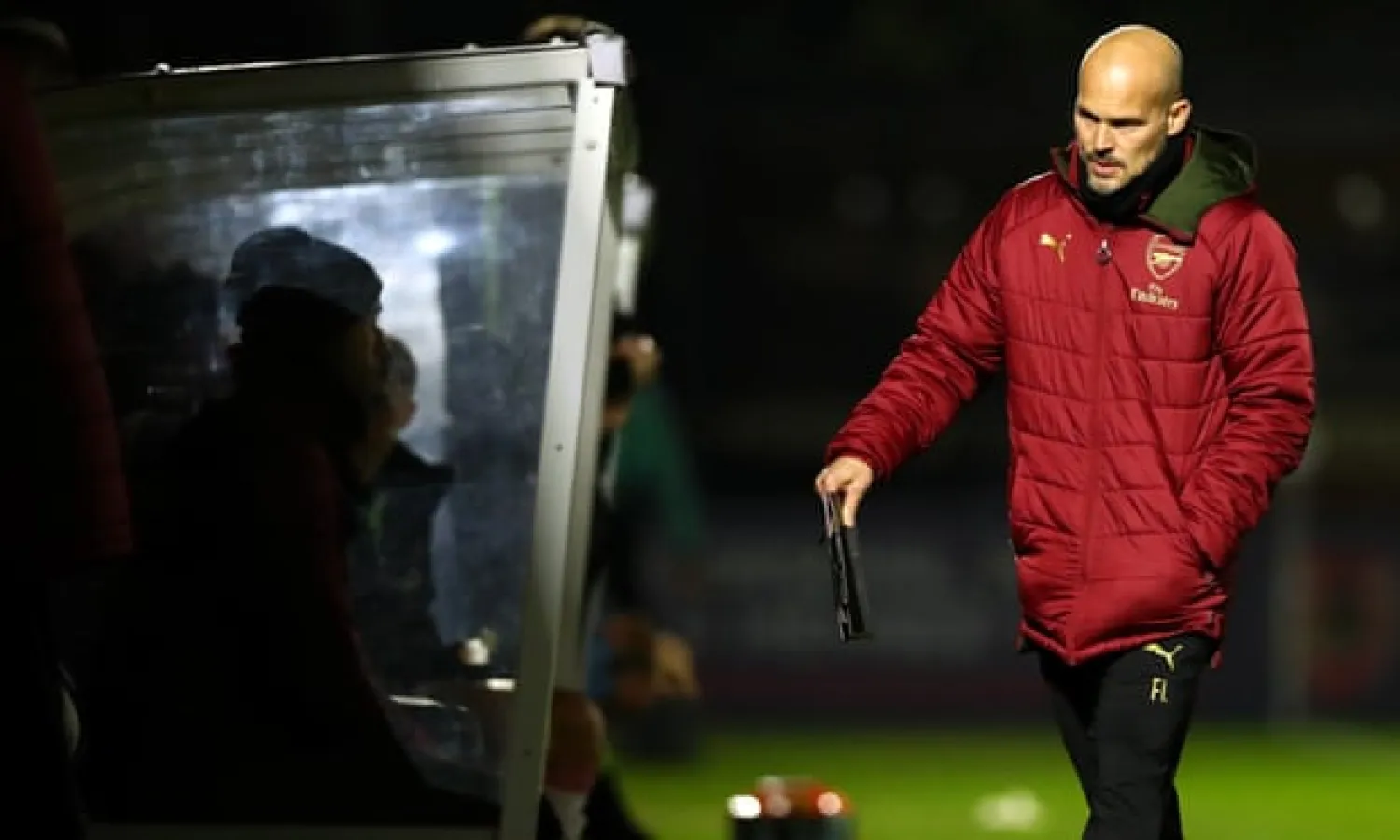

Freddie Ljungberg Steps up to Give Arsenal a Glimpse of the Future

 Freddie Ljungberg is bringing on the next generation of Arsenal players. Photograph: Naomi Baker/Getty Images
Freddie Ljungberg is bringing on the next generation of Arsenal players. Photograph: Naomi Baker/Getty Images
TT

Freddie Ljungberg Steps up to Give Arsenal a Glimpse of the Future

 Freddie Ljungberg is bringing on the next generation of Arsenal players. Photograph: Naomi Baker/Getty Images
Freddie Ljungberg is bringing on the next generation of Arsenal players. Photograph: Naomi Baker/Getty Images

There was something deeply symbolic about the moment an ineffective Mesut Özil was substituted for Joe Willock as Arsenal floundered in the Europa League final. With the club’s most lavishly paid, highest-status player hooked for a teenager who had played 64 minutes of Premier League football, it was natural for most of the impact to swirl around the falling star. But back at Arsenal a lot of behind-the-scenes attention revolved around the youngsters and their potential to sparkle more. Dynamics at Arsenal need to shift and this substitution brought a lot into focus.

Willock had an excellent season for Arsenal’s Under-23s and made inroads at the fringes of the senior squad. Granted game time in the Europa League, FA Cup and Carabao Cup he demonstrated his knack for arriving in the box from midfield to finish with aplomb. He struck six goals from six appearances in cup games for the first team.

So, what do Arsenal do with a 19-year-old like Joe Willock? It is part of a broader question that is very pertinent at the club. The transfer budget is mediocre. Wages are a problem. The club feel they have a particularly strong group of young players knocking on the door. But the Premier League has been a notoriously difficult nut to crack for the 18-to-21 age group in recent years and the Jadon Sancho principle is a dazzling example of how an increasing number of prodigies in the English system are encouraged to develop outside of these shores. In England, conventional wisdom dictates it is not practical to throw a bunch of young players in at the deep end.

Arsenal have come up with a strategy to try to tackle the need for progress in this age group. The “transition team” was launched this summer, with Freddie Ljungberg central to it. The Swede’s strides on the youth coaching circuit at Arsenal are highly regarded. He has spent time with most of the age groups at Hale End because they are so impressed to see how he fares and what impression he makes, and his promotion to the first-team staff after an exciting year with the Under-23s is a move to create a link between youth and senior squads. “The transition from Under-23 to first team is massive,” says the director of football, Raúl Sanllehí. “It’s a pretty specifically English issue as we don’t have B teams playing at a high level which our European competitors have. So we need to make careful choices around who stays with the Under-23s, who trains [and plays] with the first team and who goes on loan. The transition team will be responsible for managing development plans for each and every player to best optimise their potential.”

Ljungberg is acutely aware there is a cluster of talent from the academy that needs testing out, needs chances. Arsenal want to avoid players disappearing into the black hole of the 18- to 21-year-old football drift. The strategy began taking shape last season when the attackers Reiss Nelson and Emile Smith Rowe had loan spells in Germany. The next steps for them, for the defender Krystian Bielik, who did well at Charlton, and for the crop who had tasters at Arsenal last season such as Willock and Bukayo Saka and a few more besides are the focus of Ljungberg and his transition team.

It is a fascinating move for Ljungberg, who has effectively swapped jobs with Steve Bould. The fascinating part concerns the amount of responsibility Ljungberg will get as part of Unai Emery’s first-team staff. His coaching personality emphasises that he is hands-on, opinionated and won’t settle for being marginalised or cone man duties. Interestingly, given his role, although player development matters, he is deep down a results-driven kind of a guy.

The Ajax example is an enticing one to follow given how the Dutch team fired football’s imagination in the Champions League last season. It is worth remembering, though, that Ajax have blended a brilliant group of youngsters with experience – that blend has to be right to have a chance of success in a sport as ruthless and competitive as high-end football.

There is a bigger picture here that also relates to Ajax. The involvement of former players in senior positions, to keep pressing club values and spirit, has been so effective. Giving Ljungberg more rope, keeping Bould’s association intact, having Robert Pires around especially helping to take drills with players on the way back from injury, and with Edu expected to return as technical director imminently, Arsenal are trying to revive some passion for the cause. Perhaps there could be more to come on that front.

“Promoting young players from within has always been a key part of Arsenal and what we represent,” Sanllehí says. “We want to continue that tradition for a number of reasons but you could boil it down to two main ones. Firstly, these players grow up with the club and we think having players with this natural bond around what it means to play for Arsenal is good in the dressing room and for the connection with our fans.

“Secondly, despite the huge investment we make into our academy, with rapid inflation in transfer fees it is financially efficient. It’s not about cutting costs or being ‘cheap’, it just means we can then focus funds to make the biggest impact, to get better players when we need to go to the external market.”

It does feel like a good time for Arsenal to re-engage in Project Youth as the vibrations around the club feel stifled by a culture of high-earning players who can’t be counted on to deliver. Still, there are bound to be bumps and bruises along the way. Given the current standards set by Manchester City and Liverpool, and taking in the ambition of the clubs just behind Arsenal in the Premier League as shown in particular by Wolves and Leicester, it is asking a lot for young players to step up, cope and express themselves.

Ljungberg might remember being a 21-year-old with a punk haircut thrown into an Arsenal debut against Manchester United. One goal and one booking later he made his mark. Opportunities are there to be seized.

The Guardian Sport


Arbeloa Vows to ‘Fight for Everything’ as Real Madrid Manager

 Real Madrid new coach Alvaro Arbeloa attends a press conference at the club's Valdebebas training ground in Madrid, Tuesday, Jan. 13, 2026. (AP)
Real Madrid new coach Alvaro Arbeloa attends a press conference at the club's Valdebebas training ground in Madrid, Tuesday, Jan. 13, 2026. (AP)
TT

Arbeloa Vows to ‘Fight for Everything’ as Real Madrid Manager

 Real Madrid new coach Alvaro Arbeloa attends a press conference at the club's Valdebebas training ground in Madrid, Tuesday, Jan. 13, 2026. (AP)
Real Madrid new coach Alvaro Arbeloa attends a press conference at the club's Valdebebas training ground in Madrid, Tuesday, Jan. 13, 2026. (AP)

Real Madrid's new manager Alvaro Arbeloa pledged to fight for everything as he stepped into the role vacated by Xabi Alonso and said he would stay in post as long as he was needed.

Real announced Alonso had left the club by mutual agreement on Monday, following a poor run of form and reports of unrest with some of his senior players.

The 42-year-old Arbeloa stepped up in his place from reserve ‌team Real Madrid ‌Castilla and inherits a side ‌trailing ⁠Barcelona by ‌four points in LaLiga and reeling from a 3-2 defeat in Sunday's Spanish Super Cup final.

"Of course, I am aware of the responsibility and the task ahead of me, and I am very excited," Arbeloa told a press conference on Tuesday. "I've found a group of ⁠players who are really eager... They share my enthusiasm to fight ‌for everything and to win."

Arbeloa, ‍who has been part ‍of Real Madrid's coaching structure since 2020, faces ‍a swift baptism of fire with only one training session before Wednesday's Copa del Rey round of 16 clash against second-division Albacete.

The former right back, who played 238 matches for Real from 2009 to 2016 and won eight trophies, including two Champions League titles, ⁠was relaxed about how long he would serve as coach.

"I've been in this house for 20 years, and I'll stay as long as they want me to," he said.

Arbeloa's immediate goal is to bridge the gap with Barcelona in LaLiga while ensuring progress in the Champions League and Copa del Rey.

"The important thing is that the players are happy, enjoy themselves on the pitch, and honor the badge. Wearing this ‌badge is the best thing that can happen to you in life," he added.


Roma Takes the Dakar Lead in Saudi Arabia as Ford Goes One-Two

 Ford Racing's Spanish driver Nani Roma and Spanish co-pilot Alex Haro compete in Stage 8 of the 48th edition of the Dakar Rally 2026, in Saudi Arabia on January 12, 2026. (AFP)
Ford Racing's Spanish driver Nani Roma and Spanish co-pilot Alex Haro compete in Stage 8 of the 48th edition of the Dakar Rally 2026, in Saudi Arabia on January 12, 2026. (AFP)
TT

Roma Takes the Dakar Lead in Saudi Arabia as Ford Goes One-Two

 Ford Racing's Spanish driver Nani Roma and Spanish co-pilot Alex Haro compete in Stage 8 of the 48th edition of the Dakar Rally 2026, in Saudi Arabia on January 12, 2026. (AFP)
Ford Racing's Spanish driver Nani Roma and Spanish co-pilot Alex Haro compete in Stage 8 of the 48th edition of the Dakar Rally 2026, in Saudi Arabia on January 12, 2026. (AFP)

Spaniard Nani Roma led compatriot Carlos Sainz in a Ford one-two at the top of the Dakar Rally car standings on Tuesday after a tough ninth stage in the Saudi Arabian desert for some frontrunners.

Dacia's previous leader and five times winner Nasser Al-Attiyah slipped to third but still only one minute 10 seconds behind Roma, with Toyota's South African Henk Lategan fourth - and with a further five minutes to make up.

"I had three punctures today, but I think everyone had problems," said Roma, who last led the Dakar 12 years ago when he won. "We are positive to be here."

Sainz said it had been hard to find the way at one point, with the cars taking ‌a different route ‌to the bikes and no longer having tracks ‌to ⁠follow.

Lategan described it ‌as a "little bit of a disaster of a day" after getting lost, suffering a puncture, broken windscreen and loss of power steering.

"I was driving with no power steering, extremely difficult in these cars because the wheels are so big so you have to have massive power to even turn the wheels," he said.

"And then we had some more punctures, got lost and we hit that bush in Seb (Loeb)'s dust ⁠that broke the windscreen. So we had to stop and kick the windscreen out because I couldn't ‌see from inside the car, put some goggles ‍on and carry on going."

The 410km ‍stage from Wadi Ad Dawasir to the overnight bivouac, first half of a ‍marathon stage, was won by 21-year-old Polish non-factory Toyota driver Eryk Goczal.

He finished seven minutes ahead of his uncle Michal, also with the Energylandia team, while father Marek was in 31st position.

Australian Toby Price, a double Dakar winner on motorcycles, was third on the stage for Toyota.

Sainz, 63, was handed a one minute 10 second penalty for speeding and finished the stage seventh but ahead ⁠of most of his rivals, including Roma in eighth.

The four times Dakar winner is now 57 seconds behind Roma, who also won on a motorcycle in 2004.

Sweden's Mattias Ekstrom, who had been second overall for Ford, lost a lot of time with a navigation error and dropped to fifth and 11 minutes and 19 seconds off the pace. Dacia's nine times world rally champion Loeb was sixth.

Spaniard Tosha Schareina won the stage in the motorcycle category for Honda, with KTM's Argentine rider Luciano Benavides losing the way and his overall lead to Australia's defending champion Daniel Sanders.

Sanders, also on a KTM, led Honda's American Ricky Brabec by six minutes ‌and 24 seconds.

The race, which ends on Saturday on the Red Sea coast, is the first round of the World Rally-Raid Championship (W2RC) season.


Sinner Seeks Australian Open ‘Three-Peat’ to Maintain Melbourne Supremacy

13 January 2026, Australia, Melbourne: Italian tennis player Jannik Sinner in action during a practice session ahead of the Australian Open tennis tournament at Melbourne Park. (dpa)
TT

Sinner Seeks Australian Open ‘Three-Peat’ to Maintain Melbourne Supremacy

13 January 2026, Australia, Melbourne: Italian tennis player Jannik Sinner in action during a practice session ahead of the Australian Open tennis tournament at Melbourne Park. (dpa)

Jannik Sinner returns to the Australian Open targeting a third straight title as the Italian seeks to impose a level of supremacy reminiscent of Novak Djokovic's stranglehold on the year's ​opening Grand Slam.

The 24-year-old will arrive at Melbourne Park under vastly different circumstances from 12 months ago when his successful title defense was partly overshadowed by a doping controversy which saw him serve a three-month ban.

With that storm firmly behind him, Sinner steps onto the blue courts unencumbered and with his focus sharpened after an outstanding 2025 in which he was only seriously challenged by world number ‌one Carlos ‌Alcaraz.

"I feel to be a better player ‌than ⁠last ​year," Sinner ‌said after beating Alcaraz to win the season-ending ATP Finals with his 58th match victory of a curtailed campaign.

"Honestly, amazing season. Many, many wins, and not many losses. All the losses I had, I tried to see the positive things and tried to evolve as a player.

"I felt like this happened in a very good way."

Sinner now sets his sights ⁠on a third straight Melbourne crown - a feat last achieved in the men's game during ‌the second of Djokovic's "three-peats" from 2019 to ‍2021 - and few would bet ‍against him pushing his overall major tally to five.

That pursuit continues ‍to be built on a game as relentless as it is precise, a metronomic rhythm from the baseline powered by near-robotic consistency and heavy groundstrokes that grind opponents into submission.

Although anchored in consistency and control, Sinner has worked ​to add a dash of magic - the kind of spontaneity best embodied by Alcaraz - and his pursuit will add intrigue ⁠to a rivalry that has become the defining duel of men's tennis.

"It's evolved in a positive way, especially the serving," Sinner said at the ATP Finals of his game.

"From the back of the court, it's a bit more unpredictable. I still have margins where I can play better at times.

"It's also difficult because you have to give a lot of credit to your opponent. Carlos is an incredible player. You have to push yourself over the limits."

The "Sincaraz" rivalry has already lit up most of the biggest tennis tournaments but Melbourne remains the missing piece, ‌and all signs point to that changing this year with the Australian Open set for a blockbuster title showdown.
