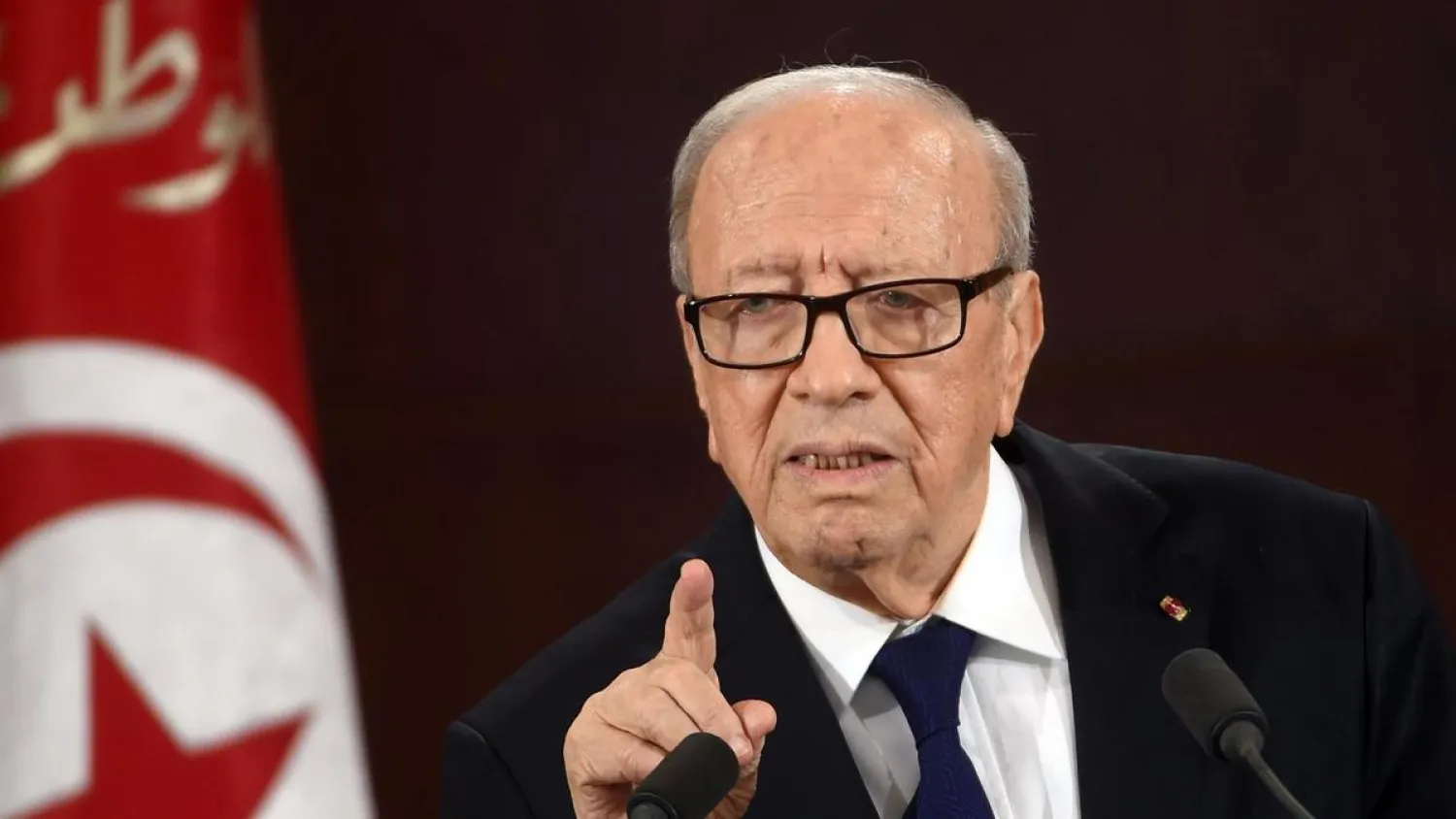
No Power Vacuum in Tunisia after President’s Health Crisis

Tunisian President Beji Caid Essebsi. (AFP)
TT

No Power Vacuum in Tunisia after President’s Health Crisis

Tunisian President Beji Caid Essebsi. (AFP)

Tunisian authorities said Friday that President Beji Caid Essebsi's condition was improving and insisted there was no power vacuum in the North African country, shaken by the 92-year-old leader's hospitalization and twin suicide attacks.

Essebsi was taken to hospital for a "serious illness" on Thursday, the same day that bombings claimed by the ISIS group killed a police officer in Tunis and wounded several other people.

"We have a president. There is no constitutional vacancy," one of Essebsi's key advisors, Noureddine Ben Ticha, told the Express FM radio station, according to AFP.

Presidential spokeswoman Saida Garrach said that Essebsi's "state of health is improving".

The president had met with the defense minister early on Friday morning and should leave hospital "soon", she told state radio, without giving further details.

On Thursday several media outlets had reported Essebsi's death after the presidency announced that one of the world's oldest heads of state -- behind only Britain's 93-year-old Queen Elizabeth II -- was taken to hospital.

But those claims were denied by the authorities.

Key adviser Firas Guefrech said the president was in a "critical" but "stable" condition, while the leader's son Hafedh Caid Essebsi said his father's condition was starting to improve.

Prime Minister Youssef Chahed visited the ailing leader and said he was receiving "the necessary care", warning people not to spread "false and confusing information".

The elderly head of state was hospitalized last week as well, for what the presidency described as non-serious treatment.

Essebsi has been a prominent figure in Tunisia since the overthrow of Zine El-Abidine Ben Ali in 2011.

Essebsi led the immediate transition as prime minister in 2011. He was elected president three years later. Essebsi had also been a senior figure before 2011, having served as foreign minister under state founder Habib Bourguiba and parliamentary speaker under Ben Ali.

In June, he said he would not run for a second term in elections this year, despite his party calling for him to stand. The party has not identified another candidate yet.

Parliamentary elections are expected to be held on October 6 with a presidential vote following on November 17.


Lebanon to Decide on Plan to Control Arms North of Litani Next Week, Minister Says

FILE PHOTO: Lebanese army members stand on a military vehicle during a Lebanese army media tour, to review the army's operations in the southern Litani sector, in Alma Al-Shaab, near the border with Israel, southern Lebanon, November 28, 2025. REUTERS/Aziz Taher/File Photo
TT

Lebanon to Decide on Plan to Control Arms North of Litani Next Week, Minister Says

FILE PHOTO: Lebanese army members stand on a military vehicle during a Lebanese army media tour, to review the army's operations in the southern Litani sector, in Alma Al-Shaab, near the border with Israel, southern Lebanon, November 28, 2025. REUTERS/Aziz Taher/File Photo

Lebanon’s ‌government will decide next week how to move to the second phase of a plan to extend its authority and place all arms under state control in areas north of the Litani River, its information minister said on Wednesday.

The decision will be based on a presentation by the army outlining its needs and capabilities, the minister, Paul Morcos, told reporters during a visit to Kuwait, where he was attending an ‌Arab meeting.

The ‌Lebanese army said in January that ‌it ⁠had taken operational control ⁠in the area between the Litani River and the border with Israel. The cabinet asked the army to brief it in early February on how to pursue disarmament in other parts of the country, Reuters reported.

"We have completed the first phase, south of the ⁠Litani River. Next week the government will ‌take a decision regarding the ‌second phase considering what the army commander sets out ‌in terms of needs and capabilities, so that ‌we can decide accordingly, based on that explanation," Morcos said.

Lebanon has been seeking to place all arms under state control, in line with a November 2024 US-brokered ceasefire that ended ‌a war between Israel and the Iran-backed Hezbollah group.

Morcos ruled out ⁠the ⁠possibility of any confrontation between the Lebanese army and Hezbollah, saying the objective was "to extend state authority and achieve stability, and insofar as these goals can be achieved together, we will proceed".

Israel has carried out regular strikes in Lebanon since the end of the war with Hezbollah, killing around 400 people since the ceasefire, according to a toll from Lebanese security sources.

Israel has accused Hezbollah of seeking to rearm in violation of the ceasefire agreement with Lebanon. Hezbollah says it has respected the ceasefire in southern Lebanon.


Israel Has Joined Trump's 'Board of Peace,' Netanyahu Says

Israeli Prime Minister Benjamin Netanyahu during a joint press conference with US President Donald Trump in the State Dining Room at the White House on September 29, 2025 (Reuters)
TT

Israel Has Joined Trump's 'Board of Peace,' Netanyahu Says

Israeli Prime Minister Benjamin Netanyahu during a joint press conference with US President Donald Trump in the State Dining Room at the White House on September 29, 2025 (Reuters)

Israel has joined US President Donald Trump's "Board of Peace" initiative, Prime Minister Benjamin Netanyahu said on Wednesday during his visit to Washington where he met Trump and Secretary of State Marco Rubio.

Visuals released earlier on Wednesday after the Netanyahu-Rubio meeting showed them holding a document with Netanyahu's signature on Israel joining the board. Netanyahu said on X he "signed Israel's accession ‌as a member ‌of the "Board of Peace.

He later discussed Iran with ‌Trump.

A ⁠UN Security Council ⁠resolution, adopted in mid-November, authorized the board and countries working with it to establish an international stabilization force in Gaza, where a fragile ceasefire began in October under a Trump plan on which Israel and Palestinian militant group Hamas signed off.

Under Trump's Gaza plan, the board was meant to supervise Gaza's temporary governance. Trump thereafter said the board, with him as chair, ⁠would be expanded to tackle global conflicts.

The board ‌will hold its first meeting on ‌February 19 in Washington to discuss Gaza's reconstruction.

Many rights experts say that Trump ‌overseeing a board to supervise a foreign territory's affairs resembled a ‌colonial structure. Israel's presence on the board is expected to bring further criticism as the board does not include a Palestinian.

Countries have reacted cautiously to Trump's invitation to join the board launched in late January. Many experts are concerned the board ‌could undermine the United Nations.

While some of Washington's Middle Eastern allies have joined, many of its traditional ⁠Western allies have ⁠stayed away.

The ceasefire in Gaza has been repeatedly violated, with at least 580 Palestinians and four Israeli soldiers reported killed since it began in October, according to Palestinian and Israeli tallies, respectively.

The next phase of Trump's Gaza plan calls for resolving complex issues like Hamas' disarmament, which the group has long rejected, further Israeli withdrawal from Gaza and the deployment of an international peacekeeping force.

Israel's assault on Gaza has killed over 72,000, according to Gaza's health ministry, caused a hunger crisis and internally displaced Gaza's entire population.

Multiple rights experts, scholars and a UN inquiry say it amounts to genocide. Israel calls its actions self-defense after Hamas-led militants killed 1,200 people and took over 250 hostages in a late 2023 attack.


Gaza Factions Tighten Security with Safe Movement, Tracking Collaborators

Palestinian boys walk near a landfill, in Gaza City, February 11, 2026. REUTERS/Dawoud Abu Alkas
TT

Gaza Factions Tighten Security with Safe Movement, Tracking Collaborators

Palestinian boys walk near a landfill, in Gaza City, February 11, 2026. REUTERS/Dawoud Abu Alkas

Palestinian armed factions in Gaza have gone on heightened alert as Israel presses ahead with targeted killings of field commanders and prominent operatives from Hamas and Islamic Jihad, field sources told Asharq Al-Awsat, saying tightened security measures have thwarted several planned assassinations in recent weeks.

The sources said security measures had foiled a series of assassination attempts planned by the Israeli army in recent days and weeks.

The Israeli military has frequently cited security incidents against its forces as justification for carrying out a string of strikes inside the enclave after a ceasefire took effect. Israeli violations have killed more than 500 Palestinians in Gaza since the agreement to halt the war was announced.

Field sources also told Asharq Al-Awsat that after the killing of prominent leaders and activists, strict instructions were issued by senior commanders of the armed wings to field operatives to adopt measures similar to those in place during the two-year war.

One source said the directives included “secure movement” from one place to another, meaning movement without carrying mobile phones or other technological devices to avoid detection by Israel's artificial intelligence. He added that members had been advised to remain concealed in specific locations for extended periods, without moving, even for days or weeks.

Failed targeting operations

Another source familiar with internal communications within an armed faction in Gaza said that “thanks to the new precautions in recent days and weeks, new assassination operations have failed.”

He cited instances of Israeli strikes on targets such as tents and other sites that did not host any of the wanted individuals or others, on several occasions.

“The Israeli forces bombed two targets hours after the Rafah incident that took place last Monday, one on the same evening and the other on Tuesday afternoon, indicating an inability to identify new targets as had happened previously,” the source said.

The factional source concluded that “the number of casualties has become much lower during the current round of escalation compared with previous violations.”

Israeli airstrikes on Monday and Tuesday killed prominent field activists in the Izz al-Din al-Qassam Brigades and the Al-Quds Brigades in two assassination operations.

The first targeted three activists in the Beit Hanoun Battalion of the Izz al-Din al-Qassam Brigades, who had overseen a series of operations, including the sniper killing of several soldiers, resulting in the deaths of seven, according to an Israeli military statement during battles in the town.

They were also said to have participated in the Oct. 7, 2023, attack. A commander of the elite unit of the Al-Quds Brigades in central Gaza was also killed.

Night checkpoints to track collaborators

Asked whether other measures had been adopted to secure their members, another field source said some steps included deploying checkpoints by security forces affiliated with the Hamas-run government, as well as field operatives from the Izz al-Din al-Qassam Brigades and the Al-Quds Brigades, particularly at night, across all areas of Gaza.

The source said the night checkpoints had reduced the movement of collaborators with Israel, as well as individuals working with armed gangs that provide intelligence on the whereabouts of certain activists after tracking and monitoring them, which he said had again weakened Israeli intelligence.

“There is other discreet activity during daylight hours carried out by the factions to pursue any suspicious movements and monitor individuals suspected of cooperating with Israeli intelligence,” the source added.

He said several suspects had been detained and interrogated, and information had been extracted about personalities being tracked. The data was then passed on to the intended targets so they could change their locations, move to safe places, and abandon the technological devices they had been using.

These security measures coincided with an announcement by the “Al-Hares” platform, affiliated with the security apparatus of armed factions in Gaza, calling on residents to “assist security in strengthening the internal front by reporting any suspicious activity or movement in their vicinity.”

It added that “any unusual behavior, attempts to gather information, or movements suspected of links to collaborator gangs constitute a key element in thwarting hostile plans and supporting the resilience of our internal front.”