


Maradona Film Reminds That Untamables Were Not Always Untouchable

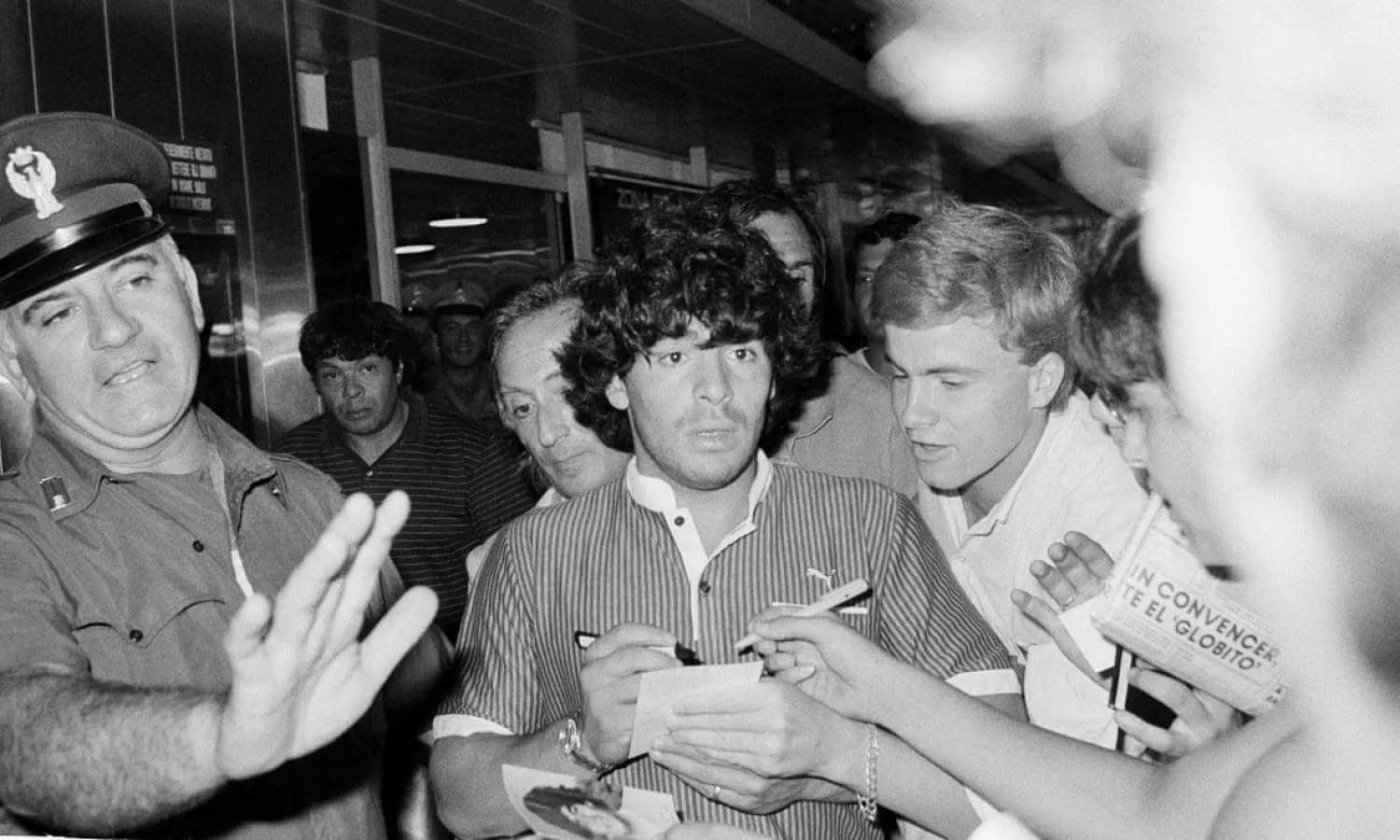
Diego Maradona thronged by fans after landing at Rome airport in July 1984, the month he signed for Napoli. Photograph: Bruno Mosconi/AP
TT

Maradona Film Reminds That Untamables Were Not Always Untouchable

Diego Maradona thronged by fans after landing at Rome airport in July 1984, the month he signed for Napoli. Photograph: Bruno Mosconi/AP

When I sat down in a cinema to watch Emir Kusturica’s documentary about Diego Maradona a decade or so ago, I still thought of myself as a Pelé man. The Brazilian was the footballer who had dominated my adolescence, which is usually the time of life at which we acquire the heroes to whom we remain in thrall. Kusturica’s film made me reconsider that loyalty. He made me think that those who believed Maradona was the greatest footballer of all time might have a point.

It was a mad film about a mad life, starting with a quote from Jorge Luis Borges and finishing with a song from Manu Chao. There was a lot of weird stuff in between. But the Serbian director also included enough football to persuade me that Maradona bent matches to his will in the way no one had done before, and that if we were trying to decide on the very greatest, a stupid but fun thing to do, then this might be the truest measure.

Asif Kapadia’s new film about Maradona, which opened last week, makes me think again. The director of documentaries about Ayrton Senna and Amy Winehouse chooses to concentrate on a particular period of the player’s career, his years with Napoli, which included the 1986 World Cup in which he led Argentina to victory. The before and the after – from the childhood in a Buenos Aires slum and the ill‑fated arrival in Europe with Barcelona to the bitter defeat against West Germany at San Siro in 1990 and the pathos of his late middle age – are also included. But what happened to him from 1984 to 1991, between the ages of 23 and 30, is the only real focus, and Kapadia makes it seem brutally short.

As an admirer of the director’s immersive approach to documentary-making, I found it a little overcooked. A film that begins with a lunatic car journey through the streets of Naples seldom takes its foot off the throttle. You could argue that Maradona’s life was like that, but it wouldn’t be entirely true. Nor was the football he played a constant barrage of thud and crunch, as Kapadia and his sound-effects team make it seem. There was poetry as well as percussion in there, although the director is right to link the two goals against England in the Azteca to the appalling smash to Maradona’s face delivered by Terry Fenwick – did he really play for England, or was it just a bad dream? – earlier in the match.

Kusturica found some poetry when he led the footballer out of a people-carrier and confronted him with Manu Chao leaning against a storefront, strumming a guitar and singing a song about his life: “If I were Maradona, I would live like him …” Maradona’s eyes are hidden, but you can sense the play of emotions behind his wraparound shades as he listens to Chao sing about a life of “a thousand rockets, a thousand friends”.

That life is Kapadia’s subject, and what he captures quite brilliantly is the unsustainable pressure exerted by the sort of adulation Maradona encountered in Naples, an endless physical assault by people wanting to touch him, to be in a photograph with him, to take away a piece of him. Those people crowd the frames of the film, eroding his soul almost as effectively as the Camorra bosses who spotted his weaknesses.

His swift and premature downfall has never held back those to whom he ranks highest in a list including not just Pelé but Ferenc Puskás, Alfredo di Stéfano, Franz Beckenbauer, George Best, Johan Cruyff, Lionel Messi, and Cristiano Ronaldo. Each has, or had, his own special story. Puskás crossed the iron curtain at the height of the cold war. Di Stéfano represented a certain regal presence. Pelé expressed the triumph of individual invention. Beckenbauer showed us how a defender could construct the play of the entire team. Best – the closest in several ways to Maradona – was untameable. Cruyff saw the whole thing, and knew how to reshape it.

And now we have the two stars whose decade‑long duel has offered such a study in contrast: Messi expressing his virtuosity with a unique air of humility, taking a goal of breathtaking execution with the air of a servant swigging a glass of vintage champagne, Ronaldo deploying his ego as an extra piece of technical equipment, forcing opponents to shrivel in the heat of his personal spotlight. For me, now, it is Ronaldo, inventing new ways of striking the ball while triumphing in England, Spain, and Italy and with his national team, who stands supreme. And you don’t have to like him to acknowledge that.

Ronaldo, Messi, and others of their generation know all about what happened to Maradona, how fame devoured him. His example, burnt into every frame of Kapadia’s film, is the reason they are now such remote figures. No footballer earning upwards of a quarter of a million pounds a week is short of instruction on how to build the walls, physical and psychological, with which to protect themselves against their worshippers.

A few hours after seeing the new film, I read an interview in these pages in which Phil Foden, a 19‑year‑old Manchester City and England star in the making, talked about his first experience of celebrity. “People are always watching you,” he said. “It’s what happens. I was walking down the road after one of my first games and people were asking for a picture. From that moment I knew it was going to be hard.” Already he probably understands the meaning of Maradona’s most poignant words in Kapadia’s film: “When you’re on the pitch, life goes away. Everything goes away.”

(The Guardian)


ATP to Introduce New Heat Policy from 2026 Season 

Novak Djokovic of Serbia cools himself with water during the men's singles semifinal match with Valentin Vacherot of Monaco, at the Shanghai Masters tennis tournament at Qizhong Forest Sports City Tennis Center, in Shanghai, China, Saturday, Oct. 11, 2025. (AP)
TT

ATP to Introduce New Heat Policy from 2026 Season 

Novak Djokovic of Serbia cools himself with water during the men's singles semifinal match with Valentin Vacherot of Monaco, at the Shanghai Masters tennis tournament at Qizhong Forest Sports City Tennis Center, in Shanghai, China, Saturday, Oct. 11, 2025. (AP)

The ATP Tour said it will introduce a new heat policy that will come into effect from 2026 after a string of retirements due to soaring temperatures and punishing humidity at the Shanghai Masters earlier this season.

The governing body of men's tennis said the rule, based on the internationally recognized Wet Bulb Globe Temperature (WBGT) index used to measure human heat stress in direct sunlight, had "clear thresholds" for cooling measures and suspension of play.

"The new heat rule provides a structured, medically supported approach to managing extreme heat, with the objective of safeguarding player health," the ATP said on Monday.

It added the rule would also improve conditions for fans, officials, ball persons and tournament staff.

If the WBGT reaches 30.1 C (86.18 F) or higher in the first two sets of a best-of-three-set singles match, a 10-minute cooling break after the second set can be requested by either player and will apply to both competitors.

During breaks, players can hydrate, change clothing, shower and receive coaching under the supervision of ATP medical staff, the governing body added. Play will be suspended when the WBGT goes past 32.2 C.

World number two Jannik Sinner's Shanghai title defense ended in agony in October when the Italian struggled to walk due to cramp in his right thigh before he retired in the deciding set of his third-round clash with Tallon Griekspoor.

At the same event, Novak Djokovic vomited during his encounter with Yannick Hanfmann while Holger Rune was heard asking an official during a medical timeout in his meeting with Ugo Humbert if players had to "die on court" amid the heat and humidity.

The need for a formal ATP heat rule had sprung up in August in Cincinnati when Arthur Rinderknech collapsed on court during a match in sweltering conditions, before handing Felix Auger-Aliassime the victory.

Previously, ATP regulations stated that decisions on the suspension of play due to adverse weather conditions - including extreme heat - lie with an onsite ATP supervisor who coordinates with medical teams at the venue as well as local authorities.

The new rule aligns the ATP with the WTA. The four Grand Slams have also formally implemented the rules that allow for extended breaks and match suspensions.

Several professional sports including football, Formula One and cycling have formal policies to deal with extreme weather.


Rodrygo Scrapes Real Madrid Win at Alaves

Real Madrid's Brazilian forward Rodrygo secured the visitors a much-needed victory at Alaves. ANDER GILLENEA / AFP
TT

Rodrygo Scrapes Real Madrid Win at Alaves

Real Madrid's Brazilian forward Rodrygo secured the visitors a much-needed victory at Alaves. ANDER GILLENEA / AFP

Kylian Mbappe and Rodrygo Goes's goals earned Real Madrid a tense 2-1 win at Alaves in La Liga on Sunday to potentially keep coach Xabi Alonso in his job.

Second-placed Madrid trimmed league leaders Barcelona's advantage back to four points and recorded only their third victory in the last nine games across all competitions.

After a home defeat by Manchester City in the Champions League on Wednesday, Spanish media reported that anything but a victory would cost Alonso his position, AFP said.

After Mbappe's superb opener, Carlos Vicente pulled Alaves level in the second half, but Rodrygo secured the visitors a much-needed victory at Mendizorroza stadium.

"It was a hard-fought game, we competed well, got in front and then lost a bit of control," Alonso told reporters.

"Alaves play with a lot of intensity, it's hard to dominate throughout. We came here to win and we got the three points."

The coach said, as he did after the City game, that he has the support of his squad.

"We're all together in this. One game isn't enough to change the dynamic," he said.

"Now before the winter break we have a cup game on Wednesday, and a game at home (in La Liga to come)."

Alonso was able to bring his key player, Mbappe, back into the side after he could only watch the defeat by City from the bench because of a painful knee.

The coach also handed a debut to Victor Valdepenas at left-back, with both Alvaro Carreras and Fran Garcia suspended, and Ferland Mendy one of several players out injured.

Mbappe appeared to be feeling his knee and also hobbling in the first few minutes but, despite that, was the game's most influential player.

The forward had a shot deflected wide and then fired narrowly over as Alaves sat deep and tried to keep the 15-time European champions at bay.

By the time Mbappe opened the scoring in the 25th minute, his discomfort seemed to have cleared up.

Released by Jude Bellingham, Mbappe drove towards goal at full tilt and whipped a shot into the top right corner for his 17th league goal of the campaign.

England international Bellingham then blasted home from close range but his strike was ruled out for handball.

Needing to fight back, Alaves moved on to the front foot and took control of the game before the break, almost pulling level.

Madrid goalkeeper Thibaut Courtois made a fine save with his head, even if he knew little about it, to deny Pablo Ibanez from close range.

Tight battle

Los Blancos were dangerous again soon after the interval, with Alaves goalkeeper Antonio Sivera saving well from Mbappe and then Vinicius Junior.

Real came to rue those misses when Vicente pulled Alaves level after 68 minutes.

The forward got in behind Antonio Rudiger, controlled former Madrid midfielder Antonio Blanco's chipped pass and whipped a shot past Courtois.

Eduardo Coudet's side almost took the lead when Vicente's low cross from the right was nudged wide by Toni Martinez, who was nudged off-balance by Raul Asencio's pressure.

Instead, Madrid pulled back in front, with Vinicius breaking in down the left and crossing for Rodrygo to finish from six yards out.

It was the Brazilian's second goal in two games after going the previous 32 matches without finding the net, and a tense Alonso celebrated wildly, knowing that his future could depend on it.

Vinicius had appeals for a penalty turned down as he fell under a challenge from Nahuel Tenaglia, and Bellingham came close in stoppage time as Madrid tried in vain to ease their nerves by putting the game to bed.

"I thought it was a clear penalty, Vini was going very fast, there was contact... it surprises me that it didn't go to VAR," said Alonso.

Third-place Villarreal's visit to Levante was postponed because of a weather warning in the Valencia region.

Real Oviedo, 19th, sacked coach Luis Carrion after a 4-0 hammering at Sevilla.

On Saturday, champions Barcelona beat Osasuna 2-0 to win a seventh straight La Liga game and ensure that they will lead the table into 2026, regardless of what happens in the final round of fixtures before the winter break.


Bayern Goalkeeper Neuer Set to Miss Last Game of Year with Hamstring Injury 

14 December 2025, Bavaria, Munich: Bayern Munich goalkeeper Manuel Neuer warms up ahead of the German Bundesliga soccer match between Bayern Munich and FSV Mainz 05 at the Allianz Arena. (dpa)
TT

Bayern Goalkeeper Neuer Set to Miss Last Game of Year with Hamstring Injury 

14 December 2025, Bavaria, Munich: Bayern Munich goalkeeper Manuel Neuer warms up ahead of the German Bundesliga soccer match between Bayern Munich and FSV Mainz 05 at the Allianz Arena. (dpa)

Bayern Munich goalkeeper Manuel Neuer could miss his team's last game of the year because of a hamstring tear.

The club said on Monday that the injury to Neuer's right hamstring was confirmed by a medical examination after the 39-year-old club captain played the entirety of Sunday's 2-2 draw with Mainz. That was a rare case of the unbeaten Bundesliga leader Bayern dropping points.

Bayern said Neuer would be unavailable “for the time being,” without giving further information on the severity of the injury.

The visit to Heidenheim in the Bundesliga on Sunday is the club's last before the winter break.

The German champion is next in action on Jan. 11 against Wolfsburg.
