


House Hunting in…Portugal

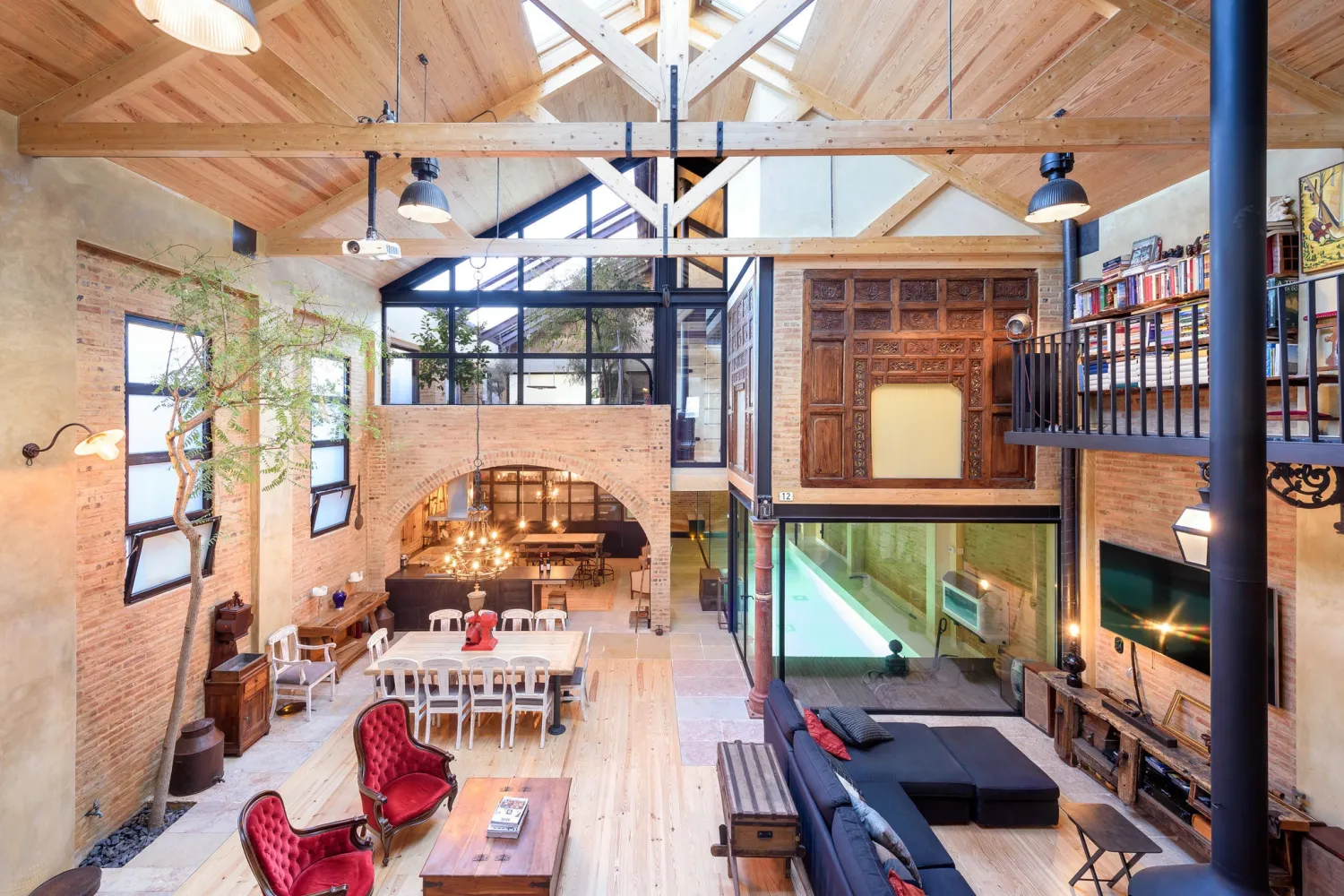
This 5,700-square-foot, loft-style house in the residential Penha de Franca section of Lisbon, Portugal, is on the market for $2.2 million. The home has three bedrooms, a mezzanine library accessible by ladder and an indoor lap pool. - João Peleteiro - NYT
TT

House Hunting in…Portugal

This 5,700-square-foot, loft-style house in the residential Penha de Franca section of Lisbon, Portugal, is on the market for $2.2 million. The home has three bedrooms, a mezzanine library accessible by ladder and an indoor lap pool. - João Peleteiro - NYT

$2.2 MILLION (1.95 MILLION EUROS)

This three-bedroom, loft-style home is in Penha de Franca, a residential section of Lisbon, Portugal, near the city’s historic center and the coastline on the Tagus River.

The 5,700-square-foot house was built in 2017 over and around what had been a garage, using thousands of handmade bricks, said the owner and designer, Luís Catarino. Mr. Catarino, a civil engineer who is trained in architecture, said the interiors are intended to spark inspiration with their mix of materials: old and modern, domestic and industrial, common and unusual.

“It’s a flexible space, a multifunctional place, as I believe in the future most people will work from the home,” he said. “I prepared the house to be a space to write, to make sculpture, to paint. And there are wonderful acoustics for music.”

The home is entered through a grotto-like hallway with an overhead image of angels, a recurrent theme that Mr. Catarino drew from Wim Wenders’s 1987 film “Wings of Desire.” An arched doorway leads to a large, open-concept living area with wood floors, brick walls and vaulted, 26-foot wood ceilings lined with skylights.

ImageThe home is entered through a grotto-like hallway with overhead images of angels. The iron stairs lead up to an open studio space that overlooks the ground floor.
The home is entered through a grotto-like hallway with overhead images of angels. The iron stairs lead up to an open studio space that overlooks the ground floor.CreditJoão Peleteiro
A hanging fireplace anchors the lounge area, which has a ladder leading to a mezzanine library. Across the room, an antique chandelier hangs over a dining table that seats 10.

The open kitchen, framed by a large brick archway and lit by another chandelier, has an island with a built-in cooktop, a farm-style sink, a large pantry and a dining table.

Above the kitchen and pool are the master bedroom and a rooftop meditation garden. Antique carved wooden doors, wall trim and cabinetry — all collected by Mr. Catarino from various countries over the years — adorn the bedroom, which has a hanging fireplace, ample closet space, skylights and a claw-foot tub. The adjacent garden has a retractable roof, six trees and a swing.

At the opposite end of the living area, a glass wall opens to a garage-like ground-level space that could serve as a work area. Iron stairs lead up to an open studio area overlooking the ground floor. Another stairway leads to a third level, where there are two more bedrooms and a bathroom.

The home was built to high energy-efficiency standards, with solar panels supplying about 40 percent of its energy needs, Mr. Catarino said.

Lisbon is Portugal’s capital and largest city, with about 500,000 residents. The Penha de Franca section is about a mile from the southeast coast and the Tagus River, which flows into the Atlantic Ocean 10 miles to the west. The neighborhood has mostly midpriced and high-end homes and sits atop one of the seven steep hills in the city. Each hill has a miradouro, or viewpoint, offering vistas of the city and the water.

Avenida da Liberdade, Lisbon’s main thoroughfare, with its upscale stores, trendy restaurants and historic plazas, is accessible via the city’s metro system, as is Monsanto Forest Park, one of Europe’s largest parks. The closest station is about a 15-minute walk, Mr. Catarino said.

Lisbon Airport is about a 10-minute drive from the house. A new airport with nearly double the capacity is under construction in Montijo, about 25 miles from the city center; completion is expected in 2022.

ust under three million, the Lisbon metropolitan area extends to the Atlantic Ocean on the west coast of Portugal and to the Península de Setúbal, across the river, to the south. The region has attracted increased international interest in recent years, largely because of two buyer-incentive programs established by the government as the country struggled to recover from a debt crisis, said Patricia Barão, head of the residential department of JLL, a real estate services company.

The Non-Habitual Residency program, introduced in 2009, allows part-time residents from other countries to earn foreign income tax-free for 10 years, while the Golden Visa program, introduced in 2012, grants residency permits to foreigners from outside the European Union who buy property valued at 500,000 euros or more. Buyers need not live there, but must own the property for more than five years.

Ms. Barão cited Lisbon’s comfortable climate, political stability and affordable cost of living as other factors in its growing appeal. “You can go to a very good restaurant close to the river and pay 20 euros for a nice meal with good wine,” she said.

Home prices have been increasing since 2014, during a time of considerable new construction and renovations in the city, said Rafael Ascenso, the general manager of Porta da Frente Christie’s, which has this listing.

“Between 2008 and 2013, the market was frozen — there were no new projects,” he said. “Now supply is more or less matching the demand.”

A new two-bedroom apartment can sell for 400,000 to 2 million euros ($450,000 to $2.25 million), depending on location, he said. The average home sale price overall last year was around $480 a square foot, according to an analysis by Knight Frank.

The highest housing prices are in the city’s historic and cultural districts, including Chiado and the beach suburbs of Cascais and Estoril, where there are marinas and golf courses, west of the city center. Prices in these areas have doubled over the last eight years, to at least $835 a square foot, Mr. Ascenso said.

Still, home prices in Lisbon remain considerably lower than those in other major European cities. The Knight Frank data showed that, as of the last quarter of 2018, 1 million euros ($1.12 million) could buy 1,345 square feet in Lisbon, compared with 463 square feet in London, 560 in Paris and 970 in Berlin.

Foreign investors often buy property to rent, but short-term rentals aimed at tourists face tough competition, said Alex Koch de Gooreynd, a partner at Knight Frank. “Airbnb is a massive business in Lisbon, and at the moment there are very few restrictions,” he said. “Investors should focus on long-term instead of short-term holiday lets.”

Who Buys in Lisbon

The Non-Habitual Residency program has gained popularity in particular with citizens of the United Kingdom, as they face continued uncertainty around Brexit, Mr. Koch de Gooreynd said. While British citizens have long vacationed in southern Portugal, he said, “more and more of our clients want to move to the city center or Cascais.”

The master suite has a hanging fireplace, ample closet space, skylights and a claw-foot tub. It looks out on the rooftop garden.

Mr. Ascenso said most of his foreign buyers are from Brazil, France, Sweden and South Africa.

Buying Basics

While it is not customary for buyers to hire a lawyer, foreigners applying for one of the incentives typically hire counsel to guide them through the various requirements, Mr. Ascenso said.

Listings are not exclusive, and sellers often list their homes with more than one agency, he said. Agents’ commissions, paid by the seller, are between 4 and 6 percent.

The New York Times



Saudi Arabia, Syria Sign Joint Airline and Telecoms Deals

Officials pose after signing a framework agreement for developmental cooperation and the launch of 45 development initiatives between the Syrian Development Fund and Saudi Arabia's Development Committee at the People's Palace in Damascus, Syria, Saturday, Feb. 7, 2026. (AP)
TT

Saudi Arabia, Syria Sign Joint Airline and Telecoms Deals

Officials pose after signing a framework agreement for developmental cooperation and the launch of 45 development initiatives between the Syrian Development Fund and Saudi Arabia's Development Committee at the People's Palace in Damascus, Syria, Saturday, Feb. 7, 2026. (AP)

Syria and Saudi Arabia signed deals Saturday that include a joint airline and a $1-billion project to develop telecommunications, officials said, as Syria seeks to rebuild after years of war.

The new authorities in Damascus have worked to attract investment and have signed major agreements with several companies and governments.

Syrian Investment Authority chief Talal al-Hilali announced a series of deals including "a low-cost Syrian-Saudi airline aimed at strengthening regional and international air links".

The agreement also includes the development of a new international airport in the northern city of Aleppo, and redeveloping the existing facility.

Hilali also announced an agreement for a project called SilkLink to develop Syria's "telecommunications infrastructure and digital connectivity".

Syrian Telecommunications Minister Abdulsalam Haykal told the signing ceremony that the project would be implemented "with an investment of around $1 billion".

For decades, Syria was unable to secure significant investments because of Assad-era sanctions.

But the United States fully removed its remaining sanctions on Damascus late last year, paving the way for the full return of investments.

Syria and Saudi Arabia also inked an agreement on water desalination and development cooperation on Saturday.

At the ceremony, Saudi Investment Minister Khalid Al-Falih announced the launch of an investment fund for "major projects in Syria with the participation of the (Saudi) private sector".

The deals are part of "building a strategic partnership" between the two countries, he said.

Syria's Hilali said the agreements targeted "vital sectors that impact people's lives and form essential pillars for rebuilding the Syrian economy".

Syria has begun the mammoth task of trying to rebuild its shattered infrastructure and economy.

In July last year, Riyadh signed investment and partnership deals with Damascus valued at $6.4 billion to help rebuild the country's infrastructure, telecommunications and other major sectors.

A month later, Syria signed agreements worth more than $14 billion, including investments in Damascus airport and other transport and real estate projects.

This week, Syria signed a preliminary deal with US energy giant Chevron and Qatari firm Power International to explore for oil and gas offshore.


India’s Modi Lauds Interim Trade Pact After US Tariff Rollback

Indian Prime Minister Narendra Modi addresses the media before the budget session of Parliament at Parliament House in New Delhi, India, 29 January 2026. (EPA)
TT

India’s Modi Lauds Interim Trade Pact After US Tariff Rollback

Indian Prime Minister Narendra Modi addresses the media before the budget session of Parliament at Parliament House in New Delhi, India, 29 January 2026. (EPA)

Indian Prime Minister Narendra Modi on Saturday hailed an interim trade agreement with the United States, saying it would bolster global growth and deepen economic ties between the two countries.

The pact cuts US "reciprocal" duties on Indian products to 18 percent from 25 percent, and commits India to large purchases of US energy and industrial goods.

US President Donald Trump, while announcing the deal Tuesday, had said Modi promised to stop buying Russian oil over the war in Ukraine.

The deal eases months of tensions over India's oil purchases -- which Washington says fund a conflict it is trying to end -- and restores the close ties between Trump and the man he describes as "one of my greatest friends."

"Great news for India and USA!" Modi said on X on Saturday, praising US President Donald Trump's "personal commitment" to strengthening bilateral ties.

The agreement, he said, reflected "the growing depth, trust and dynamism" of their partnership.

Modi's remarks came hours after Trump issued an executive order scrapping an additional 25 percent levy imposed over New Delhi's purchases of Russian oil, in a step to implement the trade deal announced this week.

Modi, who has faced criticism at home about opening access of Indian agricultural markets to the United States and terms on oil imports, did not mention Russian oil in his statement.

"This framework will also strengthen resilient and trusted supply chains and contribute to global growth," he said.

It would also create fresh opportunities for Indian farmers, entrepreneurs and fishermen under the "Make in India" initiative.

In a separate statement, Commerce Minister Piyush Goyal said the pact would "open a $30 trillion market for Indian exporters".

Goyal also said the deal protects India's sensitive agricultural and dairy products, including maize, wheat, rice, soya, poultry and milk.

Other terms of the agreement include the removal of tariffs on certain aircraft and parts, according to a separate joint statement released Friday by the White House.

The statement added that India intends to purchase $500 billion of US energy products, aircraft and parts, precious metals, tech products and coking coal over the next five years.

The shift marks a significant reduction in US tariffs on Indian products, down from a rate of 50 percent late last year.

Washington and New Delhi are expected to sign a formal trade deal in March.


Gold Bounces Back on Softer Dollar, US-Iran Concerns; Silver Rebounds

Gold and silver bars are stacked in the safe deposit boxes room of the Pro Aurum gold house in Munich, Germany, January 10, 2025. REUTERS/Angelika Warmuth
TT

Gold Bounces Back on Softer Dollar, US-Iran Concerns; Silver Rebounds

Gold and silver bars are stacked in the safe deposit boxes room of the Pro Aurum gold house in Munich, Germany, January 10, 2025. REUTERS/Angelika Warmuth

Gold rebounded on Friday and was set for a weekly gain, helped by bargain hunting, a slightly weaker dollar and lingering concerns over US-Iran talks in Oman, while silver recovered from a 1-1/2-month low.

Spot gold rose 3.1% to $4,916.98 per ounce by 09:31 a.m. ET (1431 GMT), recouping losses posted during a volatile Asia session that followed a fall of 3.9% on Thursday. Bullion was headed for a weekly gain of about 1.3%.

US gold futures for April delivery gained 1% to $4,939.70 per ounce.

The US dollar index fell 0.3%, making greenback-priced bullion cheaper for the overseas buyers.

"The gold market is seeing perceived bargain hunting from bullish traders," said Jim Wyckoff, senior analyst at Kitco Metals.

Iran and the US started high-stakes negotiations via Omani mediation on Friday to try to overcome sharp differences over Tehran's nuclear program.

Wyckoff said gold's rebound lacks momentum and the metal is unlikely to break records without a major geopolitical trigger.

Gold, a traditional safe haven, does well in times of geopolitical and economic uncertainty.

Spot silver rose 5.3% to $74.98 an ounce after dipping below $65 earlier, but was still headed for its biggest weekly drop since 2011, down over 10.6%, following steep losses last week as well.

"What we're seeing in silver is huge speculation on the long side," said Wyckoff, adding that after years in a boom cycle, gold and silver now appear to be entering a typical commodity bust phase.

CME Group raised margin requirements for gold and silver futures for a third time in two weeks on Thursday to curb risks from heightened market volatility.

Spot platinum added 3.2% to $2,052 per ounce, while palladium gained 4.9% to $1,695.18. Both were down for the week.
