


Gold Falls on Investor Caution ahead of Key US Economic Data

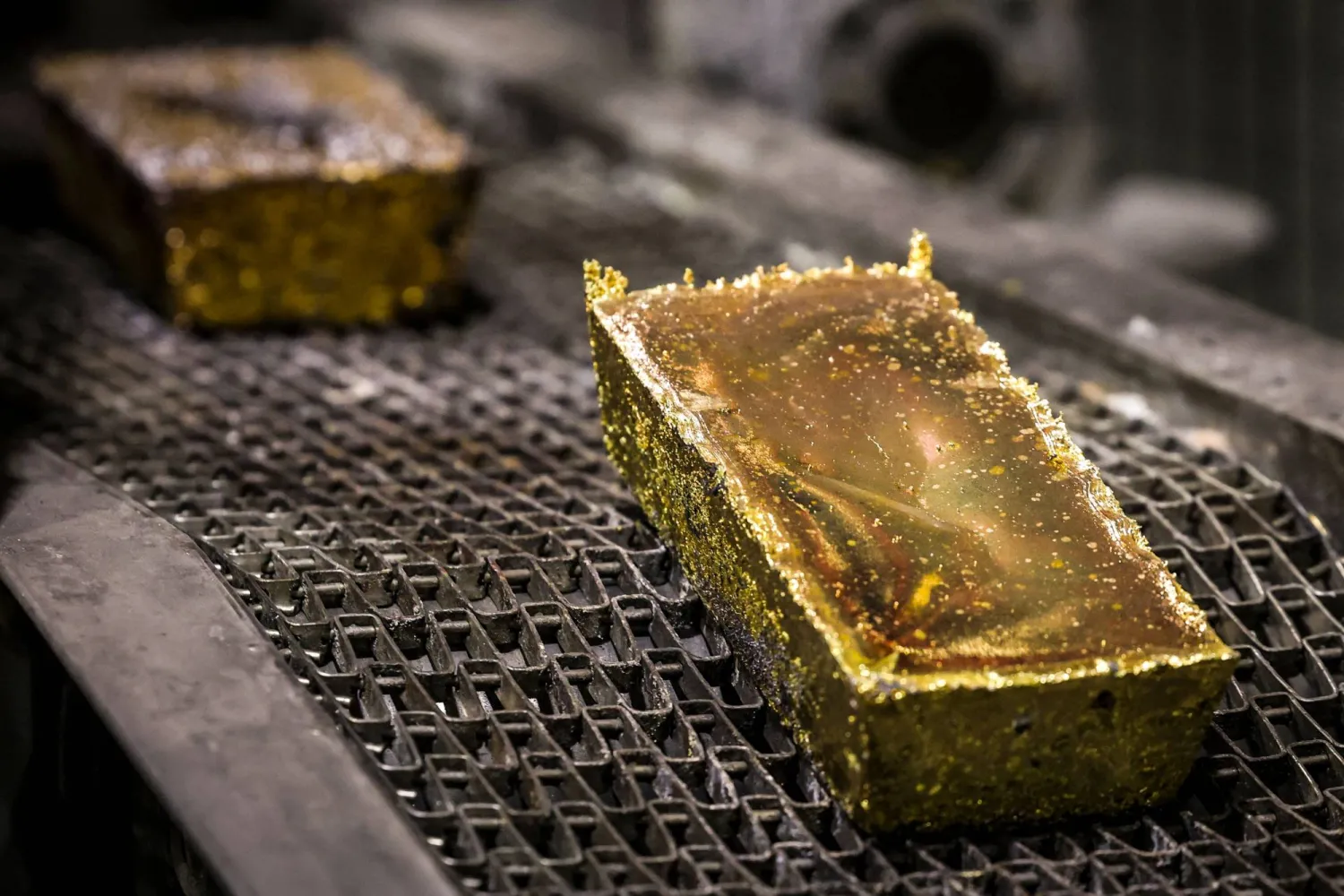
Gold bars being washed after removal from molds at a refinery in Sydney (AFP)
TT

Gold Falls on Investor Caution ahead of Key US Economic Data

Gold bars being washed after removal from molds at a refinery in Sydney (AFP)

Gold fell on Tuesday, though held above the $5,000-per-ounce level, as investors stayed cautious ahead of key US jobs and inflation data due later this week that could help gauge the US Federal Reserve's interest rate trajectory.

Spot gold fell 0.7% to $5,030.80 per ounce by 0716 GMT. The metal gained 2% on Monday, as the dollar weakened to its lowest level in more than ‌a week. ‌Gold scaled a record high of $5,594.82 on ‌January ⁠29.

US gold ‌futures for April delivery lost 0.5% to $5,051.70 per ounce.

Spot silver slipped 2.1% to $81.63 an ounce, after rising nearly 7% in the previous session. It had hit an all-time high of $121.64 on January 29.

"We're in a situation where gold has something of a built-in upside bias broadly, and now it's a question of ⁠just how much will short-term Fed policy expectations matter," said Ilya Spivak, head of ‌global macro at Tastylive.

The US dollar ‍edged higher on Tuesday, ‍making greenback-priced metals more expensive for overseas buyers.

Spivak added that ‍gold is being pulled back to the $5,000 level from both the upper and lower price ranges, while silver is showing more volatility on speculative trading.

Investors are awaiting a string of US economic data - retail sales due Tuesday, the nonfarm payrolls report on Wednesday and inflation data on Friday. Markets are currently pricing ⁠in at least two 25-basis-point rate cuts in 2026, with the first expected in June.

The non-yielding bullion tends to do well in a low-interest-rate environment.

White House economic adviser Kevin Hassett said on Monday that US job gains could be lower in the coming months.

For gold, "$5,000 is a support and $80 for silver. But intraday, both metals will be broadly range-bound, with a slight tilt towards negativity because of profit booking," Jigar Trivedi, a senior research analyst at IndusInd Securities, said, adding that investors are ‌cautious given recent volatility.

Spot platinum shed 2% to $2,080.30 per ounce, while palladium lost 1.1% to $1,721.75.


Saudi Arabia Builds its Own Digital Sovereignty Model

A woman stands in front of an information screen at the LEAP tech exhibition in Saudi Arabia (SPA)
TT

Saudi Arabia Builds its Own Digital Sovereignty Model

A woman stands in front of an information screen at the LEAP tech exhibition in Saudi Arabia (SPA)

In a world where digital borders are blurring and countries are racing to control data and build technological power, Saudi Arabia has chosen to carve out its own digital path.

Through an ambitious strategic vision, the Kingdom has launched a network of policies, investments, and high-value partnerships that have turned it into a global model for digital transformation. It ranked first in the International Telecommunication Union’s 2025 Digital Readiness Framework, scoring 94 out of 100.

But the score tells only part of the story. More important is what it signals, a deep shift in how Saudi Arabia views digital sovereignty. It is no longer just a shield for protecting data. It has become a driver of growth and a tool for shaping the future.

To understand that shift, the concept itself must be redefined.

Ayman AlRashed, IBM’s regional vice president in Saudi Arabia, says digital sovereignty is often wrongly reduced to a technical question of where data is stored.

“It is important to look at digital sovereignty as an integrated operational capability,” AlRashed told Asharq Al-Awsat.

He said it covers an organization’s ability to control and govern its data, operate its digital systems, and manage outcomes with confidence and continuity over the long term.

That broader definition gives digital sovereignty a far deeper meaning. It is not a wall built to stop data from leaving. It is a full governance system that ensures accountability, access controls, oversight and auditability, while preserving the reliability of digital systems and their ability to scale securely and in compliance with regulations.

Mohamed Talaat, vice president for Saudi Arabia, Egypt, North Africa and the Levant at Dell Technologies, said the Kingdom has translated that approach into practical policy through clear regulatory frameworks, led by the Personal Data Protection Law.

He told Asharq Al-Awsat that the law helped create an environment that supports global expansion while maintaining strict control over data.

Saudi Arabia has also made itself more attractive to international technology companies through economic zones, tax incentives, and partnerships with cloud service providers.

How fintech flourished

The fintech sector offers one of the clearest examples of how digital sovereignty is reshaping the Saudi economy.

The sector has expanded sharply in recent years. AlRashed says digital sovereignty was one of the main factors behind that growth.

The reason is straightforward. Once sensitive financial data could be processed and stored inside the Kingdom under local regulatory frameworks, investors, banks, insurers and end users became more confident in fintech solutions.

Digital sovereignty removed one of the biggest barriers to growth, concern over where sensitive data sits and who controls it.

Crucially, that did not come at the expense of innovation. IBM provided sovereign and hybrid cloud solutions that allow financial institutions to keep sensitive data locally while still using advanced cloud capabilities.

That model gave fintech firms a practical way to balance fast innovation with strict regulatory compliance, without sacrificing either.

From compliance to expansion

Digital sovereignty has not only helped large institutions. It has also changed the equation for Saudi startups.

AlRashed says that storing and processing data within the Kingdom under clear regulatory frameworks has enabled startups to launch and grow while remaining compliant from day one.

But the economic impact goes beyond easier compliance. Digital sovereignty has strengthened trust among customers and partners in local solutions. That has helped speed up the adoption of digital products, expand customer bases, improve access to investment, build partnerships with major institutions, and increase the likelihood of early revenue.

AlRashed says the deeper impact lies in preparing startups for regional expansion.

By building digital solutions on strong, sovereign standards within the Kingdom, Saudi companies have gained a clear competitive edge, especially as regulatory policies across several regional markets converge. What they built locally has become easier to export and scale.

A delicate balance

One of the toughest questions is how Saudi Arabia managed to attract major global technology firms to invest locally without giving up control over national data.

Talaat says the Kingdom struck a careful balance. It offered international companies a clean regulatory environment and attractive incentives, while imposing strict guarantees to keep sensitive data under national control.

He said this approach has taken practical form in a secure local infrastructure that supports national artificial intelligence agendas.

One example is Dell Technologies’ opening in 2024 of a new merger and distribution center in Dammam, part of a multimillion-dollar investment to strengthen local operations and supply chain resilience.

The move reflects a model in which global companies become partners in building sovereignty, not threats to it.

A regional digital hub

What will this ecosystem look like by 2030?

Talaat sketches an ambitious picture, a sovereign digital economy expected to be the largest in the Middle East, with artificial intelligence alone forecast to contribute $135 billion to the economy and local data center capacity exceeding 1.5 gigawatts.

Saudi Arabia is working to cement its position as a global hub for cloud computing, artificial intelligence innovation and sustainable technology manufacturing, supported by integrated smart cities and secure sovereign data systems.

AlRashed says the Kingdom has a real chance to move beyond the domestic arena and help shape global models for digital sovereignty through a growing network of local, regional and international partnerships.

That marks a shift from importing technology to exporting models and standards.

Still, both men acknowledge that the vision faces a central challenge, closing human skills gaps.

Advanced infrastructure is essential, but it is not enough. Saudi Arabia also needs deep, parallel investment in developing national talent capable of managing and leading its digital future.

In the end, Saudi Arabia’s experience shows that digital sovereignty is not a defensive strategy designed to cut data off from the world. It is a way for countries and companies to engage with global innovation from a position of strength, not dependence.


China Signals Tariff Cuts, Advances in Farm Market Access After Trump-Xi Summit

An aerial view of newly imported cars parked at the automobile terminal at the Port of Los Angeles on May 08, 2026 in Wilmington, California. (Getty Images/AFP)
TT

China Signals Tariff Cuts, Advances in Farm Market Access After Trump-Xi Summit

An aerial view of newly imported cars parked at the automobile terminal at the Port of Los Angeles on May 08, 2026 in Wilmington, California. (Getty Images/AFP)

China and the United States have agreed to expand agricultural trade through tariff reductions and tackle non-tariff barriers and market access issues, China's commerce ministry said on Saturday after this week's summit in Beijing.

The agreements are "preliminary" and will be "finalized as soon as possible," the ministry said following US President Donald Trump's visit.

China's farm imports from the US still face an additional 10% levy after last year's rounds of tit-for-tat tariffs sharply curtailed trade, which fell 65.7% year-on-year to $8.4 billion in 2025, according ‌to US ‌Department of Agriculture data.

The commerce ministry said ‌both ⁠sides aim to ⁠promote two-way trade, including in agricultural products, through measures such as reciprocal tariff reductions across a range of goods. It did not specify which products.

China resumed purchases of some US farm goods after an October meeting, fulfilling a US-stated commitment to buy 12 million metric tons of soybeans by the end ⁠of February. It has also purchased some US ‌wheat cargoes and large ‌volumes of sorghum.

Market watchers expect a 10% cut in soybean tariffs, which could ‌allow private Chinese crushers to resume purchases that were ‌largely sidelined during last year's US harvest, when state crop traders were the only buyers.

"Tariff reductions on agricultural products would mark a normalization of China-US farm trade, allowing commercial buyers to re-enter the market," ‌said Johnny Xiang, founder of Beijing-based AgRadar Consulting.

The ministry said both sides agreed to "resolve or ⁠make substantive progress" ⁠on non-tariff barriers and market access issues.

China will work to address US concerns over registration of beef facilities and poultry exports from certain US states, it said.

Beijing on Friday granted five-year registration extensions to 425 US beef plants that had largely been shut out after their registrations lapsed last year, and approved new five-year registrations for 77 additional US facilities.

US Trade Representative Jamieson Greer said on Friday the US expects China to buy "double-digit billions" worth of US farm goods over the next three years, although neither side has yet released details on specific products, values or volume.


Mercedes Benz Mulls Diversification into Defense

President of the European Automobile Manufacturers' Association (ACEA) Ola Kallenius attends a press point in the European Parliament in Brussels, Belgium, 13 May 2026. (EPA)
TT

Mercedes Benz Mulls Diversification into Defense

President of the European Automobile Manufacturers' Association (ACEA) Ola Kallenius attends a press point in the European Parliament in Brussels, Belgium, 13 May 2026. (EPA)

The CEO of German automaking giant Mercedes-Benz has said he has not ruled out entering the defense industry.

"The world has become more unpredictable, and I think it is quite clear that Europe needs to strengthen its defense capabilities," CEO Ola Kaellenius said in an interview with The Wall Street Journal published Friday.

"If we are able to play a positive role in this area, we would be ready to do so," said Kaellenius, a German-Swedish national.

His remarks come amid Germany beefing up its military capacity in response to Russia's invasion of Ukraine in February 2022.

The German defense industry has locked onto that trend, as illustrated by the rise of arms maker Rheinmetall in recent years, with the group recently pushing into the naval and drone-making spheres.

In contrast, German automakers, such as Mercedes-Benz and Volkswagen, are battling crises, caught between tariffs and bitter Chinese competition.

In late March, the CEO of fellow German auto giant, Volkswagen, Oliver Blume, said he was "in contact" with defense companies, particularly those involved in missile defense, to convert a German factory to produce military transport equipment.

According to the Financial Times, discussions are under way with Rafael Advanced Defense Systems, the company that designed Israel's Iron Dome.

Asked by AFP to comment on Kaellenius's interview, a Mercedes-Benz spokesperson said the firm "has for many years been supplying chassis to specialized firms which equip and market them under their own responsibility and under their own brand for military applications".

"Our activities in the security and defense sector constitute a strategic development focus that we will continue to actively pursue, in collaboration with our partners," the spokesperson added.

In his Wall Street Journal interview, Kaellenius did not go into details on what kind of products Mercedes-Benz might manufacture.

He predicted that defense-related business would represent only a "minor part of Mercedes-Benz's operations" compared with auto and van manufacture.

But he added defense could be "a rapidly growing niche that could also contribute to the group's financial results."
