


On Pigeon Patrol, Rufus the Hawk Rules the Skies Over Wimbledon

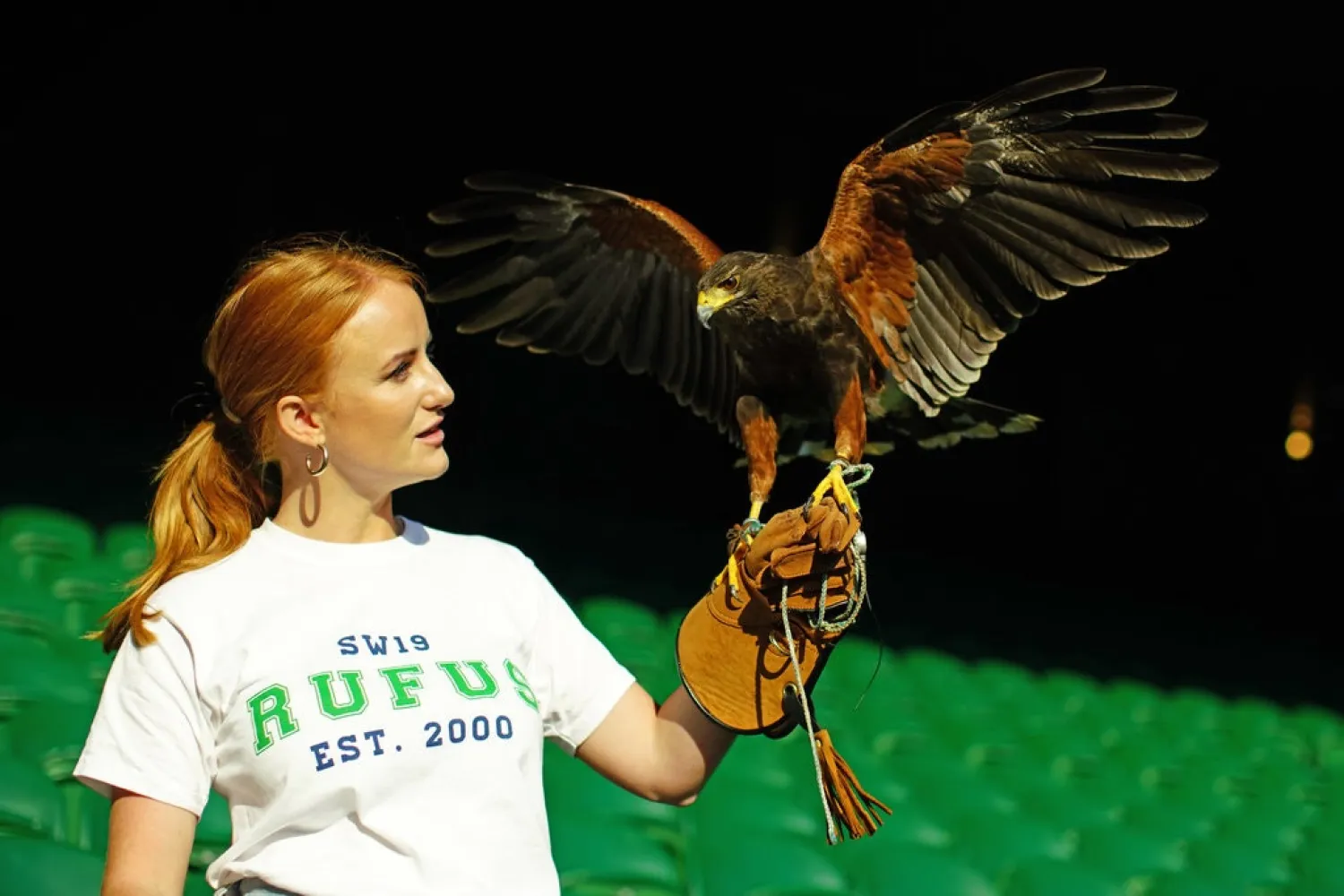
Imogen Davis, another handler, said Rufus once stayed in the Centre Court rafters overnight.CreditJane Stockdale for The New York Times
TT

On Pigeon Patrol, Rufus the Hawk Rules the Skies Over Wimbledon

Imogen Davis, another handler, said Rufus once stayed in the Centre Court rafters overnight.CreditJane Stockdale for The New York Times

Roger Federer is serving for the Wimbledon title. He tosses the ball and cranes his neck.

Plop. A gift from a pigeon, right on the forehead.

Luckily, something like that hasn’t happened. At least not yet, not during a big match in recent memory.

For that, Wimbledon can thank a brown and chestnut bird of prey with keen eyes, a four-foot wingspan and bone-crushing talons. His name is Rufus the Hawk, and he plays a crucial role at the world’s oldest tennis tournament.

Every day, in the early morning, well before the matches begin, Rufus soars the skies over the All England Club, on the prowl for pigeons.

Without him, Wimbledon just might descend into aviary chaos. Pigeons could reign supreme, not just in the air, but also in the rafters, on the rooftops and across the grass courts.

The place is perfect for pigeons. “All of the grass seeds, all of the nooks and crannies, and the food waste from the fans,” Wayne Davis, one of Rufus’s handlers, said. Without Rufus, he reckoned, pigeons would number in the hundreds.

“Feral pigeons breed year round,” he said. “If you have just one pair breeding in the rafters at Centre Court, you would end up by the end of the year with about 40 more birds. You could have Roger Federer serving and clouds of pigeons wafting about.

“And pigeon poop, too, of course.”

Flocks of pigeons became a growing problem in the late 1990s, a threat to the prim fastidiousness that Wimbledon prizes above all. That was when the All England Club telephoned Davis and his family-run Avian Environmental Consult­ants.

Another of their birds was the first to patrol Wimbledon. Then Rufus the Hawk took over. He has become an English icon.

From dawn to dusk, he soars, on the prowl for pigeons. He doesn’t kill them. He toys with them, barreling from above, twisting, turning, squawking and nipping at their wings, announcing to all that the skies over Wimbledon belong to him.

“The pigeons learned he was in charge,” Davis said. “Other than a few stragglers, they stopped coming around like they did before. He scares them away.”

Rufus would have been a fearsome predator in the wild. Although he weighs just 1 pound 6 ounces, he cuts a much larger figure with his confident bearing and cascade of feathers.

He can spread his talons almost as wide as a person’s hand, and he can see 10 times better than any human. He can focus on a pigeon from a mile way.

Davis and his daughter, Imogen, feed him by hand because his weight is important. At less than a pound and a half, he can become too hungry and might have a pigeon for lunch. Maybe in front of the royal box.

They have taught him to come when they whistle.

Most often, he does.

On one occasion three years ago, however, Imogen Davis had to chase him down at a nearby golf course. He took off again, across a road, then out of sight. She followed the jingle of his small bronze bell, attached to a talon.

She found him in the middle of a pond, standing in a thicket of weeds, hovering over a freshly killed duck. She couldn’t let him eat it. A full tummy would mean he wouldn’t come home until he was hungry again.

She waded through muck and lily pads, then through waist-high water. When she trooped back to Wimbledon, past crowds lined up to watch tennis in their finery, she had Rufus in her clutches.

One time, he vanished overnight.

Wayne Davis had left the bird in the family camper, parked outside an apartment they stay at during tournaments. Davis tucked him into the black cage that is his bedroom, and cracked a camper window just enough for ventilation. In the morning, Rufus and his cage were gone.

Someone had broken in and stolen him.

“My heart sank,” Imogen Davis said. She, her parents and her siblings had bought Rufus from a breeder when he was 16 weeks old, and he had become a member of the family.

“It was terrible,” she said. “There were a lot of tears.”

By then, Rufus had celebrity status, even a Twitter handle. The theft of Rufus the Hawk became headline news.

“Game, set and snatched,” wrote The Daily Mail.

The police said to expect someone to be in touch, demanding a ransom.

Three days went by. Then, from a phone booth, someone telephoned the Royal Society for the Prevention of Cruelty to Animals. No one knows for sure what had transpired — maybe Rufus had gotten away from the birdnappers, or maybe they decided to simply give him up — but he had been spotted in a park.

The animal welfare charity picked him up. Rufus went back to work. He hasn’t missed a day since.

Imogen Davis said Rufus has taught her important lessons. Like the morning he flew into the Centre Court rafters and decided to stay there.

Two hours passed. Then five. Then 10. He still wouldn’t budge. “Luckily it wasn’t during the actual tournament,” she said, a nod to the fact that Rufus polices Wimbledon year round. She and her mother, Donna, wrapped themselves in towels and spent the night on Centre Court.

“We didn’t sleep in the royal box,” Imogen Davis said. “We didn’t sleep at all.”

The next day, Rufus came down.

The lesson was a lot like Zen: Rufus never gets ruffled. He does things in his own good time.

Has he ever, in his own good time, decided to perch in the Center Court rafters during a match?

No, Davis said. She chuckled. “But if he did, he would just stay perched up there, saying, ‘I don’t know who Roger Federer is.’”

The New York Times


Veteran Monfils Exits to Standing Ovation on Australian Open Farewell

Gael Monfils of France acknowledges to the crowds after losing his Men’s Singles first round match against Dane Sweeny of Australia at the Australian Open tennis tournament in Melbourne, Australia, 20 January 2026. (EPA)
TT

Veteran Monfils Exits to Standing Ovation on Australian Open Farewell

Gael Monfils of France acknowledges to the crowds after losing his Men’s Singles first round match against Dane Sweeny of Australia at the Australian Open tennis tournament in Melbourne, Australia, 20 January 2026. (EPA)

French entertainer Gael Monfils was bundled out of the Australian Open in the first round on Tuesday in a brave farewell to a tournament he has lit up so many times.

The 39-year-old, one of the most colorful and popular players in men's tennis, battled all the way but Australian qualifier Dane Sweeny prevailed 6-7 (3/7), 7-5, 6-4, 7-5 in an epic lasting nearly four hours.

There was an on-court presentation and standing ovation afterwards for Monfils, who said: "Somehow it is the finish line, but thank you so much for an amazing ride.

"I have a lot of great memories here."

Monfils, who has won 13 ATP titles in a career stretching back to 2004, said in October that this year would be his last in tennis.

Launching his 20th Australian Open campaign, Monfils outlasted Sweeny, who is 15 years his junior, in an attritional first set.

Roared on by a partisan full house at Melbourne Park, Sweeny fought back to seize the second set and level an enthralling match.

Monfils, now ranked 110 but who rose to six in the world in his pomp, looked to be struggling physically in glaring sunshine.

The French veteran was frequently bent over double between points, one hand on his left knee and the other using his racquet to stay upright.

He alternately grimaced and grinned.

Monfils saw a trainer after losing the second set but still trudged out for the third, and was soon broken on the way to losing the set.

In a raucous party atmosphere, Monfils summoned reserves of energy from somewhere to race into a 4-1 lead in the fourth set, only for Sweeny to peg him back.

Sweeny clinched on his first match point before collapsing to the court.

He faces American eighth seed Ben Shelton in round two.

Paris-born Monfils has never won a Grand Slam but he has frequently gone deep in the biggest tournaments, including making the quarter-finals in Melbourne in 2016 and 2022.

Monfils married Ukrainian player Elina Svitolina in 2021 and they welcomed a daughter, Skai, a year later.


Morocco's Igamane Suffers ACL Injury

Morocco's forward #07 Hamza Igamane reacts as he misses his penatly during the Africa Cup of Nations (CAN) semi-final football match between Nigeria and Morocco at the Prince Moulay Abdellah stadium in Rabat on January 14, 2026. (Photo by FRANCK FIFE / AFP)
TT

Morocco's Igamane Suffers ACL Injury

Morocco's forward #07 Hamza Igamane reacts as he misses his penatly during the Africa Cup of Nations (CAN) semi-final football match between Nigeria and Morocco at the Prince Moulay Abdellah stadium in Rabat on January 14, 2026. (Photo by FRANCK FIFE / AFP)

Lille striker Hamza Igamane suffered an anterior cruciate ligament injury in Morocco's Africa Cup of Nations final against Senegal, the Ligue 1 side announced on Monday, casting doubt over his participation in this year's World Cup.

The 23-year-old was on the bench ‌for the ‌final, which Senegal ‌won ⁠1-0, before ‌coming on in extra time as the sixth substitute. He lasted seven minutes before going off injured, leaving Walid Regragui's side to finish the match with ⁠10 men.

"Tests carried out on the ‌player have unfortunately confirmed ‍a serious ‍injury. Hamza Igamane has indeed ‍suffered a rupture of the anterior cruciate ligament in his right knee," Reuters quoted Lille as saying in a statement.

"Hamza will be unavailable for several months," it added, with ⁠the injury coming five months before the 2026 World Cup, where Morocco will face Brazil, Scotland and Haiti in Group C.

Igamane, who joined Lille from Rangers in the close season, has scored nine goals in 21 games for the French ‌side in all competitions.


Precision-Serving Former Finalist Rybakina Powers on in Melbourne

Kazakhstan's Elena Rybakina signs autographs after her victory against Slovenia's Kaja Juvan in their women's singles match on day three of the Australian Open tennis tournament in Melbourne on January 20, 2026. (AFP)
TT

Precision-Serving Former Finalist Rybakina Powers on in Melbourne

Kazakhstan's Elena Rybakina signs autographs after her victory against Slovenia's Kaja Juvan in their women's singles match on day three of the Australian Open tennis tournament in Melbourne on January 20, 2026. (AFP)

Former finalist Elena Rybakina warned Tuesday if her serve was firing she would be a threat at the Australian Open, after reinforcing her title credentials with a comfortable first-round victory.

The fifth seed, who lost the 2023 final in three tough sets to Aryna Sabalenka, sent Slovenia's Kaja Juvan packing 6-4, 6-3 with her serve proving a potent weapon.

Rybakina won 83 percent of her first-serve points to keep up her record of safely negotiating the first hurdle at every Grand Slam since the 2022 US Open.

"No matter who is on the other side, if the serve is going, then it's perfect," she said after routinely racing to 40-0 leads and holding to love three times.

"Of course, little things (to work on) on the serve. Maybe adjust, be better in the first few shots of the rally, then we will see how it's going to go.

"But I'm happy with the serve, it really worked today."

It was her second serve that truly separated her from Juvan, winning 10 of 18 points behind it and not facing a break point until the final game of the match.

Rybakina, who won Wimbledon in 2022, faces France's Varvara Gracheva next.
