Abbas Says Palestine For Canaanites...Outsiders Will Leave

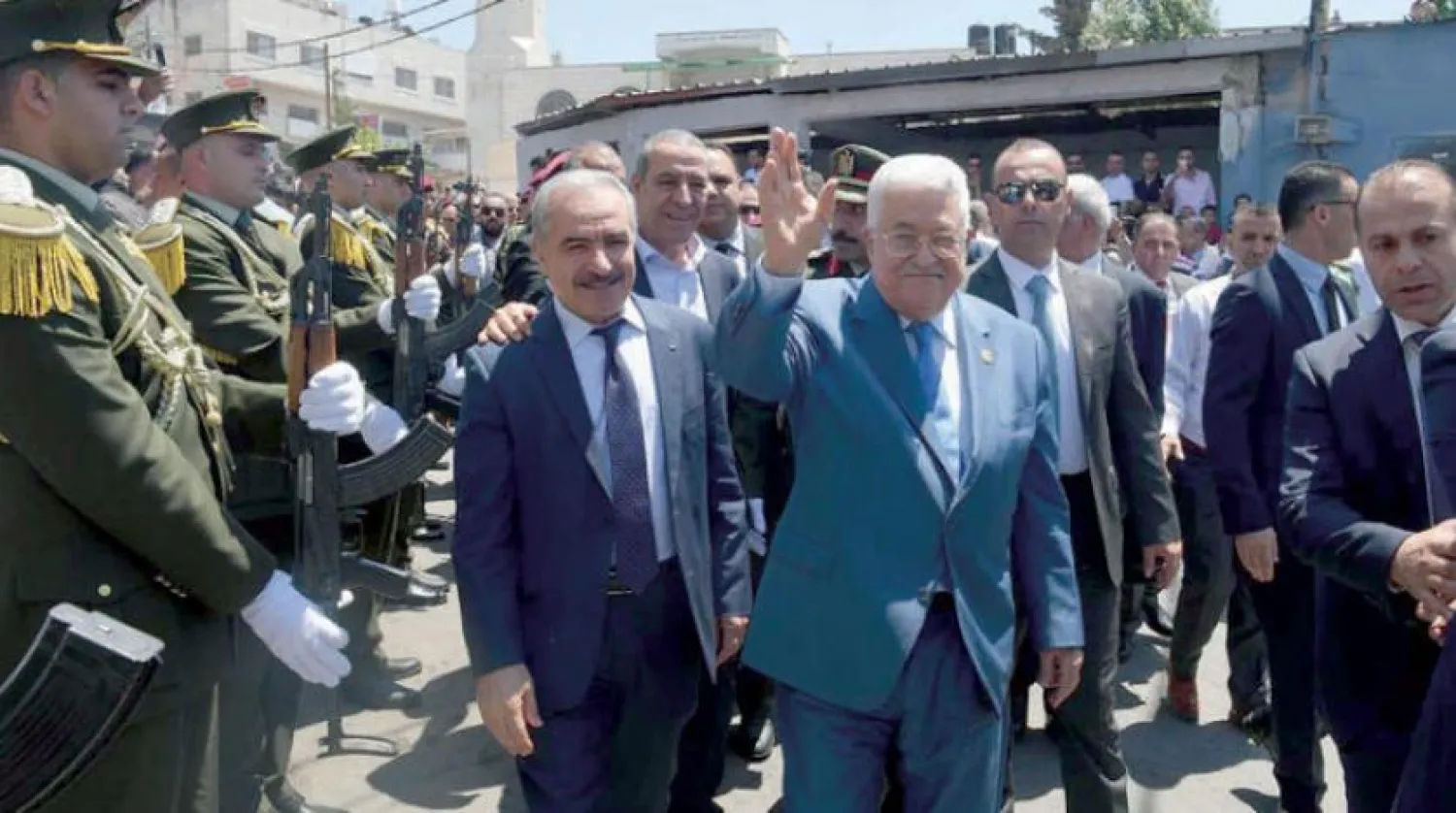
 PA President Mahmoud Abbas inspects Jalazone camp on Saturday, August 10, 2019 (Wafa)
PA President Mahmoud Abbas inspects Jalazone camp on Saturday, August 10, 2019 (Wafa)
TT

Abbas Says Palestine For Canaanites...Outsiders Will Leave

 PA President Mahmoud Abbas inspects Jalazone camp on Saturday, August 10, 2019 (Wafa)
PA President Mahmoud Abbas inspects Jalazone camp on Saturday, August 10, 2019 (Wafa)

Palestinian Authority (PA) President Mahmoud Abbas said Saturday that outsiders will be deported from the Palestinian land to the "dustbin of history" because this land is for the Canaanites.

“We are the Canaanites,” he stressed.

Addressing the crown in Jalazone refugee camp in Ramallah, Abbas said the Palestinians will remain “steadfast, patient and resilient.”

“We will remain in our homeland, and the outsiders on this land has no right in this country. The land is for its inhabitants, this land is for the Canaanites who were here 5,000 years ago, and we are the Canaanites.”

Abbas’s rhetoric was sharp compared to his usual diplomatic speeches. He congratulated the masses on Eid al-Adha, hoping victory to be achieved by next year.

He praised the Palestinian people’s honorable stance and patience, especially as they haven’t received their full salaries for a quiet period of time now.

Abbas was referring to the deduction of half the salaries of civil servants for nearly six months now after Israel deducted money from Palestinian tax revenues as punishment for the PA for continuing to pay the martyrs and wounded.

The PA refused to receive deducted money and rejected any compromises.

“We won’t accept that our martyrs be labeled as terrorists,” Abbas noted, adding that they are martyrs of the homeland and ‘we will not accept the deduction of a penny from their money.”

He reiterated the Palestinian political position rejecting the US “Deal of the Century,” affirming that no meetings are accepted or attended without the Palestinians’ consent.

Abbass added that Jerusalem will remain Palestine’s capital, stressing that all Palestinians and Islamic and Christian Arab nation will visit this capital one day.

He urged Palestinians in Gaza Strip to end the division that only serves the enemy, adding that Hamas and its leaderships are working for the enemy, not for Palestine.

Palestinian unity should include Gaza, Jerusalem and the West Bank for the State of Palestine to have East Jerusalem as its eternal capital, Abbas further noted.

Abbas has earlier arrived in Jalazone camp and was briefed with the refugees’ conditions and needs. He visited the camp’s institutions and met its residents.


Arab League Condemns Attack on Aid Convoys in Sudan

A general view shows the opening session of the meeting of Arab foreign ministers at the Arab League Headquarters (Reuters)
TT

Arab League Condemns Attack on Aid Convoys in Sudan

A general view shows the opening session of the meeting of Arab foreign ministers at the Arab League Headquarters (Reuters)

Arab League Secretary-General Ahmed Aboul Gheit strongly condemned the attack by the Rapid Support Forces on humanitarian aid convoys and relief workers in North Kordofan State, Sudan.

In a statement reported by SPA, secretary-general's spokesperson Jamal Rushdi quoted Aboul Gheit as saying the attack constitutes a war crime under international humanitarian law, which prohibits the deliberate targeting of civilians and depriving them of their means of survival.

Aboul Gheit stressed the need to hold those responsible accountable, end impunity, and ensure the full protection of civilians, humanitarian workers, and relief facilities in Sudan.


Gaza's Rafah Crossing Reopens, Allowing Limited Travel as Palestinians Claim Delays, Mistreatment

Ayada Al-Sheikh is welcomed by his sister, Nisreen, upon his arrival in Khan Younis in the southern Gaza Strip after returning to Gaza following the long-awaited reopening of the Rafah border crossing, early Thursday, Feb. 5, 2026. (AP Photo/Abdel Kareem Hana)
TT

Gaza's Rafah Crossing Reopens, Allowing Limited Travel as Palestinians Claim Delays, Mistreatment

Ayada Al-Sheikh is welcomed by his sister, Nisreen, upon his arrival in Khan Younis in the southern Gaza Strip after returning to Gaza following the long-awaited reopening of the Rafah border crossing, early Thursday, Feb. 5, 2026. (AP Photo/Abdel Kareem Hana)

A limited number of Palestinians were able to travel between Gaza and Egypt on Sunday, after Gaza's Rafah crossing reopened after a two-day closure, Egyptian state media reported.

The vital border point opened last week for the first time since 2024, one of the main requirements for the US-backed ceasefire. The crossing was closed Friday and Saturday because of confusion about reopening operations.

Egypt's Al Qahera television station said that Palestinians began crossing in both directions around noon on Sunday. Israel didn't immediately confirm the information, according to The AP news.

Meanwhile, Israeli Prime Minister Benjamin Netanyahu is expected to travel to Washington this week, though the major subject of discussion will be Iran, his office said.

Over the first four days of the crossing's opening, just 36 Palestinians requiring medical care were allowed to leave for Egypt, plus 62 companions, according to UN data, after Israel retrieved the body of the last hostage held in Gaza and several American officials visited Israel to press for the opening.

Palestinian officials say nearly 20,000 people in Gaza are seeking to leave for medical care that isn't available in the territory. Those who have succeeded in crossing described delays and allegations of mistreatment by Israeli forces and other groups involved in the crossing, including an Israeli-backed Palestinian armed group, Abu Shabab.

A group of Palestinian patients and wounded gathered Sunday morning in the courtyard of a Red Crescent hospital in Gaza’s southern city of Khan Younis, before making their way to the Rafah crossing with Egypt for treatment abroad, family members told The Associated Press.

Amjad Abu Jedian, who was injured in the war, was scheduled to leave Gaza for medical treatment on the first day of the crossing’s reopening, but only five patients were allowed to travel that day, his mother, Raja Abu Jedian, said. Abu Jedian was shot by an Israeli sniper while he doing building work in the central Bureij refugee camp in July 2024, she said.

On Saturday, his family received a call from the World Health Organization notifying them that he is included in the group that will travel on Sunday, she said.

“We want them to take care of the patients (during their evacuation),” she said. “We want the Israeli military not to burden them.”

The Israeli defense branch that oversees the operation of the crossing didn't immediately confirm the opening.

Heading back to Gaza A group of Palestinians also arrived Sunday morning at the Egyptian side of the Rafah crossing to return to the Gaza Strip, Egypt’s state-run Al-Qahera News satellite television reported.

Palestinians who returned to Gaza in the first few days of the crossing's operation described hours of delays and invasive searches by Israeli authorities and Abu Shabab. A European Union mission and Palestinian officials run the border crossing, and Israel has its screening facility some distance away.

The crossing was reopened on Feb. 2 as part of a fragile ceasefire deal to halt the Israel-Hamas war.

The Rafah crossing, an essential lifeline for Palestinians in Gaza, was the only one in the Palestinian territory not controlled by Israel before the war. Israel seized the Palestinian side of Rafah in May 2024, though traffic through the crossing was heavily restricted even before that.

Restrictions negotiated by Israeli, Egyptian, Palestinian and international officials meant that only 50 people would be allowed to return to Gaza each day and 50 medical patients — along with two companions for each — would be allowed to leave, but far fewer people have so far crossed in both directions.

A senior Hamas official, Khaled Mashaal, said the militant group is open to discuss the future of its arms as part of a “balanced approach” that includes the reconstruction of Gaza and protecting the Palestinian enclave from Israel.

Mashaal said the group has offered multiple options, including a long-term truce, as part of its ongoing negotiations with Egyptian, Qatari and Turkish mediators.

Hamas plans to agree to a number of “guarantees,” including a 10-year period of disarmament and an international peacekeeping force on the borders, “to maintain peace and prevent any clashes,” between the militants and Israel, Mashaal said at a forum in Qatar’s capital, Doha.

Israel has repeatedly demanded a complete disarmament and destruction of Hamas and its infrastructure, both military and civil.

Mashaal accused Israel of financing and arming militias, like the Abu Shabab group which operates in Israeli military-controlled areas in Gaza, “to create chaos” in the enclave.

In the forum, Mashaal was asked about Hamas’ position from US President Donald Trump’s Board of Peace. He didn’t offer a specific answer, but said that the group won’t accept “foreign intervention” in Palestinian affairs.

“Gaza is for the people of Gaza. Palestinians are for the people of Palestine,” he said. “We will not accept foreign rule.”



Three Deadly Attacks on Health Centers in Sudan's South Kordofan in Past Week, Says WHO

Sudanese families prepare to ride on trucks while on their way to Egypt through the Qustul border, after the crisis in Sudan's capital Khartoum, in the Sudanese city of Wadi Halfa, Sudan May 1, 2023. (Reuters)
TT

Three Deadly Attacks on Health Centers in Sudan's South Kordofan in Past Week, Says WHO

Sudanese families prepare to ride on trucks while on their way to Egypt through the Qustul border, after the crisis in Sudan's capital Khartoum, in the Sudanese city of Wadi Halfa, Sudan May 1, 2023. (Reuters)

Sudan's South Kordofan region has seen attacks on three health facilities in the past week alone, leaving more than 30 dead, the World Health Organization said Sunday, AFP reported.

"Sudan's health system is under attack again," WHO chief Tedros Adhanom Ghebreyesus said on X, pointing out that, since February 3, "three health facilities were attacked in South Kordofan, in a region already suffering acute malnutrition".