

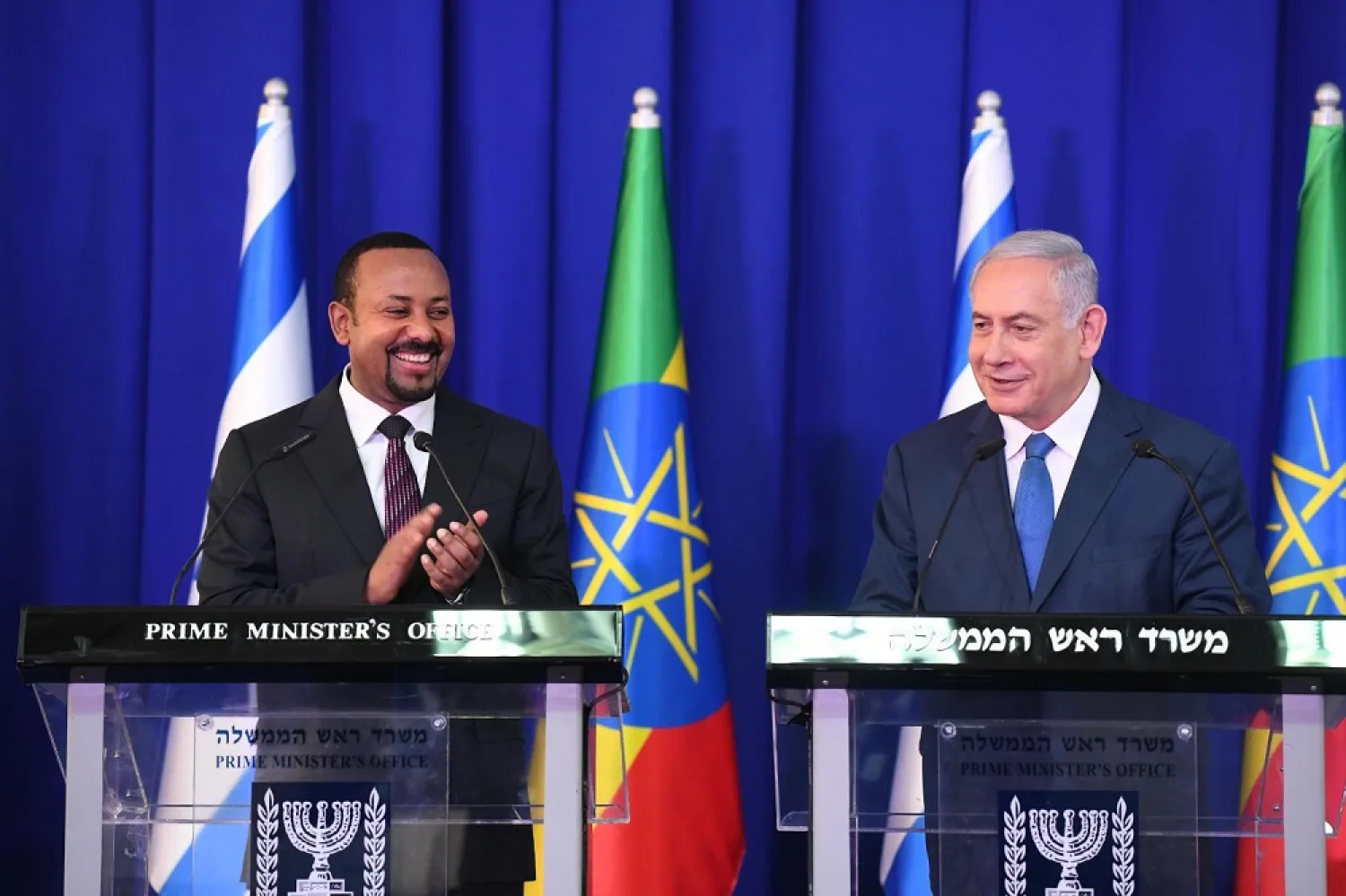

Israel, Ethiopia Agree to Cooperation Deals

Prime Minister Benjamin Netanyahu (R) and Ethiopian Prime Minister Abiy Ahmed speak at a press conference at the Prime Minister's Office on September 1, 2019. (PMO)
TT

Israel, Ethiopia Agree to Cooperation Deals

Prime Minister Benjamin Netanyahu (R) and Ethiopian Prime Minister Abiy Ahmed speak at a press conference at the Prime Minister's Office on September 1, 2019. (PMO)

Ethiopia’s Prime Minister Abiy Ahmed struck Sunday with his Israeli counterpart Benjamin Netanyahu agreements and understandings to bolster cooperation and bilateral trade tenfold.

“Ethiopia is looking up to Israeli investors to contribute to key sectors, including irrigation, water, energy, navigation and modernization of Ethiopia's agriculture sector,” Ahmed said.

He expressed his desire to promote bilateral relations in accordance with their mutual interests and orient them towards strategic partnership.

Cooperation between Ethiopia and Israel exceeds bilateral relationship to reach regional and international issues, he stressed, adding that his country will work through a dynamic partnership to promote regional and international peace and security.

Netanyahu, for his part, described Ahmed as his “best friend,” praising his influential role as a leader over the past year and a half in Africa.

He also hailed Ahmed’s great courage to fortify Ethiopia’s position on the regional and international levels, congratulating him on his achievements.

“You are making efforts to change the Ethiopian economy from within. I congratulate you because I frankly do the same here, and we are seeing results on the ground,” Netanyahu added.

Ethiopia is viewed from a new perspective in Israel, he noted.

“The historical relations between our two peoples are distinguished because they are reinforced by a human bridge consisting of 150,000 Israelis of Ethiopian origin, who bring Ethiopian culture and pride to Israel,” he explained.

“They have also preserved the Jewish people’s culture and pride in Ethiopia,” he further noted.



Iran Halts Israel Operation after First Post-truce Clash

The Iran flag flutters from a tall flagpole over high-rise buildings in northern Tehran on May 12, 2026. (AFP)
TT

Iran Halts Israel Operation after First Post-truce Clash

The Iran flag flutters from a tall flagpole over high-rise buildings in northern Tehran on May 12, 2026. (AFP)

Iran on Monday said it was ending its latest military operation against Israel after the first exchanges of fire between the foes since a shaky ceasefire began, but warned it could inflict a more "crushing" response.

Iran fired dozens of missiles at Israel overnight and Israel responded by targeting military sites in the Islamic republic, sparking fears the escalation could usher in a new full-scale conflict after the April 8 truce.

"Israel and Iran must immediately stop 'shooting.' President DONALD J. TRUMP," the US leader wrote on his Truth Social network.

Minutes later, he added in a new post that "final negotiations" towards peace were proceeding "subject to ignorance or stupidity getting in its way."

Iran's military command then said it was halting the operation against Israel after delivering a "painful response".

But it warned "that should acts of aggression and hostility continue, including in southern Lebanon, much more severe and crushing measures than before will follow".

Shortly after, Israel's army intercepted three projectiles fired from Lebanon, according to an AFP journalist near their shared border, with the military confirming the munitions had targeted its forces operating in Lebanon's south.

"Some of the projectiles were intercepted prior to crossing into Israeli territory, and an additional projectile fell near -army- soldiers. No injuries were reported," the military said.

Tehran's earlier strikes followed attacks by Israel against targets of the Iran-backed Lebanese group Hezbollah in the southern suburbs of Beirut.

Iran had repeatedly warned it would strike Israel if the Lebanese capital was targeted.

No casualties have been reported in either Israel or Iran after the exchange of fire.

The Israeli military said it struck and dismantled Iranian defense systems deployed across several areas in the country. Iran fired nearly 30 missiles towards Israel since Sunday night, an Israeli military official said.

An AFP correspondent also saw a missile fall in agricultural land in the area of Najha, in the countryside of the Syrian capital Damascus, causing a fire around the impact site but no reported human casualties.

"Material damage is minor, but the psychological impact is significant. The area is home to children, farm caretakers, livestock and solar power installations," said Fadil Ataya, a local farmer.

A military source told the Tasnim news agency that "Iran is prepared for a long-term war with the Zionist regime and for strikes against US interests" in the region.

It also remains unclear who is leading decision-making in Tehran with Mojtaba Khamenei, said to have been wounded in a US-Israeli strike, yet to appear in public after taking over from his father Ali Khamenei who was killed on the first day of the war on February 28.

The European Union's top diplomat Kaja Kallas called on both sides to "sit down to a negotiation table and agree", adding that "the region does not need an escalation."


Israel Military Says Iran Fired Nearly 30 Missiles Since Sunday

 An Israeli ultra-Orthodox Jewish man reacts near a part of a missile protruding from the ground, following strikes from Iran, in the central Israeli-occupied West Bank, June 8, 2026. (Reuters)
An Israeli ultra-Orthodox Jewish man reacts near a part of a missile protruding from the ground, following strikes from Iran, in the central Israeli-occupied West Bank, June 8, 2026. (Reuters)
TT

Israel Military Says Iran Fired Nearly 30 Missiles Since Sunday

 An Israeli ultra-Orthodox Jewish man reacts near a part of a missile protruding from the ground, following strikes from Iran, in the central Israeli-occupied West Bank, June 8, 2026. (Reuters)
An Israeli ultra-Orthodox Jewish man reacts near a part of a missile protruding from the ground, following strikes from Iran, in the central Israeli-occupied West Bank, June 8, 2026. (Reuters)

An Israeli military official said Iran fired nearly 30 missiles towards Israel since Sunday night, in the first exchange of fire between the two countries since a truce in April.

"Last night the Iranian regime began firing ballistic missiles towards Israel... they fired close to 30 ballistic missiles towards Israel," the official told journalists on Monday, adding that Yemen's Houthi militants separately fired two missiles at the country.

Israel's military said earlier Monday it had struck several targets at a petrochemical complex in Mahshahr in southwestern Iran in retaliation.

"In this complex, chemical materials are produced and used for ballistic missiles that are fired towards here, towards the state of Israel," the official said.

"The strikes and the damage to the complex disrupts their ability to manufacture various types of weapons."

The Israeli military said it also struck Iranian air defense systems.

The official said the Israeli military chief Lieutenant General Eyal Zamir had spoken twice to the head of US Central Command (CENTCOM) over the past day.

"Over the past day, the Israeli army chief of the general staff has spoken twice to the commander of CENTCOM and they are discussing the situation," the official said, without elaborating.

Air raid sirens sounded across large areas of northern and central Israel, with explosions heard over Jerusalem earlier on Monday, AFP journalists reported.

The exchange of fire between the two countries is the first such since a truce was announced on April 8 in the Middle East War.


WHO Chief Visits Ebola-hit Uganda

Members of a Congolese Red Cross team wearing personal protective equipment place the coffin of a woman suspected of having died from Ebola virus disease on a pickup truck ahead of her safe burial at her home in Bunia on June 7, 2026. (Photo by Jospin Mwisha / AFP)
TT

WHO Chief Visits Ebola-hit Uganda

Members of a Congolese Red Cross team wearing personal protective equipment place the coffin of a woman suspected of having died from Ebola virus disease on a pickup truck ahead of her safe burial at her home in Bunia on June 7, 2026. (Photo by Jospin Mwisha / AFP)

The head of the World Health Organization on Monday visited Uganda, where a deadly Ebola outbreak has killed two people after spreading from the neighboring Democratic Republic of Congo.

The WHO has declared an international health emergency over the current outbreak, which was announced on May 15 in the northeastern DRC.

WHO Director-General Tedros Adhanom Ghebreyesus recently also visited the DRC, which has seen 515 confirmed Ebola infections, including 91 deaths, according to the UN health agency.

"I am in Uganda, where the government has mounted a prompt and capable response to the outbreak of Ebola," Tedros wrote on X.

"Screening at the borders helped detect cases arriving from neighboring DRC, and the country's surveillance, testing and case management systems are doing steady work."

The WHO chief early on Monday met a senior Ugandan health ministry official, a WHO spokesman in Geneva told AFP.

"Of the 19 confirmed cases so far, 14 were among people who entered from DRC and five are Ugandan nationals," Tedros said on X.

"Sadly, two people from DRC have died, and our thoughts are with their families," he added.

It is the 17th Ebola outbreak to hit the DRC, a vast central African country of more than 100 million people.

There is no specific vaccine or treatment for the Bundibugyo Ebola strain behind the latest outbreak.

Tedros said the WHO was supporting Uganda alongside the Africa Centers for Disease Control and Prevention and other partners across the region "as the country leads this response."

"With continued collaboration, I am confident this outbreak can be brought under control," he added.