

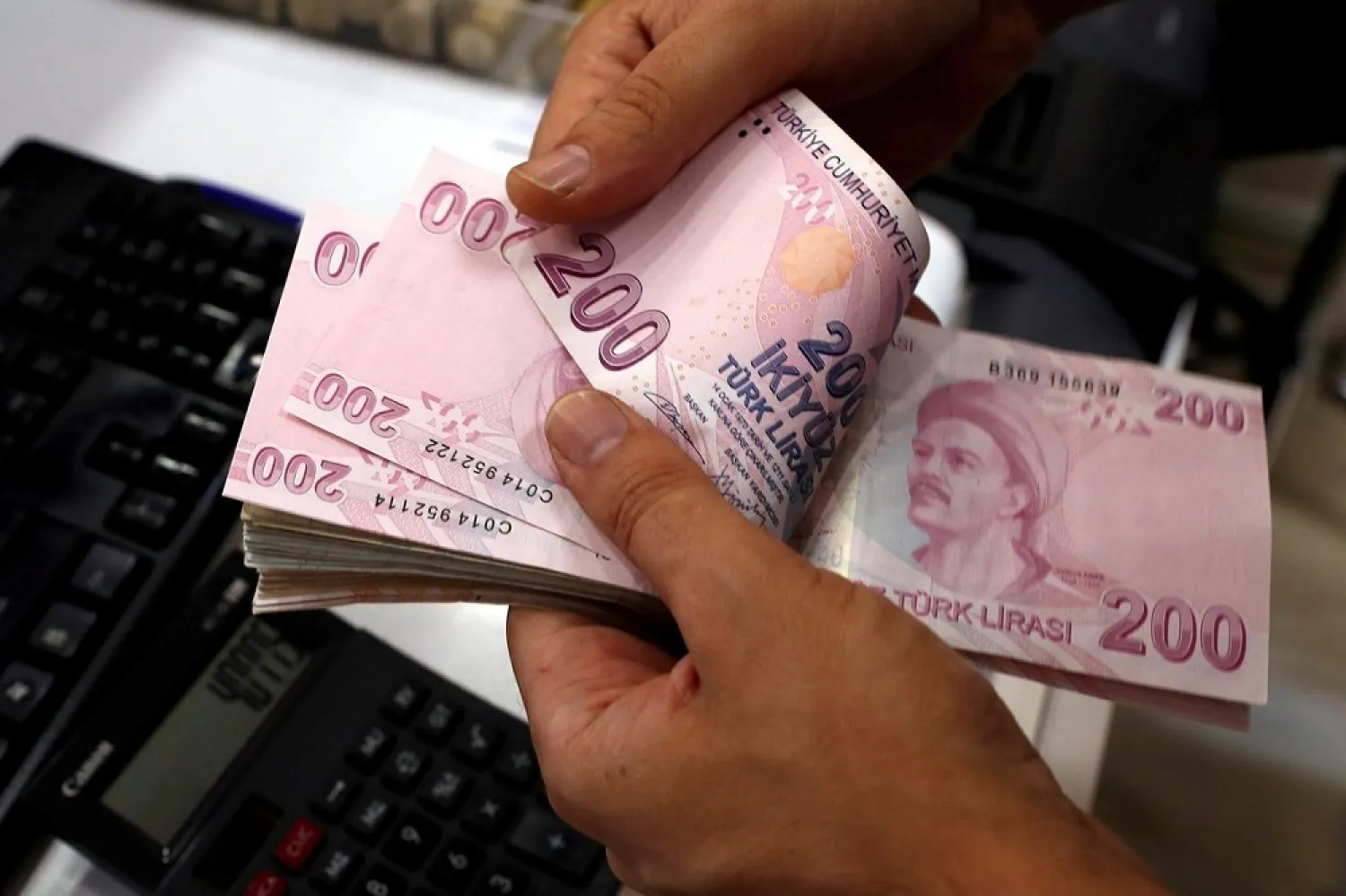

Turkish Lira Tumbles through Key Level as Syria Push Begins

The Turkish lira tumbles through key level as Syria offensive begins. (Reuters)
TT

Turkish Lira Tumbles through Key Level as Syria Push Begins

The Turkish lira tumbles through key level as Syria offensive begins. (Reuters)

Turkey’s lira slid 0.5% on Wednesday, breaking through what traders called a key support level of 5.85 against the dollar, after Turkey launched a military operation targeting Kurdish fighters in northeast Syrian.

The lira traded at 5.8660 at 1542 GMT, its weakest intraday level since August as worries grew about the fallout from the conflict and any reaction from Washington including possible sanctions.

The currency was on track for its weakest close since June.

The lira, which closed on Tuesday at 5.8350, has come under heavy pressure this week since the White House announced US troops would begin withdrawing from the Syrian region near Turkey’s border.

Just days after US troops pulled back from the area, Turkey on Wednesday launched aerial and artillery strikes targeting Kurdish YPG positions around the border town of Ras al Ain.

Risks

S&P Global Ratings said the military deployment raised risks for the lira and Turkey’s balance of payments, which has improved markedly since a currency crisis last year tipped its economy into recession.

Traders told Reuters that Turkish state banks had been selling dollars over the last three days to stop the lira from sliding beyond 5.85, a level it approached but did not breach this week until President Recep Tayyip Erdogan announced the incursion.

One trader estimated that the banks may have sold a total of $3.5 billion this week, including $1 billion on Wednesday alone, to support the lira.

“5.85 is the level,” said another trader, before it was breached on Wednesday.

The Treasury could not be immediately reached for comment about any possible interventions.

Last year’s crisis chopped some 30% off the value of the lira, which is down another 10.8% this year.

In the days before nationwide local elections on March 31 this year, Turkey directed its state banks to withhold lira liquidity from London’s overnight swap market, sources said at the time.

“State-owned banks have been allegedly selling dollars around 5.85/84, but they have not been able to prevent a break higher amid rising geopolitical risk,” said Piotr Matys, Rabobank’s emerging markets strategist, adding that the next key technical level was around 6.00.

“The response from Washington will be critical,” and Turkey’s central bank may eventually have to “seriously consider” raising interest rates to defend the lira, he added.

The lira weakened as far as 5.8465 on Tuesday before closing slightly stronger. On Monday it again approached 5.85, weakening as far as 5.8440.

The currency has been pulled in both directions this week by comments from US President Donald Trump.

A day after warning he could “obliterate” Turkey’s economy if it went too far in its Syria operation, Trump tweeted on Tuesday that Ankara was a “big trading partner” of the United States and had been “good to deal with”.

The extensive area of Ankara’s planned incursion into Syria could lead to months of military activity that raises concern in the markets, dealers say.

Turkey’s sovereign dollar bonds declined, with longer-dated issues suffering the most. The 2045 bond slipped 1.1 cents to a two-week low, Tradeweb data showed.



IMF Expects to Provide Vulnerable Economies Hit by Iran War Up to $50 bn

FILED - 24 October 2024, US, Washington: The logo of the International Monetary Fund (IMF) is pictured on the facade of the conference building on Pennsylvania Street. Photo: Soeren Stache/dpa
TT

IMF Expects to Provide Vulnerable Economies Hit by Iran War Up to $50 bn

FILED - 24 October 2024, US, Washington: The logo of the International Monetary Fund (IMF) is pictured on the facade of the conference building on Pennsylvania Street. Photo: Soeren Stache/dpa

The International Monetary Fund expects to have to provide up to $50 billion in immediate financial assistance to countries affected by the Middle East war, its managing director said on Thursday, with the crisis likely to have lasting economic effects.

"Given the spillovers of the Middle East war, we expect near-term demand for IMF balance-of-payments support to rise to somewhere between $20 billion and $50 billion, with the lower bound prevailing if the ceasefire holds," Kristalina Georgieva said, according to prepared remarks shared with AFP.

She added that food insecurity due to transport and supply chain disruptions caused by the war was expected to affect at least 45 million people.

"Even in a best case, there will be no neat and clean return to the status quo ante," she said, as a fragile ceasefire appeared to hold on Thursday.

The IMF will pare its global growth forecast for 2026 based on the impact of the crisis, with spiraling energy costs hitting some vulnerable economies harder than others.

Georgieva said that even in the Fund's "most hopeful scenario," infrastructure damage, supply disruptions and a loss of market confidence among other "scarring effects" meant growth would be less than expected.

She highlighted the "asymmetric" effects of the crisis, hitting low-income energy importers with limited fiscal space much harder than others.

"Spare a thought for the Pacific Island nations at the end of a long supply chain, wondering if fuel will still reach them in the wake of such a severe disruption," she said.


Cyprus' Aphrodite Signs 15-year Natgas Supply Deal with Egypt

A general view of a beach in Limassol, Cyprus, March 24, 2026. REUTERS/Yiannis Kourtoglou
TT

Cyprus' Aphrodite Signs 15-year Natgas Supply Deal with Egypt

A general view of a beach in Limassol, Cyprus, March 24, 2026. REUTERS/Yiannis Kourtoglou

Cyprus' offshore Aphrodite field signed a 15-year deal to sell natural gas to the Egyptian Natural Gas Holding Company, one of the ⁠partners in Aphrodite said on ⁠Thursday.

NewMed Energy said a binding term sheet was signed for ⁠the sale of all of the natural gas quantities recoverable from the Aphrodite reservoir with the national Egyptian gas company.

The term could ⁠be ⁠extended by another five years, Reuters quoted it as saying.

Last month, Egypt and Cyprus signed a framework agreement for cooperation on gas.


Simsek: Türkiye Ready with Other Measures if War Shock Persists

FILE PHOTO: Turkish Finance Minister Mehmet Simsek speaks during a meeting of Turkish Industry and Business Association (TUSIAD) in Istanbul, Türkiye, July 11, 2024. REUTERS/Murad Sezer/File Photo
TT

Simsek: Türkiye Ready with Other Measures if War Shock Persists

FILE PHOTO: Turkish Finance Minister Mehmet Simsek speaks during a meeting of Turkish Industry and Business Association (TUSIAD) in Istanbul, Türkiye, July 11, 2024. REUTERS/Murad Sezer/File Photo

The impact on Türkiye's economy of the conflict in the Middle East may be temporary and reversible if the recent ceasefire holds, and authorities are ready with a different set of tools if the shock persists, Finance Minister Mehmet Simsek said on Thursday.

In an interview on broadcaster Haberturk, Simsek ⁠said authorities are prepared ⁠with a new response beyond steps already taken if the newly agreed US-Iran ceasefire does not hold.

According to Reuters, he did not detail the potential response but said authorities' "main scenario" was for a month-long ⁠war, adding that a three-month conflict would be bad.

This week's ceasefire has mostly halted the more than five-week war that gripped the Middle East and sent energy prices soaring, although Israel bombed more targets in Lebanon on Thursday, potentially jeopardizing the deal.

Simsek said the central bank's reserves had fallen by $48.7 billion since ⁠the ⁠war began and that some $162 billion remained. They will rebound to pre-crisis levels once the war ends, he said.

If the ceasefire does not hold, he said, the risks included global recession and stagflation, and in any case it would likely take months for disrupted global supply chains to return to pre-war levels.