


Football’s Diverse Landscape Remains Polluted by Racists Despite Our Outrage

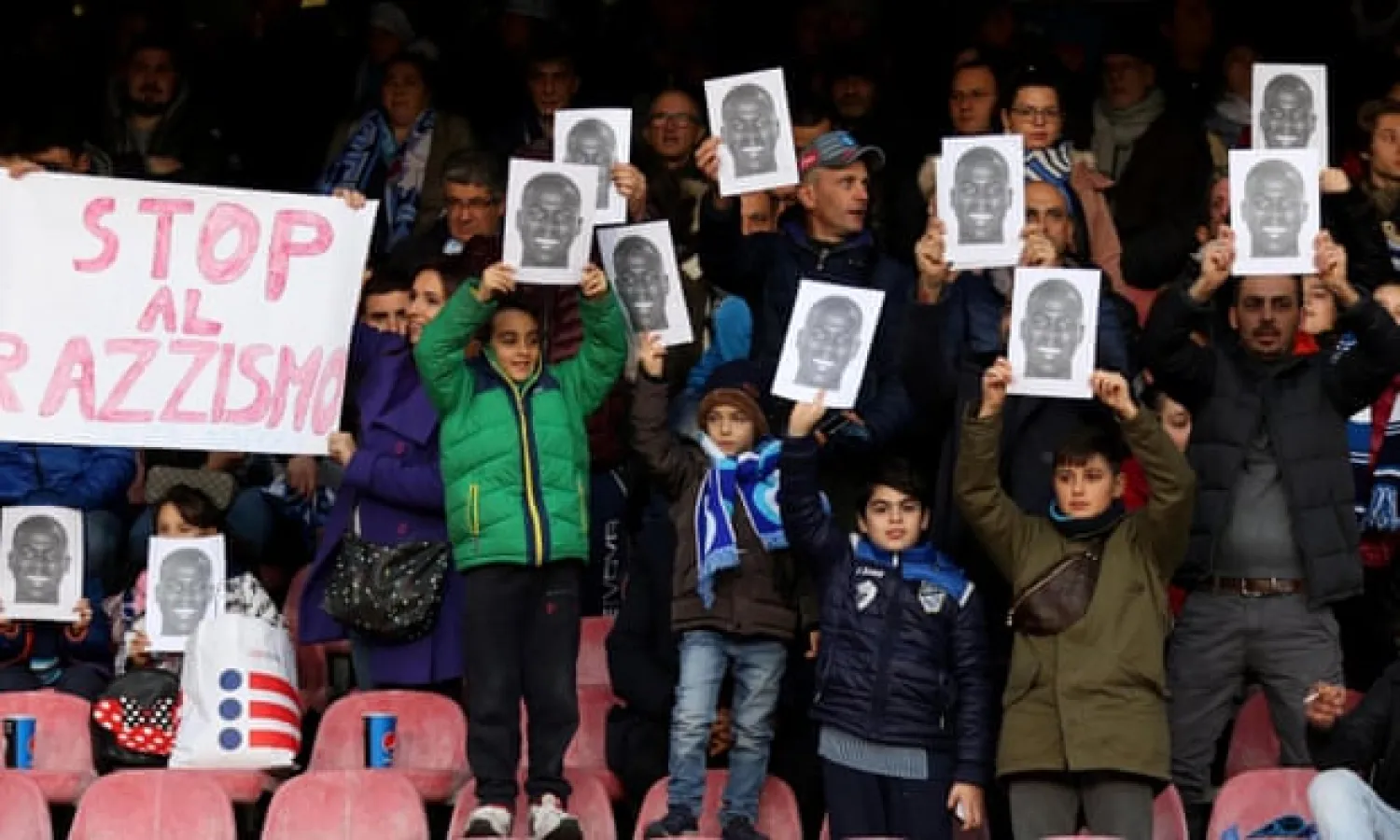
 Napoli fans hold up photographs and a banner in support of Kalidou Koulibaly after the Senegalese defender was racially abused in December 2018. Photograph: Cesare Abbate/AP
Napoli fans hold up photographs and a banner in support of Kalidou Koulibaly after the Senegalese defender was racially abused in December 2018. Photograph: Cesare Abbate/AP
TT

Football’s Diverse Landscape Remains Polluted by Racists Despite Our Outrage

 Napoli fans hold up photographs and a banner in support of Kalidou Koulibaly after the Senegalese defender was racially abused in December 2018. Photograph: Cesare Abbate/AP
Napoli fans hold up photographs and a banner in support of Kalidou Koulibaly after the Senegalese defender was racially abused in December 2018. Photograph: Cesare Abbate/AP

Last Monday Fifa’s The Best football awards were held at La Scala opera house in Milan. It was, as usual, an excruciating affair, full of turgid speeches and embarrassing links by the presenters. But amid this face-reddening fanfare the president of Fifa, Gianni Infantino, appealed to the audience of football celebrities on a serious matter. He noted that there had been another episode of racism in Italian football at the weekend and declared: “We have to say no to racism in whatever form.”

A short while later, Megan Rapinoe, winner of the women’s player of the year award, ribbed Infantino for stealing her thunder because she wanted to be the person to address these issues. Then she name-checked “Raheem Sterling and [Kalidou] Koulibaly” for taking on racism. “If we really want to have meaningful change,” she told the gathered stars, “then what I feel would be most inspiring would be if everybody other than Raheem Sterling and Koulibaly [was] as outraged about racism as they are.”

Both were noble sentiments, but what do they actually mean? Almost as if to test that question, Conguitos‑gate was unfolding. Last Sunday Sterling’s Manchester City teammate Bernardo Silva, the eloquent Portuguese midfielder, tweeted a photograph of another teammate, Benjamin Mendy, as a young child next to the cartoon that is the marketing symbol for the Spanish chocolate brand Conguitos – think of a Malteser with big red lips and large eyes. Above the images Silva wrote: “Guess who?”

It got more than 6,000 likes, including one from Kylian Mbappé, the black Paris Saint-Germain forward who appeared on stage at the Fifa event. Was the tweet racist? Silva insisted it was not and Mendy said he was not offended. But plenty of people thought it played on a racist caricature – and at the very least, one would say the logo looks as shamefully out of date as the late and not at all lamented Robertson’s jam “golliwog” mascot.

Anyway, the tweet was deleted, the anti-racism charity Kick It Out said they were “shocked”, the Football Association complained to City, and Silva tweeted his own complaint: “Can’t even joke with a friend these days … you guys.”

Of course, Silva can joke with his friend – it was sharing it with more than 600,000 followers that caused the problem. But what level of outrage directed at Silva would Rapinoe find inspiring? Obviously more than Mbappé and Mendy displayed. More, too, than John Barnes, who said the tweet was not racist.

And what can the authorities do to say no to racism, as Infantino instructed? There was talk of banning Silva for six matches. Or perhaps he needs to be sent away to a re-education camp – that is also a joke, Bernardo.

Here lies the problem with racism and combating it with outrage. First off, very few people actually believe they are racist. The week before Silva’s tweet Peter Beardsley was found guilty of using racist language when he was a youth coach at Newcastle and banned from football for 32 weeks. An FA independent panel found that the former England forward had called a black player a “monkey” during a game of head tennis and, on a team-building trip to the adventure park Go Ape, told black players: “You should be used to that.”

But the panel stated it did not think Beardsley was racist. And nor, apparently, does he. Really? “Monkey?” “Go Ape – you should be used to that?” What was he thinking? The answer, almost certainly, is he wasn’t thinking. And nor I suspect was Silva. Neither of them would sign up to a campaign that said “Yes to racism”. For them it was all just “banter”.

With obvious exceptions, racism isn't usually overt but largely an insidious, unexamined process, an accumulation of negative ideas and images – of which I would say the Conguitos mascot is a small but not inconsequential part – that eventually come bursting forth from the reptilian depths of inflamed minds.

Last weekend those ugly depths came to the surface at the National League match between Hartlepool and Dover, which was nearly called off after Dover’s Inih Effiong was racially abused by a small group of fans. But why should a few racists stop a match? And what happens when a player is targeted because his wife had an affair or due to homophobia? Should those matches be called off, too?

Racism is structural at its base. Sterling was on to something when last year he drew a contrast between how two young Manchester City players – one black, one white – were treated in press reports about their buying expensive houses for their mothers. One was celebrated, the other portrayed as flash. As Stan Collymore said at the time: “You don’t have to be a genius … to figure out which is which.” Collymore went on to blame the lack of black, Asian and minority ethnic people in the media for the problem. Doubtless it is an important factor. But it is also a little more complex than that. The Daily Mail journalist who wrote the story Sterling criticised was himself from an Asian background.

Ultimately it will not be the demise of the Conguitos mascot or unfair stories about black footballers that spells the end of racism but both will be signs that we are heading in the right direction.

In many respects football leads the argument against racial prejudice. It is an impressively diverse environment, at least among the players – the coaching side has a long way to go (hence the survival of Beardsley’s approach to team bonding).

But, if Fifa and its continental counterparts really want to say no to racism, they have a role to play, particularly with large-scale examples of it. One happened this year in Montenegro, where locals racially abused Sterling during the match with England. Such incidents should, in the first instance, lead to teams having to play behind closed doors for several matches – Montenegro were punished by Uefa for one match.

The game’s authorities should have no problem banning guilty fans because they have allowed the banning of innocent ones for many years. Rapinoe, in her speech, said she was inspired by the “young Iranian woman who eventually set herself on fire because she wasn’t able to go to the game”. She did not get a name-check but she was called Sahar Khodayari and she killed herself early this month after she was charged with committing a “sinful act” – ie, trying to watch an Iranian men’s football match.

Infantino now claims he has got Iran to admit women to future matches. But why has it taken so long? How has Iran (Saudi Arabia, too, until last year) been allowed to compete in Fifa competitions while preventing half its population from watching? Perhaps Fifa feared that, if it penalised such nations, it would be accused of racism. That would be a terrible irony.

Expressing outrage about racism is necessary. But it should never be confused with what it takes to stop it.

The Guardian Sport


Liverpool Sack Slot, Iraola in Line to Take Over

Liverpool's manager Arne Slot sits on the bench prior to the start of the English Premier League soccer match between West Ham United and Liverpool, in London, Sunday, Nov. 30, 2025. (AP)
TT

Liverpool Sack Slot, Iraola in Line to Take Over

Liverpool's manager Arne Slot sits on the bench prior to the start of the English Premier League soccer match between West Ham United and Liverpool, in London, Sunday, Nov. 30, 2025. (AP)

Liverpool sacked manager Arne Slot on Saturday, saying the club were seeking a "change of direction", after a disastrous defense of their Premier League title.

The Reds finished fifth in the table, 25 points behind champions Arsenal, despite spending a Premier League record of nearly £450 million ($605 million) on new players in one transfer window last year.

Outgoing Bournemouth boss Andoni Iraola is reportedly set to take over at Anfield after leading the Cherries into Europe for the first time in the club's history.

Just over a year ago Slot was heralded as a hero after taking on the daunting role of succeeding Jurgen Klopp and leading Liverpool to a record-equaling 20th English top-flight title in his debut season in charge.

Yet fans turned on the Dutchman this season after a series of lackluster performances.

There was also sign of dressing room disharmony, most notably from Mohamed Salah on his way out of the club.

In an explosive social media post earlier this month, which was liked by multiple members of the Liverpool squad, Salah called for a return to "heavy metal football", referring to Klopp's high energy style of play, in a perceived dig at Slot's more cautious approach.

Liverpool's return of 60 points was their lowest since the 2015/16 season.

Despite their troubles, it had been reported that Slot would be handed a stay of execution after securing Champions League qualification.

- 'Different approach' -

However, the club's owners, the American-based Fenway Sports Group, have succumbed to fan pressure to axe the former Feyenoord boss.

"We have collectively come to the conclusion that change is necessary in order for the club to keep moving forward. Again, it must be stressed that this is not a decision which has been reached lightly, anything but," the club said in a statement.

"The conclusion we have come to is built on a belief that the team's trajectory is best addressed through a change of direction. That does not diminish the work Arne has done here, or the respect we have for him. Nor is it a reflection of his talents. Rather, it is indicative of the need for a different approach.

"Arne leaves with our gratitude, with a Premier League title to his name, and with the knowledge that he and his family will always be welcomed back at Anfield."

Liverpool added that "the process to appoint a successor is under way".

Many fans were keen for the return of Xabi Alonso to Anfield, but the club's former midfielder will instead take charge of Chelsea next season.

Iraola's stock is high after an 18-game unbeaten league run to finish the campaign in sixth, just three points behind Liverpool despite vastly inferior resources.

The Spaniard also worked together with Liverpool sporting director Richard Hughes, who previously held a similar role at Bournemouth.

Slot ultimately paid for failing to get a return on Liverpool's huge investment last summer.

British transfer record signing Alexander Isak was beset by fitness problems, while Florian Wirtz struggled with the transition to the Premier League after a £100 million move from Bayer Leverkusen.

Slot, though, also had to deal with emotional turmoil caused by the death of forward Diogo Jota in a car accident in July.


Fonseca Fever Sparks Tennis Boom in Brazil

Joao Fonseca of Brazil reacts as he plays against Novak Djokovic of Serbia during their third round men's singles tennis match at the French Open tennis tournament in Paris, Friday, May 29, 2026. (AP)
TT

Fonseca Fever Sparks Tennis Boom in Brazil

Joao Fonseca of Brazil reacts as he plays against Novak Djokovic of Serbia during their third round men's singles tennis match at the French Open tennis tournament in Paris, Friday, May 29, 2026. (AP)

The rise of teenage tennis star Joao Fonseca -- who pulled off a stunning win over Serbian great Novak Djokovic at Roland Garros -- has fueled a tennis fever among the youth in his home country, Brazil.

In recent years, fans from the football-mad nation have brought their boisterous energy to typically restrained tennis matches as they followed the 19-year-old's ascension to number 30 in the world.

In Brazil, children are flocking to tennis academies and youth tournaments to follow in his footsteps.

"Today, we have no spots available. There is a waiting list," tennis coach Juninho Nascimento told AFP at his academy in Sao Bernardo do Campo, 20 kilometers from Sao Paulo.

One of his students, 13-year-old Henry Takahashi, said he trains every day, with Fonseca serving as his "inspiration".

"I like how (Fonseca) carries himself on the court, his shots... everything," Takahashi said shyly.

With his aggressive playing style, a heavy forehand, and plenty of charisma, Rio de Janeiro native Fonseca has emerged as the great hope of South American tennis.

In the process, he has put Brazil back on the map among the men's tennis elite.

On Friday he blasted Djokovic out of the French Open in an almost five-hour match.

In 2025 -- when he won his first titles on the ATP Tour in Buenos Aires and Basel -- Fonseca became just the fifth Brazilian in history to break into the top 25 of the world rankings.

His highest ranking has been 24th.

This places him in an exclusive club alongside Gustavo Kuerten -- the country's only world number one -- Thomaz Bellucci, Fernando Meligeni, and Thomaz Koch.

It had been a long time coming for Brazil: Kuerten retired in 2008, Meligeni in 2003, and Koch in 1985.

- Same racket, same moustache -

Brazil recorded a 34 percent jump in the number of participants in a national youth championship for players between the ages of 12 and 18 and the Federation Cup -- an elite tournament for rising stars in which Fonseca himself once competed.

"It's crazy! I joke with everyone: Joao Fonseca wins a match in the morning, and by the afternoon, the number of registered members goes up," Danilo Gaino, president of the Sao Paulo tennis federation, told AFP.

Thiago Freitas, Brazil operations director for the Roc Nation sports agency, said Fonseca attracted young fans.

"If you look at the boys, they're all growing little mustaches and beards just like Joao's," Nascimento said -- referring to the goatee often sported by the player.

Many also use his racket model.

Just breaking into the professional ranks, Luis "Guto" Miguel is one of Brazil's most promising young tennis players.

Ranked second in the International Tennis Federation's junior standings, the 17-year-old believes that Fonseca is "paving a path" for others to follow.

"It's a tough road. With his dedication, his shot-making, and his attitude, he helps us learn faster and reach the very top," Miguel told AFP after competing in the Latin American Open in Sao Paulo -- his debut on the ATP Tour.

In Sao Bernardo do Campo, other up-and-coming young players wrap up a practice session.

Seeing "such a young player" like Fonseca win titles is an inspiration, said one of them, Bruno Rodrigues.

"If he can do it, maybe one day we can too."


Key Talking Points Ahead of PSG vs Arsenal Champions League Final

The match ball is on display prior to a press conference, in Budapest, Hungary, 29 May 2026. (EPA)
TT

Key Talking Points Ahead of PSG vs Arsenal Champions League Final

The match ball is on display prior to a press conference, in Budapest, Hungary, 29 May 2026. (EPA)

Champions League holders Paris Saint-Germain face Arsenal in Saturday's final in Budapest aiming to defend their crown.

The Gunners have never won the trophy but after clinching the Premier League title for the first time in 22 years Mikel Arteta's side believe they can dethrone the French champions.

AFP Sport looks at five key talking points ahead of the clash at the Puskas Arena.

Arsenal's set-piece threat

This season Arteta's team have sometimes struggled to create from open play, but they have produced incredible danger from dead ball situations.

Arsenal's physical players cause havoc at corners, particularly center-back Gabriel Magalhaes, and they will look to put PSG goalkeeper Matvey Safonov under heavy pressure, perhaps their weakest link.

Set piece coach Nicolas Jover is considered the best in the business and nearly 40 percent of Arsenal's goals in their run to the Premier League title came from dead ball situations.

"People may say that they don't score team goals, but who cares about that?" said PSG coach Luis Enrique, acknowledging Arsenal's effective tactics. "Ask any Arsenal fan and I'm sure they're delighted."

PSG's strong left flank

Arsenal are boosted by Jurrien Timber's return to fitness after a groin injury, particularly given the biggest problem for Arteta to solve is how to handle PSG's left flank.

Winger Khvicha Kvaratskhelia has arguably been the competition's best player, scoring 10 goals for the French side, and behind him at left-back Nuno Mendes is a dynamic force going forward.

Arteta must decide whether to put Timber straight into the line-up after two-and-a-half months out, or if he will deploy center-back Cristhian Mosquera on the right.

Declan Rice has also been used there in Timber's absence but the midfielder will be vital in the center of the pitch up against PSG's Vitinha.

Mileage check

Many of Arsenal's likely starting line-up in the final have played over 3,000 minutes each this season across all competitions, with Declan Rice, William Saliba, Gabriel, Martin Zubimendi and David Raya hitting 4,000.

Arteta has stayed faithful to a core of players and insisted his team should not use fatigue as an "excuse".

"That's the context and that's the scenario, and we have to embrace it and especially enjoy the opportunity," said the Spanish coach last month, in the thick of the title race.

By contrast, Luis Enrique has been able to rotate and rest many of his first choice players in Ligue 1 as PSG claimed their 12th title in the last 14 years.

Only Willian Pacho, Vitinha and Warren Zaire-Emery have more than 3,000 minutes banked this season.

"Rest is also an integral part of preparation, especially when we're playing matches like these," said Luis Enrique before the final.

PSG did compete at the Club World Cup last summer though, increasing the need for the Asturian coach to balance his players' game-time.

Clean sheet machine

The statistics of both sides lead many to imagine the final will turn out to be a question of whether the "unstoppable force" of PSG can break down Arsenal's "immovable object".

Arsenal have conceded just six goals in the tournament, staying unbeaten, and goalkeeper David Raya has nine clean sheets, matching the all-time record.

In front of him Gabriel and William Saliba form a formidable center-back pairing for Ballon d'Or winner Ousmane Dembele to try and break through, amply supported by Khvicha Kvaratskhelia and Desire Doue.

PSG have scored 44 goals in the tournament, one short of the record of 45 set by Barcelona in the 1999-2000 campaign.

A Luis Enrique surprise

PSG outgunned Bayern Munich with a thrilling 5-4 victory in the first leg of the semi-final clash, leaving the world licking their lips and waiting for more entertainment from the second leg.

However, wily coach Luis Enrique changed his gameplan considerably and PSG played far more conservatively in Munich, securing a 1-1 draw to reach the final.

Always keen to spring a surprise on his opponents, Luis Enrique said the Ligue 1 champions would adapt their game to face Arsenal.

"We'll have to adapt to play and defend in a different way compared to what we usually do if we want to get the better of them," said Luis Enrique.

Goalkeeper Safonov blasted the ball off the pitch several times, as a strategy to congest the areas around dangerous Bayern Munich winger Michael Olise.

"We have analyzed everything they do in every phase," said Arteta.

"We've prepared the possible scenarios. We try to understand the purpose behind what they do and what they want to achieve."
