


A Squash Mystery in Egypt: Is there Something in the Nile?

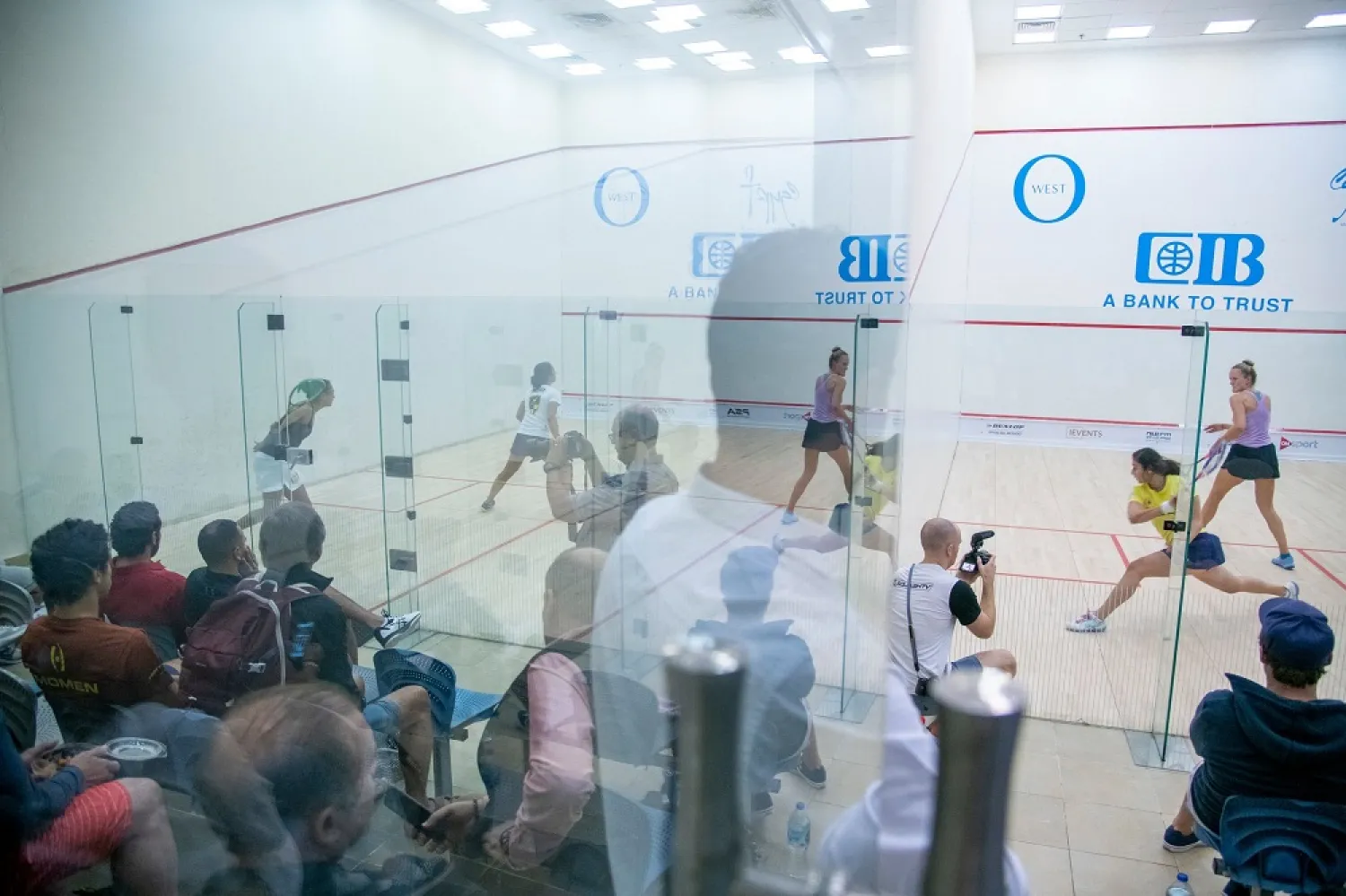
Second-ranked Nour El Sherbini, in yellow, played on a court next to El Welily in the first round of the women’s world championship. (The New York Times)
TT

A Squash Mystery in Egypt: Is there Something in the Nile?

Second-ranked Nour El Sherbini, in yellow, played on a court next to El Welily in the first round of the women’s world championship. (The New York Times)

It is one of the most compelling mysteries in sports.

Twenty years ago, Egypt could point to a handful or two of great squash players in its history, and the last time it had produced a worldbeater was in the mid-60s, when A.A. AbouTaleb won the British Open three years in a row.

Today, if victory were cake, these people would be gluttons. The top four men in the world rankings are Egyptian, and five more are in the top 20. Since 2003, an Egyptian has won the men’s world championship 10 times.

The dominance of the Egyptian women may be even more impressive, given how few played the game at the turn of the century. Four of the top five female squash players are Egyptian, including the world No. 1, Raneem El Welily, and reinforcements are on the way: The girls’ junior national team has won the world championship seven years running.

“I get asked all the time, ‘What is the big secret?’” El Welily said in a recent interview. “I tell them that is the million-dollar question. No one really knows. But there are a few theories.”

This week, those theories were revisited as Egypt demonstrated its squash prowess in a quintessentially Egyptian setting. The Professional Squash Association held its women’s world championship, with the matches at night in an outdoor glass court set up in front of the Great Pyramid of Giza.

Studied in detail, Egypt’s squash hegemony offers lessons in how any country can compete in any individual sport, with the right combination of history, culture and geography. In 1996, a breakout performance by a 19-year-old started a craze. The best athletes in Egypt were drawn by squash’s new cachet, which was bolstered when top American universities and prep schools started recruiting here. It helps that the pros are clustered in two cities, which makes it easy for young players to watch and learn from the greats.

Success begets success, and now Egypt’s biggest problem is a lagging supply of courts to meet demand. Omar El Borolossy, a former No. 14, said there were more than 2,000 players ages 5 to 10 among his academy and two other squash clubs he is familiar with in Cairo.

“That’s enough to dominate squash for the next 20 years,” he said.

Much about Egypt’s playbook could be gleaned during a visit to Cairo last month, at a three-day match attended by six of the best squash clubs in the country. Among the men’s players were Ali Farag, the world No. 1; Tarek Momen, who is No. 3; and Karim Abdel Gawad, No. 4. On the women’s side were El Welily; Nour El Sherbini, No. 2; Nour El Tayeb, No. 3; and Nouran Gohar, No. 5.

There was no money on the line, no trophy up for grabs. There wasn’t even much of an audience. It was like a game of pickup basketball in which LeBron James, Elena Delle Donne and other greats from the NBA and the WNBA. got together to play, largely in private.

One of the players was an American, Sabrina Sobhy, who is ranked 61st. She was so amazed by the dominance of Egyptian squash players that in August she relocated to Cairo.

“I came to crack the code,” she said during pre-match stretching.

She quickly learned the most obvious part of Egyptian squash exceptionalism: concentrated quality. The United States has far more squash players — about 1.7 million, according US Squash, the sport’s national governing body — and roughly 3,500 courts.

Egypt has about 400 courts and fewer than 10,000 players, say players and coaches. But the finest Egyptian players are bunched in about 10 clubs in two cities, Cairo and Alexandria, which are about a three-hour drive apart.

For aspiring players, proximity to greatness “is like a performance-enhancing drug,” said Daniel Coyle, author of “The Talent Code,” which chronicles talent outbreaks in different sports and countries. “These young players get to see how the greats play, train, eat.”

But how did Egypt produce so much talent in the first place?

Some history. Squash was born at Harrow, a private school in England, early in the 19th century, and was exported to colonies through clubs built for British officers. (To this day, Egyptian players score and referee their matches in English.) For years, the sport was a niche product in Egypt, until 1996, when young Ahmed Barada tore through the draw as a wild card at the inaugural Al-Ahram International, the first time a tournament was held beside the Great Pyramid of Giza.

Barada lost in the final, but his on-court aggression and hunky good looks, set against that ancient backdrop, made him a national hero. “A Star Is Born,” read a front-page headline in Al-Ahram, the newspaper that organized the tournament. It helped that one of his most vocal supporters was the president at the time, Hosni Mubarak, a squash player and enthusiast himself.

Barada won the Al-Ahram in 1998 and ultimately reached No. 2 in the world rankings. He retired from the game in 2001, a year after he was stabbed near his home in Cairo, an unsolved crime. He recorded an album of pop songs, then starred in a romantic comedy called “Girl’s Love.” Today, he is an executive at a gold mining company who revels in the aftermath of his days on the court.

“Everyone wanted to be like me,” he said in a phone interview. “Those tournaments were on television, so people who’d never heard of squash were suddenly watching it. And there were 5,000 people in the stands.”

One of those people was El Welily, who was 8 at the time. Coyle refers to Barada’s breakout as “an ignition event” — an improbable athletic achievement that inspires others.

In 2003, Egypt had its first squash world champion in decades. It was Amr Shabana, a calisthenic lefty who combined unparalleled speed with put-away shots as startling as magic tricks. He won the title three more times. Starting in 2006, an Egyptian has been the top-ranked male player nine and a half of the last 13 years.

It helped Egyptian squash that as it rose, rivals declined, in part because children in other countries where squash is popular, like Britain, had more options.

Since 2008, Britain has won 75 gold medals in three summer Olympics, in sports as varied as boxing, diving, tennis, field hockey, sailing, swimming, taekwondo and track and field. Egypt has won none. (Squash has never been an Olympic sport, to the boundless irritation of fans.)

For 20 years, squash has been the second most prestigious sport in Egypt, behind football. So for Alexandria-born El Sherbini, 23, who has won three women’s world championships — she is known here as Miracle Girl — a squash career was all but inevitable.

Egyptians have also changed how squash is played. For decades, the game’s default strategy centered on wearing down an opponent through lengthy rallies. It’s a methodical, attrition-based approach that takes time, which Egyptians apparently don’t have in abundance.

“Have you seen the way we drive?” said El Tayeb, the women’s world No. 3, during a break after a match.

Egyptian squash is dynamic and unstructured, with out-of-nowhere drop shots and deceptive flicks of the wrist. Time and again, players and coaches described their attitude toward the game as “undisciplined,” by which they mean it is improvised and unscientific. Most would rather play a match than hone a skill through repetitive drilling.

El Tayeb and fellow professionals are not chasing riches, at least by the standards of more popular professional sports. The average professional squash player earns about $100,000 a year, and the top player earned about $280,000 in all of 2018, according to the website Improve Squash. That’s roughly what tennis players earned for reaching the round of 16 at the United States Open in 2019.

But squash has plenty of social capital, and it is often a path to a spot at a top American university or prep school. There are four Egyptian players at Harvard. Behind many of the best young players in Egypt are parents hoping their children will get the finest education.

“Egyptian mothers are like our secret weapon,” said Amir Wagih, a former member of Egypt’s national team and a full-time coach.

The New York Times


Kobe's Sasaki Scores Late Penalty to Claim Draw in Asian Champions League

Soccer Football - Friendly - Vissel Kobe v FC Barcelona - Japan National Stadium, Tokyo, Japan - June 6, 2023 Vissel Kobe players pose for a team group photo before the match REUTERS/Kim Kyung-Hoon/File Photo
TT

Kobe's Sasaki Scores Late Penalty to Claim Draw in Asian Champions League

Soccer Football - Friendly - Vissel Kobe v FC Barcelona - Japan National Stadium, Tokyo, Japan - June 6, 2023 Vissel Kobe players pose for a team group photo before the match REUTERS/Kim Kyung-Hoon/File Photo

Hosts Vissel Kobe salvaged a 2-2 draw with Chinese Super League outfit Chengdu Rongcheng through Daiju Sasaki's 90th-minute penalty in the Asian Champions League Elite on Tuesday to bring down the curtain on coach Takayuki Yoshida's time in charge.

Yoshida announced last week that he was standing down after three-and-a-half years in charge having led the club to the J-League title in 2023 and 2024, but Kobe were unable to give the 48-year-old a winning send-off.

Yoshinori Muto put Kobe in front in the 18th minute when he scored on the turn from eight yards out but Chengdu forward Felipe lashed in the equaliser from distance in first half stoppage time, Reuters reported.

The Brazilian was on target again from the penalty spot with 13 minutes remaining, although Sasaki was also successful with his spot kick in the final minute to earn Kobe a point.

The draw means Kobe are two points clear in the eastern league phase standings of second-placed Machida Zelvia, who cruised to a 3-1 win over Ulsan HD from South Korea.

Asahi Masuyama gave the home side the lead when he deflected Hokuto Shimoda's volley past Jo Hyeon-woo in the sixth minute and Takuma Nishimura doubled the advantage 15 minutes later.

Oh Se-hun's header two minutes into the second half extended Machida's lead before Um Won-sang slid in to score a consolation for Ulsan in the 55th minute.

GOALKEEPER CHEN DENIES JOHOR DARUL TA'ZIM

Johor Darul Ta'zim moved up to sixth with a 0-0 draw against Shanghai Port with the Malaysian side thwarted by a stellar performance from Chinese goalkeeper Chen Wei while Bergson and Nacho Mendez hit the woodwork for the hosts.

Buriram United, meanwhile, were frustrated by a late penalty decision that earned Gangwon FC a 2-2 draw in Thailand after Mark Jackson's side had come from behind to lead.

Mo Jae-hyeon put the visitors in front in the 33rd minute but Ko Myeong-seok's header levelled the scores 13 minutes into the second half.

Suphanat Mueanta's calm finish from an angle put Buriram in front in the 65th minute before Guilherme Bissoli was judged to have fouled Park Ho-yeong in the area. Kim Dae-won converted the 74th-minute spot kick to earn his side a point.

The first eight finishers in the 12-team league phase will advance to March's last 16 in both east and west Asia with the quarter-finals, semi-finals and final to be played in a centralized venue in Saudi Arabia in April.


Salah-less Liverpool Plays Inter in Champions League. Barcelona, Bayern, Chelsea All in Action

Liverpool's Mohamed Salah passes manager Arne Slot, left, as he takes part in a training session in Liverpool, England, Monday, Dec. 8, 2025. (AP Photo/Jon Super)
TT

Salah-less Liverpool Plays Inter in Champions League. Barcelona, Bayern, Chelsea All in Action

Liverpool's Mohamed Salah passes manager Arne Slot, left, as he takes part in a training session in Liverpool, England, Monday, Dec. 8, 2025. (AP Photo/Jon Super)

After leaving Mohamed Salah at home, Liverpool needs to show it can win without the Egyptian forward as Arne Slot's team takes on Inter Milan in the Champions League on Tuesday.

On a night when Barcelona, Bayern Munich, Chelsea and Tottenham are all in action, the focus is on Liverpool after Salah said Saturday it “seems like the club has thrown me under the bus.” Liverpool's response was to leave him out of the squad for its trip to Italy, The Associated Press said.

Liverpool's poor recent form boosts Inter's chances of picking up a fifth win in six games. A win for 13th-place Liverpool would put Slot's team back into the hunt for the top eight seedings for the knockout stages.

After losing its last Champions League game 3-0 to Chelsea, Barcelona aims to recover at home to struggling Eintracht Frankfurt. It will have to do without defender Ronald Araujo, who is suspended after his red card against Chelsea and has also been unavailable for personal reasons.

Seventh-place Chelsea is unbeaten in four Champions League games and visits Atalanta aiming to strengthen its hold on a top-eight spot offering direct entry to the round of 16. Bayern can earn its fifth win of the league stage by beating Sporting Lisbon in an early kickoff.

Tottenham, which lost 5-3 to Paris Saint-Germain last time out, has an easier task against Czech team Slavia Prague. Atletico Madrid visits PSV Eindhoven, Monaco hosts Galatasaray and Union Saint-Gilloise plays Marseille.

One game starts in an unusually early window at 1530 GMT (10:30 a.m. ET) as Kazakhstan's Kairat Almaty hosts Greece's Olympiacos.


SEA Games to Open in Thailand with Tightened Security

Security was heightened at the Southeast Asian Games after Thailand-Cambodia border clashes reignited. Chanakarn Laosarakham / AFP
TT

SEA Games to Open in Thailand with Tightened Security

Security was heightened at the Southeast Asian Games after Thailand-Cambodia border clashes reignited. Chanakarn Laosarakham / AFP

The Southeast Asian Games officially open in Bangkok on Tuesday with security for athletes tightened due to fresh border clashes between Thailand and Cambodia.

The SEA Games run until December 20 in Bangkok and the nearby coastal province of Chonburi, with thousands of athletes from 11 southeast Asian countries competing in events ranging from football and fencing to skateboarding, sailing and combat sports, reported AFP.

They include world-class performers such as Olympic weightlifting gold medallists Hidilyn Diaz of the Philippines and Rizki Juniansyah of Indonesia, and Thailand's badminton silver medallist Kunlavut Vitidsarn.

The Thai King and Queen are scheduled to open the Games ceremony at the Rajamangala National Stadium in Bangkok Tuesday evening, with a performance South Korea–trained Thai artist BamBam.

Far from the competition, renewed combat this week over a long-standing border dispute between Thailand and Cambodia has killed six Cambodian civilians and three Thai soldiers, and wounded more than 20 others.

Citing safety concerns, Cambodia last month withdrew about half of its athletes, pulling out of eight events including football, wrestling, judo and karate.

Thailand's deputy Prime Minister Thammanat Prompao said Tuesday that Thailand will "ensure the highest level of security" for Cambodian at athletes during the ongoing border tensions.

Security personnel will be deployed to guarantee their safety, he said, though specific operational details were not disclosed.

Thailand is hosting the SEA Games, which take place every two years, for the first time since 2007. They were first held in Bangkok in 1959.

The SEA Games are known for inclusion of non-Olympic sports from the region such sepak takraw, foot volleyball played with a rattan ball and pencak silat, a martial art popular in Indonesia.
