

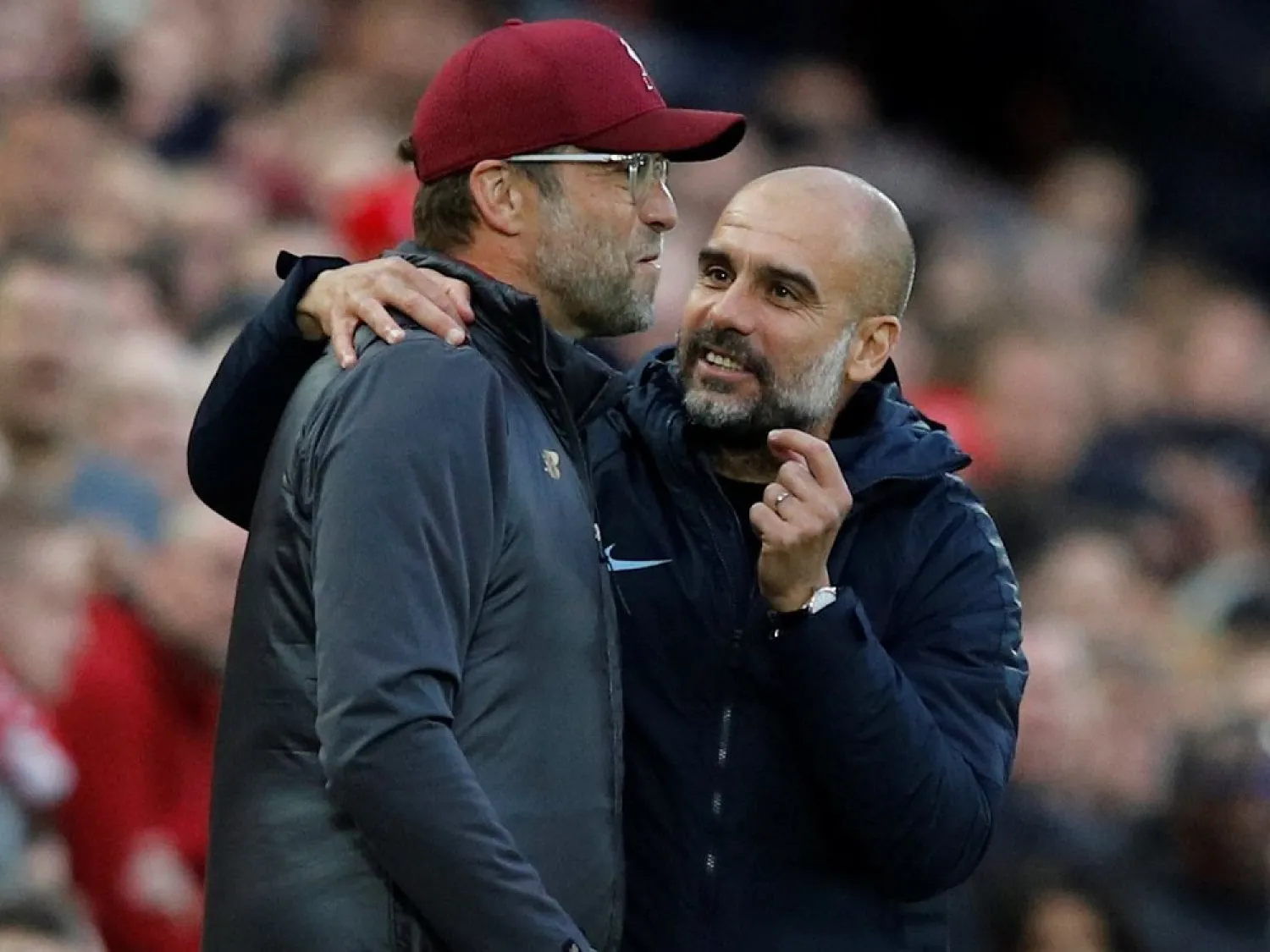

Can Liverpool vs. Manchester City Be Accepted as England’s Biggest Game?

Liverpool manager Jurgen Klopp (L) with Manchester City manager Pep Guardiola. (Reuters)
TT

Can Liverpool vs. Manchester City Be Accepted as England’s Biggest Game?

Liverpool manager Jurgen Klopp (L) with Manchester City manager Pep Guardiola. (Reuters)

Crunch time arrives in the Premier League at the weekend. It is only necessary to glance at the league table now or last season to see why games between Liverpool and Manchester City are important in terms of the title race. The managers have had a nibble at each other over diving and tactical fouling in the buildup and few attending Anfield on Sunday will doubt that one side or the other will end up champions, yet for a variety of reasons there seems a reluctance to accept this fixture as the biggest in English football.

Perhaps the most obvious one is that it is not yet the biggest rivalry in English football. When it was suggested to Jürgen Klopp last season that the City game might soon assume the significance of Liverpool’s ancient battle for supremacy with Manchester United, with all its perch-clearing braggadocio and title hauls running into double figures, even a German knew England well enough to dismiss the notion as rubbish.

It is not that Klopp feels the United rivalry particularly keenly – during his time in England he has never had to encounter a sustained threat from the direction of Old Trafford – it is more that like everyone else he doubts whether City and Liverpool have been going at it long enough to claim a place at the forefront of this country’s footballing culture.

Liverpool have not won a league title for 30 years, and in those circumstances Klopp is understandably wary of claiming his side are at the forefront of anything. City have been the team to beat for two impeccable campaigns now – last season they added a clean sweep of domestic trophies to their impressive 100-point total in 2017-18 – yet before the overseas money arrived they were even longer in the wilderness between titles, not to mention dropping as low as the third tier of English football.

So while this particular two-team hegemony is a new twist at the top of the Premier League, no one quite knows how long it will last and a certain amount of ill-feeling building up over time is what is required to produce memorable set pieces such as Arsenal’s Battle of the Buffet at Old Trafford or Rafa Benítez’s infamous list of facts.

Klopp and Pep Guardiola seem to quite like each other. On the evidence of previous meetings mutual admiration is more likely than mischief or mind games and to an extent the same is true of both sets of supporters. There is not much history of grudge or animosity between Liverpool and City fans, even if the former did give the visitors’ coach a rough ride when the teams met in the Champions League at Anfield two seasons ago. All too plainly their common dislike of Manchester United is greater than any rancorous mistrust of each other.

What might it take then, to turn the absorbing battle between the best two sides in the country into a fully fledged rivalry, something to be savored in the present and remembered down the years? It would undoubtedly help for a start were Guardiola and Klopp to stick around for several more seasons.

At the moment they are not perceived as permanent fixtures at their clubs; Guardiola especially is expected to continue moving around rather than putting in many more years at the Etihad Stadium and the idea that City and Liverpool have achieved their present levels of excellence by bringing in the best European managers available on a short-term basis is contributing to the feeling that this phase of English football might be a relatively transitory one.

Short-term is itself a relative construct – both managers have been at their clubs for three or four years already and could easily stay much longer – but it would be a considerable surprise were either to last half as long as Sir Alex Ferguson or Arsène Wenger. Nothing wrong with that, probably no one is going to manage that sort of longevity in the Premier League again, though as Klopp and Guardiola are undoubtedly wringing the utmost from their respective sets of players it follows they might be hard to replace without a drop in performance.

Without attempting to look too far into the future, it is not easy to see how City or Liverpool will be able to carry on seamlessly under different managers and the suspicion that succession problems lie ahead adds to the impression that these two sides may never have it quite so good again.

Before all that is worked out, however, another intriguing possibility could take shape. Supposing City were to win the Champions League this season, and Liverpool end their wait for a league title? This was a plausible scenario for much of last season and remains so this time.

Given City’s frustrations in Europe over the years and Liverpool’s overwhelming desire to see their title total ticking over again, both clubs would be highly satisfied with such an outcome. It is not a binary situation: either City or Liverpool could win both prizes, or end up with one between them or nothing at all, though there would be a pleasing symmetry should last season’s roles be reversed.

This mirror-image conclusion would not be a first for English football or even for Liverpool. Bob Paisley’s side won the European Cup in 1978 and the First Division title a year later, while Brian Clough’s Nottingham Forest were European champions in 1979 a season after picking up their first and only English title.

While that was not the most long-lasting of rivalries either, it was feisty at the time and the names will never be forgotten. If City and Liverpool can stage some sort of repeat, in the intensified era of the Premier League and the Champions League, it is probably safe to say that history will take due note.

The Guardian Sport


French Player Folliot Suspended for 20 Years over Match-fixing

Paris 2024 Olympics - Tennis Training - Roland Garros Stadium, Paris, France - July 24, 2024. General view of tennis balls during training REUTERS/Claudia Greco
TT

French Player Folliot Suspended for 20 Years over Match-fixing

Paris 2024 Olympics - Tennis Training - Roland Garros Stadium, Paris, France - July 24, 2024. General view of tennis balls during training REUTERS/Claudia Greco

French player Quentin Folliot has been suspended for 20 years for committing 27 breaches of tennis's anti-corruption program, the International Tennis Integrity Agency (ITIA) said on Thursday.

Folliot was a central figure in a network of players operating on behalf of a match-fixing syndicate, an ITIA investigation found, and is the sixth player to be sanctioned as a result.

Folliot's career-high ranking was 488th, according to the ATP, and he earned prize money of $60,047 in singles and doubles.

The Frenchman denied 30 charges relating to 11 matches between 2022 and 2024, eight of which he played in, and an independent Anti-Corruption Hearing Officer, Amani Khalifa, upheld 27 of the charges in October.

Khalifa's written decision said the 26-year-old Folliot was "a vector for a wider criminal syndicate, actively recruiting other players and attempting to embed corruption more deeply into the professional tours".

Folliot, who was provisionally suspended in May 2024, has also been fined $70,000 and ordered to repay corrupt payments totaling more than $44,000, Reuters reported.

Time served under the provisional suspension was credited against his period of ineligibility meaning Folliot's ban will end on May 16 2044, subject to repayment of outstanding fines.


Morocco Pick Hakimi, Confident He Will be Ready for Cup of Nations

Paris 2024 Olympics - Football - Men's Quarter-final - Morocco vs United States - Parc des Princes, Paris, France - August 02, 2024. Achraf Hakimi of Morocco celebrates scoring their third goal. REUTERS/Piroschka Van De Wouw/File Photo
TT

Morocco Pick Hakimi, Confident He Will be Ready for Cup of Nations

Paris 2024 Olympics - Football - Men's Quarter-final - Morocco vs United States - Parc des Princes, Paris, France - August 02, 2024. Achraf Hakimi of Morocco celebrates scoring their third goal. REUTERS/Piroschka Van De Wouw/File Photo

Hosts Morocco have included African Footballer of the Year Achraf Hakimi in their 26-man squad for the Africa Cup of Nations, confident he will recover from an ankle injury in time to play.

There had been concern about the full back's availability for the tournament, which kicks off on December 21, after suffering a severe sprain of his left ankle during Paris St Germain's 2-1 defeat by Bayern Munich in the Champions League last month, according to Reuters.

Coach Walid Regragui had already expressed optimism that Hakimi would be available to captain the team in the opening match against Comoros in Rabat.

"He's been working hard since his injury and doing what he has to do. He's a hard worker. He wants to be there from the first match," the Moroccan coach told French radio at the weekend.

Left out of the squad, but named as a reserve is Lille striker Hamza Igamane, who hurt his adductors playing against Olympique de Marseille last Friday.

Igamane has made a major impact in Ligue 1 and with the Morocco side and was expected to be a starter at the tournament for the hosts.

Morocco, who were semi-finalists at the last World Cup and are heavily fancied for home success, also take on Mali and Zambia in Group A.

Squad

Goalkeepers: Yassine Bounou (Al Hilal), Munir El Kajoui (Renaissance Berkane), El Mehdi Al Harrar (Raja Casablanca)

Defenders: Nayef Aguerd (Olympique de Marseille), Abdelhamid Ait Boudlal (Stade Rennais), Mohamed Chibi (Pyramids), Jawad El Yamiq (Al Najma), Achraf Hakimi (Paris St Germain), Adam Masina (Torino), Noussair Mazraoui (Manchester United), Romain Saiss (Al Sadd), Anass Salah-Eddine (PSV Eindhoven)

Midfielders: Sofyan Amrabat (Real Betis), Eliesse Ben Seghir (Bayer Leverkusen), Brahim Diaz (Real Madrid), Neil El Aynaoui (AS Roma), Bilal El Khannous (VfB Stuttgart), Azzedine Ounahi (Girona), Oussama Targhaline (Feyenoord)

Forwards: Ilias Akhomach (Villarreal), Ayoub El Kaabi (Olympiakos), Youssef En-Nesyri (Fenerbahce), Abdessamad Ezzalzouli (Real Betis), Soufiane Rahimi (Al Ain), Ismael Saibari (PSV Eindhoven), Chemsdine Talbi (Sunderland).


Verona's Ancient Roman Arena Gets Modern Facelift for 2026 Winter Olympic Games

Visitors enjoy their tour at the Arena of Verona, Italy, Wednesday, Dec. 10, 2025. (AP Photo/Luca Bruno)
TT

Verona's Ancient Roman Arena Gets Modern Facelift for 2026 Winter Olympic Games

Visitors enjoy their tour at the Arena of Verona, Italy, Wednesday, Dec. 10, 2025. (AP Photo/Luca Bruno)

Verona’s ancient Roman Arena will receive a modern facelift and become more accessible to people with disabilities ahead of the 2026 Milan Cortina Games, where it will host both the Olympic closing ceremony and the Paralympic opening ceremony.

Built by the Romans in the 1st Century, the Verona Arena was envisioned for gladiator fights and ancient hunts of exotic beasts, repurposed as a Medieval marketplace and most recently functions as the venue of a renowned opera festival.

In none of its previous iterations has the imposing structure been made suitably accessible for disabled people or those needing assistance of any kind. In addition, some safety features intended as stopgaps have endured for decades without being updated.

The upcoming Games have provided the occasion to give the ancient Arena — which predates the Roman Colosseum by decades — an accessibility and safety makeover before it hosts an expected 11,000 people for the Feb. 22 closing ceremony and nearly 10,000 for the Paralympic opening ceremony on March 6.

“This is an ancient monument that is some 2,000 years old, that remains active and hosts audiences,” said architect Giulio Fenyves, whose Milan studio designed the new safety and accessibility features.

“The occasion of the Olympics has made it possible to reconsider a series of logistical aspects, including facilitating the entry and exit, precisely because it continues to host major events with thousands of people,” The Associated Press quoted Fenyves as saying.

The facelift is part of an 18-million-euro ($21 million) project that improves accessibility for the entire area surrounding the Arena and is being overseen by the governmental company responsible for Olympic infrastructure.

The works include making a kilometer-stretch of sidewalks from Verona’s main train station to the Arena safer for wheelchairs or baby strollers by building small curb ramps. Dedicated bike lanes are also being built.

Paralympians participating in the Parade of Athletes up Corso Porta Nuova, across Piazza Bra, and into the Arena will find that the route has been significantly upgraded for people who require wheelchairs or have other mobility issues.

The work is being coordinated with officials responsible for the preservation of the monument as well as those overseeing accessibility codes to bring the structure more in line with current legislation.

The new elements “must be integrated in the most delicate and harmonious way possible to a monument that is both robust and fragile at the same time,” Fenyves said.

Inside the Arena, the centerpiece project is a wheelchair-accessible ramp clad with pre-rusted steel and the same Prun stone from the Lessinia hills above Verona that was used by the Romans to build the Arena.

The local stone gives the Arena its pinkish-yellow hue and contains fossilized shells — remnants of a prehistoric sea that once covered this region now known for hills and vineyards.

The ramp will be removable, but project manager Paolo Zecchinelli said he hopes that it will be retained as a legacy of the Games.

Until now, people with wheelchairs or walkers approached from a natural slope leading down from the adjacent Piazza Bra.

In addition to the ramp that is meant to blend with the Arena’s original features, the local organizing committee is planning an ad hoc temporary ramp to accommodate not only disabled spectators and athletes, but also the elderly, families with children and anyone needing assistance.

The overall project also includes a new railing along the top level of the Arena to replace one built in the 1950s that was meant to be temporary, as well as new handrails at varied heights on internal stairways and at the 72 entrances to the tiered seats. Bathrooms are being renovated by the city, and the infrastructure company is making new ramps to make them more accessible.

Work will continue after the Olympics and Paralympics, including the installation of an elevator that will allow people with limited mobility to reach the Arena's uppermost level, either to watch a show or take in a view of the surrounding hills.

“A part will remain as a gift to the city, which will help this beautiful monument to be more accessible both to people who tour it and those who attend opera performances and other concerts,” Zecchinelli said.
