


Suez Canal is 'Lifeline' for Egypt, Says Authority Head

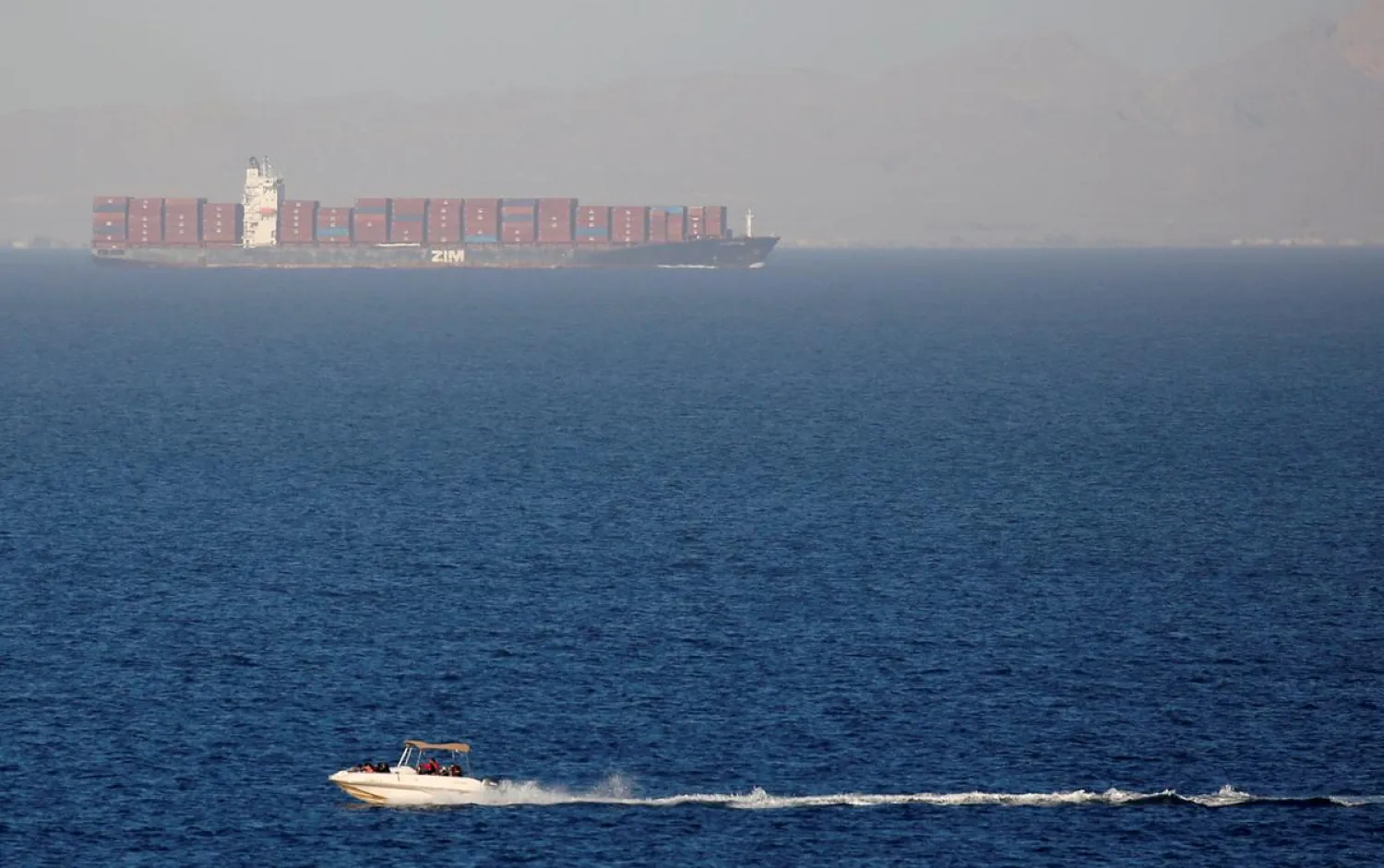
FILE PHOTO - People sail on a boat near a container ship crossing the Gulf of Suez towards the Red Sea before entering the Suez Canal, near El Ain El Sokhna in Suez, east of Cairo, Egypt, March 17, 2018. REUTERS/Amr Abdallah Dalsh
TT

Suez Canal is 'Lifeline' for Egypt, Says Authority Head

FILE PHOTO - People sail on a boat near a container ship crossing the Gulf of Suez towards the Red Sea before entering the Suez Canal, near El Ain El Sokhna in Suez, east of Cairo, Egypt, March 17, 2018. REUTERS/Amr Abdallah Dalsh

One hundred and fifty years after the Suez Canal opened, the international waterway is hugely significant to the economy of modern-day Egypt, which nationalized it in 1956.

The canal, which links the Mediterranean to the Red Sea, was opened to navigation in 1869 and was expanded in 2015 to accommodate larger ships. 

Dug in the 19th century using "rudimentary tools," the canal has today become "a lifeline for Egypt and countries around the world," Admiral Osama Rabie, head of the Suez Canal Authority, told Agence France Presse in an interview.

"We give credit to Ferdinand de Lesseps for putting forward the idea," he said, referring to the French diplomat who masterminded the waterway dug over a decade between 1859 to 1869.

But he insisted it was thanks to the "genius" of the Egyptian people that the project really came to life.

"It was a miracle by all accounts to excavate a 164-kilometer-long canal in 10 years with rudimentary tools," he said.

"A quarter of Egyptians took part in the excavations, that was about a million citizens out of the population of 4.5 million people at that time." 

In 2015, Egyptians threw their support behind President Abdel Fattah al-Sisi's project to expand the canal, "purchasing 64 billion Egyptian pounds (3.5 million euros, $3.8 million) of investment certificates within eight days". 

Thanks to that project, transit time has now been cut from 22 to 11 hours, and the number of vessels crossing daily has increased from an average of 40-45 to 60-65 giant tankers, he said. 

Nowadays, container ships account for more than half of the canal's total traffic, with some of them being among the largest in the world reaching a capacity of up to 23,000 TEU (twenty-foot equivalent unit). 

Giant oil tankers carrying more than 200,000 tons can now transit through the canal as well. 

Authorities have also sought to develop the Sinai Peninsula, which lies on the eastern edge of the canal.

"We have also dug six tunnels under the Suez Canal to facilitate movement crossing to and from the Sinai," Rabie told AFP.

"Before we used to talk about developing the Sinai peninsula without any serious decisions having been taken. Now access is easy for people and investors." 

Egypt is also developing a free-zone trade hub spanning 461 square kilometers known as "the Suez Canal Economic Zone". 

"Many projects exist along the banks," said Rabie, citing ship supply zones, pharmaceutical factories and car assembly plants. 

He maintained also that the canal "is perfectly secured" under the command of the Egyptian armed forces. 

Ongoing fighting between the Egyptian army against militants in North Sinai "has not affected" the canal or trade, he stressed.



Türkiye Central Bank Holds Rates at 37% as it Eyes Iran War Fallout

Central Bank of Türkiye (official website)
TT

Türkiye Central Bank Holds Rates at 37% as it Eyes Iran War Fallout

Central Bank of Türkiye (official website)

Türkiye's central bank held its key interest rate at 37% as expected on Wednesday, deciding not to hike but warning that fallout from the Iran war could yet change the inflation outlook.

It was the second straight policy meeting at which the bank held steady despite some expectations that it could tighten, suggesting it was preparing to stand pat well into the summer, analysts said.

The central bank also did not adjust its overnight lending and borrowing rates from 40% and 35.5% respectively. Since the war started in late February, it has halted an easing cycle that began in late 2024 and taken other liquidity steps that pushed the lira overnight rate up to the 40% limit - moves that prompted some analysts to predict a 300-point hike this week.

The bank said it is closely monitoring any "potential second-round effects" on inflation, for which "leading indicators suggest a slight increase in the underlying trend in April".

"Amid geopolitical developments and the resulting uncertainties, energy prices remain elevated and exhibit notable volatility," its policy committee added.

In a Reuters poll, 19 of 23 economists predicted no change to borrowing costs, while four forecast a rate hike. The war-related surge in energy prices has rattled import-heavy economies like Türkiye where inflation was 30.87% last month, but where expectations have risen. On Tuesday, US President Donald Trump extended the war ceasefire indefinitely.

The ceasefire allowed the central bank "to refrain from tightening," William Jackson, economist at Capital Economics, said in a note. "So long as energy prices don't spike again, we think the CBRT will opt to leave interest rates on hold for at least a few more months."

Economists generally anticipate that rate cuts may resume in September. The Reuters poll predicted rates would be cut to only 32.75% by year-end. A separate poll found end-2026 consumer price inflation at 27.53%, compared with 25.38% in a previous poll.

In its quarterly inflation report in February - before the war began - the central bank had kept its end-2026 interim inflation target at 16%, while lifting its forecast range to 15-21% from 13-19% previously.

A year ago, the central bank temporarily reversed course and hiked rates in the face of political instability that rattled markets, though it returned to rate cuts by mid-2025.


Oil Prices Rise despite US-Iran Ceasefire Extension

FILE PHOTO: FILE PHOTO: A view shows oil pump jacks outside Almetyevsk in the Republic of Tatarstan, Russia June 4, 2023. REUTERS/Alexander Manzyuk/File Photo
TT

Oil Prices Rise despite US-Iran Ceasefire Extension

FILE PHOTO: FILE PHOTO: A view shows oil pump jacks outside Almetyevsk in the Republic of Tatarstan, Russia June 4, 2023. REUTERS/Alexander Manzyuk/File Photo

Oil prices edged higher Wednesday while Europe's main stock markets eased on uncertainty surrounding the prospect of resumed Mideast peace talks following an extension to the US-Iran ceasefire.

Asian equities had a mixed trading day as investors wait for clarity but broadly expect that both US President Donald Trump and the authorities in Iran want to end a war that has sent oil and gas prices soaring.

"The ceasefire extension hasn't done much to calm nerves given that worries remain about the impact of the energy squeeze on the global economy," said Susannah Streeter, chief investment strategist at Wealth Club, AFP reported. 

"Shipments from the Middle East are in limbo and a resolution to the conflict remains elusive, and the price of Brent crude, the benchmark, reflects this."

Brent North Sea was once more closing in on $100 a barrel while main US contract, West Texas Intermediate, traded back above $90.

Iranian gunboats attacked at least one container ship in the Strait of Hormuz on Wednesday, maritime agencies said, despite US President Donald Trump announcing he was extending a ceasefire to allow more time for peace talks.

Trump said the US blockade of Iran's ports would continue while Pakistani mediators try to revive dialogue.

Tehran has all but shut the strait in the seven weeks since the United States and Israel launched attacks on Iran that plunged the Middle East into war, with higher energy prices threatening economic growth worldwide.

"The US and Iran may be trying to shore up leverage and playing a game of who blinks first," said Christopher Wong, a strategist at Oversea-Chinese Banking Corp.

"Whatever the outcome, the suspense in the interim may see risk appetite being curtailed," he said.

Away from the war, investors were keeping tabs on the confirmation hearing by senators of Kevin Warsh, Trump's pick to replace Federal Reserve boss Jerome Powell, whose term ends in May.

Warsh told lawmakers he would not be controlled by the president as he fielded questions on his assets and central bank independence during his first hearing.

Trump has assailed Powell for not cutting interest rates more aggressively, and told CNBC on Tuesday that he would be disappointed if the new chair did not swiftly lower borrowing costs despite rising inflation.

In Britain, official data showed that annual inflation jumped to 3.3 percent in March as the Middle East war sent oil and gas prices surging.


PIF Anchors State Street’s Newly Launched Saudi Equity ETF

Officials from PIF and State Street IM (Saudi PIF)
TT

PIF Anchors State Street’s Newly Launched Saudi Equity ETF

Officials from PIF and State Street IM (Saudi PIF)

The Saudi Public Investment Fund (PIF) and State Street Investment Management (State Street IM), one of the world’s largest asset managers, launched on Thursday the State Street Saudi Arabia Enhanced Active Equity (SAQL) with PIF as anchor investor.

The fund actively invests in equities of companies in Saudi Arabia using a quantitative multi-factor stock selection model, PIF said in a statement.

SAQL has its primary listing on the Xetra exchange in Germany and is cross listed on the LSE in the United Kingdom, where a bell ringing ceremony was held. The fund will be available to investors in both markets as well as investors across other key markets in Europe, the statement said.

The investment marks another step in PIF’s strategy to further deepen and diversify the Saudi capital market by attracting international capital flows, empowering financial institutions, broadening financing options for the private sector and introducing new products.

The newly launched fund is the second State Street IM ETF in which PIF has made an anchor investment, and the fifth ETF investment for PIF across nine global markets with leading international asset managers. New and innovative Saudi-focused products were listed in Hong Kong, London, Shanghai, Shenzhen, Tokyo, Frankfurt, Italy and Singapore.

“PIF is further strengthening Saudi Arabia’s capital market ecosystem, working with our partners to open gateways for international investors, enable access and drive global capital inflow into the country,” said Deputy Governor and Head of MENA Investments at PIF Yazeed Al-Humied.

“Our continued partnership with State Street IM reinforces a shared commitment to enhance and diversify the product range, to present new opportunities for international investors into the Saudi market and unlock capital pools,” he said.

“The launch of this ETF further deepens the Saudi market and builds on a series of PIF-anchored ETF listings across international markets, cementing PIF’s role in driving increased product diversification to enhance liquidity and fulfill market needs,” Al-Humied added.

Chief Executive Officer of State Street Investment Management Yie-Hsin Hung praised Saudi Arabia’s "success story," adding: “At State Street, as with PIF, innovation is in our DNA and we’re pleased to offer a new product in this same vein, drawing on our decades of experience and commitment to quality to underpin an exciting new offering, anchored by PIF.”

Quantitative funds, such as SAQL, use mathematical modeling, algorithmic, and data-driven methods to manage portfolios. The Saudi capital market has evolved beyond legacy sectors, with maturation of market structure and data quality – enabling SAQL to use a systematic active approach when investing in Saudi equity securities.

SAQL provides an opportunity for international investors to obtain investment exposure to this rapidly evolving economy.

The fund is registered for sale in Austria, Denmark, Finland, France, Germany, Ireland, Italy, Luxembourg, the Netherlands, Norway, Spain, Sweden and the UK.