


Wilf Mcguinness: ‘I Thought Munich Was the End, That United Were Finished’

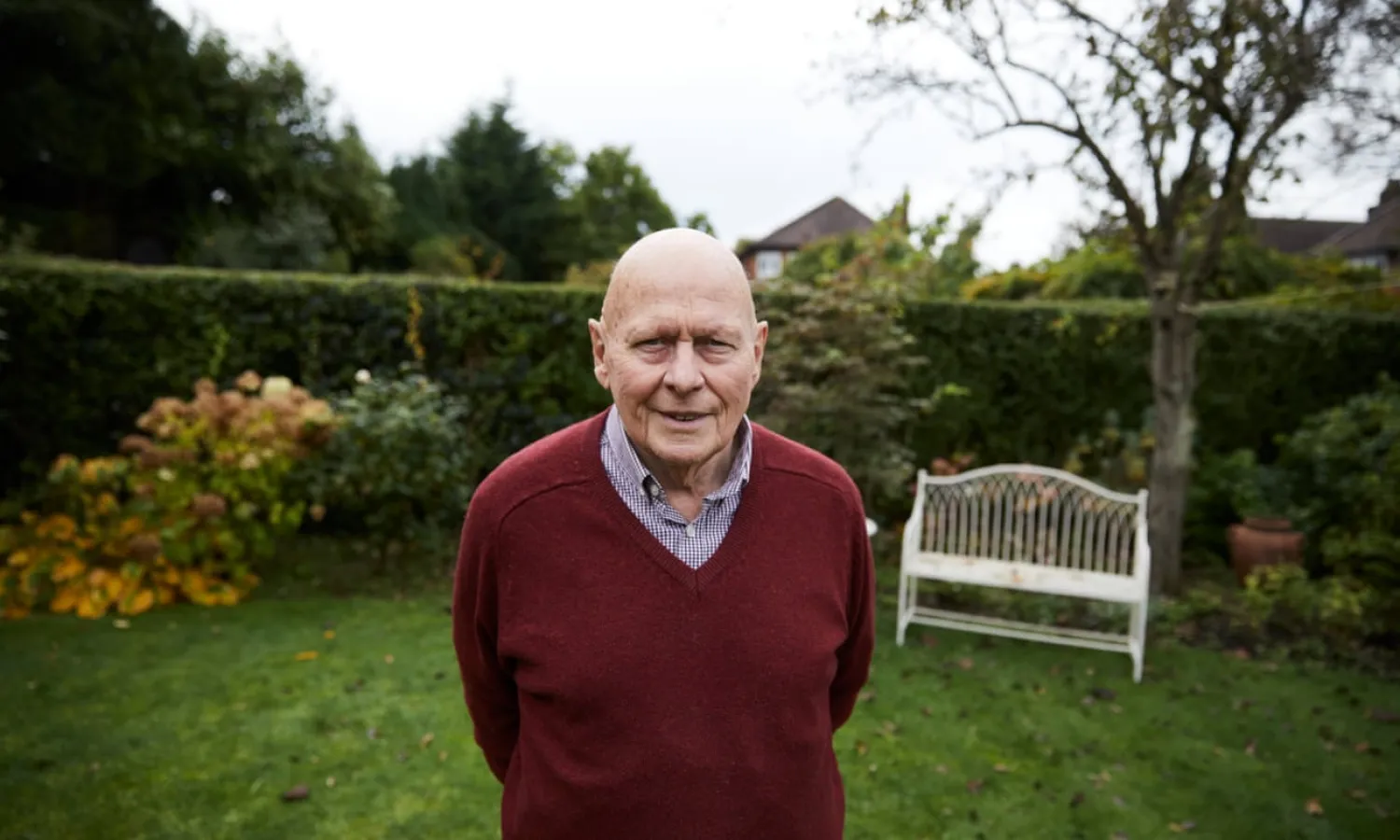
 Wilf McGuinness retired from playing at 22 after breaking his leg but succeeded Sir Matt Busby as Manchester United manager. Photograph: Christopher Thomond/The Guardian
Wilf McGuinness retired from playing at 22 after breaking his leg but succeeded Sir Matt Busby as Manchester United manager. Photograph: Christopher Thomond/The Guardian
TT

Wilf Mcguinness: ‘I Thought Munich Was the End, That United Were Finished’

 Wilf McGuinness retired from playing at 22 after breaking his leg but succeeded Sir Matt Busby as Manchester United manager. Photograph: Christopher Thomond/The Guardian
Wilf McGuinness retired from playing at 22 after breaking his leg but succeeded Sir Matt Busby as Manchester United manager. Photograph: Christopher Thomond/The Guardian

Wilf McGuinness is 82 but his face lights up with vivid memories of the man who had such an impact on his life. “Matt Busby was a god,” McGuinness says simply as he looks up with an expression of gratitude and awe and remembers the football manager who turned Manchester United into one of the world’s greatest clubs. “We used to look up at him when we were growing up. We thought: ‘There he is. That’s the boss.’ That’s what we called him. Boss. He was a wonderful man.”

McGuinness was one of the original Busby Babes, a team of youthful brilliance which was decimated by the Munich disaster of 1958. He was injured and so missed being on the plane which took the lives of many of his best friends and teammates, while scarring those who survived. McGuinness was part of the second wave of Babes with whom Busby created a new team that would eventually become the first English club to win the European Cup in 1968. Another bad injury had ended his career long before then but Busby respected him so much that he persuaded McGuinness to become a coach at Old Trafford.

When he eventually retired for the first time in 1969, Busby chose McGuinness to succeed him. Over the next 18 months, McGuinness did a respectable job but he experienced the difficulties of replacing a legendary figure at a club as big as United. That struggle has been felt again by all the managers who have tried to lead the club in the wake of Sir Alex Ferguson’s long and imposing reign at Old Trafford.

McGuinness is one of the key voices in a poignant new documentary about Busby. It explains the significance of Busby as being the first modern manager in English football who understood the power of the European Cup and who also recognised that the game would soon become big business. But the film is most affecting when charting the pain of Munich and the guilt felt by Busby. He had pushed hard for United to venture into Europe and yet the adventure was devastated by the loss of 23 lives when their plane crashed while trying to leave the tarmac for a third time on a snowy afternoon in Munich.

There is something beautiful yet painful in McGuinness’s words when he says: “Munich will always be in a corner of my mind.” He pauses and adds: “Always. Even now. They were very special people. I wasn’t in their class even though I played a lot in those days. I tried to forget the sad parts about it. But I don’t want to forget the players because they were great. I try not to remember it too much because it was definitely the saddest moment I’ve ever had. It was only because I was injured that I didn’t go on the trip. So I was very fortunate. Eddie Colman and Duncan Edwards were the wing halves but I played in that position too.”

It’s difficult for McGuinness to remember the day he heard the news of the tragedy but his son, Paul, who also used to work as a coach at Manchester United, helps his dad by sitting with us in the family home in Sale. “I think you were in town, weren’t you?” Paul prompts his father, “and you saw the story on the newsstands. I think you went to the Guardian office as the press people were getting the information.”

McGuinness nods. “Yes. I went to the Guardian and they told me what happened. I had lost teammates and friends.”

A long sigh slips from a great old man. “I thought it was the end of the world. I felt that’s it. United are finished now. We can’t carry on. We haven’t got a team. I also thought Matt was on the dying list at that stage. And I knew we had lost Duncan Edwards. What a great, great player he was. They all were. They were tremendous. But, really, Duncan was also like a god to us. He was the best I ever saw.”

In the film there is a shattering moment when, still recovering from his injuries, Busby returns to the training ground to address his squad. But he is so choked up that he can’t talk. Does McGuinness remember that moment? “I can remember him as a great man. I was in the squad then, after Munich. I was in it a bit before but nowhere near as good as some of them. We were just grateful Matt was back. He and Jimmy Murphy [Busby’s assistant and the driver of the club’s youth policy] were brilliant people. I’ve never met anybody with their personality or determination.”

Busby, clearly, was haunted by Munich. McGuinness nods. “It must have stuck in his mind. But he always said: ‘Go out and play well, and play for the fans.’ Not play for you. Play for the fans. We were very fortunate that, under Matt Busby, Man United became a great team. They weren’t a great team until he sorted it all out. He was a tremendous manager.”

The drab nature of life in the postwar years seeps through the archive footage but Busby was determined to bring joy to Manchester through football. “He wanted us to give people something to look forward to,” McGuinness says of Busby, who became United’s manager in 1945. Ten years later, in October 1955, McGuinness made his first team debut at the age of 17. Other gifted teenagers, like Edwards and Bobby Charlton, were also part of the Busby Babes. “£20 a week was the maximum wage. We couldn’t get more. But I was happy getting the bus to training at The Cliff in Salford or to games at Old Trafford.”

Did people get excited when they saw United players on the bus? “Yeah, a lot did. I was hoping the girls did, but they didn’t. It was mainly the lads. But it was good. I was usually with Bobby who was a very close friend. We were the same age and played for England boys together when we were 15. I was his captain at England schoolboys.”

Busby chose McGuinness for United’s first team before he selected Charlton. “That was mainly because my position became available,” McGuinness explains. “Bobby was a wonderful player. We grew up together and so we were good pals. He stayed at our house because I’m a Manchester lad and Bobby came down to United from Northumberland. We stuck together.”

Charlton survived Munich but, like Busby, he was scarred. Did he talk to his friend about the tragedy? “Oh no,” McGuinness says. “That was private.”

Yet, out of such grief and pain, Busby built a team that won the European Cup in 1968. United’s 4-1 defeat of Benfica was the culmination of a long quest for Busby. McGuinness then coached the reserves, having been forced to retire at 22 after breaking his leg, and he was close to Busby and Murphy. He coached George Best in some reserve games before the Belfast wizard broke into the first team and became a dizzying part of that European Cup-winning side.

Did Best stand out immediately as being exceptional? “You knew he was special. Only a blind man wouldn’t know. George was shy until he went to the dance halls. Then he wasn’t so shy. But they were all special. Think of Bobby and Nobby Stiles. And Bill Foulkes and Harry Gregg who survived Munich. Those two were very hard men. Tough as nails. I thought the world of them. We were a club where we thought about each other. That was down to Matt Busby and Jimmy Murphy.

When we finally won the European Cup it meant a great deal. Especially for Matt. It was something we could hold up and say: ‘Look, after everything that happened, we’ve done it. Let’s do it again.”

Busby, however, was exhausted after managing United for 24 years and so, in January 1969, he announced he would step down at the end of that season. He was 60 and he hand-picked his successor – the 31-year-old McGuinness who took over as United manager in June 1969. “I was very proud of that. A bit surprised, but very proud. The press had got hold of the story first but I had a feeling it was going to be me. Matt and Jimmy always lifted me up.”

It must have felt like an impossible job, following Busby? “I didn’t look at it that way. It was a great job and a wonderful life.”

United finished eighth in his one full season in charge. McGuinness was sacked in December 1970 and Busby returned briefly but United finished eighth again that season. “You had five semi-final games, including replays, in the League Cup and FA Cup,” Paul says to his dad “You were a bit unfortunate. You didn’t get the signings you wanted. You took over an older team and you wanted to sign younger players like Malcolm Macdonald, Mick Mills and Colin Todd.” His father smiles. “I was still a learner as a manager – don’t forget that.”

Does he feel empathy for all the United managers who have followed Ferguson? He smiles and looks a little confused. “After all those years with Sir Alex, it was difficult for someone else to come in, wasn’t it, Dad?” Paul says. “I think you felt a bit sorry for David Moyes at the time.”

McGuinness is at his best in the more distant past but I ask him if he still goes to Old Trafford. “Dad watches them on TV,” Paul explains. “Sometimes we go to the ground.”

It must be tough watching United these days compared to the peak Busby and Fergie years? “They’ve got to find the sparks we had in our day,” McGuinness says. “For me there was only one Matt Busby. He was special.”

The documentary is intriguing in explaining how Busby led the way when he persuaded Louis Edwards, then the United chairman, to plan for the installation of corporate boxes. Busby could see into football’s lucrative future even though his roots in a Lanarkshire mining village meant he always valued his players over money. “He went to America, didn’t he?” Paul says of Busby, “and saw some of the great sports stadiums and the boxes. He made sure that Old Trafford got bigger and bigger. He was very forward-thinking.”

For McGuinness no one in football today can compare to giants like Busby and Edwards, Murphy and Charlton who lived through raw and beautiful days. Paul looks at his father. “I think you’ve done quite well today, haven’t you Dad?

“Yeah,” McGuinness says with a contented smile.

I suggest he must feel lucky, too, to have known Busby so well. “Oh yes,” McGuinness says, as his eyes gleam again with light. “He was such a warm man. Yeah. He was just terrific.”

The Guardian Sport


PSG, Marseille Looking to Bounce Back after Champions League Losses

Soccer Football - Ligue 1 - Paris St Germain Press Conference - Parc des Princes, Paris, France - July 5, 2022 General view as the Paris St Germain emblem is seen ahead of the press conference REUTERS/Benoit Tessier/File Photo
TT

PSG, Marseille Looking to Bounce Back after Champions League Losses

Soccer Football - Ligue 1 - Paris St Germain Press Conference - Parc des Princes, Paris, France - July 5, 2022 General view as the Paris St Germain emblem is seen ahead of the press conference REUTERS/Benoit Tessier/File Photo

After they were beaten midweek in the Champions League, Ligue 1 rivals Paris Saint-Germain and Marseille need to be more convincing back on the domestic stage.

PSG, which became European champion for the first time last season, lost at Sporting 2-1 and Marseille was overwhelmed by Liverpool 3-0 at home.

PSG is going through a mediocre patch, having lost two of its last three matches across competitions. Friday's trip at second-to-last Auxerre should help Luis Enrique's team rebuild some confidence.

On paper, the task faced by Marseille is more difficult, hosting leader Lens at Stade Velodrome.

Key matchups Lens travels south in full confidence after recording a 10th consecutive win across all competitions last weekend. Lens claimed its only French title in 1998 and has a one point lead over defending champion PSG, The AP news reported.

Third-placed Marseille, meanwhile, has been putting on brilliant displays and boasts the league's best attacking record, with 41 goals after 18 rounds. But the nine-time champion has also been inconsistent at the back. The loss against Liverpool marked the first time since March 2022 that Marseille lost back-to-back home games without scoring.

Before the trip to Auxerre, PSG boss Luis Enrique said it's time for his team to take control of Ligue 1.

“We’re not yet where we want to be in the league," he said. "We need to keep working hard and trying to win. We’re used to deep defensive blocks. That’s often how our opponents play against us. We want to become leaders but Lens are in great form with 10 consecutive wins. It’s exciting.”

Players to watch Adrien Thomasson has played a crucial role in Lens' rise to the top. Thomasson has been thriving since he was repositioned in a deeper role. Alongside PSG's Vitinha, he is the joint top assist provider with six, and has two goals.

Back from the Africa Cup of Nations after losing with Morocco to Senegal in a chaotic final, defender Achraf Hakimi is expected to return for PSG. “He’s in normal shape,” Luis Enrique said. "We’ll have to wait and see how he is on the training ground.”

Off the field French magazine Paris Match reported this week that PSG and France defender Lucas Hernandez has been accused of human trafficking and undeclared work.

The magazine said a Colombian family accused the player and his wife of having employed them without a legal framework and with excessively long working hours. The Versailles public prosecutor’s office told French media that an investigation was underway.


Bayern Munich is Smashing its Own Records in the Bundesliga and Rivals Aren't Close

Soccer Football - Bundesliga - VfL Bochum v Bayern Munich - Vonovia Ruhrstadion, Bochum, Germany - October 27, 2024 Bayern Munich's Thomas Mueller celebrates with teammates after the match REUTERS/Leon Kuegeler
TT

Bayern Munich is Smashing its Own Records in the Bundesliga and Rivals Aren't Close

Soccer Football - Bundesliga - VfL Bochum v Bayern Munich - Vonovia Ruhrstadion, Bochum, Germany - October 27, 2024 Bayern Munich's Thomas Mueller celebrates with teammates after the match REUTERS/Leon Kuegeler

Bayern Munich is running away with the Bundesliga again.

But this time it’s smashing even its own records.

The Bavarian powerhouse has a whopping 71 goals in 18 games, conceded only 14 goals, and drawn only two matches. It has won the other 16.

With 50 points and a goal difference of plus-57, Bayern has made the best ever start to the Bundesliga at this stage of the season.

And its rivals are struggling to keep up, The AP news reported.

Bayern already leads by 11 points from Borussia Dortmund and is on course for its 13th Bundesliga title in 14 years.

Bayern next hosts relegation threatened Augsburg in a Bavarian derby on Saturday.

Key matchups Bayern hasn’t dropped points since a surprising 2-2 draw with Mainz in mid-December. Augsburg hasn’t won a game since beating Bayer Leverkusen — the only team to break Bayern’s dominance in the last 13 years — in early December.

Leverkusen, which lost to Olympiakos in the Champions League on Tuesday, will hope to snap its three-game losing run against visiting Werder Bremen on Saturday.

St. Pauli entertains Hamburger SV in the city derby on Friday. St. Pauli, which won the reverse fixture in August, can climb off the bottom by avoiding defeat, with relegation contenders Mainz playing Wolfsburg and Heidenheim entertaining Leipzig on Saturday.

Also on Saturday, Eintracht Frankfurt, which crashed out of the Champions League on Wednesday, hosts in-form Hoffenheim. Frankfurt is still looking for a coach following the dismissal of Dino Toppmöller. The team has conceded three goals in every game in 2026.

Players to watch Harry Kane missed a penalty in Bayern’s 2-0 win over Union Saint-Gilloise in the Champions League on Wednesday and though he scored both goals he’ll be keen to “make amends” for his penalty miss. He already has 34 goals in 29 games for Bayern this season.

Nicolas Jackson is back at Bayern after helping Senegal win the Africa Cup of Nations. Jackson scored two goals for the Teranga Lions at the tournament but could find playing time restricted on his return to Munich.

Stuttgart has Bilal El Khannouss back after his impressive Africa Cup performances for Morocco, where he became a starter for the host team.

Who is out? Morocco’s Eliesse Ben Seghir returned to Leverkusen from the Africa Cup with an ankle problem. Defender Edmond Tapsoba also came back injured from his participation with Burkina Faso, while forward Nathan Tella and goalkeeper Mark Flekken are out “long term” with serious knee injuries from Leverkusen’s defeat to Hoffenheim last weekend.

Jamal Musiala made his anticipated return for Bayern in a brief appearance last weekend, but he’s returning to a team that had been doing just fine without him. Bayern attackers Kane, Luis Díaz, Serge Gnabry and the 17-year-old Lennart Karl have been outstanding, giving Vincent Kompany a selection problem any coach would love to have.


Swiatek Says Packed Tennis Season Makes it 'Impossible' to Switch Off

Tennis - Australian Open - Melbourne Park, Melbourne, Australia - January 22, 2026 Poland's Iga Swiatek celebrates after winning her second round match against Czech Republic's Marie Bouzkova REUTERS/Tingshu Wang
TT

Swiatek Says Packed Tennis Season Makes it 'Impossible' to Switch Off

Tennis - Australian Open - Melbourne Park, Melbourne, Australia - January 22, 2026 Poland's Iga Swiatek celebrates after winning her second round match against Czech Republic's Marie Bouzkova REUTERS/Tingshu Wang

Six-time major champion Iga Swiatek stepped up her criticism of the tennis schedule Thursday saying that the season was too long and it was impossible to switch off.

The Polish second seed turned on the style to motor past the Czech Republic's Marie Bouzkova 6-2, 6-3 and into the Australian Open third round in Melbourne.

It set up a clash against Russian world number 33 Anna Kalinskaya, who swept past Austria's Julia Grabher 6-3, 6-3.

While Swiatek said she felt physically fine, she let rip about the ever-growing WTA schedule.

"For sure the schedule is packed. There's not much time to reset completely. It's kind of impossible," she said.

"It feels like there's no beginning of the season and end of the season because honestly, for people that work physically for 11 months basically, getting 10 days without the racquet, it's not enough time to reset.

"I mean, that's what I got. Because for four days you're still thinking about the season and last days you already think about the preparation for the next one."

Swiatek said her goal for 2026 was to try and "go somewhere and just reset and not do anything".

"Like, unplug a bit better. Hopefully I'm going to have more energy till the end of the season."

Swiatek has won four French Opens, the US Open and Wimbledon, but a title at Melbourne Park has proved elusive, with the 24-year-old making the semi-finals twice.

Last year she surged into the last four but failed to get past eventual winner Madison Keys.

Swiatek arrived in Melbourne this year on the back of two singles defeats at the lead-up United Cup and was then pushed hard by Chinese qualifier Yuan Yue in round one.

She was more convincing against Bouzkova, cutting down on the 35 unforced errors against Yuan to 27, while blasting 31 winners.

Serving was an issue for both players early on, exchanging first-set breaks before Swiatek got into her rhythm to take charge.

The Pole served to love to open set two, but a pair of baseline errors handed the Czech a break and she consolidated for a 3-1 advantage.

But it was a fleeting lead with Swiatek levelling at 3-3 and making the crucial break for 5-3 with a backhand winner before serving out for the match.
