


Still in Streets, Iraqis Say Problem is Poverty

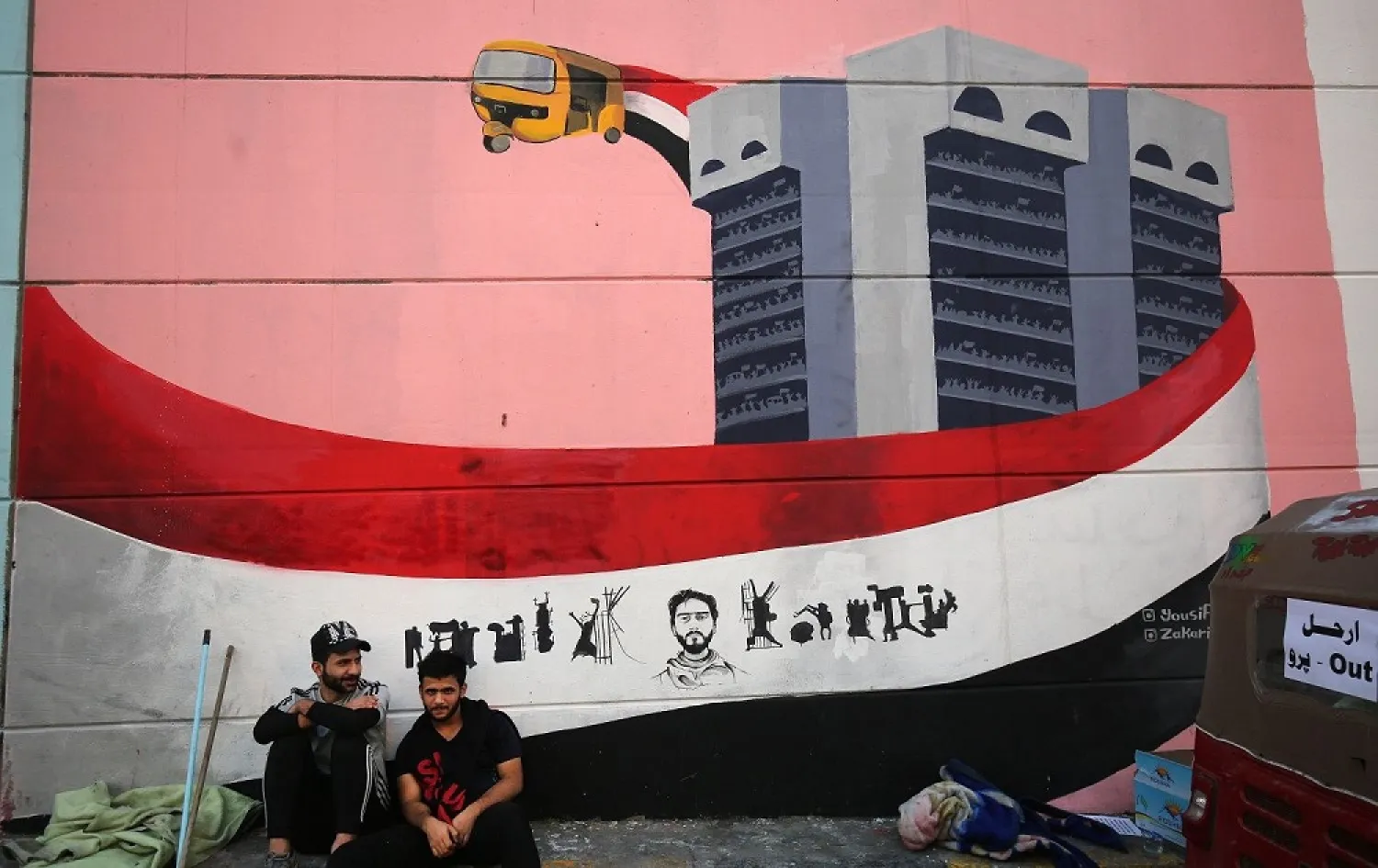
Iraqi demonstrators rest in front of a mural painting in Tahrir Square during anti-government demonstrations in Baghdad on November 8, 2019. (AFP)
TT

Still in Streets, Iraqis Say Problem is Poverty

Iraqi demonstrators rest in front of a mural painting in Tahrir Square during anti-government demonstrations in Baghdad on November 8, 2019. (AFP)

Chants demanding complete regime change have echoed across Iraq for weeks, but what first brought demonstrators onto the street was the profound poverty of one of the world's most oil-rich countries.

And that is what has kept them there, with protesters brushing off the resignation of Prime Minister Adel Abdul Mahdi as failing to root out the rampant corruption that denies them jobs and public services.

In the southern protest hotspot of Diwaniyah, one of the poorest agricultural areas in the country, Umm Salah has joined rallies every day outside the provincial council.

"I've suffered in my country, even though it's a rich country," she told AFP, carrying an Iraqi tricolor.

The 57-year-old widow has been protesting every day since October with her seven children, none of whom are employed.

They walk four kilometers (nearly three miles) to reach the protest camp as they cannot afford a taxi from the worn-down informal shelter where they live.

"My husband died four years ago because we are poor and couldn't afford medical treatment in private clinics or hospitals abroad," Umm Salah says.

Iraq suffers from an extremely dilapidated health care system, with hospitals severely under-equipped and doctors often threatened on the basis of political or tribal disputes.

A bleak future

Despite Iraq being OPEC's second-largest crude producer, one in five of its people live in poverty and youth unemployment stands at one quarter, the World Bank says.

The government has been the largest employer by far for decades but has recently struggled to provide jobs for a growing number of graduates.

Already, youths make up 60 percent of the 40 million-strong population, which is set to grow by 10 million more before 2030.

The future looks even bleaker given predictions that heavy crude exports -- which fund more than 90 percent of Iraq's state budget -- will become less profitable as the world shifts to other energy sources.

For now, protesters blame the staggering joblessness rates on a patronage system that hands out work based on bribes, family connections or party affiliation instead of merit.

Muhannad Fadel, 30, dreamed of a government post when he graduated years ago with a degree in physical education, but his diploma opened few doors for him.

After a brief stint as a university lecturer, Fadel sought other work but his monthly income didn't rise above $100.

"I started to drive a taxi but I was afraid some of my students would recognize me," he told AFP.

"Then I opened a little confectionery store on the ground floor of our home and I make around 5,000 dinars a day," or just $3, he added.

Scraping together some savings, Fadel could marry but not buy a house, so his new wife moved in with his family.

"Our whole family together earns $150 per month. How is that possible in one of the countries with the most oil in the world?" he said.

For him and many protesters, the root of the problem is a political class more interested in earning money and paying homage to regional backers than in improving Iraqi infrastructure, or people's lives.

"They're corrupt and steal the people's money to give to Iran and other parties," Fadel said bitterly.

Iraq is ranked the 12th most corrupt country in the world by watchdog group Transparency International.

A recent government probe found over $450 billion in public funds were lost to embezzlement, fake contracts or salaries for so-called ghost employees since 2003.

'They stole our oil'

"The deterioration of the economic conditions of Iraqis is the main reason for protests, as eight million Iraqis live under the poverty line," said Moussa Khalaf, an economic history professor in Diwaniyah.

A series of flare-ups before the major wave of protests erupted in October had hinted at the conflagration that was to come.

In September, local authorities began demolishing unauthorized houses in the city of Karbala, in Basra in the south and in the central city of Kut.

The settlements are home to three million Iraqis, many of them the poorest of the poor.

That same month, a young man in Kut died after desperately setting himself alight when authorities seized his mobile kiosk.

"You need an economic policy that makes use of resources based on scientific and economic facts, not on privileges or political gains," says Khalaf.

Protesters have clung on in the streets and public squares even days after Abdul Mahdi stepped down.

"Of course that's not enough," one young demonstrator in Baghdad's Tahrir Square told AFP about bringing down the head of government.

"We won't leave our barricades until the regime falls, until we get jobs, water, electricity," he said.

Another protester, 45-year-old Hussein Maneh, slammed the government for its years of failure.

"Since 2003, they've done nothing but increased poverty, destroyed agriculture and industry, impoverished schools and hospitals, created confessionalism, and stole our oil," he fumed.



UN Warns Clock Ticking for Sudan's Children

Sudanese children play on a street in Tokar, in Red Sea State, following heavy flooding in October, 2024 © AFP/File
TT

UN Warns Clock Ticking for Sudan's Children

Sudanese children play on a street in Tokar, in Red Sea State, following heavy flooding in October, 2024 © AFP/File

The United Nations warned Tuesday that time was running out for malnourished children in Sudan and urged the world to "stop looking away".

Famine is spreading in Sudan's western Darfur region, UN-backed experts warned last week, with the grinding war between the army and RSF leaving millions hungry, displaced and cut off from aid.

Global food security experts say famine thresholds for acute malnutrition have been surpassed in North Darfur's contested areas of Um Baru and Kernoi, AFP reported.

Ricardo Pires, spokesman for the UN children's agency UNICEF, said the situation was getting worse for children by the day, warning: "They are running out of time".

In parts of North Darfur, more than half of all children are acutely malnourished, he told a press conference in Geneva.

"Extreme hunger and malnutrition come to children first: the youngest, the smallest, the most vulnerable, and in Sudan it's spreading," he said.

Fever, diarrhoea, respiratory infections, low vaccination coverage, unsafe water and collapsing health systems are turning treatable illnesses "into death sentences for already malnourished children", he warned.

"Access is shrinking, funding is desperately short and the fighting is intensifying.

"Humanitarian access must be granted and the world must stop looking away from Sudan's children."

Since April 2023, the conflict between Sudan's army and the paramilitary Rapid Support Forces has killed tens of thousands, displaced 11 million and triggered what the UN calls one of the world's worst humanitarian crises.

Shible Sahbani, the World Health Organization's representative in Sudan, said the country was "facing multiple disease outbreaks: including cholera, malaria, dengue, measles, in addition to malnutrition".

At the same time, health workers and health infrastructure are increasingly in the crosshairs, he told reporters.

Since the war began, the WHO has verified 205 attacks on healthcare, leading to 1,924 deaths.

And the attacks are growing deadlier by the year.

In 2025, 65 attacks caused 1,620 deaths, and in the first 40 days of this year, four attacks led to 66 deaths.

Fighting has intensified in the southern Kordofan region.

"We have to be proactive and to pre-position supplies, to deploy our teams on the ground to be prepared for any situation," Sahbani said.

"But all this contingency planning... it's a small drop in the sea."


Israeli Minister Calls West Bank Measures ‘De Facto Sovereignty,’ Says No Future Palestinian State

Palestinian boys look out over the Israeli-occupied West Bank city of Hebron from a rooftop on February 9, 2026. (AFP)
TT

Israeli Minister Calls West Bank Measures ‘De Facto Sovereignty,’ Says No Future Palestinian State

Palestinian boys look out over the Israeli-occupied West Bank city of Hebron from a rooftop on February 9, 2026. (AFP)

A top Israeli official said Tuesday that measures adopted by the government that deepen Israeli control in the occupied West Bank amounted to implementing “de facto sovereignty,” using language that mirrors critics' warnings about the intent behind the moves.

The steps “actually establish a fact on the ground that there will not be a Palestinian state,” Energy Minister Eli Cohen told Israel’s Army Radio.

Palestinians, Arab countries and human rights groups have called the moves announced Sunday an annexation of the territory, home to roughly 3.4 million Palestinians who seek it for a future state.

Cohen’s comments followed similar remarks by other members of Prime Minister Benjamin Netanyahu’s government, including Finance Minister Bezalel Smotrich and Defense Minister Israel Katz.

The moves — and Israeli officials’ own descriptions of them — put the country at odds with both regional allies and previous statements from US President Donald Trump. Netanyahu has traveled to Washington to meet with him later this week.

Last year, Trump said he won’t allow Israel to annex the West Bank. The US-brokered ceasefire between Israel and Hamas that aimed to stop the war in Gaza also acknowledged Palestinian aspirations for statehood.

Widespread condemnation

The measures further erode the Palestinian Authority’s limited powers, and it’s unclear the extent to which it can oppose them.

Still, Hussein Al Sheikh, the Palestinian Authority’s deputy president, said on Tuesday "the Palestinian leadership called on all civil and security institutions in the State of Palestine" to reject them.

In a post on X on Tuesday, he said the Israeli steps “contradict international law and the agreements signed with the Palestine Liberation Organization."

A group of eight Arab and Muslim-majority countries expressed their “absolute rejection” of the measures, calling them in a joint statement Monday illegal and warning they would “fuel violence and conflict in the region.”

Israel’s pledge not to annex the West Bank is embedded in its diplomatic agreements with some of those countries.

United Nations Secretary General Antonio Guterres said he was “gravely concerned” by the measures.

“They are driving us further and further away from a two-State solution and from the ability of the Palestinian authority and the Palestinian people to control their own destiny," his spokesperson, Stephane Dujarric, said on Monday.

What the measures mean

The measures, approved by Netanyahu's Security Cabinet on Sunday, expand Israel’s enforcement authority over land use and planning in areas run by the Palestinian Authority, making it easier for Jewish settlers to force Palestinians to give up land.

Smotrich and Katz on Sunday said they would lift long-standing restrictions on land sales to Israeli Jews in the West Bank, shift some control over sensitive holy sites — including Hebron’s Ibrahimi Mosque, also known as the Tomb of the Patriarchs — and declassify land registry records to ease property acquisitions.

They also revive a government committee empowered to make what officials described as “proactive” land purchases in the territory, a step intended to reserve land for future settlement expansion.

Taken together, the moves add an official stamp to Israel’s accelerating expansion and would override parts of decades-old agreements that split the West Bank between areas under Israeli control and areas where the Palestinian Authority exercises limited autonomy.

Israel has increasingly legalized settler outposts built on land Palestinians say documents show they have long owned, evicted Palestinian communities from areas declared “military zones” and villages near archaeological sites it has reclassified as “national parks.”

More than 700,000 Israelis live in the occupied West Bank and east Jerusalem, territories captured by Israel in 1967 and sought by the Palestinians for an independent state along with the Gaza Strip.

Palestinians are not permitted to sell land privately to Israelis. Settlers can buy homes on land controlled by Israel’s government.

The international community overwhelmingly considers Israeli settlement construction to be illegal and an obstacle to peace.

“These decisions constitute a direct violation of the international agreements to which Israel is committed and are steps toward the annexation of Areas A and B,” anti-settlement watchdog group Peace Now said on Sunday, referring to parts of the West Bank where the Palestinian Authority exercised some autonomy.


Over 4,500 ISIS Detainees Brought to Iraq from Syria, Says Official

Vehicles transporting ISIS detainees by the US military, according to a security source from the Syrian Democratic Forces, head from Syria towards Iraq, in Qamishli, Syria, February 8, 2026. (Reuters)
TT

Over 4,500 ISIS Detainees Brought to Iraq from Syria, Says Official

Vehicles transporting ISIS detainees by the US military, according to a security source from the Syrian Democratic Forces, head from Syria towards Iraq, in Qamishli, Syria, February 8, 2026. (Reuters)

More than 4,500 suspected extremists have been transferred from Syria to Iraq as part of a US operation to relocate ISIS group detainees, an Iraqi official told AFP on Tuesday.

The detainees are among around 7,000 suspects the US military began transferring last month after Syrian government forces captured Kurdish-held territory where they had been held by Kurdish fighters.

They include Syrians, Iraqis and Europeans, among other nationalities.

Saad Maan, a spokesperson for the Iraqi government's security information unit, told AFP that 4,583 detainees had been brought to Iraq so far.

ISIS swept across swathes of Syria and Iraq in 2014 where it committed massacres. Backed by US-led forces, Iraq proclaimed the defeat of ISIS in 2017, while in neighboring Syria the Kurdish-led Syrian Democratic Forces ultimately beat back the group two years later.

The SDF went on to jail thousands of suspected extremists and detain tens of thousands of their relatives in camps.

In Iraq, where many prisons are packed with ISIS suspects, courts have handed down hundreds of death sentences and life terms to those convicted of terrorism offences, including many foreign fighters.

This month Iraq's judiciary said it had begun investigations into detainees transferred from Syria.