


UN: Nearly a Half-Billion in Asia-Pacific Still Going Hungry

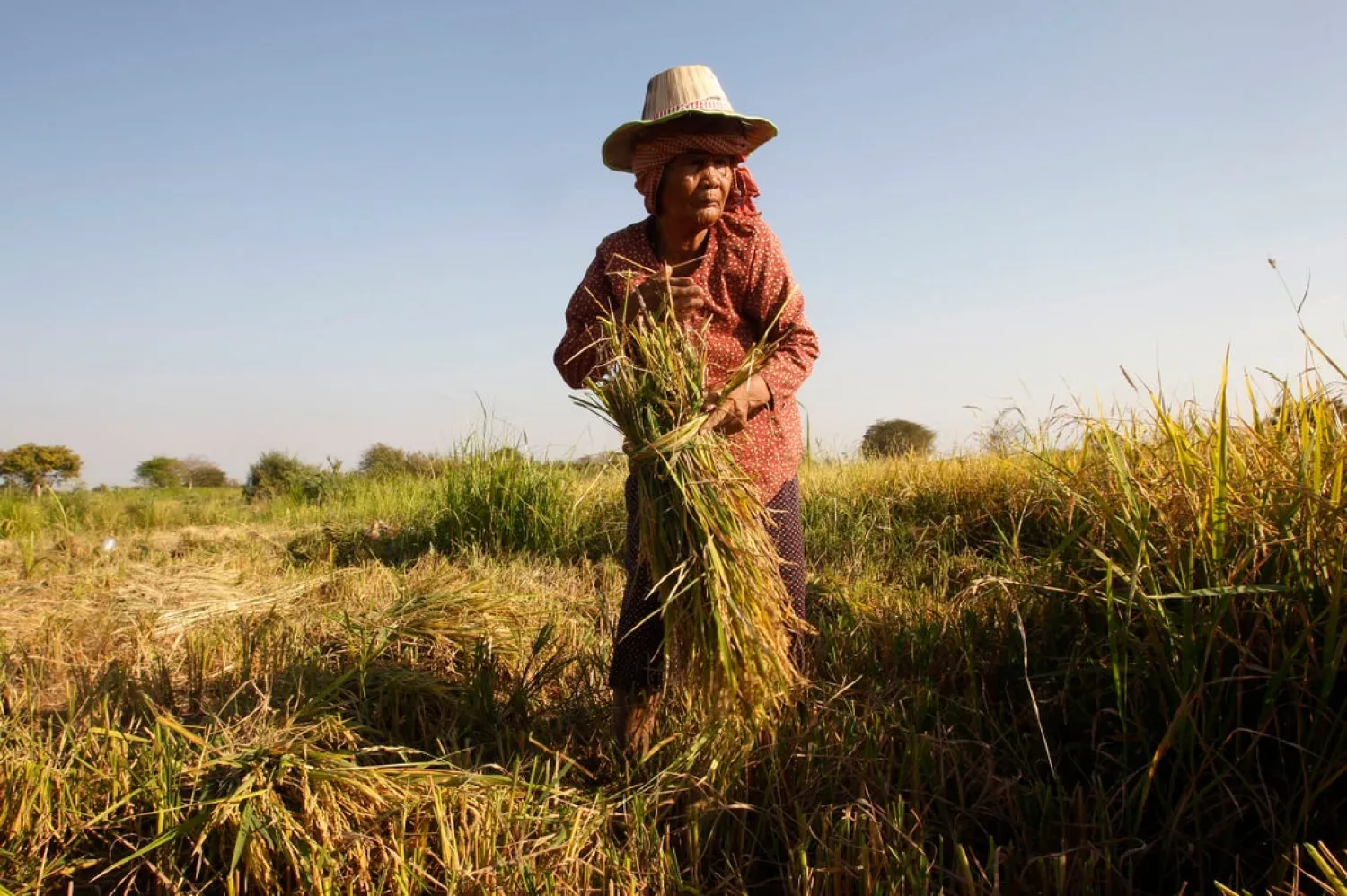
In this Feb. 11, 2019, file photo, woman cuts rice in the village of Samroang Kandal on the north side of Phnom Penh, Cambodia. Nearly a half-billion people in the Asia-Pacific are still malnourished and to achieve a goal of zero hunger by 2030 requires that millions escape food insecurity each month, according to a report released Wednesday by United Nations agencies. (AP Photo/Heng Sinith, File)
TT

UN: Nearly a Half-Billion in Asia-Pacific Still Going Hungry

In this Feb. 11, 2019, file photo, woman cuts rice in the village of Samroang Kandal on the north side of Phnom Penh, Cambodia. Nearly a half-billion people in the Asia-Pacific are still malnourished and to achieve a goal of zero hunger by 2030 requires that millions escape food insecurity each month, according to a report released Wednesday by United Nations agencies. (AP Photo/Heng Sinith, File)

Nearly a half-billion people in the Asia-Pacific are still malnourished and eliminating hunger by 2030 requires that millions escape food insecurity each month, according to a report released Wednesday by UN agencies.

Data compiled by the United Nations show slow progress and even backsliding in the areas of child wasting and stunting and other problems related to malnutrition. Worsening inequality means that despite relatively fast economic growth, incomes in the region are not increasing fast enough to help ensure adequate, nutritional diets for hundreds of millions still living in poverty, it says.

The report urges that governments combine efforts to end poverty and with nutrition, health, and education-oriented policies.

The UN's sustainable development goals for 2030 call for ending hunger and ensuring all people have adequate access to food all around the year.

"We are not on track," said Kundhavi Kadiresan, the FAO's regional representative. "Progress in reducing undernourishment has slowed a lot in the past few years."

More than a fifth of all people in the Asia-Pacific region are facing moderate to severe food insecurity, meaning they must scrimp on food or go hungry part of the year, and in the worst cases go days without eating.

More than half of the 479 million in the region who are undernourished live in South Asia, where more than a third of all children suffer from chronic malnutrition, said the report written by the Food and Agriculture Organization, UNICEF, the World Food Program and the World Health Organization.

In India, nearly 21% of children suffer from wasting, a more acute form of malnutrition.

Failing to ensure children are well-nourished jeopardizes their future development, especially their cognitive abilities - a crucial handicap in the 21st century age of advanced technologies, said Michael Samson, research director of the Economic Policy Research Institute, who spoke at the report's release in Bangkok.

Cognitive abilities cannot be traded or manufactured, so "Investing in the first 1,000 days (of a child's life) is the most important investment you can make in future productivity," he said.

Governments have begun to implement some policies aimed at addressing the severe shortfalls in child and maternal nutrition. Thailand has provided subsidies that have helped improve the health and diets of families with young children. In neighboring Myanmar, trial programs in the Chin state are being expanded to cover more of the country.

The focus is not just on providing cash, but improving awareness about nutrition, family planning, and water and sanitation," said Shein Myint, an assistant director in the Social Protection section of Myanmar's Ministry of Social Welfare.

"From monitoring, we see that beneficiaries mainly use the cash to have nutritious food and use it for healthcare costs," Shein Myint said.

Cambodia is expanding a program called NOURISH that originally was funded by the US Agency for International Development. It provides help for impoverished pregnant women and families during the first 1,000 days of a baby's life. In areas where the program was implemented there was a nearly 20% decrease in stunting and marked improvement in toddlers' diets, said Laura Cardinal, who directed the program.

While many in Asia still do not get enough calories to thrive, in the Pacific the problem is too many empty calories: obesity rates in the Pacific islands are among the world's highest and rising fast, partly because healthy foods are costly and less available and partly because local cultures focus much on feasting, said Lu'isa Manuofetoa, the acting chief executive for Tonga's Ministry of Internal Affairs.

"People like to have feasts all the time, that's something we need to change," she said.


Russia: Man Suspected of Shooting Top General Detained in Dubai

An investigator works outside a residential building where the assassination attempt on Russian Lieutenant General Vladimir Alexeyev took place in Moscow, Russia February 6, 2026. REUTERS/Anastasia Barashkova
TT

Russia: Man Suspected of Shooting Top General Detained in Dubai

An investigator works outside a residential building where the assassination attempt on Russian Lieutenant General Vladimir Alexeyev took place in Moscow, Russia February 6, 2026. REUTERS/Anastasia Barashkova

Russia's Federal Security Service (FSB) said on Sunday that the man suspected of shooting top Russian military intelligence officer Vladimir Alexeyev in Moscow has been detained in Dubai and handed over to Russia.

Lieutenant General Vladimir Alexeyev, deputy head of the GRU, ⁠Russia's military intelligence arm, was shot several times in an apartment block in Moscow on Friday, investigators said. He underwent surgery after the shooting, Russian media ⁠said.

The FSB said a Russian citizen named Lyubomir Korba was detained in Dubai on suspicion of carrying out the shooting.

Russian Foreign Minister Sergei Lavrov accused Ukraine of being behind the assassination attempt, which he said was designed to sabotage peace talks. ⁠Ukraine said it had nothing to do with the shooting.

Alexeyev's boss, Admiral Igor Kostyukov, the head of the GRU, has been leading Russia's delegation in negotiations with Ukraine in Abu Dhabi on security-related aspects of a potential peace deal.


Factory Explosion Kills 8 in Northern China

Employees work on an electric vehicle (EV) production line at the Volkswagen Anhui factory in Hefei, Anhui province, China, February 4, 2026. REUTERS/Florence Lo
TT

Factory Explosion Kills 8 in Northern China

Employees work on an electric vehicle (EV) production line at the Volkswagen Anhui factory in Hefei, Anhui province, China, February 4, 2026. REUTERS/Florence Lo

An explosion at a biotech factory in northern China has killed eight people, Chinese state media reported Sunday, increasing the total number of fatalities by one.

State news agency Xinhua had previously reported that seven people died and one person was missing after the Saturday morning explosion at the Jiapeng biotech company in Shanxi province, citing local authorities.

Later, Xinhua said eight were dead, adding that the firm's legal representative had been taken into custody.

The company is located in Shanyin County, about 400 kilometers west of Beijing, AFP reported.

Xinhua said clean-up operations were ongoing, noting that reporters observed dark yellow smoke emanating from the site of the explosion.

Authorities have established a team to investigate the cause of the blast, the report added.

Industrial accidents are common in China due to lax safety standards.
In late January, an explosion at a steel factory in the neighboring province of Inner Mongolia left at least nine people dead.


Iran Warns Will Not Give Up Enrichment Despite US War Threat

Traffic moves through a street in Tehran on February 7, 2026. (Photo by ATTA KENARE / AFP)
TT

Iran Warns Will Not Give Up Enrichment Despite US War Threat

Traffic moves through a street in Tehran on February 7, 2026. (Photo by ATTA KENARE / AFP)

Iran will never surrender the right to enrich uranium, even if war "is imposed on us,” its foreign minister said Sunday, defying pressure from Washington.

"Iran has paid a very heavy price for its peaceful nuclear program and for uranium enrichment," Abbas Araghchi told a forum in Tehran.

"Why do we insist so much on enrichment and refuse to give it up even if a war is imposed on us? Because no one has the right to dictate our behavior," he said, two days after he met US envoy Steve Witkoff in Oman.

The foreign minister also declared that his country was not intimidated by the US naval deployment in the Gulf.

"Their military deployment in the region does not scare us," Araghchi said.
