


Decade in Review: What the Smartphone Has Wrought

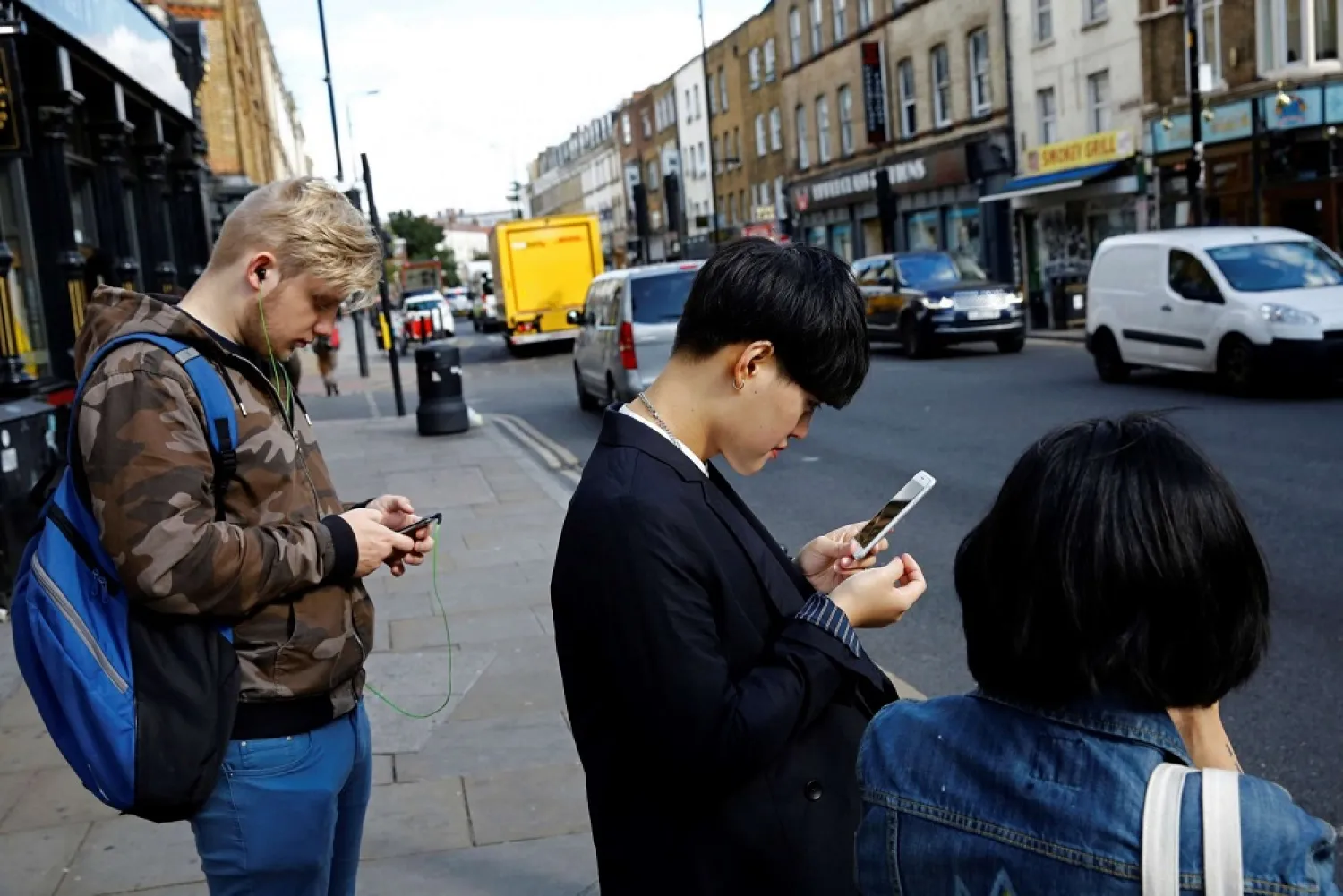
Pedestrians in London looking at their smartphones. (Reuters)
TT

Decade in Review: What the Smartphone Has Wrought

Pedestrians in London looking at their smartphones. (Reuters)

When the first Apple iPhone hit the market in 2007, not everyone was convinced it would supplant the flip-phone. When Google’s Android software system arrived a year later, the Blackberry still seemed to have bright future.

But with the iPhone 4 in 2010, featuring a high-resolution display, sleek design and front-facing camera, our collective fate was sealed. Here are 10 ways the smartphone has made its mark over the decade.

Access everywhere

Today some 5 billion smartphones are in use around the world, according to Canalysis Research. The total number of internet subscriptions has soared to 7.2 billion globally from 1.3 billion in 2010, the vast majority of them mobile subscriptions, International Telecommunications Union data shows. The explosion in connectivity has been especially dramatic in the developing world, where there are now more mobile connections than people.

Tech uber alles

Apple Inc, once a niche computer company, is now one of the world’s most valuable companies thanks to the iPhone. The five largest Fortune 500 technology companies - Apple, Amazon, Google, Microsoft and Facebook - currently boast a market cap of $4.7 trillion, compared with about $800 billion for the top five in 2010. Not all of that is due to the smartphone, of course, but the mobile-related technologies and services accounted for nearly $4 trillion in economic activity in 2018, according to trade group GSMA.

There’s an app for that

Whether we’re hailing a cab, ordering food, playing a game, finding a date, listening to music or shopping for just about anything, there’s a good chance we’ll be doing it with a smartphone app that didn’t exist in 2010. Many of most popular apps are free, but consumers are still expected to spend more than $120 billion in app stores during 2019, according to App Annie, a mobile apps analytics firm.

Feed me

The endless scroll on Facebook, Instagram, Twitter and other social media apps now consumes 34 minutes of every US adult’s day, according to Nielsen. Fewer people are sitting on the sofa to watch live TV at set times, and advertisers are following. Mobile ad spending surpassed TV for the first time in 2018 in terms of percentage share of the US market, according to research firm eMarketer. We can also thank the smartphone for Instagram influencers and fake news.

Smile for the (smartphone) camera

Global shipments of digital cameras dropped from their 2010 peak of 121 million to just 19 million units in 2018, according to the Camera & Imaging Products Association (CIPA). Meantime the latest phones pack as many four camera lenses and cutting-edge software that makes it easier than ever to get that perfect shot. The front-facing camera might be the busiest: Google reports that its Android devices take 93 million selfies every day.

Where am I?

The satellite tracking technology known as GPS, combined with information from cell towers and Wi-Fi networks, has made the smartphones incredibly powerful tracking devices. Google maps and its poorer cousins enable even the most directionally impaired find their way around unfamiliar locales with ease.

For the privacy-minded, though, it’s a disaster: Phone companies and app makers routinely record the movements of subscribers and sell that data to advertisers, a $20 billion-a-year business. The data is “anonymized,” but as numerous studies and a recent New York Times investigation have revealed it is often a simple matter to identify who is behind the dot on the map. Nearly 50 percent of companies surveyed by Verizon this year used or planned to soon use smartphone management tools to track their employees.

You can look it up

The 2010 edition of the venerable Encyclopedia Britannica, all 32 volumes and 129 pounds of it, turned out to be the last. But untold barroom arguments or dining room debates can now be settled on the spot: Wikipedia is consulted more than 240 million times daily.

Distracting ourselves to death

In 2018 alone in the United States, 2,628 fatal crashes involved a distracted driver, and of those deadly crashes, about 13% involved mobile phone use, according to the National Highway Traffic Safety Administration (NHTSA).

Forget your wallet

Apple Pay and Google Pay are still afterthoughts for most US consumers, but China may be a harbinger. Alipay and WeChat pay, China’s two big smartphone payment services, have reached a combined adoption rate of over 80% since they were launched around the beginning of the decade, according to a study by Bain. The QR code now peppers storefront windows. Even streetside beggars have adapted, sometimes rejecting cash and asking that payments be made via WeChat Pay or Alipay.

Say what?

Among the major casualties of the smartphone era is the conventional phone call itself: ubiquitous messaging apps have helped make video calls, GIFs, emojis and audio messaging preferred modes of communication. In the UK, for example, the total number of minutes spent on voice calls fell from 254 billion in 2013 to 206 billion in 2018, and the number of text messages dropped from 129 billion to 74 billion over the same period, according to Ofcom. Mobile data usage, meanwhile, jumped almost nine-fold between 2013 and 2018. The number of available emojis has nearly tripled to almost 3,000 since 2010.



US Astronaut to Take her 3-year-old's Cuddly Rabbit Into Space

FILE PHOTO: An evening launch of a SpaceX Falcon 9 rocket carrying 20 Starlink V2 Mini satellites, from Space Launch Complex at Vandenberg Space Force Base is seen over the Pacific Ocean from Encinitas, California, US, June 23, 2024. REUTERS/Mike Blake/File Photo
TT

US Astronaut to Take her 3-year-old's Cuddly Rabbit Into Space

FILE PHOTO: An evening launch of a SpaceX Falcon 9 rocket carrying 20 Starlink V2 Mini satellites, from Space Launch Complex at Vandenberg Space Force Base is seen over the Pacific Ocean from Encinitas, California, US, June 23, 2024. REUTERS/Mike Blake/File Photo

When the next mission to the International Space Station blasts off from Florida next week, a special keepsake will be hitching a ride: a small stuffed rabbit.

American astronaut and mother, Jessica Meir, one of the four-member crew, revealed Sunday that she'll take with her the cuddly toy that belongs to her three-year-old daughter.

It's customary for astronauts to go to the ISS, which orbits 250 miles (400 kilometers) above Earth, to take small personal items to keep close during their months-long stint in space.

"I do have a small stuffed rabbit that belongs to my three-year-old daughter, and she actually has two of these because one was given as a gift," Meir, 48, told an online news conference.

"So one will stay down here with her, and one will be there with us, having adventures all the time, so that we'll keep sending those photos back and forth to my family," AFP quoted her as saying.

US space agency NASA says SpaceX Crew-12 will lift off on a SpaceX Falcon 9 rocket from Cape Canaveral in Florida to the orbiting scientific laboratory early Wednesday.

The mission will be replacing Crew-11, which returned to Earth in January, a month earlier than planned, during the first medical evacuation in the space station's history.

Meir, a marine biologist and physiologist, served as flight engineer on a 2019-2020 expedition to the space station and participated in the first all-female spacewalks.

Since then, she's given birth to her daughter. She reflected Sunday on the challenges of being a parent and what is due to be an eight-month separation from her child.

"It does make it a lot difficult in preparing to leave and thinking about being away from her for that long, especially when she's so young, it's really a large chunk of her life," Meir said.

"But I hope that one day, she will really realize that this absence was a meaningful one, because it was an adventure that she got to share into and that she'll have memories about, and hopefully it will inspire her and other people around the world," Meir added.

When the astronauts finally get on board the ISS, they will be one of the last crews to live on board the football field-sized space station.

Continuously inhabited for the last quarter century, the aging ISS is scheduled to be pushed into Earth's orbit before crashing into an isolated spot in the Pacific Ocean in 2030.

The other Crew-12 astronauts are Jack Hathaway of NASA, European Space Agency astronaut Sophie Adenot, and Russian cosmonaut Andrey Fedyaev.


iRead Marathon Records over 6.5 Million Pages Read

Participants agreed that the number of pages read was not merely a numerical milestone - SPA
TT

iRead Marathon Records over 6.5 Million Pages Read

Participants agreed that the number of pages read was not merely a numerical milestone - SPA

The fifth edition of the iRead Marathon achieved a remarkable milestone, surpassing 6.5 million pages read over three consecutive days, in a cultural setting that reaffirmed reading as a collective practice with impact beyond the moment.

Hosted at the Library of the King Abdulaziz Center for World Culture (Ithra) and held in parallel with 52 libraries across 13 Arab countries, including digital libraries participating for the first time, the marathon reflected the transformation of libraries into open, inclusive spaces that transcend physical boundaries and accommodate diverse readers and formats.

Participants agreed that the number of pages read was not merely a numerical milestone, but a reflection of growing engagement and a deepening belief in reading as a daily, shared activity accessible to all, free from elitism or narrow specialization.

Pages were read in multiple languages and formats, united by a common conviction that reading remains a powerful way to build genuine connections and foster knowledge-based bonds across geographically distant yet intellectually aligned communities, SPA reported.

The marathon also underscored its humanitarian and environmental dimension, as every 100 pages read is linked to the planting of one tree, translating this edition’s outcome into a pledge of more than 65,000 trees. This simple equation connects knowledge with sustainability, turning reading into a tangible, real-world contribution.

The involvement of digital libraries marked a notable development, expanding access, strengthening engagement, and reinforcing the library’s ability to adapt to technological change without compromising its cultural role. Integrating print and digital reading added a contemporary dimension to the marathon while preserving its core spirit of gathering around the book.

With the conclusion of the iRead Marathon, the experience proved to be more than a temporary event, becoming a cultural moment that raised fundamental questions about reading’s role in shaping awareness and the capacity of cultural initiatives to create lasting impact. Three days confirmed that reading, when practiced collectively, can serve as a meeting point and the start of a longer cultural journey.


Imam Turki bin Abdullah Royal Reserve Launches Fifth Beekeeping Season

Jazan’s Annual Honey Festival - File Photo/SPA
TT

Imam Turki bin Abdullah Royal Reserve Launches Fifth Beekeeping Season

Jazan’s Annual Honey Festival - File Photo/SPA

The Imam Turki bin Abdullah Royal Nature Reserve Development Authority launched the fifth annual beekeeping season for 2026 as part of its programs to empower the local community and regulate beekeeping activities within the reserve.

The launch aligns with the authority's objectives of biodiversity conservation, the promotion of sustainable environmental practices, and the generation of economic returns for beekeepers, SPA reported.

The authority explained that this year’s beekeeping season comprises three main periods associated with spring flowers, acacia, and Sidr, with the start date of each period serving as the official deadline for submitting participation applications.

The authority encouraged all interested beekeepers to review the season details and attend the scheduled virtual meetings to ensure organized participation in accordance with the approved regulations and the specified dates for each season.