Women’s Football Has Seen a Decade of Progress but There Is Much More to Do

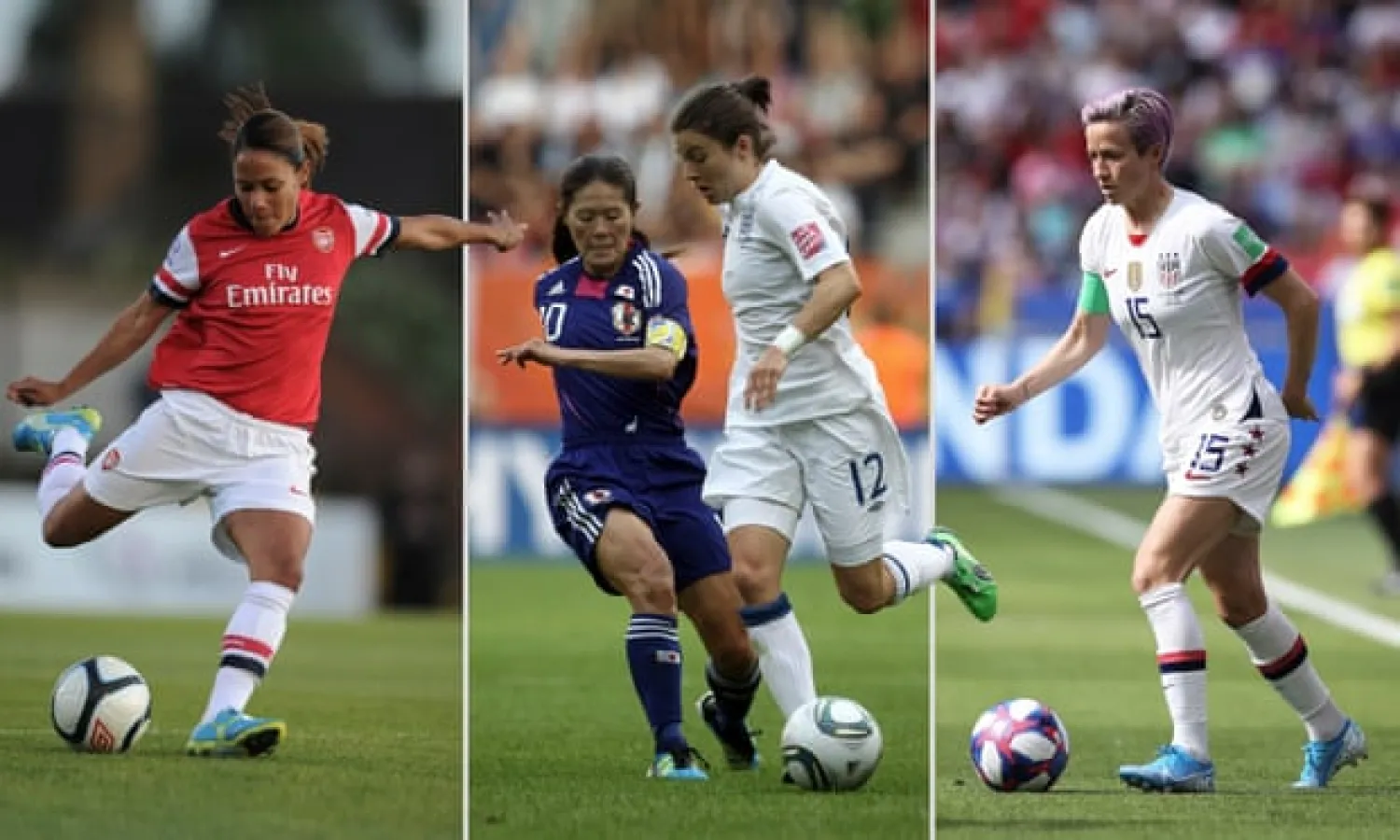
 Arsenal’s Alex Scott in 2012, England’s Karen Carney is challenged by Japan’s Homare Sawa at the 2011 Women’s World Cup, and Megan Rapinoe of the USA in the 2019 Women’s World Cup final. Photograph: Getty Images
Arsenal’s Alex Scott in 2012, England’s Karen Carney is challenged by Japan’s Homare Sawa at the 2011 Women’s World Cup, and Megan Rapinoe of the USA in the 2019 Women’s World Cup final. Photograph: Getty Images
TT

Women’s Football Has Seen a Decade of Progress but There Is Much More to Do

 Arsenal’s Alex Scott in 2012, England’s Karen Carney is challenged by Japan’s Homare Sawa at the 2011 Women’s World Cup, and Megan Rapinoe of the USA in the 2019 Women’s World Cup final. Photograph: Getty Images
Arsenal’s Alex Scott in 2012, England’s Karen Carney is challenged by Japan’s Homare Sawa at the 2011 Women’s World Cup, and Megan Rapinoe of the USA in the 2019 Women’s World Cup final. Photograph: Getty Images

Women’s football has come a very long way in a decade. Ten years ago there existed an indifference towards the few women who chose to persevere in what many viewed a novel and headstrong manner to play the men’s game – because, let’s face it, that is what “the people’s game” actually meant. Now, Chelsea’s Fran Kirby can post photos on social media of her dog sitting in front of a Bentley. It may be a loaned Bentley (the gap hasn’t closed that much) but the England forward does have numerous sponsorship deals, with Nike and Swarovski among others.

If the Noughties was the decade in which players such as Alex Scott edged from washing the shirts and shorts of the Arsenal men’s team towards the possibility of scraping a living from football, then this last decade has been the one that has provided respect and with it professionalism, sponsorship, support and the chance to make a modest living out of the game.

Delayed by a year because of the economic downturn, the Women’s Super League was launched in 2011 with eight teams and not without controversy as 16 teams applied for places. By 2014 it was expanded to include a second tier of 10 teams, with Doncaster Belles relegated to make way for the revamped Manchester City.

In 2017 the Football Association switched the leagues from a summer to a winter schedule to match the men’s calendar, while launching its four-year Gameplan for Growth strategy. By the launch of the 2018-19 season, a full-time professional top tier and semi-professional second division was in place. The changes have been rapid. And they have been forced. The casualties, and there have been many, have been necessary according to the FA’s head of women’s football, Sue Campbell.

“Yes it’s tough on them but, unfortunately, whenever you create these kind of step changes there are casualties,” she told BBC Radio 5 Live in May 2018. “Others have stepped up to the mark. It has to be a commitment from the club to step up and move forward together with us.”

There is an element of truth to that. It could be argued players and staff of teams such as Sunderland and Watford were let down by the lack of ambition and commitment of their clubs as much as the FA. On the other hand Donny Belles, Yeovil, and others who have been long-time investors in the women’s game but were unable to compete with the increased financial demands of the FA, have been sacrificed.

In the meantime, amid all that upheaval, attendances have stagnated. From an average of 728 in 2014 they climbed to 1,128 by 2016 but then dipped as the winter switch took its toll, eventually averaging 996 for the first fully professional season.

Where domestically audiences have stood still, interest has been driven internationally. Viewing figures for the Lionesses at international competitions have steadily climbed. For the 2011 World Cup in Germany a peak match average viewing figure of 1.7m was reached. The 2013 Euros were a bit of a blip, a 1.3m peak match average was prevented from climbing further when England crashed out of their group with one point (ending Hope Powell’s tenure). By 2015 the World Cup in Canada saw a peak of 2.4m watching England’s semi-final defeat to Japan. At the 2017 Euros 4m watched their exit to the Netherlands (a 66% increase on 2015).

Last year, though, felt like a turning point. After a decade, or two even, of somewhat steady growth women’s football took a leap forward. A massive 11.7m watched England’s defeat by USA at the World Cup, a 192.5% increase on their 2017 Netherlands exit.

By mid-November domestic WSL attendances, boosted by big games, were averaging 4,112 (and 1,425 with the showpiece games at Stamford Bridge, Tottenham Hotspur Stadium and elsewhere removed from the equation). The close to £20m investment by Barclays in the top division and grassroots football was the pinnacle of a host of sponsorship deals for clubs, the national team and players.

There is a real optimism in women’s football. The media, the FA, commercial partners, clubs and fans are, broadly speaking, on the same page. There is an ideological belief in the importance of building the game, perhaps a result of the way attitudes have changed around women, women’s bodies and women’s rights more widely, but that is coupled with a much cruder realisation that there are real longer‑term financial and image benefits to backing the women’s game.

Not everything is rosy. The gap between the haves of Arsenal, Chelsea, Manchester City and Manchester United and the have-nots is growing. Lyon face a similar scenario in France, where their investment is almost punished by teams unwilling to play catch-up.

And, while attitudes generally have changed dramatically, there is still a long way to go – within organisations but also more generally in society. The first comment on Twitter in response to Megan Rapinoe being named the 2019 Guardian Footballer of the Year was: “Sure, I agree. Still not watching women’s football though.” Another said: “Lol. Hypocrite look in the mirror and start with yourself. You obnoxious P.O.S.”

Almost every comment on Facebook was negative. There is a vocal minority who are not content to just ignore what they don’t like but feel compelled for some unknown reason to shout it. They find their fuel in the bodies that perpetuate the inequity – the clubs that forced Spanish footballers to strike, Fifa’s decision to let a $370m gap in World Cup prize money grow by $10m despite a doubling of the women’s fund to $60m, US Soccer’s equal-pay dispute with their most successful ever senior team.

There is still so much to do. Women’s football should be swimming with the tide but, unfortunately, there is still much for which to be fought. Here’s hoping this decade sees that change.

The Guardian Sport


‘Not Competitive’ Brazil Can Improve, Insists Ancelotti

Brazil's head coach Carlo Ancelotti looks on before the Mizuho Blue Challenge – The Kallang Football Series international friendly match between Japan and Brazil at the National Stadium in Singapore, 14 November 2026. (EPA)
TT

‘Not Competitive’ Brazil Can Improve, Insists Ancelotti

Brazil's head coach Carlo Ancelotti looks on before the Mizuho Blue Challenge – The Kallang Football Series international friendly match between Japan and Brazil at the National Stadium in Singapore, 14 November 2026. (EPA)

Brazil coach Carlo Ancelotti on Monday promised an improved performance in the year-ending clash against Singapore, admitting that his squad was "currently not competitive."

The Selecao lost 3-2 against Japan in a friendly in Singapore on Saturday, where Ancelotti and skipper Raphinha were red-carded after Japan scored the dramatic clincher in stoppage time.

"Given that the team is currently not competitive, I want to do more," Ancelotti told reporters in Singapore, where Brazil play on Tuesday.

The Italian, Brazil's first-ever permanent foreign coach, said: "I want to do more because I enjoy being here, so that the team can become more competitive on the global stage.

"The priority is to play well first (tomorrow) and to do well."

Ancelotti, 67, is coming under increasing pressure, following a string of underwhelming performances including two defeats, two wins and a draw in Brazil's last five international outings.

Japan avenged a 2-1 defeat by Brazil in their previous meeting at this year's World Cup, when the South Americans beat them in a round-of-32 clash.

After Saturday's loss, Ancelotti faced a barrage of criticism, including from former Brazilian national team star Romario.

Ancelotti brushed off Romario's remarks, saying "like anyone he has the right to express an opinion."

But the former Real Madrid coach, who reacted with fury after Brazil appealed for a foul in the build-up to Japan's winning goal on Saturday -- which was upheld by VAR -- said that his team "didn't deserve to lose" against Japan.

Japan face Paraguay on Tuesday in the second match of the double-header at Singapore's National Stadium.


Vinicius Says Less Training and Transfer Distractions May Explain Dip in Form

 Brazil's Vinicius Junior celebrates after goal during a friendly soccer match between Japan and Brazil in Singapore, Saturday, Nov. 14, 2026. (AP)
Brazil's Vinicius Junior celebrates after goal during a friendly soccer match between Japan and Brazil in Singapore, Saturday, Nov. 14, 2026. (AP)
TT

Vinicius Says Less Training and Transfer Distractions May Explain Dip in Form

 Brazil's Vinicius Junior celebrates after goal during a friendly soccer match between Japan and Brazil in Singapore, Saturday, Nov. 14, 2026. (AP)
Brazil's Vinicius Junior celebrates after goal during a friendly soccer match between Japan and Brazil in Singapore, Saturday, Nov. 14, 2026. (AP)

Real Madrid winger Vinicius Junior says ‌his reduced training schedule, and transfer interest, may have affected his performances in an underwhelming start to his Real Madrid season.

The Brazilian signed a new contract until 2032 in August, but so far his output on the pitch has fallen short of his own previous standards. Press scrutiny in Spain has been intensified by the impressive start of Ivorian signing Yan Diomande, who has eclipsed Vinicius in his preferred left-sided role.

“I don’t think I prepared as well as I could have after the World Cup, because ‌the impact of ‌that tournament is so significant for all ‌Brazilians," ⁠he told a ⁠press conference in Singapore on Monday.

"Being knocked out so early was something we hadn’t expected. So, I took advantage of my holidays to enjoy myself, rest, relax, and spend more time with my family. I ended up training less than in previous years," he said.

“That may have affected my start to the season."

Vinicius' future ⁠at Real Madrid was a talking point in ‌Spain for months as he entered ‌the final year of his contract before re-signing in August. Premier ‌League champions Arsenal were said to be interested at the ‌time.

"On top of that, regarding my contract renewal, with so many clubs showing interest last summer, I felt truly overwhelmed, as with the situation at Real Madrid. But it’s a very long season.”

The 26-year-old said he ‌had a track record of hitting top form in the decisive moments of the season, ⁠and that he ⁠was on a positive trajectory.

“Maintaining such a high level for so long is always very difficult," said Vinicius.

"I think only Cristiano Ronaldo and (Lionel) Messi have managed to do this for so many years, reaching the same kinds of numbers."

"I am human, I often make mistakes, but I always try to improve.”

This season Vinicius has scored one goal and given three assists in his 12 Real Madrid appearances. Coach Jose Mourinho has only used him for a full 90 minutes on three occasions.

Nevertheless, he did score twice on Saturday in Brazil's 3-2 loss to Japan, and is likely to feature in another friendly against Singapore on Tuesday.


Belgium’s Lukaku Retires from International Football

Belgium's forward #09 Romelu Lukaku celebrates after scoring his team third goal during the UEFA Nations League, League A - Group 1, football match between Belgium and Turkey at the Maurice Dufrasne stadium, in Liege, eastern Belgium on October 2, 2026. (AFP)
TT

Belgium’s Lukaku Retires from International Football

Belgium's forward #09 Romelu Lukaku celebrates after scoring his team third goal during the UEFA Nations League, League A - Group 1, football match between Belgium and Turkey at the Maurice Dufrasne stadium, in Liege, eastern Belgium on October 2, 2026. (AFP)

Belgium forward Romelu Lukaku on Monday retired from international football after scoring 94 goals in 135 games for his country, saying he was "at peace" with his decision.

Lukaku featured in four World Cups for the Red Devils and helped them reach the quarter-finals of this year's tournament before losing to eventual winners Spain.

The 33-year-old, who now plays for Turkish club Fenerbahce, made his debut in 2010 as a teenager and was an unused substitute in Sunday's 4-1 Nations League win over Italy.

"These 16 years I gave all I had for the national team. It was a nice ride and I enjoyed every single moment," Belgium's record goal scorer said on Instagram.

"To the Belgium fans, thank you for the support you gave our team. I am proud to have represented my country in 4 World Cups and 3 European Championships.

"I will never forget those moments. I'm at peace with my decision to stop here," Lukaku said.

The former Chelsea, Manchester United and Inter Milan forward was part of Belgium's so-called "golden generation".

Lukaku, alongside Kevin De Bruyne, Thibaut Courtois and Eden Hazard, finished third at the 2018 World Cup, a best-ever finish for Belgium in the tournament but they failed to lift a trophy during the period.

"I played with amazing teammates that I will always be grateful for," Lukaku said.

"I want to thank them all. I want to thank all the coaches as well for pushing and trusting me to help the team," he added.

- 'Legend, my brother' -

A host of fellow Belgian players paid tribute to Lukaku.

"Legend, my brother," midfielder Axel Witsel said on Instagram.

"Thank you for everything my bro," Courtois said.

"So many amazing memories," the Real Madrid goalkeeper added.

Lukaku's last appearance for his country came in October's 4-1 loss to France.

"Beyond his exceptional performances on the pitch, he has been a true leader, with a strong personality and an essential role in the dressing room," Lukaku's former team-mate and now Belgium's technical director Simon Mignolet said in a statement from the Belgian football association.

"We respect his decision and are deeply grateful to him for everything he has brought to our national team," the former Liverpool goalkeeper added.

Belgium's first game without Lukaku will be a Nations League last-eight fixture in March.

"We must now turn our attention to the future and prepare for the Nations League quarter-finals," Mignolet said.

"With the ambition of continuing to make progress as a team," he added.