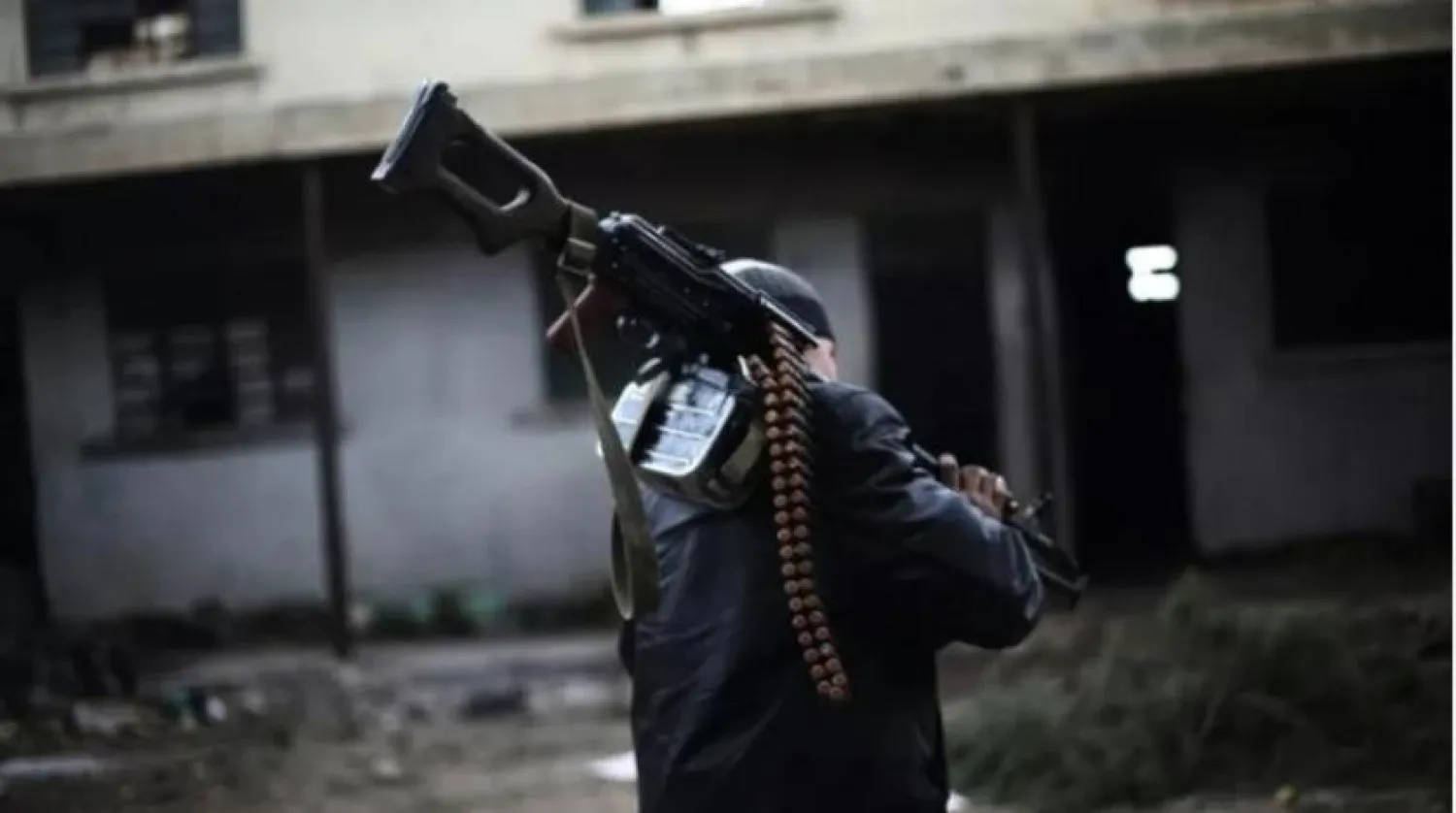
France Arrests Syrian Extremist on War Crime Charges

A Jaysh al-Islam fighter. AFP file photo
TT

France Arrests Syrian Extremist on War Crime Charges

A Jaysh al-Islam fighter. AFP file photo

A senior member of Syrian armed group Jaysh al-Islam implicated in the disappearance of a prominent activist in 2013 has been arrested in France and charged with war crimes and torture, a judicial source told AFP.

The suspect, a former spokesman of the group who is in his early thirties, was in France on an Erasmus student visa and detained in the southern city of Marseille.

He appeared before an investigating magistrate in Paris who charged him with torture, war crimes and complicity in forced disappearances, the source said on Friday.

Jaysh al-Islam is notably suspected of involvement in the December 2013 kidnapping of Syrian activist Razan Zaitouneh, her husband Wael Hamada and two colleagues, Samira Khalil and Nazem Hammadi. They have never been found.

Zaitouneh was one of the most prominent civil society figures in the uprising against Bashar al-Assad's regime that erupted in March 2011 and then descended into civil war.

That year, she was awarded the prestigious Sakharov prize for human rights along with other activists. She was a vociferous critic of abuses by all parties in the conflict.

The International Federation for Human Rights (FIDH) and two other groups behind the complaint said in a statement that the man arrested is called Majdi Mustafa Nameh, although he operates under the nom-de-guerre of Islam Alloush.

They said Islam Alloush is a former captain in the Syrian armed forces, who then defected and became a senior official and spokesman for Jaysh al-Islam, close to its leader Zahran Alloush.

"Islam Alloush was also allegedly involved in the forced enlistment of children in the armed group. Several victims also directly incriminate him for kidnapping and torture," their statement said.


Syria Affirms Deep Ties with Saudi Arabia

Saudi Ambassador to Damascus Dr. Faisal Al-Mujfel visits the Kingdom’s pavilion, guest of honor at the Damascus International Book Fair (Saudi Embassy account). 
TT

Syria Affirms Deep Ties with Saudi Arabia

Saudi Ambassador to Damascus Dr. Faisal Al-Mujfel visits the Kingdom’s pavilion, guest of honor at the Damascus International Book Fair (Saudi Embassy account). 

Syria has reaffirmed the strength of its relations with Saudi Arabia during a visit by the Saudi ambassador to Damascus, Dr. Faisal Al-Mujfel, to the Saudi pavilion, guest of honor at the 2026 Damascus International Book Fair.

Saudi Arabia’s participation in the fair, held from Feb. 6-16, is led by the Literature, Publishing and Translation Commission.

At the start of the visit, Al-Mujfel met Syria’s Minister of Culture, Mohammad Yassin Saleh, who welcomed the Kingdom’s designation as guest of honor as a clear affirmation of the depth of Saudi-Syrian cultural relations, based on partnership and mutual respect.

Saleh praised Saudi Arabia’s cultural efforts and commended the pavilion for showcasing activities that reflect the richness and diversity of Saudi cultural heritage.

He noted that the Saudi program highlights the Kingdom’s commitment to supporting culture and literature at both the Arab and international levels. The pavilion features a wide range of events, including seminars and poetry evenings, with the participation of leading Saudi writers and intellectuals.

During a guided tour, the Saudi ambassador was briefed on the creative diversity presented at the pavilion. Exhibits include a collection of manuscripts, a section dedicated to traditional Saudi attire, displays of archaeological replicas, and a selection of publications issued by the Literature, Publishing and Translation Commission.

Among the featured works are titles from the “Translate” initiative, the “Saudi Literature Comics” series, and short story collections from Saudi authors, offering visitors insight into the Kingdom’s contemporary literary scene.

The commission is overseeing Saudi Arabia’s participation as guest of honor at the 2026 book fair, presenting what it described as a vibrant cultural experience that celebrates Saudi creativity and promotes dialogue through books.

The program aligns with the Kingdom’s National Culture Strategy under Vision 2030, which emphasizes cultural exchange, knowledge sharing, and constructive dialogue among nations, while reinforcing Saudi Arabia’s role in the Arab and global cultural landscape.

The visit was attended by several Arab diplomats accompanying the Saudi ambassador, including the ambassadors of Bahrain, Oman and Lebanon, as well as the chargé d’affaires of the United Arab Emirates embassy in Damascus.


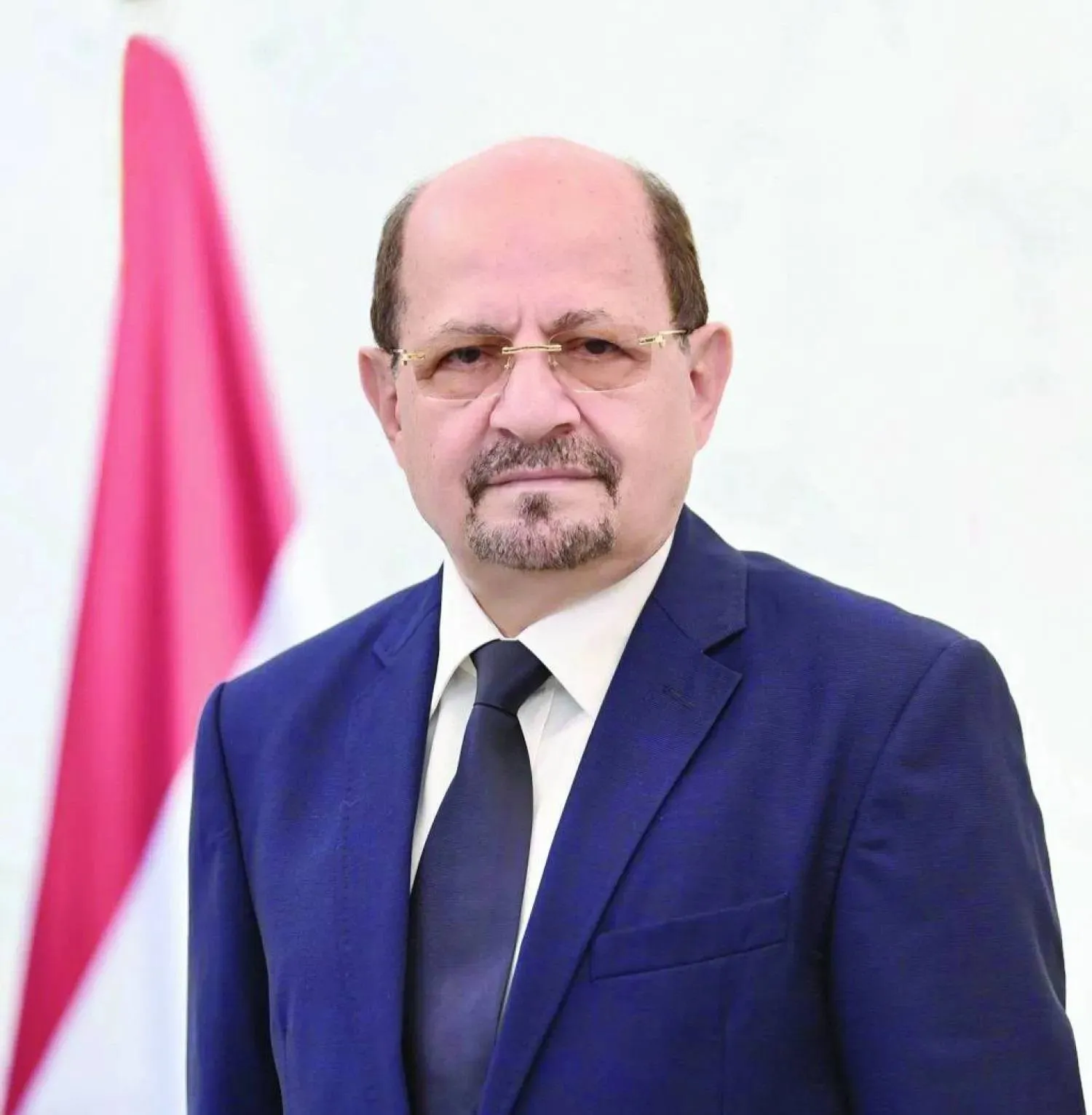
Al-Zindani to Asharq Al-Awsat: Govt to Move to Aden Soon, Foreign Ministry Retained to Complete Reforms

Yemen’s Prime Minister and Foreign Minister, Dr. Shaya Al-Zindani 
TT

Al-Zindani to Asharq Al-Awsat: Govt to Move to Aden Soon, Foreign Ministry Retained to Complete Reforms

Yemen’s Prime Minister and Foreign Minister, Dr. Shaya Al-Zindani 

Yemen’s Prime Minister and Foreign Minister, Dr. Shaya Al-Zindani, has signaled the first concrete move by his newly sworn-in government, announcing that it will relocate to Aden in the near future, just 24 hours after taking the constitutional oath.

In remarks to Asharq Al-Awsat, Al-Zindani said his decision to retain the foreign affairs portfolio was driven by the need “to complete the work already begun,” stressing that a return to Yemen is essential to restoring effective governance.

He noted that the move inside the country is a necessary step to activate performance, adding that a presence in Aden must be linked to a genuine ability to manage state files and restore regular institutional functioning.

The comments came during a special episode of the Asharq Al-Awsat Podcast, recorded at Asharq TV studios at the Saudi Research and Media Group headquarters in Riyadh’s King Abdullah Financial District.

Al-Zindani spoke at a time of acute economic pressure and heightened political expectations. He said the current phase does not allow for expansive rhetoric, but rather requires gradual, practical work to rebuild confidence, noting that stabilizing institutional rhythm must precede any expansion of objectives.

Addressing questions on the composition of his cabinet, Al-Zindani highlighted that ministers were selected on purely professional criteria, based on competence, specialization, and experience, away from partisan dictates. He emphasized that weak institutional foundations had been a central cause of past failures, underscoring the need to rebuild state structures and strengthen oversight.

He pointed to relative improvements in some public services, particularly electricity, with Saudi support, while noting that the real challenge lies in sustaining economic reforms and managing resources effectively. On accountability, he argued that unifying political decision-making has opened the door to enforcing the rule of law. When authority is unified, reward and punishment become possible, he underlined.

On economic policy, Al-Zindani avoided quick promises, instead focusing on resource management and reprioritization. Recovery, he said, cannot be achieved through piecemeal decisions but requires restructuring public finance, enhancing transparency, and activating oversight mechanisms. He stressed that financial stability is the foundation for any tangible improvement in citizens’ lives and for restoring domestic and international confidence.

He continued that working from within Yemen will enable the government to better understand societal priorities and reassert the state’s presence in public life, an influence eroded by years of conflict. He described taking the oath in Riyadh as a constitutional and security necessity dictated by circumstances, arguing that attention should focus on the substance of government action rather than symbolism.

On security, Al-Zindani adopted a cautious, realistic tone, acknowledging that years of accumulated challenges cannot be erased quickly. Still, he said coordination among security agencies and unified political leadership have led to relative improvements. While recognizing protests as part of transitional phases, he stressed the need for adherence to legal frameworks to preserve stability and avoid derailment of recovery efforts.

According to the Yemeni official, reorganizing the armed forces requires unified command and redeploying units outside cities to consolidate state authority and reduce overlap between military and security roles. He noted that multiple loyalties in previous phases weakened institutions and must be overcome to restore stability.

Internationally, he said unified political representation strengthens Yemen’s legal and diplomatic standing. He justified retaining the foreign ministry to complete reforms already underway, including restructuring the ministry and overseas missions, describing diplomatic normalization as integral to rebuilding the state.

He further described relations with Saudi Arabia as having evolved from traditional support into a multi-dimensional partnership impacting vital sectors, with scope to expand cooperation in development and economic stability.

On the Houthis, Al-Zindani said the government showed flexibility in peace efforts but faced repeated noncompliance, adding that recent military and economic developments have weakened the group’s position. Any future negotiations, he stressed, must rest on clear references, with unified anti-Houthi forces giving the government a stronger negotiating hand amid rapid regional and international shifts.



US Forces Withdraw from Syria's Al-Tanf Base

An American soldier shakes hands with a member of the Syrian Democratic Forces (SDF) in the Al-Tanf region - December 28, 2024 (US Army)
TT

US Forces Withdraw from Syria's Al-Tanf Base

An American soldier shakes hands with a member of the Syrian Democratic Forces (SDF) in the Al-Tanf region - December 28, 2024 (US Army)

US forces have withdrawn to Jordan from Syria's Al-Tanf base, where they had been deployed as part of the international coalition against the ISIS group, two Syrian military sources told AFP on Wednesday.

One source said "the American forces withdrew entirely from Al-Tanf base today" and decamped to another in Jordan, adding Syrian forces were being deployed to replace them.

A second source confirmed the withdrawal, adding the Americans had been moving equipment out for the past 15 days.

The second source said the US troops would "continue to coordinate with the base in Al-Tanf from Jordan".

During the Syrian civil war and the fight against ISIS, US forces were deployed in the country's Kurdish-controlled northeast and at Al-Tanf, near the borders with Jordan and Iraq.

The Kurdish-led Syrian Democratic Forces (SDF) had been a major partner of the anti-ISIS coalition, and were instrumental in the group's territorial defeat in Syria in 2019.

However, after the fall of longtime ruler Bashar al-Assad over a year ago, the United States has drawn closer to the new government in Damascus, recently declaring that the need for its alliance with the Kurds had largely passed.

Syria agreed to join the anti-ISIS coalition when President Ahmed al-Sharaa visited the White House in November.

As Sharaa's authorities seek to extend their control over all of Syria, the Kurds have come under pressure to integrate their forces and de facto autonomous administration into the state, striking an agreement to do so last month after losing territory to advancing government troops.

Since then, the US has been conducting an operation to transfer around 7,000 suspected extremists from Syria -- where many were being held in detention facilities by Kurdish fighters -- to neighboring Iraq.

Following the withdrawal from Al-Tanf and the government's advances in the northeast, US troops are mainly now based at the Qasrak base in Hasakeh, according to the Syrian Observatory for Human Rights.

Despite ISIS's territorial defeat, the group remains active.

It was blamed for a December attack in Palmyra in which a lone gunman opened fire on American personnel, killing two US soldiers and a US civilian.

Washington later conducted retaliatory strikes on ISIS targets in Syria.