


Social Media and Video Games Really Can Hurt Footballers' Decision-Making

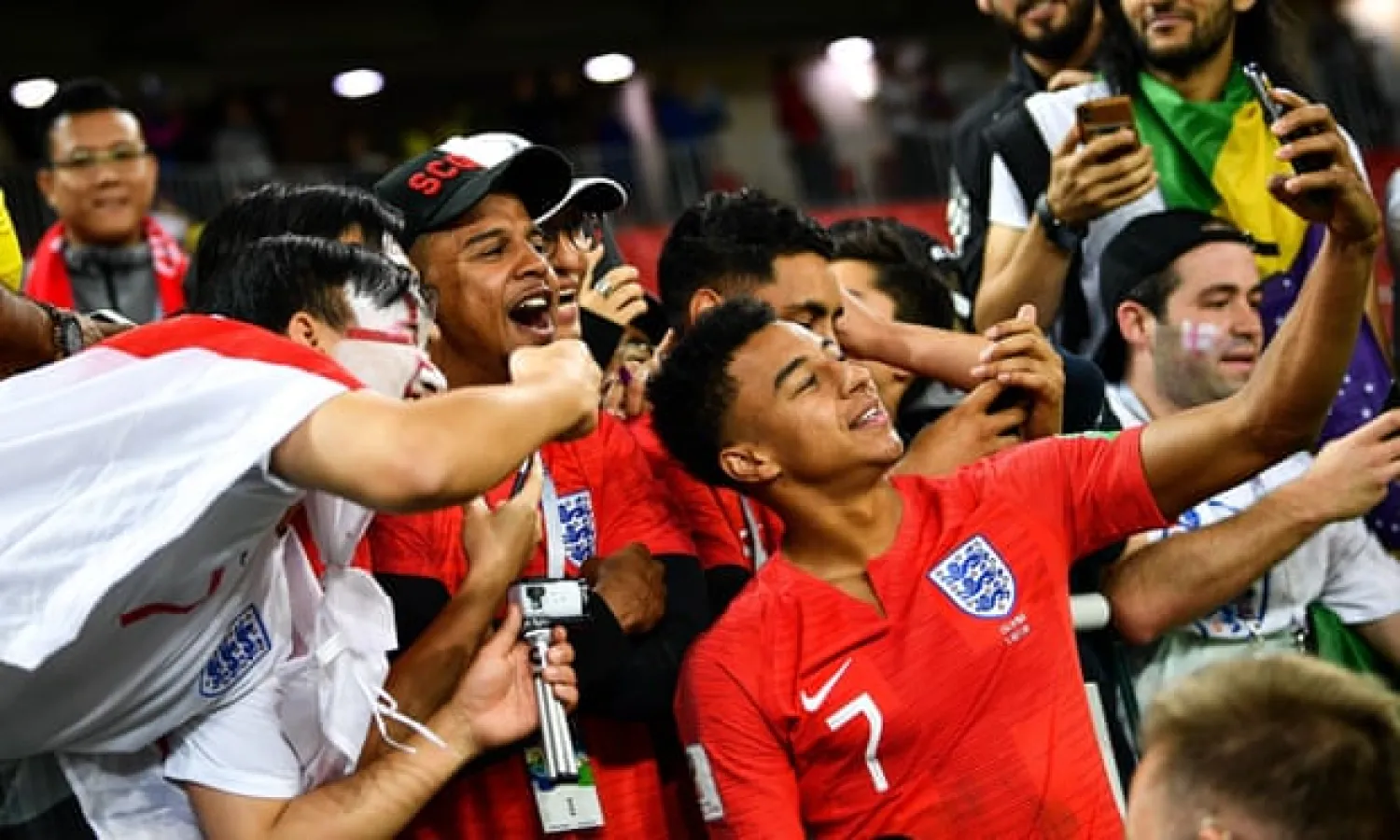
 Jesse Lingard takes a selfie with his family and friends after England beat Colombia in the 2018 World Cup. Photograph: Imaginechina/REX/Shutterstock
Jesse Lingard takes a selfie with his family and friends after England beat Colombia in the 2018 World Cup. Photograph: Imaginechina/REX/Shutterstock
TT

Social Media and Video Games Really Can Hurt Footballers' Decision-Making

 Jesse Lingard takes a selfie with his family and friends after England beat Colombia in the 2018 World Cup. Photograph: Imaginechina/REX/Shutterstock
Jesse Lingard takes a selfie with his family and friends after England beat Colombia in the 2018 World Cup. Photograph: Imaginechina/REX/Shutterstock

Could spending too much time on Twitter, Facebook or Instagram affect a footballer’s performance? Manchester United appear to think so. One report before their trip to Anfield claimed the club were “consulting leading experts” about how to help their stars deal with the negative mental effects of social media and also suggested there were concerns that players were suffering dips in form as a result of being abused online.

Some may suggest the players should just “man up”. But scientists are increasingly scrutinising how mental fatigue – the lack of energy we feel from long periods of purely cognitive activity – can influence sporting performance, often with startling results.

Only last week a study by academics on Brazilian professional footballers, published in the prestigious Journal of Sports Sciences, came to an eye-opening conclusion. Being on “social networks on smartphones and/or playing video games for at least 30 minutes before official matches impairs the passing decision-making performance in professional soccer athletes”. The researchers’ advice for managers was also as crisp as a Zico free-kick. “Coaches should evaluate the use of social networks on smartphones and/or playing video games before official matches in soccer athletes.”

It is easy to imagine many old-school managers rolling their eyes and saying “tell us something we didn’t know 10 years ago”.

However, the snappily titled article, “The effect of smartphones and playing video games on decision‑making in soccer players: A crossover and randomised study”, is significant because it backs up that instinct with hard science.

The academics’ research was based on a series of pre‑season matches played by professional players from two teams in Brazil – only with a twist. Before each game they split players into three groups. The first control group watched videos for 30 minutes. The second looked at social media on their phone for the same period. The third played Fifa 18. The footballers also did the Stroop task, a well-established psychological test, before and after these activities to assess their mental fatigue. They then warmed up and played a 90-minute match which was filmed and analysed.

Three or four days later the players switched their pre-match activity and played another 90 minutes. Six matches were played in total and to keep the players motivated they were told the games would be used to select the team once the season started.

The due diligence did not end there. The academics asked the participants to rate their levels of energy before each game to assess recovery from the previous match. Afterwards players had their blood lactate levels analysed and were required to give their perceived rate of exertion during the game.

As well as all that, two experienced analysts watched each game. Their task was simple: assess every pass made by every player and assess whether it was a good decision. After the numbers had been crunched the scientists found that, while each of the three groups – video watchers, social media viewers and Fifa 18 players – made a similar number of passes overall, the quality of passing decision-making decreased in the players who had used social media or played Fifa beforehand when compared with the passive video watchers.

So what might be going on? We all know football is an extremely dynamic and tactical sport, which places high mental demands on decision-making. However, the academics suggest being on social media and playing Fifa 18 leads to a prolonged period of electrical impulses in certain areas of the brain, reducing the speed of information processing – thus leading to less successful decision‑making accuracy.

“When mentally fatigued, athletes usually demonstrate longer fixation time on opponents and shorter fixation time on their teammates,” they point out. “Mentally fatigued athletes may not adequately interpret (sports perception) or anticipate (frontal cortex) opponent’s actions, which affects the decision-making accuracy. Thus, it seems that mental fatigue negatively affects the way players choose their tactical actions during matches.”

This is a small study, one of the veryfew that have looked at concrete evidence of the link between smartphones and video game use on elite performance on the pitch. However, other studies based on non-elite athletes have found mental fatigue has led to slower and less accurate reactions, poorer visual perception and even a reduction in the collective movement of a team in small‑sided games.

Elsewhere laboratory studies have also found some evidence of a decline in endurance performance following a mentally challenging task. One study, for instance, found a significant decline in power output in a 20-minute cycling time trial when athletes are already mentally fatigued.

Other research, based on interviews with elite Australian athletes, found mental fatigue can negatively influence player performance in other ways – including decreased motivation and enthusiasm and less attention to details.

Perhaps most of this comes as no surprise. Even so, after years when academics have focused largely on the physical nature of fatigue as opposed to its mental aspects, the focus on potential mental stressors and their relation to mental fatigue in elite sport is surely overdue.

At any rate the message from the Brazilian academics seems clear enough: staying off social media immediately before a match will not just help you to avoid the trolls; it might help you to perform better.

The Guardian Sport


ATP to Introduce New Heat Policy from 2026 Season 

Novak Djokovic of Serbia cools himself with water during the men's singles semifinal match with Valentin Vacherot of Monaco, at the Shanghai Masters tennis tournament at Qizhong Forest Sports City Tennis Center, in Shanghai, China, Saturday, Oct. 11, 2025. (AP)
TT

ATP to Introduce New Heat Policy from 2026 Season 

Novak Djokovic of Serbia cools himself with water during the men's singles semifinal match with Valentin Vacherot of Monaco, at the Shanghai Masters tennis tournament at Qizhong Forest Sports City Tennis Center, in Shanghai, China, Saturday, Oct. 11, 2025. (AP)

The ATP Tour said it will introduce a new heat policy that will come into effect from 2026 after a string of retirements due to soaring temperatures and punishing humidity at the Shanghai Masters earlier this season.

The governing body of men's tennis said the rule, based on the internationally recognized Wet Bulb Globe Temperature (WBGT) index used to measure human heat stress in direct sunlight, had "clear thresholds" for cooling measures and suspension of play.

"The new heat rule provides a structured, medically supported approach to managing extreme heat, with the objective of safeguarding player health," the ATP said on Monday.

It added the rule would also improve conditions for fans, officials, ball persons and tournament staff.

If the WBGT reaches 30.1 C (86.18 F) or higher in the first two sets of a best-of-three-set singles match, a 10-minute cooling break after the second set can be requested by either player and will apply to both competitors.

During breaks, players can hydrate, change clothing, shower and receive coaching under the supervision of ATP medical staff, the governing body added. Play will be suspended when the WBGT goes past 32.2 C.

World number two Jannik Sinner's Shanghai title defense ended in agony in October when the Italian struggled to walk due to cramp in his right thigh before he retired in the deciding set of his third-round clash with Tallon Griekspoor.

At the same event, Novak Djokovic vomited during his encounter with Yannick Hanfmann while Holger Rune was heard asking an official during a medical timeout in his meeting with Ugo Humbert if players had to "die on court" amid the heat and humidity.

The need for a formal ATP heat rule had sprung up in August in Cincinnati when Arthur Rinderknech collapsed on court during a match in sweltering conditions, before handing Felix Auger-Aliassime the victory.

Previously, ATP regulations stated that decisions on the suspension of play due to adverse weather conditions - including extreme heat - lie with an onsite ATP supervisor who coordinates with medical teams at the venue as well as local authorities.

The new rule aligns the ATP with the WTA. The four Grand Slams have also formally implemented the rules that allow for extended breaks and match suspensions.

Several professional sports including football, Formula One and cycling have formal policies to deal with extreme weather.


Rodrygo Scrapes Real Madrid Win at Alaves

Real Madrid's Brazilian forward Rodrygo secured the visitors a much-needed victory at Alaves. ANDER GILLENEA / AFP
TT

Rodrygo Scrapes Real Madrid Win at Alaves

Real Madrid's Brazilian forward Rodrygo secured the visitors a much-needed victory at Alaves. ANDER GILLENEA / AFP

Kylian Mbappe and Rodrygo Goes's goals earned Real Madrid a tense 2-1 win at Alaves in La Liga on Sunday to potentially keep coach Xabi Alonso in his job.

Second-placed Madrid trimmed league leaders Barcelona's advantage back to four points and recorded only their third victory in the last nine games across all competitions.

After a home defeat by Manchester City in the Champions League on Wednesday, Spanish media reported that anything but a victory would cost Alonso his position, AFP said.

After Mbappe's superb opener, Carlos Vicente pulled Alaves level in the second half, but Rodrygo secured the visitors a much-needed victory at Mendizorroza stadium.

"It was a hard-fought game, we competed well, got in front and then lost a bit of control," Alonso told reporters.

"Alaves play with a lot of intensity, it's hard to dominate throughout. We came here to win and we got the three points."

The coach said, as he did after the City game, that he has the support of his squad.

"We're all together in this. One game isn't enough to change the dynamic," he said.

"Now before the winter break we have a cup game on Wednesday, and a game at home (in La Liga to come)."

Alonso was able to bring his key player, Mbappe, back into the side after he could only watch the defeat by City from the bench because of a painful knee.

The coach also handed a debut to Victor Valdepenas at left-back, with both Alvaro Carreras and Fran Garcia suspended, and Ferland Mendy one of several players out injured.

Mbappe appeared to be feeling his knee and also hobbling in the first few minutes but, despite that, was the game's most influential player.

The forward had a shot deflected wide and then fired narrowly over as Alaves sat deep and tried to keep the 15-time European champions at bay.

By the time Mbappe opened the scoring in the 25th minute, his discomfort seemed to have cleared up.

Released by Jude Bellingham, Mbappe drove towards goal at full tilt and whipped a shot into the top right corner for his 17th league goal of the campaign.

England international Bellingham then blasted home from close range but his strike was ruled out for handball.

Needing to fight back, Alaves moved on to the front foot and took control of the game before the break, almost pulling level.

Madrid goalkeeper Thibaut Courtois made a fine save with his head, even if he knew little about it, to deny Pablo Ibanez from close range.

Tight battle

Los Blancos were dangerous again soon after the interval, with Alaves goalkeeper Antonio Sivera saving well from Mbappe and then Vinicius Junior.

Real came to rue those misses when Vicente pulled Alaves level after 68 minutes.

The forward got in behind Antonio Rudiger, controlled former Madrid midfielder Antonio Blanco's chipped pass and whipped a shot past Courtois.

Eduardo Coudet's side almost took the lead when Vicente's low cross from the right was nudged wide by Toni Martinez, who was nudged off-balance by Raul Asencio's pressure.

Instead, Madrid pulled back in front, with Vinicius breaking in down the left and crossing for Rodrygo to finish from six yards out.

It was the Brazilian's second goal in two games after going the previous 32 matches without finding the net, and a tense Alonso celebrated wildly, knowing that his future could depend on it.

Vinicius had appeals for a penalty turned down as he fell under a challenge from Nahuel Tenaglia, and Bellingham came close in stoppage time as Madrid tried in vain to ease their nerves by putting the game to bed.

"I thought it was a clear penalty, Vini was going very fast, there was contact... it surprises me that it didn't go to VAR," said Alonso.

Third-place Villarreal's visit to Levante was postponed because of a weather warning in the Valencia region.

Real Oviedo, 19th, sacked coach Luis Carrion after a 4-0 hammering at Sevilla.

On Saturday, champions Barcelona beat Osasuna 2-0 to win a seventh straight La Liga game and ensure that they will lead the table into 2026, regardless of what happens in the final round of fixtures before the winter break.


Bayern Goalkeeper Neuer Set to Miss Last Game of Year with Hamstring Injury 

14 December 2025, Bavaria, Munich: Bayern Munich goalkeeper Manuel Neuer warms up ahead of the German Bundesliga soccer match between Bayern Munich and FSV Mainz 05 at the Allianz Arena. (dpa)
TT

Bayern Goalkeeper Neuer Set to Miss Last Game of Year with Hamstring Injury 

14 December 2025, Bavaria, Munich: Bayern Munich goalkeeper Manuel Neuer warms up ahead of the German Bundesliga soccer match between Bayern Munich and FSV Mainz 05 at the Allianz Arena. (dpa)

Bayern Munich goalkeeper Manuel Neuer could miss his team's last game of the year because of a hamstring tear.

The club said on Monday that the injury to Neuer's right hamstring was confirmed by a medical examination after the 39-year-old club captain played the entirety of Sunday's 2-2 draw with Mainz. That was a rare case of the unbeaten Bundesliga leader Bayern dropping points.

Bayern said Neuer would be unavailable “for the time being,” without giving further information on the severity of the injury.

The visit to Heidenheim in the Bundesliga on Sunday is the club's last before the winter break.

The German champion is next in action on Jan. 11 against Wolfsburg.
