


At the Oscars, 'The Cave' Aims to Provide Hope to Syria

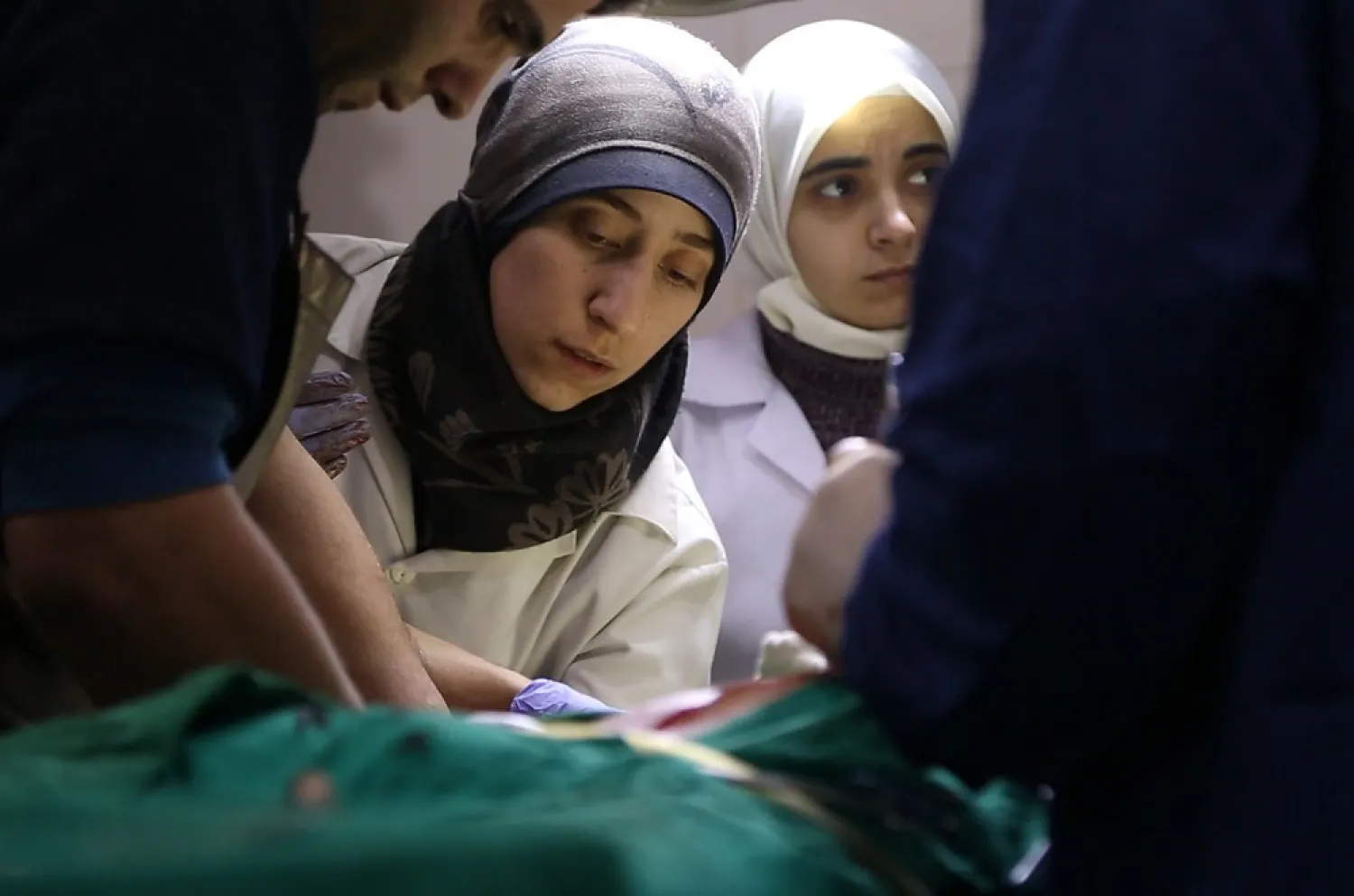
This image released by National Geographic shows Dr. Amani, center, in the operating room in Syria in a scene from the Oscar nominated documentary ‘The Cave.’ (National Geographic via AP)
TT

At the Oscars, 'The Cave' Aims to Provide Hope to Syria

This image released by National Geographic shows Dr. Amani, center, in the operating room in Syria in a scene from the Oscar nominated documentary ‘The Cave.’ (National Geographic via AP)

Home is a complicated notion for Feras Fayyad, the director of the Oscar-nominated Syrian documentary “The Cave.”

His family home in Syria is believed to have been taken just weeks ago as Bashar Assad’s Russian-backed regime seized the area. His family is living in temporary housing near the Turkish border. For several years, Fayyad has been living in exile in Copenhagen.

After a lengthy struggle to obtain a visa to attend Sunday’s Academy Awards that included an outpouring of support from the film community, Fayyad finally arrived last week in Los Angeles. Being among filmmakers and friends he has made through his two Oscar-nominated films, Fayyad said, has been a relief. Even a little like being home.

“There’s nothing harder than losing your home, nothing harder than losing everything around you,” Fayyad told The Associated Press in an interview by phone. “But there is something that gives me hope that I can speak about this and bring more attention to this situation and remind the Syrian people: We are still human, we still have a dream, we still believe in justice. For this little moment, I would love for ‘The Cave’ to bring hope to my country and my people.”

“The Cave,” Fayyad’s follow-up to this Oscar-nominated “The Last Man in Aleppo” (which made him the first Syrian filmmaker nominated for an Oscar) is one of the five films nominated for best documentary at this Sunday’s Academy Awards.

Shot between 2012 and 2018, it depicts a subterranean medical facility in Eastern Ghouta during constant bombing by Syrian regime forces and their Russian allies. The hospital lacks much of what it needs, including anesthetics and food, and the incoming flow of injured and dead — many of them children — is ceaseless. A smell of chlorine fills the air after a chemical attack.

The hospital was administered by Dr. Amani Ballour, a young woman trained as pediatrician, who stayed behind to save as many lives as she could. “They took the light,” she intones in the film. “We are living in darkness.” Ballour was the only woman leading a hospital in Syria; even as she’s tending to wounded, she’s also combating deeply ingrained misogyny.

“When I was young, no one tried to tell me that I had rights, that I can be something important. All the people around me said, ‘You’ll get married and have children,’” Ballour said in an interview by phone. “I wanted strongly to change this image, to tell young girls that you have rights, that you can be very important, that you are no different than the boys.”

Like Fayyad, Ballour is coming to the Oscars from a life in exile. She fled Syria in 2018 after the hospital was overtaken and moved to Turkey. She's applying for asylum in Canada. The United States last year abruptly pulled forces out of Syria, a withdrawal that drew a rare bipartisan rebuke from Congress. President Donald Trump’s administration has slashed the number of refugees it will accept from Syria.

Syria’s nine-year war have been called the greatest humanitarian crisis in the world. Since December, the Syrian regime has advanced into the country’s last opposition stronghold in northern Syria. Following the more than 6 million refugees already caused by the war, the United Nations on Monday said half of a million more have been displaced since Dec. 1, 80% of them women and children.

It would be hard to fathom a more sorrowful place than the hospital of “The Cave.” But it would be equally difficult to imagine a more inspiring figure than Ballour.

“I wanted to bring all of the struggle against the sadness, the depression, the death, the daily attacks on the hospital, where we can see the most courageous people and a woman who is fighting to make a space for hope,” says Fayyad. “We own the narrative here, completely, proudly.”

Fayyad and Ballour are both coming to the Academy Awards with a personal mission to call for justice in Syria and to signal to their countrymen that all is not hopeless.

“To be the voice for the people in Syria who are voiceless right now, to support them and try to get help in any way, this is my goal now,” says Ballour, speaking in a midtown Manhattan high-rise. “They have nothing in Syria, nothing. Even buildings like this, we don’t have.”

Fayyad has twice been jailed by the Syrian regime for a total period of 18 months, so his ability to shoot “The Cave” on location was challenging. He depended heavily on his local cinematographers, communicating remotely from Copenhagen. Four staff members of the hospital died during filming.

It was difficult for Fayyad and Ballour just to get to the Oscars partly due to the US travel ban on seven predominantly Muslim countries, including Syria. Fayyad’s visa was ultimately granted after protests were lodged by PEN America and the International Documentary Association.

Preventing him to travel until last week had its own cost, diminishing how much time Fayyad had to do bring attention to Syria before the ceremony. (Another film about war-torn Syria, Waad Al-Kateab and Edward Watts’ “For Sama,” is also nominated for best documentary.)

But the campaign around “The Cave,” a National Geographic film, is ongoing. Following the Oscars, Ballour will travel the US and Europe in a series of fundraising events for the Syrian American Medical Society, which helped secure Fayyad’s visa. Screenings are planned at the United Nations and at the Hague.

An Oscar nomination is just one of many honors for Ballour, who was recently awarded the Council of Europe’s Raoul Wallenberg Prize, an award named for the Swedish diplomat who saved thousands of Jews during World War II.

“A lot of minds will be blown, a lot of minds will be changed when they see the courage of this woman,” says Fayyad.

They come to the Academy Awards with heavy hearts, intent on providing a beacon for Syria. But they aren’t immune to the celebrity of the Oscars. At the film academy’s luncheon last week, Fayyad met Brad Pitt and Al Pacino. Ballour, on her way to Los Angeles, has one other goal, besides her self-appointed duty to her country. She says: “I want to see Tom Cruise!”



Trying to Improve Your Health and Wellness in 2026? Keep it Simple

A man is silhouetted against the sky at sunset as he jogs in a park at the close of a hot summer day, Aug. 1, 2022, in Kansas City, Mo. (AP Photo/Charlie Riedel, File)
TT

Trying to Improve Your Health and Wellness in 2026? Keep it Simple

A man is silhouetted against the sky at sunset as he jogs in a park at the close of a hot summer day, Aug. 1, 2022, in Kansas City, Mo. (AP Photo/Charlie Riedel, File)

The new year is a time when many try to start new good habits and commit to improving health and wellness.

But resolutions, lofty as they may be, can turn daunting quickly with all the advice and sometimes contradicting information coming at you from news reports, advertisers, influencers, friends and even politicians.

But they don't have to be.

This year, The Associated Press got the downlow on all manner of health and wellness claims and fads. The good news is that the experts mostly say to keep it simple.

As 2026 arrives, here's what you can skip, what you should pay attention to and how to get credible information when you are inevitably faced with more confusing claims next year.

Protein and fiber are important, but you probably don't need to pay more When it comes to your diet, experts say most people can skip the upcharge. If you're eating enough, you're probably getting enough protein and don't need products that promise some big boost.

And it's true that most people could use more fiber in their diets. But, please, ditch the “fiber-maxxing” trend. Instead, eat whole foods such as fruits, vegetables, beans and whole grains.

A good skin care routine is not expensive or complicated That 20-step skin care routine and $200 serum some TikToker sold you on? Dermatologists say you really don't need it. Stay away from the beef tallow and slather on a good sunscreen instead (yes, even if you have darker skin ), they say.

And the same rule for simplicity applies to that hourlong “everything shower." The best showers are simple and short, dermatologists say, no "double cleansing" required.

There are many simple ways to get that workout in If the gym and all its equipment feel intimidating, you can drop the illusion that a good workout requires either. This year, the comeback of calisthenics put the focus back on no frills, bodyweight workouts you can do in the comfort of home. Research shows calisthenics helps with muscle strength and aerobic conditioning. You may eventually need weightlifting or other equipment, but it is a great place to start to build consistency and confidence.

Be wary of wellness fads and treatments — they are often too good to be true Even if you imbibe too much this New Year's Eve, doctors say you can do without “ IV therapy ” which have vitamins you can get more easily and cheaper in pill form — if you even need more, which is unlikely if you have a balanced diet. You're pretty much just paying for “expensive urine,” one doctor said.

Same for “wellness” focused products like microbiome testing kits that generate information that doctors can't actually act on. And if you don't have diabetes, there's scant evidence that you need a continuous glucose monitor.

To improve your health, go back to the basics The idea of a panacea pill, product or routine can be enticing. But science already knows a lot about how to improve mental and physical health, and they are tried and true:

1. Whether you're in the city or the country — walk more. Research shows walking is great for physical and mental health. It's so good for you, doctors are literally prescribing time in the outdoors to their patients.

2. Take steps to get certain health metrics under control, likehigh blood pressure, which often goes undiagnosed and is known to cause a range of health problems down the road. Prioritize getting enough sleep, and make sure your family does too. Don't just eat right — eat slower.

3. Give your mind some care too. Set better boundaries with your technology andregain and retrain your attention span. Build out your social networks and invest inall forms of love for the people around you.

These lifestyle changes don't just make you feel better in the moment. Research shows they impact your life for years to come, by lowering the risk of dementia and many other health issues.

Don't know who to trust? Start with your doctor It can be tough to know who to listen to about your health, faced with compelling personal stories on social media from people who swear something worked from them, or clever marketing and advertising from companies that scare you or promise an easy fix.

Doubts have been raised this year about established medicine, including the safety of food dyes, fluoride dental treatments,hepatitis B shot for newborns, and hormone therapies for menopause.

While the medical system is not perfect, your doctor remains the best person to talk to about prevention, health concerns and potential treatments.

If you can't get to a human doctor and turn to Dr. Google instead, be sure to follow these tips and never use it to diagnose yourself. When you do get that doctor's appointment, you can make the most of it by bringing a list of written questions — and don't hesitate to ask for any clarification you need.


Citrus Harvest Season Kicks off in AlUla

The citrus harvest in AlUla is a significant agricultural and economic event  - SPA
The citrus harvest in AlUla is a significant agricultural and economic event - SPA
TT

Citrus Harvest Season Kicks off in AlUla

The citrus harvest in AlUla is a significant agricultural and economic event  - SPA
The citrus harvest in AlUla is a significant agricultural and economic event - SPA

The citrus harvest season has officially begun in AlUla Governorate, which is renowned for its agricultural production, according to SPA.

Citrus groves in AlUla cover approximately 654.57 hectares and contain around 261,826 trees, yielding about 6,545.65 tons of fruit annually.

The governorate produces a variety of delicious and nutritious citrus fruits, most notably navel oranges, citron, and sweet lemons. The citrus harvest season typically runs from December to March.

These fruits are distinguished by their high quality, attributed to the governorate's unique climate and fertile soil, resulting in exceptional flavor and high nutritional value.

The citrus harvest in AlUla is a significant agricultural and economic event that highlights the diversity of the governorate's agricultural production. It also plays a crucial role in supporting agricultural activity and promoting local products in the marketplace.


Saudi Arabia's Qassim National Park Records Third Consecutive Arabian Oryx Births

Saudi Arabia's Qassim National Park recorded the birth of an Arabian oryx for the third consecutive year. (SPA)
TT

Saudi Arabia's Qassim National Park Records Third Consecutive Arabian Oryx Births

Saudi Arabia's Qassim National Park recorded the birth of an Arabian oryx for the third consecutive year. (SPA)

Saudi Arabia's Qassim National Park in Buraidah recorded the birth of an Arabian oryx for the third consecutive year, reported the Saudi Press Agency on Monday.

The development is an important environmental milestone that reflect the ongoing success of release and reintroduction programs led by the National Center for Wildlife (NCW), which aims to preserve endangered wild species and boost biodiversity in their natural habitats.

The achievement exemplifies a pioneering collaboration between the NCW and the National Center for Vegetation Cover Development and Combating Desertification through initiatives such as vegetation enhancement, natural habitat rehabilitation, and the creation of suitable conditions for the breeding and sustainability of wild species.

Qassim National Park is one of several national parks implementing afforestation and environmental rehabilitation projects under the Saudi Green Initiative, strengthening the region’s ecological diversity and showcasing the role of national parks as models of successful environmental sustainability programs in the Kingdom.