


What Is 5G and Will It Change Our Lives?

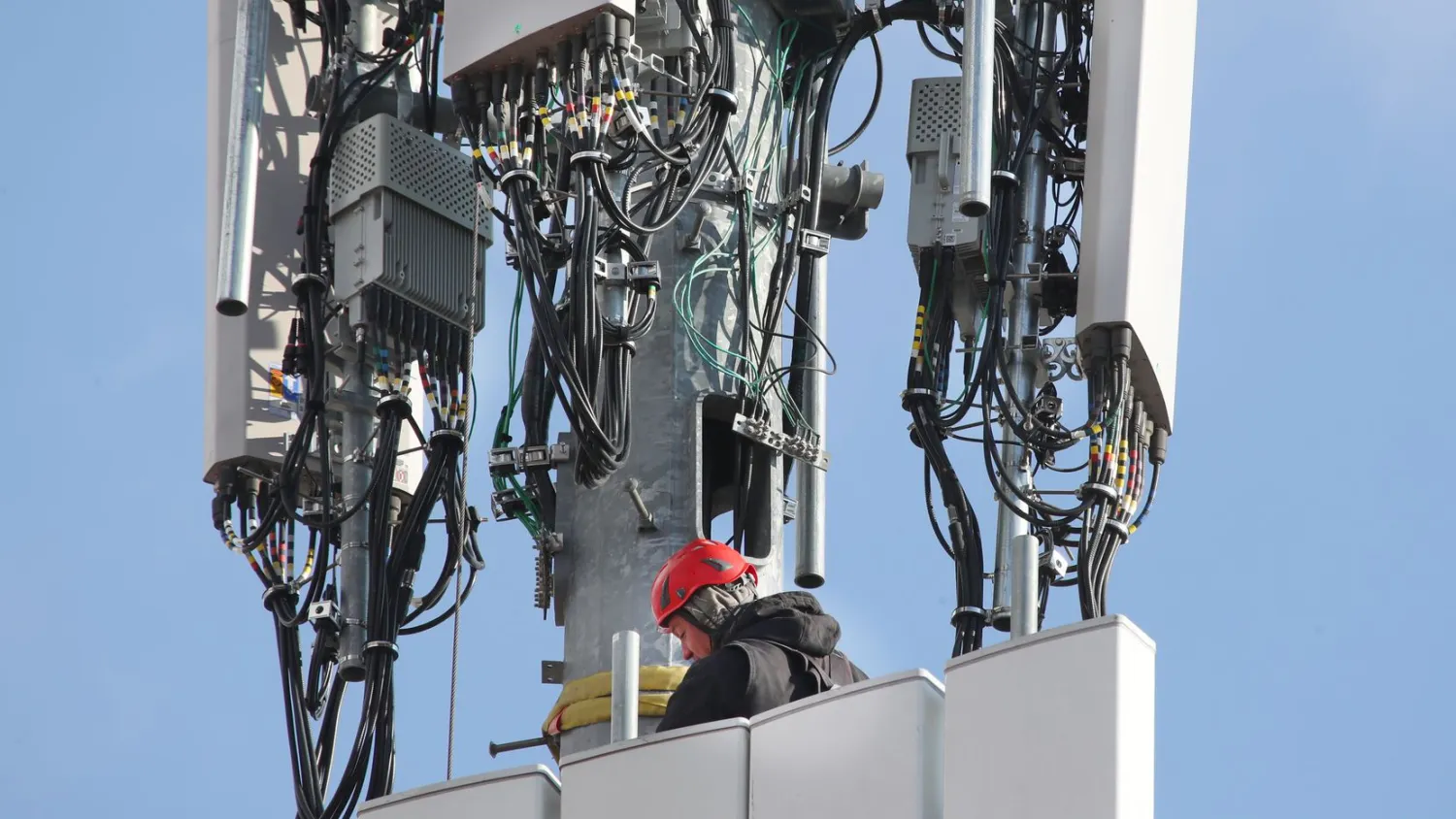
In this file photo, a worker rebuilds a cellular tower with 5G equipment for the Verizon network in Orem, Utah. (Photo by George Frey/Getty Images)(George Frey / Getty Images)
TT

What Is 5G and Will It Change Our Lives?

In this file photo, a worker rebuilds a cellular tower with 5G equipment for the Verizon network in Orem, Utah. (Photo by George Frey/Getty Images)(George Frey / Getty Images)

This week a reader wrote: “I have searched the Internet for an explanation about what 5G is, what it will do, and why it is so great. All I get is a lot of technical information about what is different about it and 4G, claims that it is going to save the world with respect to health without saying why or how, and that that reception speed or something like that will be so fast it will make us think we are in heaven rather than on earth.”

Hmm. I can tell you what 5G is, but I’ll need some (divine?) help to tell you why it might make you think you’re in heaven.

5G is a wireless technology that can transfer data over the air from cell towers to phones and other devices at much faster speeds than we have now.

Think about the broadband internet connection at your home.

I’ll use my house as an example. I have AT&T internet (not fiber or gigabit). My internet plan’s connection speed is advertised to be 28 megabits per second. This is the speed of downloads from the internet to my house.

I ran a quick test at Speedtest.net, and my download speed is 28.05 Mbps. You can’t get much closer to advertised speeds (thanks, AT&T).

Last week I was able to test Verizon’s 5G network in the Dallas Medical District using the new Samsung Galaxy S20 Ultra, and that same speed test showed a download speed of 975 Mbps.

Simple math tells me that 5G connection is almost 35 times faster than my home internet, and it comes through the air, not through a wire that has to connect to my house.

Not all 5G is the same
There are different types of 5G based on the part of the radio spectrum in use.

Low-band uses 600 megahertz, 800 MHz and 900 MHz and has a peak download speed of around 100 Mbps.
Midband uses frequencies from 2.5 gigahertz to 4.2 GHz with peak speeds of 1 gigabit per second.
High-band uses several bands between 24 GHz and 47 GHz and it offers peak speeds up to 10 gigabits per second.
You might see the midband referred to as Sub-6, while the high bands are also called millimeter Wave.

So lower bands are slower, but the signal travels much farther from the tower and penetrates buildings better.

Higher bands are much faster, but the signal doesn’t travel as far from the towers, so you need higher tower density to get good coverage. It also doesn’t penetrate buildings very well.

Midband is a good mix of speed, distance, and building penetration.

According to Digital Trends, T-Mobile uses a lot of low-band spectrum, Sprint owns a majority of the midband, and AT&T and Verizon are rolling out high-band.

In use
Aside from faster phone data connections, 5G can bring much faster internet to your home — if you live in range. Right now, most people in Dallas/Fort Worth can get home internet through only one phone company and one cable company.

Today, if I want 1 Gbps service at my home, I have to call my phone or cable company and have them run a new wire to my house.

How great will it be if three or four wireless companies are all competing to sell 5G service for your home without needing to install anything more than a small wireless hotspot to make it happen?

There are also potential uses in health care (perhaps remote robotic surgery), self-driving cars (they need huge amounts of data to move down the street) and even smart infrastructure that could allow a city’s traffic signals to talk to one another. It could improve vehicle safety, for example, if your new car knows how soon a traffic light will change so you have more time to react at a busy intersection.

5G is going to change our lives. It might not be very evident for the next year to two, but I believe it will be significant. In five to 10 years, we might marvel at ever having had wired internet connections.

I’m ready, and I hope this cleared things up a bit.

(The Dallas Morning News)
(Tribune Media)


China Approves First Two Level-3 Autonomous Driving Cars from State-owned Automakers

People pass by the entrance to Volkswagen (China) Technology Company, a 3 billion euros ($3.5 billion) R&D center in Hefei in eastern China's Anhui province, on Feb. 25, 2025. (AP Photo/Ken Moritsugu)
TT

China Approves First Two Level-3 Autonomous Driving Cars from State-owned Automakers

People pass by the entrance to Volkswagen (China) Technology Company, a 3 billion euros ($3.5 billion) R&D center in Hefei in eastern China's Anhui province, on Feb. 25, 2025. (AP Photo/Ken Moritsugu)

China's industry regulator on Monday approved two Chinese cars with level-3 autonomous driving capabilities, marking the first time such vehicles have been cleared by the national regulator as legitimate products ready for mass adoption.

The Ministry of Industry and Information Technology approved the two electric sedans from state-owned automakers Changan Auto and BAIC Motor in its latest automobile product entry category, said Reuters.

The two models are allowed to activate conditional autonomous driving in designated areas of Chongqing and Beijing with speed limits of 50km/h and 80km/h, respectively, the ministry said in a statement. The automakers will conduct trial operation with the cars on the specific roads via their ride-hailing units, it added.

The auto industry has defined five levels of autonomous driving, from cruise control at level one to fully self-driving cars at level five, and level three allows drivers to take their eyes and hands off the road in certain situations.

The move underscored China's ambition to lead the development and adoption of autonomous driving, a technology poised to disrupt the auto industry globally. Last year, China lined up nine automakers for public tests to advance the adoption of self-driving cars.

Chinese regulators earlier this year had sharpened scrutiny of the assisted driving technologies following an accident involving a Xiaomi SU7 sedan in March. That incident killed three occupants when their car crashed seconds after the driver took control from the assisted-driving system.

But government officials are pressing Chinese automakers to rapidly deploy even more advanced systems. In their level-3 push, Chinese regulators also are upping the regulatory ante by holding automakers and parts suppliers liable if their systems fail and cause an accident.

Autonomous driving developers such as Pony AI and WeRide have been testing their level-4 cars with licenses granted by local governments across China.

Tesla's Full Self-Driving, a level-2 driver assistance system, has been partially approved in China since February and falls short of its capabilities in the United States.


Elm Company Named Strategic Partner for International Data and AI Conference

Elm Company Named Strategic Partner for International Data and AI Conference
TT

Elm Company Named Strategic Partner for International Data and AI Conference

Elm Company Named Strategic Partner for International Data and AI Conference

The Saudi Data and Artificial Intelligence Authority (SDAIA) announced a strategic partnership with Elm Company for the International Conference on Data and AI Capacity Building (ICAN 2026), enhancing collaboration to empower the data and artificial intelligence ecosystem and promote innovation in education and human capacity development.

This partnership comes as part of preparations for ICAN 2026, organized by SDAIA from January 28 to 29 at King Saud University in Riyadh, with the participation of a select group of specialists and experts from around the world, SPA reported.

The step represents a qualitative addition that contributes to enriching the conference’s knowledge content and expanding partnerships with leading national entities.

Elm Company brings extensive experience in designing digital solutions and building technical capabilities, reinforcing its role as a strategic partner in supporting the conference. It contributes by developing training tracks and digital empowerment programs, participating in the technology exhibition, and presenting qualitative initiatives that help empower national competencies in the fields of data and artificial intelligence.


Foxconn to Invest $510 Million in Kaohsiung Headquarters in Taiwan

Construction is scheduled to start in 2027, with completion targeted for 2033. Reuters
TT

Foxconn to Invest $510 Million in Kaohsiung Headquarters in Taiwan

Construction is scheduled to start in 2027, with completion targeted for 2033. Reuters

Foxconn, the world’s largest contract electronics maker, said on Friday it will invest T$15.9 billion ($509.94 million) to build its Kaohsiung headquarters in southern Taiwan.

That would include a mixed-use commercial and office building and a residential tower, it said. Construction is scheduled to start in 2027, with completion targeted for 2033.

Foxconn said the headquarters will serve as an important hub linking its operations across southern Taiwan, and once completed will house its smart-city team, software R&D teams, battery-cell R&D teams, EV technology development center and AI application software teams.

The Kaohsiung city government said Foxconn’s investments in the city have totaled T$25 billion ($801.8 million) over the past three years.
