
Far From the Gladdening Crowd: Live Sport Is Our Collective Therapy

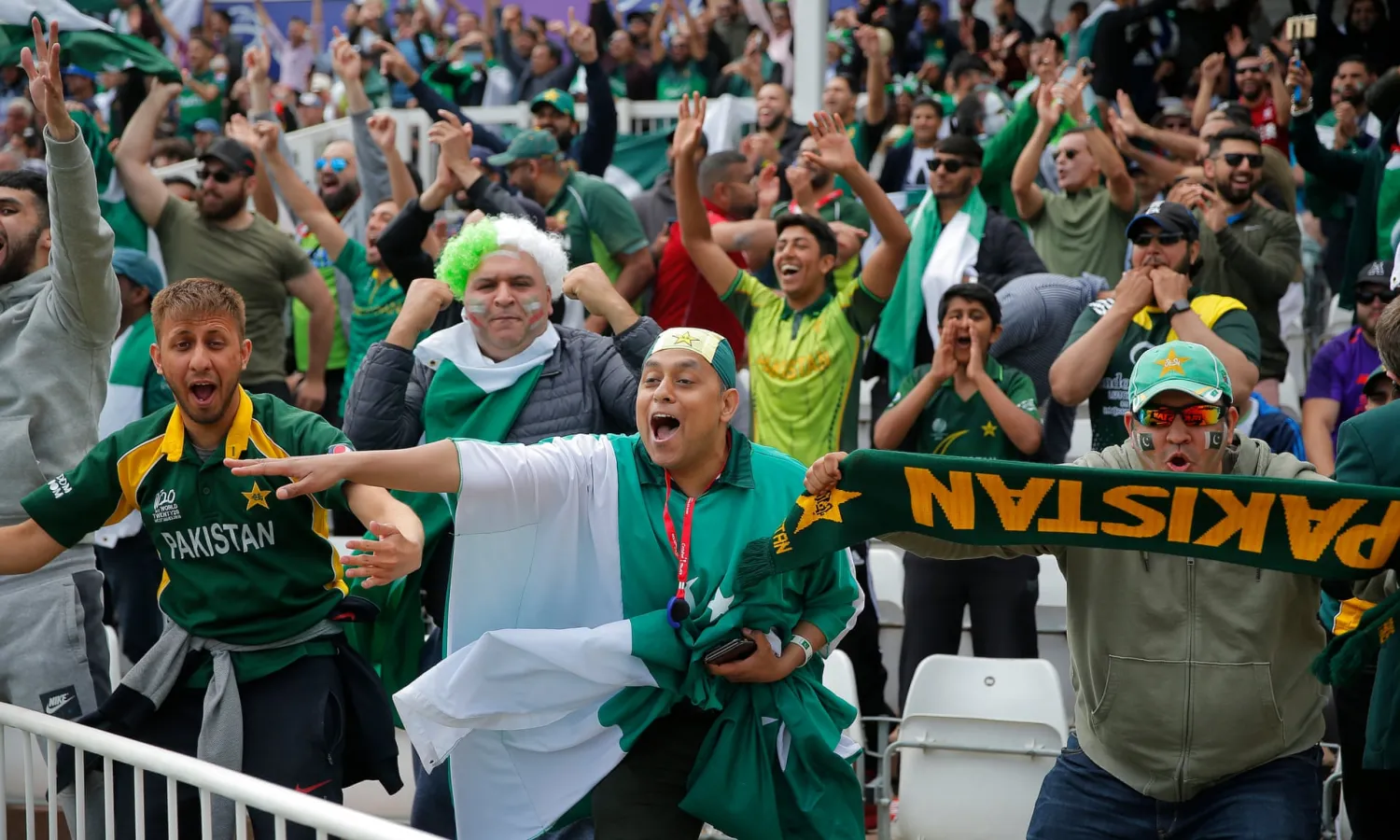
Pakistan fans celebrate during the World Cup match against England at Trent Bridge last summer. Photograph: Tom Jenkins/The Guardian
TT

Far From the Gladdening Crowd: Live Sport Is Our Collective Therapy

Pakistan fans celebrate during the World Cup match against England at Trent Bridge last summer. Photograph: Tom Jenkins/The Guardian

“The future belongs to crowds,” Don DeLillo wrote in Mao II, a quote that makes DeLillo sound po-faced and serious, when he also wrote things like “Bloomberg weighed three hundred pounds … I revered his weight. It was an affirmation of humanity’s reckless potential”, and “you people are a bunch of feeble-minded shitfarmers”.

But DeLillo was right about the future and about crowds. Even if currently it seems the present belongs instead to something else entirely, to the opposite of crowds.

Yes, it’s another article about sport not happening. There won’t be many more of these. But it has only been a week and there is still time to grieve the loss of so many wonderful everyday things; and to think about how to replace those warm feelings in the coming isolation.

What do you miss most about sport right now? Is it the endless narrative twists? Is it the fact the story has simply stopped mid-frame? In another timeline Liverpool are trying to win the league title this weekend. José Mourinho is speaking in an amused, lucid, strangely crowing tone about exactly how every single person in professional football has let him, José Mourinho, down.

Meanwhile England are batting incredibly slowly in Sri Lanka, reinventing Test cricket as a source of invigorating hair-shirt agony. People everywhere are beginning the slow build-up to pretending to know things about Olympic sports. And endless competing strains of noise and color are drowning out the rest of what we like to call the real world.

Or not as it turns out. Snap back to the present day and instead you’re grappling with a man in a baseball cap over the last pack of Morrisons own-brand charcoal oatcakes. Outside Pestilence, Famine and Binbag Shortage are clip-clopping through the side-streets, flickering at the edge of everyone’s vision. And before long we will begin to hunker down, atomized, reduced to our base units, and entering an unexpected ordeal of solitude. This is what I’m going to miss above all: the crowds! Sport has a tendency to overstate wildly its own importance. But it is startling how directly this new, much worse version of the immediate future speaks to sport’s most notable characteristic, the power to make people gather together.

This is not a straightforward love affair. Nobody loves being in a crowd the way they love plenty of other, more personal things we’re going to miss in the coming isolation. But to congregate is clearly a vital part of our nature. And outside of pilgrimages, demos, concerts and the hive-mind of aimless weekend consumerism, sport has become the most obvious expression for this urge.

The current weekend would have seen 850,000 people go to watch football in England and Scotland, astonishing numbers, particularly when suddenly this has become an absence. But then this has always been the strange power of spectator sport, from its birth in England in the rear field of the Trent Bridge Inn, where the landlord noticed large crowds flocking to watch the local cricketers and decided to put a rope around it and make this a thing.

Plus on micro-level sport itself is a statement of our desire to be social, a way of finding form and beauty in the crowd: from stylized individual pursuits such as tennis where two people stand apart, surrounded by others, and only embrace at the conclusion, to those which are essentially choreographed collisions.

Rugby gives us the scrum, so dear and so tenderly protected, but also the backs, whose entire existence is defined by a dance of angles and intersection. Football has always been about space and lack of space, about compressing and escaping the crowd, about getting tight, dropping off and, of course, firing home through a forest of legs. The best forms of cycling exist almost entirely around the power and the limits of the peloton, sport as crowd momentum, crowd flow. As for things like the marathon, well, this is sport reduced to first principles, zombie apocalypse in shorts: basically a few thin fast people running away from a crowd.

Mainly, though, the point is the people who gather to watch. This was supposed to be a column about some favorite sporting crowds and how much fun it will be for us to go back and appreciate them a little more.

But looking up I see words, phrases, digressions crowding down on top of this point like a spume of humanity flowing back from the lunchtime stairwells in the Compton stand on a sunny Saturday Test match afternoon.

Still, here is a random list of some of the ones I will miss in a non-partisan way, from the street party chanson of Parc des Princes, to the weird kinetic surges around Anfield, to the strolling pleasures of the grassy banks at Kingsmead and Buffalo Park, the choir in Cape Town, the crackle of hostility around an angry Stamford Bridge, the barrelling noise of places as disparate as the Bet365, Old Trafford (up-for-it version), the Maracanã and the full beer-sodden haze of Alexandra Palace (ie any time after 10.30 am weekdays).

The crowd can be inconvenient. It can behave badly, suck the joy out of your day, make you queue and shiver with cold, chip grease smeared down the front of your goose-down North Face gilet, stray elbows jammed in your ears, trains canceled, bothered by boozed-up lad-swarms, trapped next to men in ancient waxy coats who smell strongly of Camembert.

It’s not about performative noise either. There is something distinct even in the most sullen and ruminative of crowds, or in one of those seething, griping, Wembley England crowds, where you hear individual sighs and shrieks, the sound of someone unwrapping another wine gum, thinking about the tube, worrying about work. There is an extraordinary effect in any crowd, one you miss most when it’s not there, a kind of self-awareness. Crowds can make noises that don’t seem to come from any one person. They can generate heat and shared feelings, emotions that spread by benevolent contagion. Sporting crowds are a statement of species power.

And yet the crowd has been canceled. This is of course entirely correct. The only option now is to shut the door and breathe your own air. But social distancing is a misleading phrase. The best part of the crowd, its collectivism, will help get us through not just Covid-19, but the separate challenges of isolation and loneliness. Now more than ever, we will need to feel that presence around us.

(The Guardian)


Late Guirassy Goal Seals Win as Dortmund Cuts Bayern’s Bundesliga Lead to 3 Points

07 February 2026, Lower Saxony, Wolfsburg: Borussia Dortmund's Serhou Guirassy celebrates scoring his side's second goal during the German Bundesliga soccer match between VfL Wolfsburg and Borussia Dortmund at Volkswagen Arena. (dpa)
TT

Late Guirassy Goal Seals Win as Dortmund Cuts Bayern’s Bundesliga Lead to 3 Points

07 February 2026, Lower Saxony, Wolfsburg: Borussia Dortmund's Serhou Guirassy celebrates scoring his side's second goal during the German Bundesliga soccer match between VfL Wolfsburg and Borussia Dortmund at Volkswagen Arena. (dpa)

Serhou Guirassy scored late for Borussia Dortmund to cut Bayern Munich’s Bundesliga lead to three points on Saturday with a 2-1 win at Wolfsburg.

Wolfsburg dominated the second half with Mohamed Amoura missing several good chances and Maximilian Arnold striking the crossbar.

Dortmund’s Maximilian Beier hit the underside of the bar with a deflected shot in the first half, when Julian Brandt opened the scoring with a header from Julian Ryerson’s corner in the 38th for the visitors.

Konstantinos Koulierakis replied in similar fashion after the break with a header from Arnold’s free kick, but Wolfsburg was to rue not taking its chances to score more.

Guirassy pounced for the winner in the 87th after good play between Fábio Silva and Felix Nmecha.

“That’s part of football,” Dortmund coach Niko Kovač said of his team’s scrappy win. “But then to decide it with one action is also a quality.”

Eighteen-year-old Italian defender Luca Reggiani went on late for Dortmund for his Bundesliga debut.

American winger Kevin Paredes made his first Wolfsburg start since April 25 after recovering from two operations on his right foot.

Bayern, which failed to win its last two games, can restore its six-point lead with a win over high-flying Hoffenheim on Sunday.

Borussia Mönchengladbach was hosting Bayer Leverkusen later.

Bremen loses on coach's debut

Werder Bremen’s coaching change did little to alter its fortunes as the team lost 1-0 in Freiburg on Daniel Thioune’s debut.

Jan-Niklas Beste let fly and found the top far corner in the 13th for Freiburg, which had Johan Manzambi sent off early in the second half for a foul on Bremen’s Olivier Deman.

Thioune’s team was unable to capitalize on the extra player and is now 11 league games without a win. Bremen faces a visit from Bayern next weekend.

Welcome win for St. Pauli

St. Pauli boosted its survival hopes with a hard-fought 2-1 win over Stuttgart.

The Hamburg-based team remained second-from-bottom, but it opened a four-point gap on bottom side Heidenheim, which lost 2-0 at home to Hamburger SV. Bremen's defeat means St. Pauli is just two points from the relegation playoff place.

Mainz keeps winning

Nadiem Amiri scored two penalties, one in each half, for Mainz to beat Augsburg 2-0 for its third straight win.

Amiri ripped off his distinctive carnival-inspired jersey as he celebrated the second one to seal the win. The thoughtful Lee Jae-sung picked it up so he could resume when the celebrations died down.

Mainz next visits Dortmund.


Man United Wins Again to Make It Four in a Row for New Coach Michael Carrick

Bruno Fernandes of Manchester United scores the 2-0 goal during the English Premier League match between Manchester United and Tottenham Hotspur, in Manchester, Britain, 07 February 2026. (EPA)
TT

Man United Wins Again to Make It Four in a Row for New Coach Michael Carrick

Bruno Fernandes of Manchester United scores the 2-0 goal during the English Premier League match between Manchester United and Tottenham Hotspur, in Manchester, Britain, 07 February 2026. (EPA)

It's four Premier League wins in a row for Manchester United under Michael Carrick and a season that was unraveling just weeks ago now looks full of promise.

A 2-0 victory against Tottenham on Saturday extended Carrick's 100% start as head coach and will further strengthen his case to be given the job on a long-term basis.

“Michael has won everything here and he knows what it means for these fans, what it means for the club to win and how much is needed to win in this football. I think that adds something special to the team,” United captain Bruno Fernandes told TNT Sports.

It was the first time in two years that United has won four straight league games and boosted its hopes of a return to the lucrative Champions League after missing out for the last two years.

Bryan Mbeumo and Fernandes scored in each half at Old Trafford in a game that saw Spurs reduced to 10 men after captain Cristian Romero was sent off in the 29th minute.

Carrick has transformed United's fortunes since he was parachuted in to replace the fired Ruben Amorim last month. Initially given a contract until the end of the season — having previously had a three-game interim spell in 2021 — his impressive impact will likely put him in serious contention to keep the job as the club's hierarchy consider its long-term plans.

“I think Michael came in with the right ideas of giving the players the responsibility, but some freedom to take the responsibility on the pitch, doing the decisions that were needed,” said Fernandes. “He's very good with the words.

“I think he still remembers what I told him the last time he was our manager for our last game. I was sure that Michael could be a great manager, and he’s just showing it.”

United is fourth and after moving up to 44 points, the 20-time English champion has already exceeded last season's total of 42 points for the entire campaign.

Fernandes’ goal, with a controlled finish off his shin in the 81st, was his 200th goal involvement since joining United in 2020.

It sealed victory after Mbeumo had given United the lead in the 38th when firing low from a corner to score his 10th goal of his debut season at the club.

While United's captain was inspirational, Tottenham's Romero did his team no favors with his sending off in the first half.

Having described as “disgraceful” the fact that Spurs were reduced to 11 fit players for the draw with Manchester City last weekend, Romero hardly helped his team’s cause with his red card for a dangerous tackle on Casemiro.

The league's stats partner Opta said it was Romero's sixth sending off since joining the club in 2021 — more than any other Premier League player in that time.


Protesters in Milan Denounce Impact of Games on Environment

 A protester sets off fireworks during a protest against the environmental, economic and social impact of the Milano-Cortina 2026 Winter Olympics, near the Olympic Village in Milan, Italy, February 7, 2026. (Reuters)
A protester sets off fireworks during a protest against the environmental, economic and social impact of the Milano-Cortina 2026 Winter Olympics, near the Olympic Village in Milan, Italy, February 7, 2026. (Reuters)
TT

Protesters in Milan Denounce Impact of Games on Environment

 A protester sets off fireworks during a protest against the environmental, economic and social impact of the Milano-Cortina 2026 Winter Olympics, near the Olympic Village in Milan, Italy, February 7, 2026. (Reuters)
A protester sets off fireworks during a protest against the environmental, economic and social impact of the Milano-Cortina 2026 Winter Olympics, near the Olympic Village in Milan, Italy, February 7, 2026. (Reuters)

Thousands of people took to the streets of Milan on Saturday in a protest over housing costs and environmental concerns on the first full day of the Milano Cortina Winter Olympics.

The march, organized by grassroots unions, housing-rights groups and social center community activists, is seeking to highlight what activists call an increasingly unsustainable city model marked by soaring rents and deepening inequality.

The Olympics cap a decade in which Milan has seen a property boom following the 2015 World Expo, with locals ‌squeezed by soaring ‌living costs as an Italian tax scheme for ‌wealthy ⁠new residents, ‌alongside Brexit, draws professionals to the financial capital.

Some groups also argue that the Olympics are a waste of public money and resources pointing to infrastructure projects they say have damaged the environment in mountain communities.

A banner stretched across the street read: "Let's take back the cities, let's free the mountains."

CARDBOARD TREES SYMBOLIZE DESTRUCTION

"I’m here because these Olympics are unsustainable — economically, socially, and environmentally," said 71-year-old Stefano Nutini, standing beneath a Communist ⁠Refoundation Party flag.

He argued that Olympic infrastructure had placed a heavy burden on mountain towns hosting events ‌in the first widely dispersed edition of the Winter ‍Games.

The International Olympic Committee (IOC) points out ‍that the Games are largely using existing facilities, making them more sustainable.

At ‍the head of the procession, about 50 people carried stylized cardboard trees to represent the larches they said were felled to build a new bobsleigh track in Cortina d'Ampezzo.

"Century-old trees, survivors of two wars...sacrificed for 90 seconds of competition on a bobsleigh track costing 124 million (euros)," read another banner.

MARCH TAKES PLACE UNDER TIGHT SECURITY

According to police estimates, more than 5,000 people were taking part in the ⁠march.

Protesters set off from the Medaglie d'Oro central square to cover nearly four kilometers (2.5 miles) to end in Milan's south-eastern quadrant of Corvetto, a historically working-class district.

A rally last weekend by the hard-left in the city of Turin turned violent, with more than 100 police officers injured and nearly 30 protesters arrested, according to an interior ministry tally.

Saturday's protest follows a series of actions in the run-up to the Games, including rallies on the eve of the opening ceremony that denounced the presence in Italy of US ICE agents and what activists describe as the social and economic burdens of the Olympic project.

The march is taking place under tight security ‌as Milan hosts world leaders, athletes and thousands of visitors for the global sport event, including US Vice President JD Vance.