New Dinosaurs Species Named After Moroccan Scientist

Supplied via AAWSAT AR
TT

New Dinosaurs Species Named After Moroccan Scientist

Supplied via AAWSAT AR

Scientists at the University of Portsmouth have discovered three new species of pterosaur that lived in Morocco in the past.

Pterosaurs are the less well-known cousins of dinosaurs. They had adept flying ability. Some were as large as a fighter jet and others as small as a model aeroplane.

Professor David Martill made the discovery with a team of researchers from Morocco and the US.

The new species belongs to a group of pterosaurs called tapejarids from the Cretaceous period. They are well known in Brazil and China, and specimens have also been discovered in Europe, but this is the first time the flying reptile has been found in Africa.

The study, published in the journal Cretaceous Research, has revealed that these species differ from the three recent ones discovered as this one had no teeth -- it was 'edentulous'.

Martill, from the University's School of the Environment, Geography and Geosciences, who led the study said: "The study of Moroccan material shows that we are still far from having found all the paleontological treasures of North Africa. Even fragmentary fossils, like the jaw piece of the new pterosaur, can give us important information about the biodiversity of the past."

Roy Smith, one of the co-authors, said: "I feel very privileged to be part of such an exciting discovery. Working in the Sahara was a life-changing experience, and discovering a new species of pterosaur is the icing on the cake."

The new pterosaur has been named Afrotapejara zouhrii to honor the Moroccan palaeontologist Professor Samir Zouhri, who has contributed to several discoveries of prehistoric reptiles in Morocco, including dinosaurs and pterosaurs.

For his part, Palaeontologist Dr. Nizar Ibrahim, said: "Samir Zouhri has played an important role in the development of Moroccan palaeontology, not only through his publications, but also because he organized scientific conferences in Morocco and edited an entire volume for the Geological Society of France on the subject of vertebrate palaeontology in Morocco."

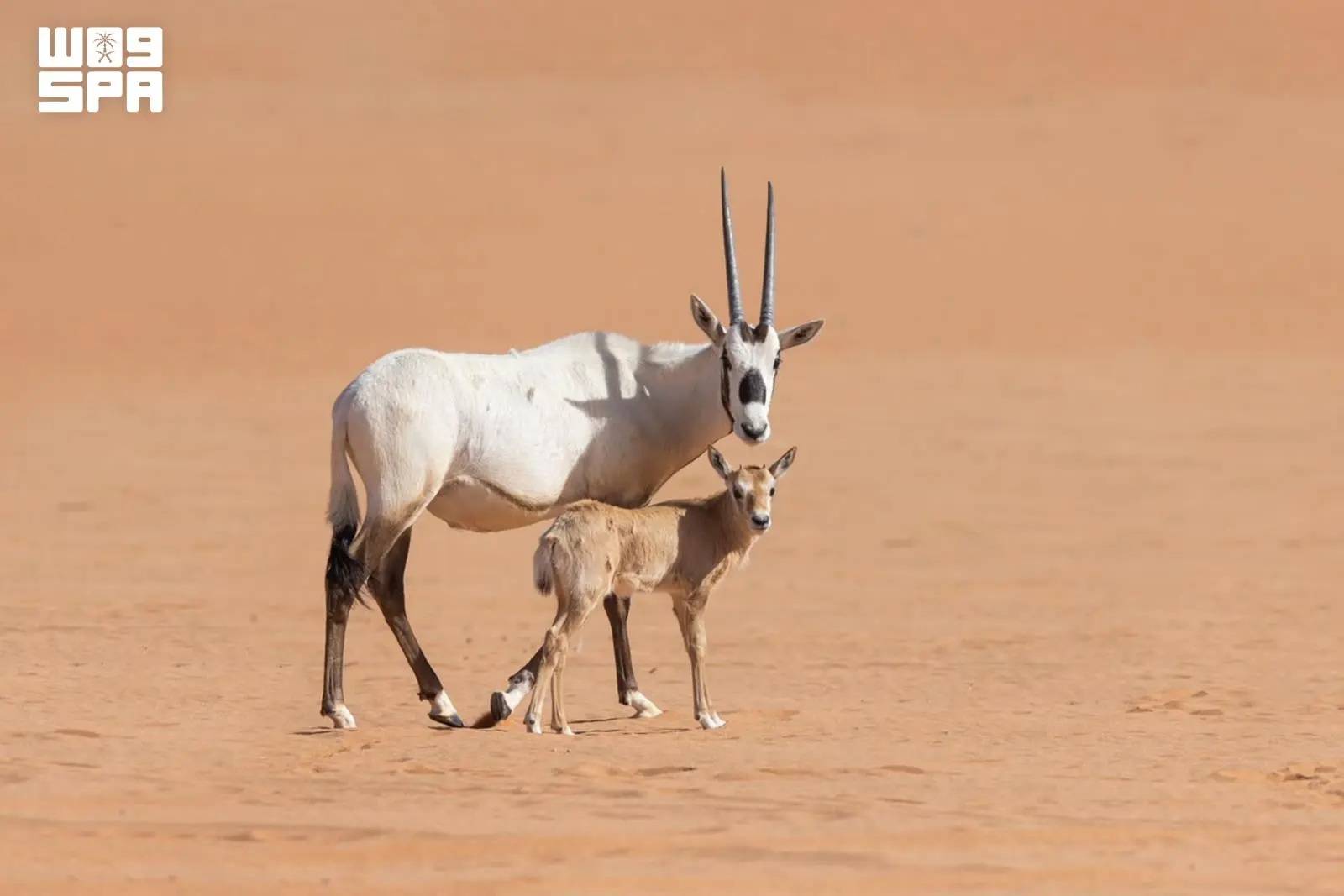

Saudi Imam Abdulaziz bin Mohammed Royal Reserve Development Authority Records 19 Wildlife Births in Q3 2026

The births included 16 Arabian sand gazelles, two Arabian oryx, and one Arabian mountain gazelle. (SPA)
TT

Saudi Imam Abdulaziz bin Mohammed Royal Reserve Development Authority Records 19 Wildlife Births in Q3 2026

The births included 16 Arabian sand gazelles, two Arabian oryx, and one Arabian mountain gazelle. (SPA)

Saudi Arabia's Imam Abdulaziz bin Mohammed Royal Reserve Development Authority recorded 19 wildlife births during the third quarter of 2026 in the Imam Abdulaziz bin Mohammed Royal Reserve and King Khalid Royal Reserve.

The births included 16 Arabian sand gazelles, two Arabian oryx, and one Arabian mountain gazelle, reflecting the effectiveness of the authority's efforts to protect wildlife, reintroduce species, and provide suitable natural habitats, reported the Saudi Press Agency on Sunday.

Head of the Wildlife Division at the Imam Abdulaziz bin Mohammed Royal Reserve Development Authority Abdullatif Al-Abdulwahab said the births were recorded through ongoing field monitoring and the use of wildlife monitoring cameras. These tools enable specialist teams to document breeding cases, monitor newborn animals, and observe species' behavior in their natural habitats.

Al-Abdulwahab added that the recorded births reflect continued natural breeding among wildlife in the two reserves and the availability of suitable environments for species to reproduce and survive.

The Imam Abdulaziz bin Mohammed Royal Reserve Development Authority recorded 19 wildlife births during the third quarter of 2026 in the Imam Abdulaziz bin Mohammed Royal Reserve and King Khalid Royal Reserve. (SPA)

He stressed the importance of protecting natural habitats to support the stability of wildlife populations and enhance biodiversity.

These results build on the authority's efforts to protect and reintroduce wildlife and develop natural habitats, contributing to environmental balance and ecosystem sustainability. They support the objectives of Saudi Vision 2030 in environmental protection and biodiversity conservation.


UK Endures Second Big Storm of the Weekend, with the North Bearing the Brunt This Time

People walk through heavy rain in Liverpool, Britain, 24 October 2026. (EPA)
TT

UK Endures Second Big Storm of the Weekend, with the North Bearing the Brunt This Time

People walk through heavy rain in Liverpool, Britain, 24 October 2026. (EPA)

The second of two storms to hit the UK this weekend brought widespread travel disruptions and power outages to Scotland, Northern Ireland and northern England on Sunday.

The Met Office, the UK's national forecaster, said Storm Boelo will bring a danger to life from flying debris and crashing waves and people should stay indoors as much as possible.

Gusts above 80 mph (128 kph) have already been recorded in Scotland, including on the island of Tiree in the Inner Hebrides. Energy company SSEN had reported a total of 93 unplanned power cuts in Scotland by 10 a.m.

An amber wind warning, the Met Office’s second most severe, is active across Scotland and the north of England until late Sunday. Flood warnings are also in place, while airports, ferries, railways and roads have seen disruptions.

Boelo, pronounced “Boo-Loh”, has followed hard on the heels of Storm Austen, which battered southern England on Friday. The National Grid, which distributes electricity around the UK, said power had been restored to more than 130,000 properties impacted by Austen by 7 p.m. on Saturday.

The Met Office began naming major storms in 2015 as a way to keep the public informed about severe weather. Storms are named in alphabetical order throughout the season, from September to August.


Ensnared Female Orangutan and Her Baby Rescued in Indonesia

A 20-year-old orangutan tries to escape as members of the BKSDA (Natural Resources Conservation Agency), the Borneo Orangutan Survival Foundation (BOSF) and the World Wide Fund for Nature (WWF) Indonesia evacuate it due to forest and land fire, in Hampangen Village, Katingan Regency, Central Kalimantan, on October 17, 2026. (AFP)
TT

Ensnared Female Orangutan and Her Baby Rescued in Indonesia

A 20-year-old orangutan tries to escape as members of the BKSDA (Natural Resources Conservation Agency), the Borneo Orangutan Survival Foundation (BOSF) and the World Wide Fund for Nature (WWF) Indonesia evacuate it due to forest and land fire, in Hampangen Village, Katingan Regency, Central Kalimantan, on October 17, 2026. (AFP)

Indonesian conservation workers rescued an orangutan ensnared in rope and her baby on the island of Borneo where the critically endangered animals are at risk from boar traps and wildfires, an official said Sunday.

The female orangutan named Gadis, about 25 years old, and her son Garis, 10 months, were found snared in a suspected trap early Friday near a village in Central Kalimantan province on the Indonesian part of Borneo.

"Gadis was found with the ropes tied to her upper right arm and lower left arms, and the wounds were bad because the ropes had torn deep into her flesh," local conservation official Muriansyah told AFP by telephone on Sunday.

"It looked like the ropes were set up as a wild boar snare trap," added Muriansyah, who like many Indonesians has one name.

Both were receiving treatment at the Orangutan Foundation International clinic near the village of Pangkalan Bun.

Wild boar hunting using rope snares is legal and common in parts of Indonesia as a pest control measure to protect crops, but illegal inside protected forests or national parks.

Officials have repeatedly cautioned that careless placement of snares near wildlife areas could instead trap endangered sun bears or orangutans.

Dozens of orangutans have also been rescued in recent weeks from rampant wildfires burning across Indonesia that have cloaked the Southeast Asian region in a toxic haze.

Two more were released in Ketapang, West Kalimantan on Saturday after being rescued from an oil palm plantation.

Orangutans are critically endangered and only about 120,000 remain in the wild in Borneo and Sumatra -- about half the number from a century ago, according to conservation group WWF.

Last month, the International Union for Conservation of Nature said fires were burning in habitats containing 52 percent of Borneo's orangutan population.