


Football Clubs' Good Deeds Go a Long Way but Shutdown Exposes Financial Faultlines

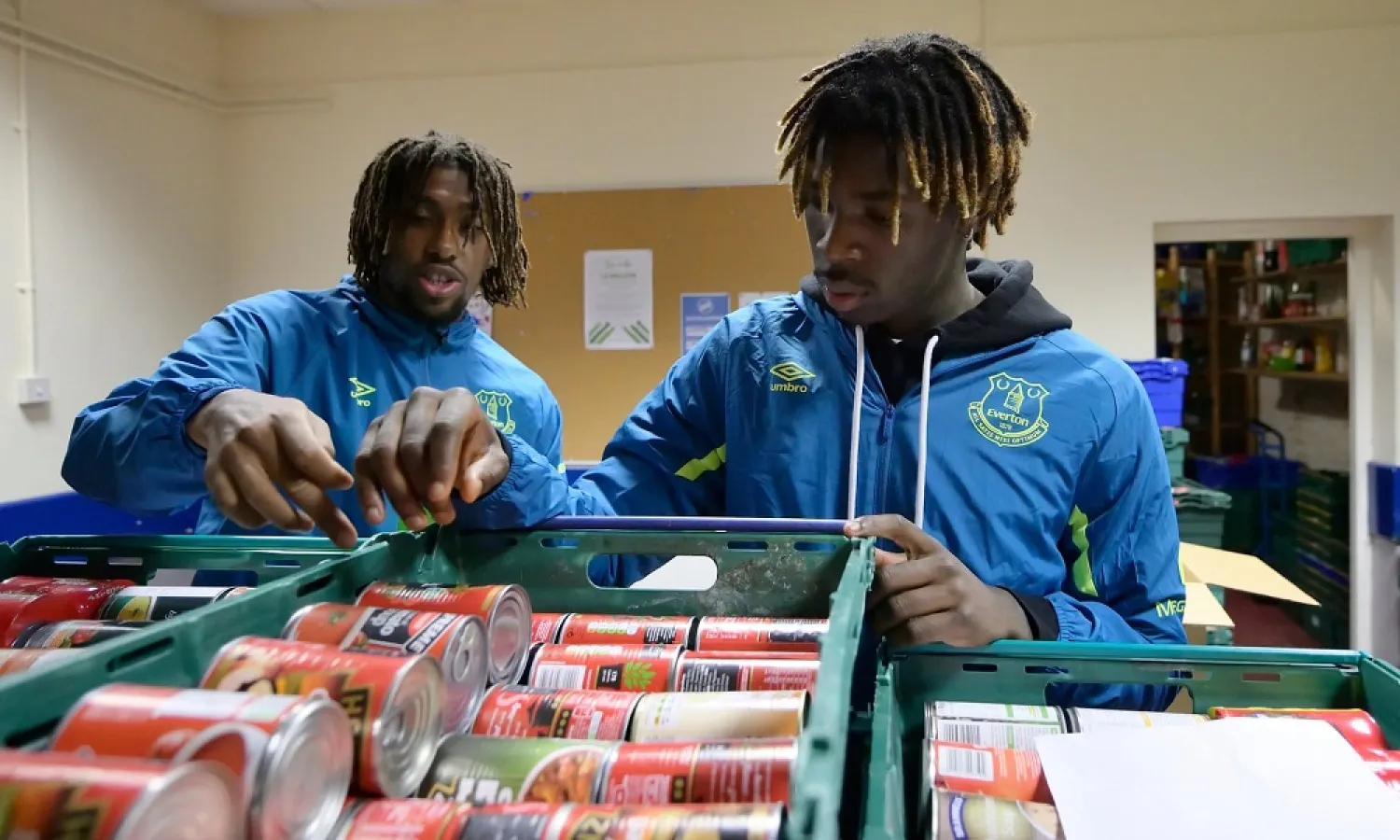
Everton players Alex Iwobi and Moise Kean help out at a foodbank in Liverpool. (Getty Images)
TT

Football Clubs' Good Deeds Go a Long Way but Shutdown Exposes Financial Faultlines

Everton players Alex Iwobi and Moise Kean help out at a foodbank in Liverpool. (Getty Images)

“What is football without a crowd?” Pep Guardiola asked a couple of weeks ago, just before it became plain that crowds of any kind now had to be avoided.

The short answer is not very much. Football has probably only just realized how much of its appeal lay in its ability to attract and entertain large numbers of people packed close together. Football stadiums are designed to accommodate crowds, to facilitate companionship; up and down the country those large edifices now standing empty and silent are powerful reminders that the human urge to congregate and commune is what has been suspended indefinitely.

Consider also the distinct lack of appetite for any sort of behind-closed-doors conclusion to the various loose ends of the season. No one is really going to do that, surely? It is hard to imagine anything more likely to demonstrate that football’s imperatives and emergencies are utterly disposable when set against the present difficulties in the real world. As an industry with crowd-pleasing as its raison d’etre, football is just going to have to wait until crowds can make a reappearance, however long that might take.

That does not mean the game has to stand idly by on the sidelines while the time of contagion passes, and nor is it. As befits a wealthy operation with legitimate claims to be community-based, football has responded in several different ways to the crisis. Manchester City and Manchester United were quick to announce a joint £100,000 donation to a local foodbank scheme, an approach also mirrored by Everton and Liverpool.

Watford have made their ground available to the NHS – Vicarage Road is close to a hospital, so think conference facilities and car parking rather than daytime kickabouts – and Chelsea have done the same with their luxury hotel. Gary Neville and Ryan Giggs were the first to announce they would keep their hotel running and make the beds available for NHS purposes, before Guardiola made a donation of €1m to help provide medical equipment in Spain.

Many leading players around Europe have made similar charitable contributions, either to nearby medical centers or to hard-pressed health workers back in their homelands. Of course, they can afford it, though there is no need to be cynical about football’s efforts to support the community when so many multimillionaire captains of industry and commerce seem to be going out of their way to appear aloof and uncaring.

Most clubs want to be seen to be doing something, whether it is donating equipment to local hospitals (Wolves), offering free tickets to frontline NHS workers for future games (Brighton and Bournemouth), or checking up on the more vulnerable members of their local community (Everton). Brighton are also telephoning elderly supporters who might be living alone to provide reassurance and help if necessary. “It’s a small but practical thing we can do to help support people that mean a lot to us,” the club’s chief executive, Paul Barber, explained.

All very commendable, though entirely predictably the virus has also exposed faultlines within football itself. The industry is not universally thriving, as we all know in a season that featured the demise of Bury and severe financial crises at similar-sized clubs, and neither do the often grotesque levels of wealth generated by the Premier League percolate through the divisions as effectively as one might wish.

While Arsenal were able to announce they would continue paying all their match-day staff and casual workers until April 30, a pledge most Premier League clubs have been able to match, Birmingham were among the first English clubs to find it necessary to propose a 50 percent pay cut as a deferral of wages for players earning £6,000 a week or more. A day later, when mighty Barcelona admitted they would be asking all their players to take a 70 percent cut until normal football can resume again, Birmingham probably wished they had gone a little further. Everyone will be joining in soon.

While most playing squads are happy to take cuts or deferrals in wages to help ensure clubs’ non-playing staff still get paid, the swiftly emerging reality is that most football wage bills are a barely tolerable burden at the best of times, and this is clearly not that. Birmingham are closer to the top than the bottom of professional football’s financial pyramid in this country, otherwise they would not be paying anyone £6,000 a week, but the effect of sudden, enforced inactivity has been to highlight the inescapable fact that what appears from the outside to be a slick business is actually a house of cards, stability always precarious due to the enormous drain on resources exerted by the players’ wages.

That principle tends to run through the whole of football, though the equally ludicrous amounts of cash coming from broadcasting rights at the top end tend to shield the leading clubs from the rest of the country’s financial reality. At the bottom end, quite simply, some of the smaller clubs may not survive this hiatus.

The solution, as Neville recently suggested, would be for Premier League clubs to pretend the present situation is as big a deal as Richard Scudamore retiring and organize a whip-round to support their struggling lower-league brethren, though when Gillingham’s chairman, Paul Scally, asked for assistance from the wealthier wing of the game, the Football League chairman, Rick Parry, insisted he was not a fan of “begging-bowl culture”.

Football and football clubs, to be clear, are not exempt from the hardship and suffering the rest of society is feeling at the moment, and it would be a mistake also to imagine only pampered players in gated mansions are affected by the shutdown. In the lower divisions the players are not all that pampered anyway, but any professional club has far more employees on the payroll than those who actually take to the pitch.

In that sense, a football club with a couple of hundred or more staff is a local employer like any other, and an industry with mega-earners at its top end ought to be better placed than most to look after itself.

If the worst comes to the worst and smaller clubs do go out of business, the greed-is-good league will inevitably get some of the blame because of the immense amounts of money it generates for itself. Begging-bowl culture is not yet as familiar an expression, yet it already has the potential to be equally damning and tenacious.

The Guardian Sport


Hospital: Vonn Had Surgery on Broken Leg from Olympics Crash

This handout video grab from IOC/OBS shows US Lindsey Vonn crashing during the women's downhill event at the Milano Cortina 2026 Winter Olympic Games on February 8, 2026. (Photo by Handout / various sources / AFP)
TT

Hospital: Vonn Had Surgery on Broken Leg from Olympics Crash

This handout video grab from IOC/OBS shows US Lindsey Vonn crashing during the women's downhill event at the Milano Cortina 2026 Winter Olympic Games on February 8, 2026. (Photo by Handout / various sources / AFP)

Lindsey Vonn had surgery on a fracture of her left leg following the American's heavy fall in the Winter Olympics downhill, the hospital said in a statement given to Italian media on Sunday.

"In the afternoon, (Vonn) underwent orthopedic surgery to stabilize a fracture of the left leg," the Ca' Foncello hospital in Treviso said.

Vonn, 41, was flown to Treviso after she was strapped into a medical stretcher and winched off the sunlit Olimpia delle Tofane piste in Cortina d'Ampezzo.

Vonn, whose battle to reach the start line despite the serious injury to her left knee dominated the opening days of the Milano Cortina Olympics, saw her unlikely quest halted in screaming agony on the snow.

Wearing bib number 13 and with a brace on the left knee she ⁠injured in a crash at Crans Montana on January 30, Vonn looked pumped up at the start gate.

She tapped her ski poles before setting off in typically aggressive fashion down one of her favorite pistes on a mountain that has rewarded her in the past.

The 2010 gold medalist, the second most successful female World Cup skier of all time with 84 wins, appeared to clip the fourth gate with her shoulder, losing control and being launched into the air.

She then barreled off the course at high speed before coming to rest in a crumpled heap.

Vonn could be heard screaming on television coverage as fans and teammates gasped in horror before a shocked hush fell on the packed finish area.

She was quickly surrounded by several medics and officials before a yellow Falco 2 ⁠Alpine rescue helicopter arrived and winched her away on an orange stretcher.


Meloni Condemns 'Enemies of Italy' after Clashes in Olympics Host City Milan

Demonstrators hold smoke flares during a protest against the environmental, economic and social impact of the Milano-Cortina 2026 Winter Olympics in Milan, Italy, February 7, 2026. REUTERS/Kevin Coombs
TT

Meloni Condemns 'Enemies of Italy' after Clashes in Olympics Host City Milan

Demonstrators hold smoke flares during a protest against the environmental, economic and social impact of the Milano-Cortina 2026 Winter Olympics in Milan, Italy, February 7, 2026. REUTERS/Kevin Coombs

Italian Prime Minister Giorgia Meloni has condemned anti-Olympics protesters as "enemies of Italy" after violence on the fringes of a demonstration in Milan on Saturday night and sabotage attacks on the national rail network.

The incidents happened on the first full day of competition in the Winter Games that Milan, Italy's financial capital, is hosting with the Alpine town of Cortina d'Ampezzo.

Meloni praised the thousands of Italians who she said were working to make the Games run smoothly and present a positive face of Italy.

"Then ⁠there are those who are enemies of Italy and Italians, demonstrating 'against the Olympics' and ensuring that these images are broadcast on television screens around the world. After others cut the railway cables to prevent trains from departing," she wrote on Instagram on Sunday.

A group of around 100 protesters ⁠threw firecrackers, smoke bombs and bottles at police after breaking away from the main body of a demonstration in Milan.

An estimated 10,000 people had taken to the city's streets in a protest over housing costs and environmental concerns linked to the Games.

Police used water cannon to restore order and detained six people.

Also on Saturday, authorities said saboteurs had damaged rail infrastructure near the northern Italian city of Bologna, disrupting train journeys.

Police reported three separate ⁠incidents at different locations, which caused delays of up to 2-1/2 hours for high-speed, Intercity and regional services.

No one has claimed responsibility for the damage.

"Once again, solidarity with the police, the city of Milan, and all those who will see their work undermined by these gangs of criminals," added Meloni, who heads a right-wing coalition.

The Italian police have been given new arrest powers after violence last weekend at a protest by the hard-left in the city of Turin, in which more than 100 police officers were injured.


Liverpool New Signing Jacquet Suffers 'Serious' Injury

Soccer Football - Ligue 1 - RC Lens v Stade Rennes - Stade Bollaert-Delelis, Lens, France - February 7, 2026  Stade Rennes' Jeremy Jacquet in action REUTERS/Benoit Tessier
Soccer Football - Ligue 1 - RC Lens v Stade Rennes - Stade Bollaert-Delelis, Lens, France - February 7, 2026 Stade Rennes' Jeremy Jacquet in action REUTERS/Benoit Tessier
TT

Liverpool New Signing Jacquet Suffers 'Serious' Injury

Soccer Football - Ligue 1 - RC Lens v Stade Rennes - Stade Bollaert-Delelis, Lens, France - February 7, 2026  Stade Rennes' Jeremy Jacquet in action REUTERS/Benoit Tessier
Soccer Football - Ligue 1 - RC Lens v Stade Rennes - Stade Bollaert-Delelis, Lens, France - February 7, 2026 Stade Rennes' Jeremy Jacquet in action REUTERS/Benoit Tessier

Liverpool's new signing Jeremy Jacquet suffered a "serious" shoulder injury while playing for Rennes in their 3-1 Ligue 1 defeat at RC Lens on Saturday, casting doubt over the defender’s availability ahead of his summer move to Anfield.

Jacquet fell awkwardly in the second half of the ⁠French league match and appeared in agony as he left the pitch.

"For Jeremy, it's his shoulder, and for Abdelhamid (Ait Boudlal, another Rennes player injured in the ⁠same match) it's muscular," Rennes head coach Habib Beye told reporters after the match.

"We'll have time to see, but it's definitely quite serious for both of them."
Liverpool agreed a 60-million-pound ($80-million) deal for Jacquet on Monday, but the 20-year-old defender will stay with ⁠the French club until the end of the season.

Liverpool, provisionally sixth in the Premier League table, will face Manchester City on Sunday with four defenders - Giovanni Leoni, Joe Gomez, Jeremie Frimpong and Conor Bradley - sidelined due to injuries.
