

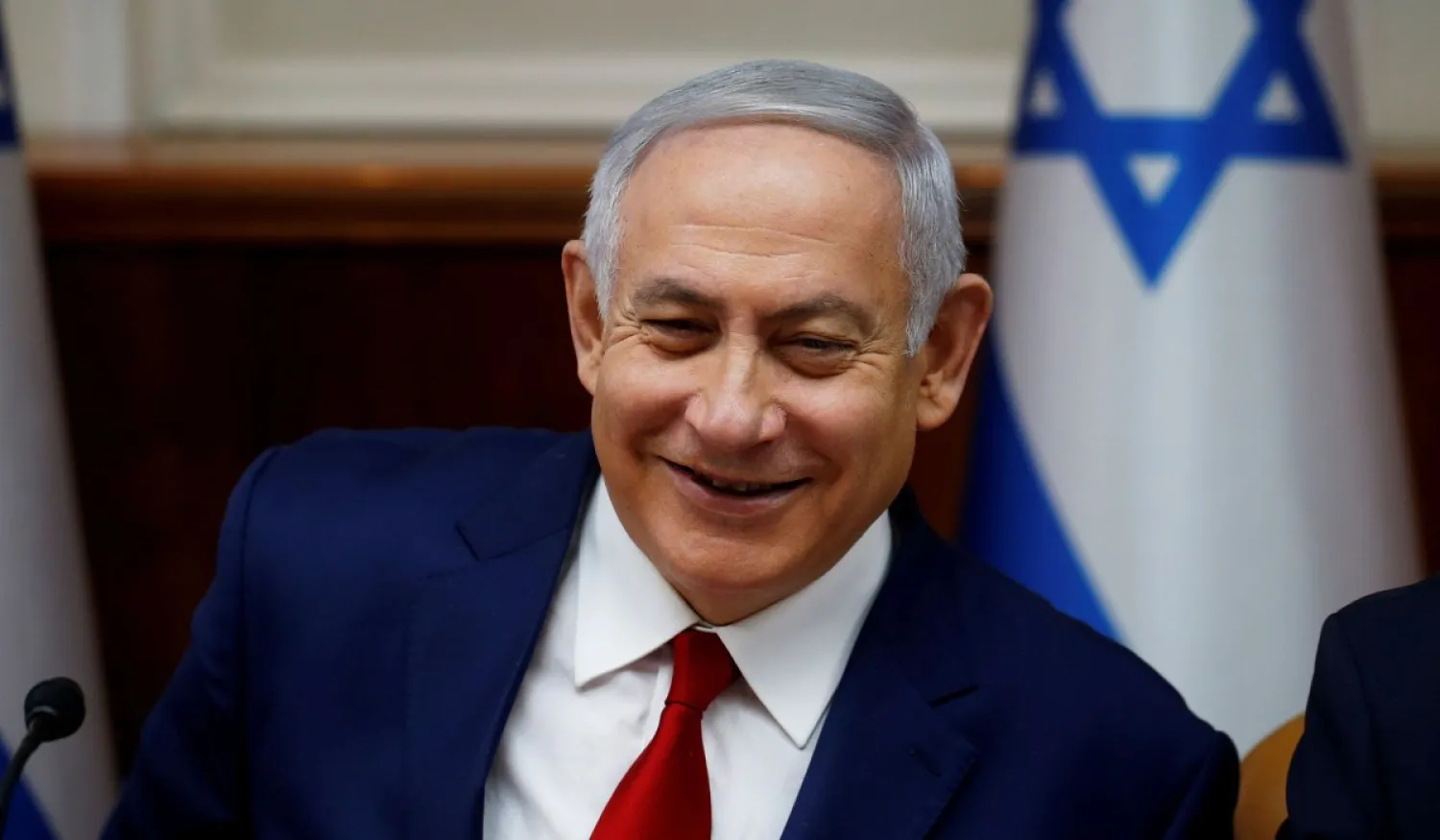

Israel Reaches Govt. Coalition Deal, Keeps Netanyahu in Power

Israeli Prime Minister Benjamin Netanyahu. (Reuters)
TT

Israel Reaches Govt. Coalition Deal, Keeps Netanyahu in Power

Israeli Prime Minister Benjamin Netanyahu. (Reuters)

Israeli Prime Minister Benjamin Netanyahu and his chief rival announced Monday that they have forged a deal to form an “emergency” government, ending months of political paralysis.

The deal averts what would have been a fourth consecutive election in just over a year as the country fights its coronavirus outbreak.

Terms of the agreement weren’t immediately announced. But Israeli media said it called for a three-year period with Netanyahu serving as prime minister for the first half, and former military chief Benny Gantz taking the job for the second half.

After the last vote on March 2 ended in a stalemate, Netanyahu and Gantz agreed late last month to try to form a unity government because of the burgeoning coronavirus crisis. The talks have dragged on and stalled several times since, reportedly over Netanyahu’s personal legal problems, sparking concern that the collapse of a deal would force the country into new elections.

Although Netanyahu repeatedly came up short in the last elections, the coalition agreement returns the long-serving leader to the premiership, defying critics who predicted his downfall and restoring his reputation as a political wizard.

The deal likely required major compromise by both men. During three bitter campaigns over the past year, Gantz and his Blue and White party vowed never to serve in a government under Netanyahu so long as he faces a slew of corruption charges. Netanyahu, meanwhile, would likely be forced to step aside and allow Gantz to serve as prime minister for part of the time, if the coalition manages to survive long enough.

Negotiations between the two leaders largely revolved around Netanyahu's corruption trial set to start next month. Main sticking points included a demand by the prime minister to have more say on judicial appointments, which could play a role if his case eventually reaches the Supreme Court.

Last month’s election, just like the campaigns last September and April, ended with no clear winner. But with a slight majority of lawmakers endorsing him, Gantz was given the first shot at building a coalition government.

The glue holding together Gantz's different backers was their shared animosity toward Netanyahu. The opposition leader had begun to move forward with legislation that would have disqualified the indicted Netanyahu from serving as prime minister in the future.

But with the virus crisis worsening, and his own shaky alliance fraying, Gantz made an about-face late last month and accepted an offer from Netanyahu to pursue a joint government to deal with the pandemic. The move drew heavy criticism from Gantz’s supporters and tore apart his Blue and White alliance, leaving him with a faction roughly half its original size.

Negotiations have continued even after Gantz’ allotted time to build a coalition ended last week, with the president now giving the Knesset until May 7 to select a candidate for prime minister. If a majority of legislators fails to choose a candidate, the Knesset would automatically be dissolved, triggering new elections.

On Sunday night, several thousand demonstrators, including Gantz’s former political partner Yair Lapid, gathered in Tel Aviv to protest the expected government deal. Protesters accused Netanyahu of using the coronavirus crisis to shield himself from prosecution and accused Gantz of abandoning his central campaign promises.

“You don’t fight corruption from within. If you’re inside, you’re part of it,” Lapid said.

Netanyahu is awaiting trial on charges of accepting bribes, breach of trust and fraud. He has denied any wrongdoing and portrays himself as a victim of a media and judicial witch hunt. Citing the coronavirus crisis, Netanyahu’s hand-picked justice minister has already delayed the trial by two months by shuttering most of the court system.

Israel has identified more than 13,000 cases of the coronavirus, with 172 deaths. While this week the country began relaxing some of its health restrictions, hundreds of thousands are out of work and the economy has come to a standstill.

There has also been growing criticism over Netanyahu’s approach to beating back the virus, with accusations that he has sidelined democratic norms in the name of fighting the virus. The government has also come under criticism for moving too slowly in compensating workers and businesses hit by the crisis.



Russia's FSB Says Ukraine's SBU Was behind Assassination Attempt on Top General

In this image made from video and provided by the Russian Defense Ministry Press Service, on June 23, 2023, Lt. Gen. Vladimir Alexeyev speaks to servicemen in an undisclosed location. (Russian Defense Ministry Press Service via AP)
TT

Russia's FSB Says Ukraine's SBU Was behind Assassination Attempt on Top General

In this image made from video and provided by the Russian Defense Ministry Press Service, on June 23, 2023, Lt. Gen. Vladimir Alexeyev speaks to servicemen in an undisclosed location. (Russian Defense Ministry Press Service via AP)

Russia's Federal Security Service said on Monday that the men suspected of shooting one of the country's most senior military intelligence officer had confessed that they were carrying out orders from the Security Service of Ukraine (SBU).

Ukraine has denied any involvement in Friday's attempted assassination of Lieutenant General Vladimir Alexeyev, deputy head of Russia's ‌GRU military ‌intelligence service. Alexeyev has regained ‌consciousness ⁠after surgery, reported Reuters.

Russia ‌said that the suspected shooter, a Ukrainian-born Russian citizen named by Moscow as Lyubomir Korba, had been questioned after he was extradited from Dubai. A suspected accomplice, Viktor Vasin, has also been questioned.

The FSB said in ⁠a statement that both Korba and Vasin had "confessed their ‌guilt" and given details ‍of the shooting which ‍they said was "committed on behalf of ‍the Security Service of Ukraine."

The FSB did not provide any evidence that Reuters was able to immediately verify. It was not possible to contact the men while they were in detention in Russia. The SBU could ⁠not be reached for immediate comment on the FSB statement.

The FSB said Korba was recruited by the SBU in August 2025 in Ternopil, western Ukraine, underwent training in Kyiv and was paid monthly in crypto-currency. For killing Alexeyev, Korba was promised $30,000 by the SBU, the FSB said.

The FSB said Polish intelligence was involved in his recruitment. ‌Poland could not be reached for immediate comment.


Venezuela's Machado Says Ally 'Kidnapped' after His Release

Venezuelan political leader Juan Pablo Guanipa gestures after their release outside Zona 7 prison in Caracas on February 8, 2026.  (Photo by Juan BARRETO / AFP)
Venezuelan political leader Juan Pablo Guanipa gestures after their release outside Zona 7 prison in Caracas on February 8, 2026. (Photo by Juan BARRETO / AFP)
TT

Venezuela's Machado Says Ally 'Kidnapped' after His Release

Venezuelan political leader Juan Pablo Guanipa gestures after their release outside Zona 7 prison in Caracas on February 8, 2026.  (Photo by Juan BARRETO / AFP)
Venezuelan political leader Juan Pablo Guanipa gestures after their release outside Zona 7 prison in Caracas on February 8, 2026. (Photo by Juan BARRETO / AFP)

Venezuela's Nobel peace laureate Maria Corina Machado said on Monday that armed men "kidnapped" a close ally shortly after his release by authorities, following ex-leader Nicolas Maduro's capture.

The country's Public Prosecutor's Office confirmed later that same day that former National Assembly vice president Juan Pablo Guanipa, 61, was again taken into custody and to be put under house arrest, arguing that he violated the conditions of his release.

Guanipa would be placed under house arrest "in order to safeguard the criminal process," the office said in a statement on Monday. The conditions of Guanipa's release have yet to be made public.

Machado claimed that her close ally had been "kidnapped" in the capital Caracas by armed men "dressed in civilian clothes" who took him away by force.

"We demand his immediate release," she wrote on social media platform X.

The arrest came after his release from prison on Sunday along with two other opposition figures, and as lawmakers prepared to vote Tuesday on a historic amnesty law covering charges used to lock up dissidents in almost three decades of socialist rule, reported AFP.

Shortly after his release, Guanipa visited several detention centers in Caracas, where he met with relatives of political prisoners and spoke to the press.

Guanipa had appeared earlier Sunday in a video posted on his X account, showing what looked like his release papers.

"Here we are, being released," Guanipa said in the video, adding that he had spent "10 months in hiding, almost nine months detained here" in Caracas.

- 'Let's go to an electoral process' -

Speaking to AFP later on Sunday, he had called on the government to respect the 2024 presidential election, which opposition candidate Edmundo Gonzalez Urrutia was widely considered to have won. Maduro claimed victory and remained in power till January.

"Let's respect it. That's the basic thing, that's the logical thing. Oh, you don't want to respect it? Then let's go to an electoral process," Guanipa said.

The opposition ally of Machado was arrested in May 2025, in connection with an alleged conspiracy to undermine legislative and regional elections that were boycotted by the opposition.

He was charged with terrorism, money laundering and incitement to violence and hatred.

Guanipa had been in hiding prior to his arrest. He was last seen in public in January 2025, when he accompanied Machado to an anti-Maduro rally.

Following Maduro's capture by US special forces on January 3, authorities have started to slowly release political prisoners. Rights groups estimate that around 700 people are still waiting to be freed.

A former Machado legal advisor, Perkins Rocha, was also freed on Sunday. So was Freddy Superlano, who once won a gubernatorial election in Barinas, a city that is the home turf of the iconic late socialist leader Hugo Chavez.

"We hugged at home," Rocha's wife Maria Constanza Cipriani wrote on X, with a photo of them.

Machado, who was awarded the 2025 Nobel Peace Prize for her efforts to advance democracy in Venezuela, had initially celebrated Guanipa's release.

"My dear Juan Pablo, counting down the minutes until I can hug you! You are a hero, and history will ALWAYS recognize it. Freedom for ALL political prisoners!!" she wrote on X on Sunday.

NGO Foro Penal said it had confirmed the release of 35 prisoners on Sunday. It said that since January 8 nearly 400 people arrested for political reasons have been freed thus far.

Lawmakers gave their initial backing to a draft amnesty last week which covered the types of crimes used to lock up dissidents during 27 years of socialist rule.

But Venezuela's largest opposition coalition denounced "serious omissions" in the proposed amnesty measures on Friday.

Meanwhile, relatives of prisoners are growing increasingly impatient for their loved ones to be freed.

Acting president Delcy Rodriguez, who was Maduro's vice president, is pushing the amnesty bill as a milestone on the path to reconciliation.

Rodriguez took power in Venezuela with the blessing of US President Donald Trump, who is eyeing American access to what are the world's largest proven oil reserves.

As part of its reforms, Rodriguez's government has taken steps towards opening up the oil industry and restoring diplomatic ties with Washington, which were severed by Maduro in 2019.


SKorea Grounds Aging Attack Choppers after Fatal Training Crash

South Korean military officials secure the site where an AH-1S Cobra attack helicopter crashed in Gapyeong, South Korea, February 9, 2026. Yonhap via REUTERS
TT

SKorea Grounds Aging Attack Choppers after Fatal Training Crash

South Korean military officials secure the site where an AH-1S Cobra attack helicopter crashed in Gapyeong, South Korea, February 9, 2026. Yonhap via REUTERS

South Korea grounded an aging fleet of military helicopters on Monday after a chopper crashed during a training exercise and killed two people on board.

The AH-1S Cobra was training for emergency landings when it "crashed due to an unidentified cause" in Gapyeong county west of Seoul, the army said in a statement.

Two service members were taken to hospital and later pronounced dead, AFP reported.

Photos in local media showed the helicopter's crumpled fuselage lying on a rocky river bank.

"Following the accident, the Army has suspended operations of all aircraft of the same model" and is investigating the cause, the forces said.

The AH-1S Cobra is a US-made, single-engine anti-tank attack helicopter.

Some of those used by South Korea's military are more than 30 years old. It is not clear how many are currently in service.

The country's defense acquisition agency said in 2022 that the Army's Cobra helicopters were "scheduled to be retired" as domestically developed light-armed choppers started flying.