Lebanon's Grand Mufti Sheikh Abdul Latif Derian receives former PM Fouad Siniora
On Saturday, Lebanon witnessed a wave of criticism against statements made by Prime Minister Hassan Diab that targeted the Governor of the Banque du Liban Riad Salameh and economic and financial policies adopted by the Levantine country over the past years.
Some considered Diab’s speech as vengeful while others said that the prime minister had attacked Lebanon as a whole, both politically and economically.
“It is the stage of revenge, which they opened against a whole period, and assigned the prime minister to assume the attack,” ex-prime minister Saad Hariri said in a vocal statement against Diab, who is accused of seeking to end the free economic system in Lebanon.
Others like ex-prime ministers Tamam Salam and Fouad Siniora and MP Nouhad al-Mashnouq also attacked Diab for his recent statements from Lebanon’s Dar el-Fatwa.
“Diab’s statement is a continuation of a policy pursued by Hezbollah and the Free Patriotic Movement, which formed the government, and it does not target a specific sect, but rather Lebanon as a whole,” sources close to the outspoken former prime ministers told Asharq Al-Awsat.
“Since forming the government, Hezbollah has been trying to seize more control over resources of this country, and here it is using Diab as means to an end,” the sources added.
Commenting on Diab’s statement, Siniora said: “This is not how things are handled, and what is required is to provide real remedies, because there are pressing living conditions; what is required today is the mobilization of citizens to support the process of real reform.”
“How can confidence be restored and we have not solved the judicial formations file? How can we gain the confidence of the Lebanese people, and we have not implemented the electricity law that has been in place for 18 years?” Siniora asked.
MP Mashnouq criticized Diab’s latest statement, pointing to “conspiracies” against the “Sunni community and Sunni politicians.”
“There is a conspiracy against Sunni politics and the Sunni community and we hope that Diab is not part of it,” said Mashnouq in remarks he made from Dar el-Fatwa.
A painting depicting people holding the Sudanese flag is seen on a wall damaged by bullets and shrapnel in Omdurman, on the outskirts of Khartoum, Sudan, Thursday, April 23, 2026. (AP)
TT
TT
RSF Drone Strike Kills Five in Sudan Capital
A painting depicting people holding the Sudanese flag is seen on a wall damaged by bullets and shrapnel in Omdurman, on the outskirts of Khartoum, Sudan, Thursday, April 23, 2026. (AP)
A paramilitary drone killed five civilians on Saturday when it hit a vehicle in greater Khartoum, a rights group said, the second such attack in the Sudanese capital this week.
Drone attacks by both Sudan's army and the paramilitary Rapid Support Forces (RSF) -- which have been at war since April 2023 -- have intensified across the country in recent months, at times killing dozens of people in a single strike.
Emergency Lawyers, a Sudanese legal advocacy group documenting abuses during the conflict, said an RSF drone struck a civilian vehicle on the Jammouiya Triangle road Saturday morning in southern Omdurman -- just across the Nile from Khartoum proper -- killing all those on board.
The vehicle was travelling from the Sheikh al-Siddiq area in White Nile state, about 90 kilometers (56 miles) south of Khartoum, the group said.
Last Tuesday, a drone strike hit a hospital in the Jebel Awliya area, around 40 kilometers (25 miles) south of central Khartoum, a security source and eyewitnesses told AFP.
It was the first such attack on the capital in months, after the area was recaptured by the army a year ago from its paramilitary rivals.
Jebel Awliya had been the RSF's last foothold in Khartoum state before the army's rapid counteroffensive, which pushed the paramilitary west towards its stronghold in the Darfur region.
The RSF carried out a series of drone strikes on Khartoum last year, largely targeting military sites, power stations and water infrastructure.
In recent months, however, the capital has seen relative calm. More than 1.8 million displaced residents have returned and the airport has resumed domestic flights, although much of the city remains without electricity or basic services.
Fighting has since been concentrated in Darfur, where the army lost its last base in October, and in Kordofan, where the RSF has sought to regain control of Sudan's key east-west highway.
Violence has also spread to southeastern Blue Nile state near the border with Ethiopia, raising fears of a more prolonged and fragmented conflict.
Now in its fourth year, the war has killed tens of thousands of people -- with some estimates putting the death toll above 200,000 -- displaced millions and triggered one of the world's largest humanitarian crises.
Israel Says Two Gaza Flotilla Activists Brought in for Questioninghttps://english.aawsat.com/arab-world/5268893-israel-says-two-gaza-flotilla-activists-brought-questioning
Vessels of the Global Sumud Flotilla, which was intercepted on international waters by the Israeli Navy, sail off the city of Ierapetra, on the island of Crete, Greece, May 1, 2026. (Reuters)
TT
TT
Israel Says Two Gaza Flotilla Activists Brought in for Questioning
Vessels of the Global Sumud Flotilla, which was intercepted on international waters by the Israeli Navy, sail off the city of Ierapetra, on the island of Crete, Greece, May 1, 2026. (Reuters)
Two activists who participated in a Gaza-bound aid flotilla have been brought to Israel for questioning, the foreign ministry said Saturday, after the vessels were intercepted by Israeli forces.
The flotilla of more than 50 vessels had set sail from ports in France, Spain and Italy with the aim of breaking an Israeli blockade of Gaza and bringing supplies to the devastated Palestinian territory.
They were intercepted by Israeli forces in international waters off Greece early on Thursday.
Israel said it had removed around 175 activists from the flotilla, but organizers accused Israeli personnel of "kidnapping" 211 people.
Two of them, Saif Abu Keshek from Spain and Thiago Avila, a Brazilian, were taken to Israel "for questioning by law enforcement authorities", the foreign ministry said on X.
Spanish Foreign Minister Jose Manuel Albares denounced Israel's detention of Abu Keshek as "illegal", warning it came at a moment of already deteriorating ties between the two countries.
"We are facing an illegal detention in international waters, outside any jurisdiction of the Israeli authorities so Saif Abu Keshek must be released immediately so that he can return to Spain," Albares told Rac1 radio.
"This is an episode that further strains our relationship... (with Israel) because of how unacceptable this situation is, because a state does not conduct itself in this manner."
- Worsening ties -
Ties between Israel and Spain have nosedived since the Gaza war sparked by the October 2023 Hamas cross-border attacks, with Israel angered by Prime Minister Pedro Sanchez's unrelenting criticism of its bombardment of the Palestinian territory.
Both countries have withdrawn their ambassadors.
Israel's foreign ministry said the two activists were affiliated with an organization that was sanctioned by the US Treasury.
That group -- the Popular Conference for Palestinians Abroad (PCPA) -- has been accused by Washington of "clandestinely acting on behalf of" Palestinian group Hamas.
The Treasury said the organization had played a role in organizing other Gaza-bound flotillas aimed at breaking Israel's blockade.
Israel's foreign ministry said Abu Keshek was a leading member of the PCPA. It said Avila was also linked to the organization and was "suspected of illegal activity".
"Both will receive a consular visit from the representatives of their respective countries in Israel," the ministry said.
Albares rejected the allegation, saying: "The information I myself have requested indicates that no link can be established between Saif Abu Keshek and Hamas".
Avila was among the organizers of a flotilla that tried to bring aid to Gaza last year. That effort was also intercepted by Israeli forces.
- Activists 'beaten' -
Israel controls all entry points into Gaza and the territory has been under Israeli blockade since 2007.
Throughout the Gaza war, there have been shortages of critical supplies in the Palestinian territory, with Israel at times cutting off aid entirely.
Organizers of the latest flotilla said the Israeli interception took place more than 1,000 kilometers from Gaza.
They said their equipment was smashed and the intervention left them facing a "calculated death trap at sea".
Dozens of intercepted activists disembarked on Friday at the Greek island of Crete, according to an AFP journalist.
Organizers published photos on X showing two activists with bruises on their faces, while one participant said in footage that Israeli forces had "beaten" them "several times".
Hamas condemned the interception, urging rights groups to pursue legal action against Israeli authorities for "crimes against the Global Sumud Flotilla, ensuring they do not enjoy impunity".
The Global Sumud Flotilla's first Mediterranean voyage to Gaza in the summer and autumn of 2025 drew worldwide attention, before Israeli forces intercepted the boats off the coasts of Egypt and Gaza in early October.
Crew members, including Swedish activist Greta Thunberg, were arrested and expelled by Israeli forces.
Israel Steps up Pressure with Displacement, Strikes after Aoun Rejects Netanyahu Meetinghttps://english.aawsat.com/arab-world/5268881-israel-steps-pressure-displacement-strikes-after-aoun-rejects-netanyahu-meeting
Rescue personnel clear rubble from buildings destroyed in the Lebanese town of Habboush, following Israeli strikes, Nabatieh Governorate, Lebanon, May 2, 2026. REUTERS/Stringer
Israel Steps up Pressure with Displacement, Strikes after Aoun Rejects Netanyahu Meeting
Rescue personnel clear rubble from buildings destroyed in the Lebanese town of Habboush, following Israeli strikes, Nabatieh Governorate, Lebanon, May 2, 2026. REUTERS/Stringer
Israel has intensified pressure on Lebanon by expanding evacuation warnings and resuming deep airstrikes, now covering most towns in the Nabatieh and Tyre districts and effectively isolating the city of Nabatieh from its surroundings. The escalation follows the failure of efforts to arrange a meeting in Washington between Lebanese President Joseph Aoun and Israeli Prime Minister Benjamin Netanyahu under US auspices.
Lebanese ministerial sources told Asharq Al-Awsat that “it is far too early” for such a meeting, stressing that the priority now is to end the war, secure an Israeli withdrawal from occupied Lebanese territory, allow displaced residents to return to their areas, and begin reconstruction.
In Beirut, the Israeli escalation is seen as additional pressure on the Lebanese state and Hezbollah amid a stalled political track. The Israeli army issued new evacuation warnings for nine towns in the Nabatieh district, adding to dozens of villages and towns previously warned starting last Sunday, prompting tens of thousands of residents to flee once again.
The new warning includes Qaquaiyat al-Jisr, Adshit al-Shaqif, Jibsheet, Aba, Kfarjouz, Harouf, Doueir, Deir al-Zahrani, and Habboush. This effectively restricts access to the city of Nabatieh, north of the Litani River, from all directions, leaving it isolated.
The Israeli army called on residents to immediately evacuate their homes and move at least 1,000 meters away to open areas, warning that “anyone near Hezbollah elements, facilities, or combat assets is putting their life at risk.”
Airstrikes
Within hours of the warning, airstrikes began targeting the affected villages. The state-run National News Agency reported that Israeli warplanes struck the old Husseiniya in the town of Doueir in Nabatieh district, completely destroying it.
Nearby, a condolence hall, additional halls and ground-level rooms, and a headquarters of the Islamic Risala Scout Association were also destroyed. Graves and a martyrs’ cemetery were heavily damaged, along with several parked vehicles.
Israeli warplanes also struck Qaquaiyat al-Jisr, Safad al-Battikh, the outskirts of Braachit, Shaqra, al-Shihabiya, Zawtar al-Sharqiya, Kounine, Adshit, Majdal Zoun, al-Shaitiya, al-Samaaiya, the area between Kafra and Yater, and the Shoukin–Nabatieh road, with reports of casualties. Meanwhile, Majdal Selm and Qabrikha came under artillery fire.
Strikes were also carried out near the vocational institute building in Nabatieh and near al-Quds roundabout in the city. A vehicle on the Kfar Dajjal–Nabatieh road was targeted, resulting in two deaths. Three residents from Shoukin, one from Meifdoun, and two Syrians were also killed in air raids on Shoukin in Nabatieh district.
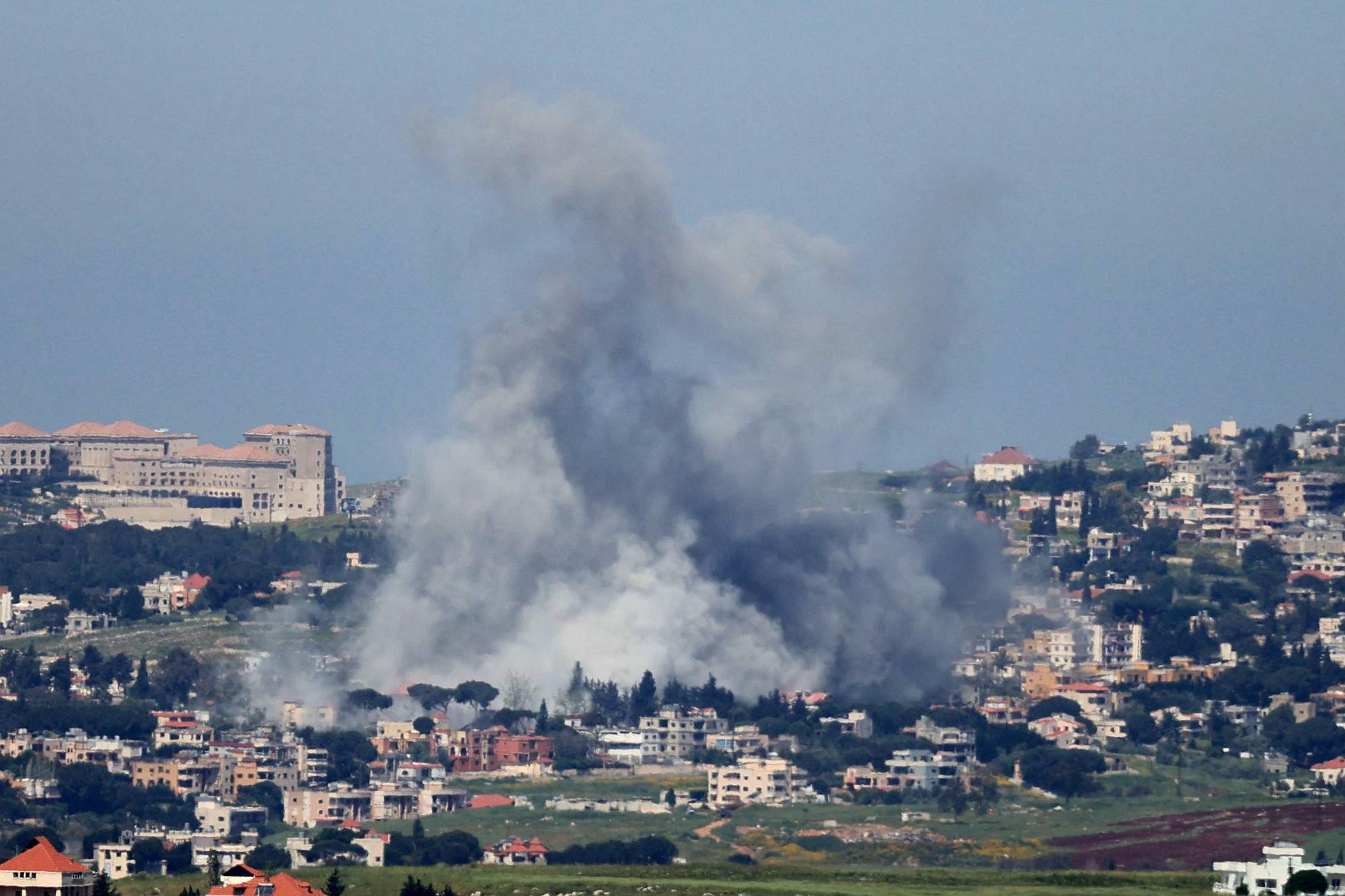
Smoke rises from the site of an Israeli airstrike that targeted the southern Lebanese village of Mayfadoun in the Nabatieh district on May 2, 2026. (Photo by AFP)
Shelling and drone attacks
Yahmar al-Shaqif was subjected to Israeli phosphorus shelling accompanied by heavy machine-gun fire near the Litani River toward the town of Taybeh. Artillery shelling also targeted Zawtar al-Sharqiya, Zawtar al-Gharbiya, Meifdoun, al-Mansouri, Majdal Zoun, Touline, and Qabrikha. An airstrike on a house in the town of al-Luweizeh in the Iqlim al-Tuffah area killed three people.
In the western sector, Israeli forces fired heavy machine guns toward the outskirts of Ramieh and Qawzah. An Israeli loitering drone targeted a motorcycle at the Deir Qanoun Ras al-Ain junction south of Tyre, killing one person and wounding another who was taken to hospitals in Tyre.
Another drone strike targeted a motorcycle on the al-Shaitiya road in Tyre district, seriously injuring the rider. Drones were also reported flying over villages in al-Zahrani.
The cumulative death toll in Lebanon since March 2 has reached 2,659 killed and 8,183 wounded, according to the Emergency Operations Center at the Ministry of Public Health.
Hezbollah
Hezbollah, for its part, continued launching suicide drones targeting Israeli soldiers and armored vehicles inside occupied Lebanese territory. In a statement, the group said its fighters targeted a gathering of Israeli forces in the town of al-Bayada with a loitering munition.
The Israeli army said its air force intercepted a rocket fired toward its forces in southern Lebanon on Saturday afternoon.
It added that Hezbollah launched rockets and explosive drones in several other incidents on Saturday, which fell near areas where Israeli forces are operating in southern Lebanon, without causing casualties.
لم تشترك بعد
انشئ حساباً خاصاً بك لتحصل على أخبار مخصصة لك ولتتمتع بخاصية حفظ المقالات وتتلقى نشراتنا البريدية المتنوعة