


Turkey Aims to Reopen Economy Starting Late May

Pigeons gather at Istanbul's iconic Taksim Square, deserted due to the novel coronavirus outbreak. (AFP)
TT

Turkey Aims to Reopen Economy Starting Late May

Pigeons gather at Istanbul's iconic Taksim Square, deserted due to the novel coronavirus outbreak. (AFP)

Turkey’s government aims to begin reviving the economy in late May after a sharp slowdown due to measures to contain the coronavirus outbreak, while minimizing the risk of a second wave of infections, a senior official said on Tuesday.

Separately, the head of a group of Turkish malls - which closed their doors independently last month - said there were plans for a gradual reopening from May 11 depending on demand from retailers and approval from a health advisory board.

The emerging time frame from both the government and private sector reflects signs that the outbreak may be ebbing in Turkey, unease over the economy’s rapid slide toward its second recession in less than two years, and examples provided by some other countries acting to loosen their coronavirus lockdowns.

“Recent studies have indicated that a reopening of the economy will be possible at the end of May and current developments confirmed this. Steps will be taken to reopen without allowing a second wave,” the senior official told Reuters.

In keeping with that outlook, Turkish Airlines on Tuesday extended its cancellation of flights by a week to May 28.

Turkey has shuttered schools, restaurants and cafes to curb a surge in cases of the COVID-19 disease. Though some workplaces remain open, it has imposed partial stay-at-home orders, largely closed borders and slowed domestic movement.

The country is seventh globally in confirmed cases of the new coronavirus at more than 112,000. And while some 2,900 people have died, there has been a fall in newly reported deaths over the last eight days.

“When we look at the case and death numbers we have come to a positive point (and) there is a possibility for the economy to reopen,” said the senior official, speaking on condition of anonymity.

Small steps

Levels of trade, spending, manufacturing and consumer confidence have deteriorated due to containment measures and touched record lows this month. The lira fell on Tuesday to below 7 to the dollar, its weakest since the worst day of a 2018 currency crisis.

While Italy and some other countries are beginning to relax their lockdowns as infection rates have declined, others such as Russia are standing pat or tightening restrictions.

President Recep Tayyip Erdogan has said Turkey aims to return to normal life after the end of the holy month of Ramadan in late May, and on Monday he said the government would soon set out specific steps and dates.

The senior official said Turkey’s cabinet had on Monday discussed further possible tax adjustments and incentives to protect jobs and cut business costs, adding the government aims to boost hard-hit tourism and airline sectors.

Reopening “will allow positive GDP readings in the second half of the year and will minimize the annual contraction,” he said, according to Reuters.

Some Turkish firms are already taking initial steps.

Private lender Denizbank said it had extended working hours in branches to help corporate borrowers, while the head of an auto parts manufacturers association said reopening the economy in May would be a best case scenario in which production only falls some 15% and returns to normal by September.

In an interview, Huseyin Alltas of the Council of Shopping Centers said a planned phased reopening from May 11 would initially exclude cinemas, playgrounds and restaurants - which the government shut down due to an especially high risk of coronavirus transmission - until approvals are given.

Malls in hard-hit cities such as Istanbul - the worst area of outbreak in Turkey - may remain closed longer but could reopen by June, the official said.

Sinan Oncel, head of the United Brands Association representing around 50,000 stores, said retailers would ask malls for rent discounts and aim for 50% of normal revenues over the first few months.
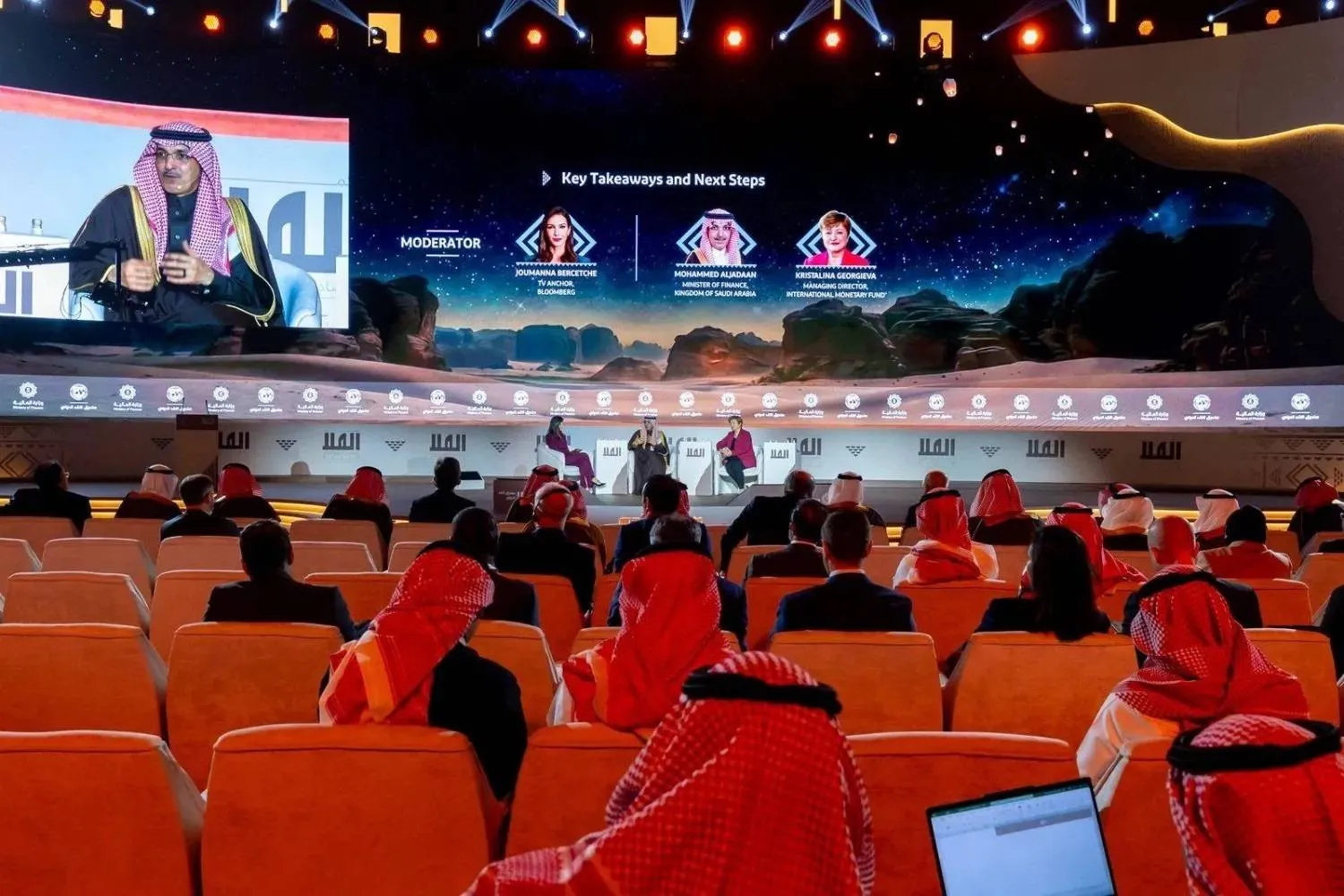



Aljadaan: Emerging Markets Account for 70% of Global Growth

Al-Jadaan speaking to the attendees at the "AlUla Conference for Emerging Market Economies" (Asharq Al-Awsat
TT

Aljadaan: Emerging Markets Account for 70% of Global Growth

Al-Jadaan speaking to the attendees at the "AlUla Conference for Emerging Market Economies" (Asharq Al-Awsat

Saudi Minister of Finance Mohammed Aljadaan stressed Sunday that the world economy is going through a “profound transition,” saying emerging markets and developing economies now account for nearly 60 percent of the global Gross Domestic Product (GDP) in purchasing power terms and over 70 percent of global growth.

In his opening remarks at the AlUla Conference for Emerging Market Economies, organized by the Saudi Ministry of Finance and the IMF in AlUla, the minister said these economies have become an increasingly important driver of global growth with their share of global economy more than doubling since 2010.

“Today, the 10 emerging economies in the G20 alone account for more than half of the world growth. Yet, they face a more complex and fragmented environment, elevated debt levels, slower trade growth and increasing exposure to geopolitical shocks.”

“Unfortunately, more than half of low income countries are either in or at the risk of debt distress. At the same time global trade growth has slowed at around half of what it was pre the pandemic,” Aljadaan added.

The Finance Minister stressed that the Saudi experience over the past decade has reinforced three lessons that may be relevant to the discussions at the two-day conference, which brings together a select group of ministers and central bank governors, leaders of international organizations, leading investors and academics.

“First, macroeconomic stability is not the enemy of growth. It is actually the foundation,” he said.

“Structural reforms deliver results only when institutions deliver. So there is no point of reforming ... if the institutions are unable to deliver,” he stated.

Finally, he said that “international cooperation matters more, not less, in a fragmented world.”


Georgieva from AlUla: Growth Still Lacks Pre-pandemic Levels

Kristalina Georgieva speaking to attendees at the second edition of the AlUla Conference for Emerging Market Economies (Asharq Al-Awsat)
TT

Georgieva from AlUla: Growth Still Lacks Pre-pandemic Levels

Kristalina Georgieva speaking to attendees at the second edition of the AlUla Conference for Emerging Market Economies (Asharq Al-Awsat)

International Monetary Fund (IMF) Managing Director Kristalina Georgieva said Sunday that world growth still lacks pre-pandemic levels, expressing concern as she expected more shocks amid high spending and rising debt levels in many countries.

Georgieva spoke at the AlUla Conference for Emerging Market Economies, organized by the Saudi Ministry of Finance and the IMF in AlUla.

The two-day conference brings together a select group of ministers and central bank governors, leaders of international organizations, leading investors and academics to deliberate on policies to global stability, prosperity, and multilateral collaboration.

Georgieva said that the conference was launched last year in recognition of the growing role of emerging market economies in a world of sweeping transformations.

“I came out of this gathering .... With a sense of hope for the pragmatic attitude and determination to pursue good policies and build strong institutions,” she said.

Georgieva stressed that “good policies pay off,” and said that growth rates across emerging economies reached four percent this year, exceeding by a large margin those of advanced economies that are around 1.5 percent.


Saudi Arabia’s flynas, Syrian Civil Aviation Authority Partner to Launch 'flynas Syria'

The new airline will operate commercial air transport services in accordance with approved regulations and standards (flynas)
TT

Saudi Arabia’s flynas, Syrian Civil Aviation Authority Partner to Launch 'flynas Syria'

The new airline will operate commercial air transport services in accordance with approved regulations and standards (flynas)

Saudi budget carrier flynas has signed an agreement with the Syrian General Authority of Civil Aviation and Air Transport to establish a new commercial airline under the name "flynas Syria," with operations scheduled to begin in the fourth quarter of 2026.

Saturday’s agreement comes within the framework of bilateral cooperation between Saudi Arabia and Syria, as well as the strategic investment agreements between the two countries, coordinated with the Saudi Ministry of Investment and the Syrian General Authority of Civil Aviation and Air Transport.

The new airline will operate commercial air transport services in accordance with approved regulations and standards, meeting the highest safety and aviation security requirements. All licensing and operational procedures will be completed in coordination with the relevant authorities.

The carrier will be established as a joint venture, with 51% ownership held by the Syrian General Authority of Civil Aviation and Air Transport and 49% by flynas.

The new airline will operate flights to several destinations across the Middle East, Africa, and Europe. This expansion aims to bolster air traffic to and from Syria, enhance regional and international connectivity, and meet growing demand for air travel.

"This step is part of our commitment to supporting high-quality cross-border investments. The aviation sector is a key enabler of economic development, and the establishment of 'flynas Syria' serves as a model for constructive investment cooperation,” said Saudi Minister of Investment Khalid Al-Falih.

“This partnership enhances economic integration and market connectivity and supports development goals by advancing air transport infrastructure, ultimately serving the mutual interests of both nations and promoting regional economic stability,” he added.

President of the Syrian General Authority of Civil Aviation and Air Transport Omar Hosari also stated that the establishment of flynas Syria represents a strategic step within a comprehensive national vision aimed at rebuilding and developing Syria's civil aviation sector on modern economic and regulatory foundations.

“This will be achieved while balancing safety requirements, operational sustainability, investment stimulation, and passenger services. The partnership reflects the state's orientation toward smart cooperation models with trusted regional partners, ensuring the transfer of expertise, the development of national capabilities, and the enhancement of Syria's air connectivity with regional and international destinations, in line with global best practices in the air transport industry."

flynas Chairman Ayed Al-Jeaid stated that the company continues to pursue strategies aimed at growth and international expansion, describing the agreement as a historic milestone in the company's journey and a promising investment model in partnership with Syria.

flynas CEO Bander Al-mohanna said the step represents a qualitative leap in the company's strategy and financial performance, highlighting the transfer of the company's low-cost aviation experience to the Syrian market to support regional and international air connectivity.

flynas currently operates 23 weekly flights from Riyadh, Jeddah, and Dammam to Damascus, including two daily direct flights from Riyadh, one daily flight from Jeddah, and two weekly flights from Dammam.

The airline made history on June 5, 2025, by adding the Syrian capital to its network, becoming the first Saudi carrier to resume scheduled flights to Damascus.