


Turkey Boosts Security Measures East Euphrates

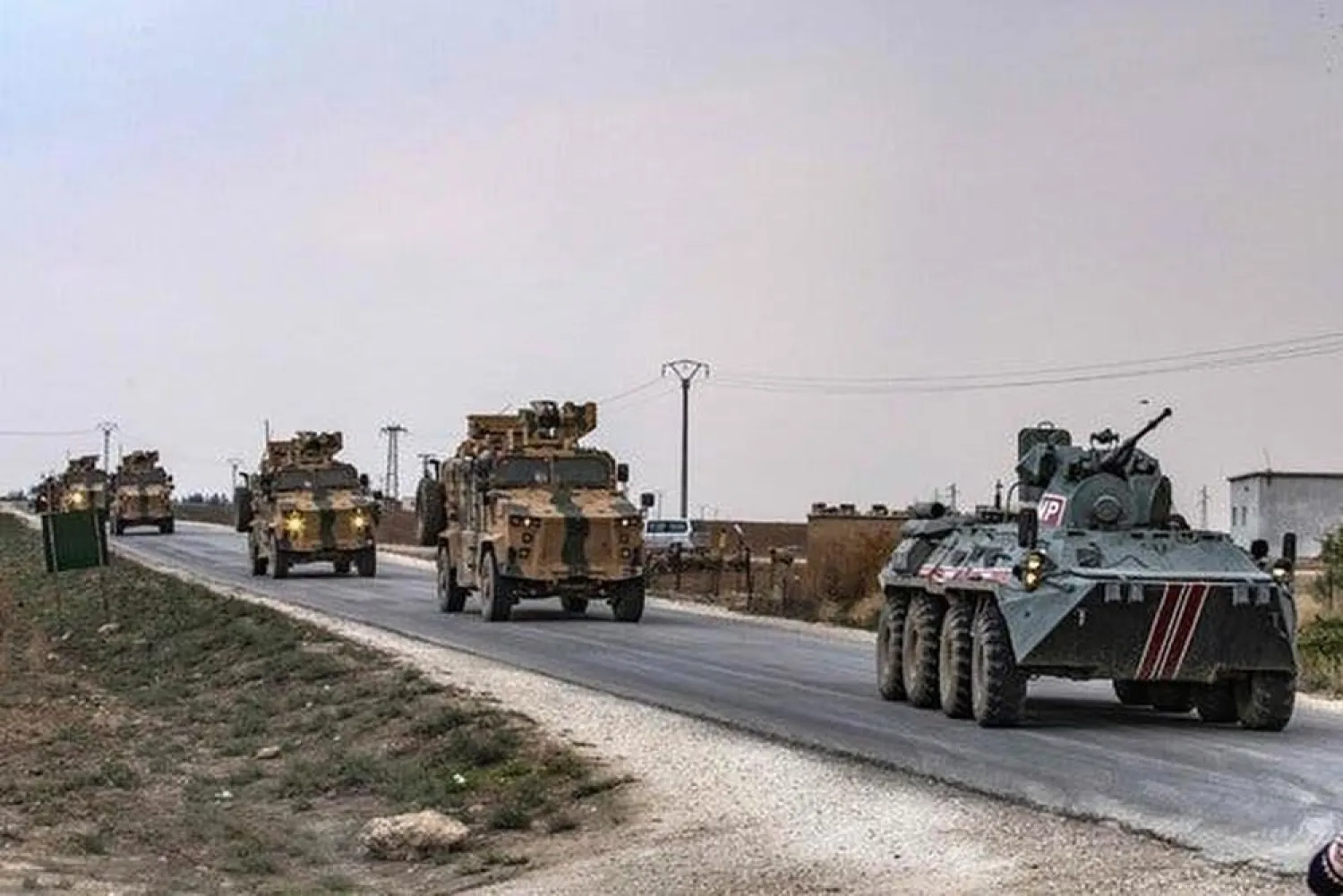
Russian (front) and Turkish military vehicles patrol in the countryside of Darbasiyah town in Syria's northeastern Hasakeh province on the Syrian-Turkish border on November 1, 2019. (AFP / Delil Souleiman)
TT

Turkey Boosts Security Measures East Euphrates

Russian (front) and Turkish military vehicles patrol in the countryside of Darbasiyah town in Syria's northeastern Hasakeh province on the Syrian-Turkish border on November 1, 2019. (AFP / Delil Souleiman)

Turkish forces heightened on Monday security measures in the Nabah al-Salam area northeast Syria where it continued to conduct joint patrols with Russia as part of the Sochi agreement signed between the two sides in Moscow last October.

A statement issued by governorship of the southeastern Sanliurfa said Turkish forces are making efforts to take measures from land and air, using police dogs and drones, to prevent Syrian-Kurdish People's Protection Units (YPG) from infiltrating into the area.

The YPG makes up most of the Syrian Democratic Forces components.

Sanliufa’s statement noted that Turkish forces have recently implemented strict security measures in the cities of Tal Abiyad and Ras al-Ain.

It said Turkey also conducted inspection operations and dismantling of explosives in cooperation with the Syrian National Army to guarantee the security and stability of the region.

“Cars entering or leaving the area are subject to delicate checking, with particulate attention to the identity card and personal documents,” the governorate said.

On Monday, Russian and Turkish forces ran a new joint patrol in the western countryside of Al-Darbasiya.

Six Russian vehicles and four other Turkish set off from Sherik crossing on Turkey’s border and toured the villages of Dalik, Malak, Abbas, Ta’alak, Tarbah, Korkond, Barakah and Bar Kafri in the western countryside of Al-Darbasiyah.

The Syrian Observatory for Human Rights said two Russian vehicles have stopped in Al-Tawrat village, while a helicopter was flying over the area. Another helicopter escorted the patrol.

Also, the Observatory said unidentified warplanes struck a base in eastern Syria on Saturday night, killing seven Iran-backed militiamen.

The strikes targeted a base near the town of Al-Bukamal close to the border with Iraq and it came days after shipments arrived at the base from Iraq.



Iraq Accelerates Efforts to Resolve Armed Factions Issue, Complete Government Formation

A patrol of Iraq's Popular Mobilization Forces (file photo - Popular Mobilization Forces website)
TT

Iraq Accelerates Efforts to Resolve Armed Factions Issue, Complete Government Formation

A patrol of Iraq's Popular Mobilization Forces (file photo - Popular Mobilization Forces website)

As Baghdad prepares to finalize the proposed agenda for Iraqi Prime Minister Ali Al-Zaidi’s visit to the United States, in coordination with Washington, an Iraqi official source told Asharq Al-Awsat that the expected visit of US envoy Tom Barrack to Iraq will “determine the final agenda for the visit and its various files across different sectors and fields.”

The same source said that “work is underway to prepare all bilateral files and issues, whether those already agreed upon and ready to be turned into agreements and memorandums of understanding, or those that remain under discussion, foremost among them the details of disarming the armed factions and the US veto on some armed political groups participating in the government, despite their declared willingness to disarm and hand over their weapons to the state.”

Asked whether Barrack’s visit to Baghdad is intended to discuss the prime minister’s Washington agenda or had already been scheduled, the official source said: “Tom Barrack coordinates relations between Baghdad and Washington and therefore visits Baghdad periodically for that purpose. He also discusses unresolved issues between the federal government and the Kurdistan Regional Government, which the US administration is keen to see resolved, particularly those related to oil.”

The source added that Barrack’s upcoming visit falls within that framework, as he will also travel to Erbil.

“Accordingly, the remaining unresolved issues, especially oil, will be on the agenda because they are among the issues the Iraqi delegation will take with it to Washington.”

Regarding completion of the cabinet, which still lacks roughly nine ministers, the source said the prime minister is holding talks with political forces to fill the remaining posts, hoping the government lineup will be completed before the Washington visit.

He added that this issue will also be discussed with Barrack in Baghdad, particularly because some ministerial portfolios are expected to go to political groups that won substantial parliamentary representation and therefore qualify for more than one ministry. Resolving the matter requires discussions with the US side to lift its veto after those groups decided to hand over their weapons to the state.

On unresolved issues with the Kurdistan Region, the government source explained that there are two categories of disputes with Erbil.

“One category is longstanding and repeatedly resurfaces. It is related to constitutional matters and is not expected to be resolved, nor is it likely to feature prominently during Barrack’s visit to Baghdad and Erbil. The second category concerns normal political disagreements, including oil exports through the region’s outlets, the region’s share of federal ministries, and disputes between the two main Kurdish parties and their impact on relations with Baghdad.”

Popular Mobilization Forces Chairman Falih Al-Fayyadh (Iraqi Prime Minister's Office)

Meanwhile, Popular Mobilization Forces Chairman Falih Al-Fayyadh on Sunday called on Prime Minister and Commander-in-Chief of the Armed Forces Ali Al-Zaidi to relocate PMF camps outside urban areas.

Speaking at the official central ceremony marking the 12th anniversary of the PMF’s establishment, Al-Fayyadh said the force “stands against sectarianism and has contributed to building a national partnership in which members of all communities and religions fight in the same trench, contrary to claims that it is a sectarian project.”

He stressed that the PMF “represents all Iraqis and has enabled minority groups to defend their own areas.”

Al-Fayyadh called on the government and relevant authorities to “provide suitable alternative camps for the Popular Mobilization Forces, ensuring the completion of their full deployment outside city centers and provincial capitals.”

For his part, Mokhtar Al-Moussawi, a member of the Iraqi parliament’s Foreign Relations Committee, said the issue of factional weapons in Iraq is not a matter of a “direct handover” but rather part of broader regional and international calculations. He noted that “the US administration understands the nature of the game just as the armed factions do.”

Al-Moussawi said there is division within the Popular Mobilization Forces structure and that the factions are not united in their positions. Some have expressed readiness to hand over their weapons or sever organizational ties, while others categorically reject such steps.

He added that Iraq’s political landscape is closely linked to regional developments.

“Iraq’s foreign policy remains unstable, and at this particular stage we are seeing a path of understandings between Iran and the United States moving toward an agreement. If such an agreement is signed, there will be an entirely different approach to dealing with the weapons issue in Iraq.”

Al-Moussawi, a lawmaker from the Badr bloc, which is included in the disarmament process, said Iraq does not have full control over the matter and that a large part of the understandings is managed in Washington and Tehran.

He added that factional weapons are directly linked to the outcome of any potential US-Iran agreement. He also stressed that what is currently taking place amounts to temporary political balancing and that the weapons file could be revisited in a different manner after any agreement is signed between the two sides.

Separately, Baghdad has provided security guarantees to Erbil regarding the protection of oil fields in the Kurdistan Region from attacks periodically carried out by armed factions.

According to a political source who disclosed details of a military delegation’s visit to Erbil led by Chief of Staff Lt. Gen. Abdul Amir Rashid Yarallah, the delegation held a series of meetings and field visits to several oil fields to assess security conditions and discuss measures needed to protect facilities and personnel.

The source added that the delegation provided direct security assurances to oil companies operating in the region, affirming that attacks targeting oil sites would not be repeated.

Kurdistan Region Prime Minister Masrour Barzani received the delegation. According to an official statement, the delegation chief briefed him on the objectives of the visit, which was undertaken under directives from the federal prime minister to follow up on efforts to maintain security and stability, particularly the protection of oil companies and the prevention of attacks against them.

Barzani expressed his appreciation to Al-Zaidi for his follow-up efforts and assurances regarding the security and stability of the Kurdistan Region, reaffirming the regional government's full support for these steps.

He also renewed his call for stronger cooperation and coordination between the Peshmerga forces and the Iraqi army to address shared security and military challenges and threats.


30 Million Sudanese Historical Documents at Risk of Deterioration

 Effects of the war on the National Records Office building. (Asharq Al-Awsat)
Effects of the war on the National Records Office building. (Asharq Al-Awsat)
TT

30 Million Sudanese Historical Documents at Risk of Deterioration

 Effects of the war on the National Records Office building. (Asharq Al-Awsat)
Effects of the war on the National Records Office building. (Asharq Al-Awsat)

Near the Sudanese army’s general command in Khartoum, millions of documents chronicling more than five centuries of Sudanese history sit inside the National Records Office, exposed to harsh wartime conditions.

Rubble and dust surround the building, which now faces the risk of further damage after sustaining extensive destruction.

The National Records Office fell under the control of the Rapid Support Forces in the first hours of the war in April 2023. Fierce fighting around the site left visible scars on the four-story building, including fire damage, destruction and structural harm that still reflect the intensity of the battles in the area.

The office holds more than 30 million historical documents collected since 1505, forming a comprehensive record of Sudan’s political, administrative and social history.

Although most of the documents survived fires that swept through large parts of the building, their continued storage in a damaged and unsuitable environment threatens their long-term survival.

Dr. Nagwa Mahmoud, director of the National Records Office, told Asharq Al-Awsat that most of its contents had survived the wartime fires. But she warned that keeping them in a damaged building could destroy old documents and manuscripts, especially those already weakened by age and fragility.

She said the office’s electronic archive had been lost, adding that the administration had prepared a digital transformation plan to begin once the documents are organized.

“We have contacted the Ministry of Communications and relevant government bodies to provide the necessary support to implement the plan, ensuring that this national heritage is protected from future risks,” she said.

After the Sudanese army regained control of Khartoum state in March 2025, the government issued a decision to relocate several state institutions from the capital's center. The decision included the National Records Office.

Mahmoud said the office had asked the Council of Ministers to exempt it from the relocation decision, stressing that the current building had been constructed in accordance with special standards for preserving historical documents and the national archive.

She said moving more than 30 million documents would pose a major logistical challenge and require an alternative site with the same technical specifications to protect them from damage and environmental factors.

Mohamed Youssef, director of the office’s General Documentation Department, voiced concern about the risks facing the documents as the rainy season approaches. He said shells that struck the building had left large openings in the ceilings, which could allow rainwater to leak into halls and storage rooms.

He said the office had memorandums of understanding with archival institutions in several Arab and African countries. He noted that important Sudanese documents were preserved at Egypt’s National Archives, along with other archives at the Arab League, particularly in documentation and archiving departments.

Documents on the floor

Inside the building, the traces of war are visible in every corner. Old manuscripts lie scattered across the floor, documenting different stages of Sudan’s history. Nearby are images of leaders who ruled the country since independence, along with documents from the Mahdist state and the Anglo-Egyptian period.

The building also contains a vast archive of Sudanese journalism spanning decades.

The ground floor, which once housed specialized laboratories and dozens of computers, was completely looted, according to officials at the office. Yet the last book digitized just days before the war began remains in place, capturing the contrast between what survived and what was lost from the country’s memory.

Despite the scale of the challenges facing the institution, officials are holding on to hopes of securing government approval to remain in the current headquarters, rehabilitate the building and restore its role in preserving Sudan’s national memory.

The roots of the National Records Office date back to 1916, when official documents were managed through the office of Sudan’s governor-general, with the participation of the financial, judicial and administrative secretaries, who preserved documents issued by state institutions at the time.

In 1965, the National Records Office Law granted the institution national status and independent legal personality. It gave the office responsibility for preserving and managing official documents produced by state institutions, as well as civil and private documents of historical value, making it the official guardian of Sudan’s national memory.


June 26 Revolution: Calls for Gaza Protests Against Hamas

Palestinians walk past the rubble of residential buildings destroyed during the war, at the Jabalia refugee camp in the northern Gaza Strip, June 12, 2026. REUTERS/Mahmoud Issa
TT

June 26 Revolution: Calls for Gaza Protests Against Hamas

Palestinians walk past the rubble of residential buildings destroyed during the war, at the Jabalia refugee camp in the northern Gaza Strip, June 12, 2026. REUTERS/Mahmoud Issa

Palestinian activists have called on social media for mass protests against Hamas and its continued rule over the Gaza Strip, setting June 26 as a day of demonstrations across the enclave, in a repeat of earlier movements that were suppressed in past years.

The activists have named the campaign the “June 26 Revolution,” calling on people to take to the streets to demand a dignified life under the slogan: “For a better life and a promising future ... the people’s right to decide their fate.”

Facebook debate

Journalist and activist Abdul Hamid Abdul Ati was the first to call for and adopt the movement. A Gaza resident, he left for Egypt with his family during the war after a previous bombardment killed and wounded many of his relatives.

In a series of posts and tweets to his thousands of followers, Abdul Ati said: “The movement is not against anyone. It is for the public interest and to save what can be saved from a reality that weighs heavily on the people of Gaza ... We are one people, bound by pain and a shared fate. Our aim is to extend a helping hand to our people and search for a way out of this harsh predicament. Difference of opinion does not justify threats, and unity remains the shortest path to protecting everyone.”

Activists known for opposing Hamas, including some who joined or called for similar movements years ago, backed Abdul Ati’s call and urged Gazans to take part. The appeal triggered a storm of reactions, some critical and others supportive.

Most of those calling for participation are now outside the strip, having left during the war or, in some cases, years earlier, after being detained by the Hamas government over similar events. Fewer voices inside Gaza have backed the movement, most of them less influential than other figures who remain in the enclave and have stayed silent.

Accusations and intimidation

As public debate widened, Hamas-affiliated media kept trying to discredit the movement and those behind it. Hamas controls part of the Gaza Strip after Israel seized more than 60% of the territory.

Activists aligned with the group mounted similar campaigns, accusing the organizers of serving foreign agendas and exploiting Israel’s escalation to launch the movement. They said those outside the strip had no right to speak for people living in displacement tents, shelters and other sites while they themselves lived abroad.

Abdul Ati said the accusations by Hamas and its supporters against him and other organizers abroad were an attempt to dodge the core issue.

“A Palestinian remains Palestinian wherever he is, whether in Gaza, the West Bank or the diaspora, and he has the right to speak about his people’s suffering and express his opinion freely,” he told Asharq Al-Awsat.

He said, “The movement has no foreign agendas and does not seek to serve one side at the expense of another. It is born of a reality people live every day and of clear popular demands everyone knows: dignity, justice, genuine representation and an end to collapse. It is not a conspiracy, but a natural right of any people.”

He said Gaza’s accumulated crises had pushed him and many journalists, activists and others to raise their voices. He strongly denied that they were trying to exploit the current situation in the strip as Israeli escalation continues.

“What is needed is not to exploit anyone, but to listen to people and respect their right to express their opinions and legitimate demands,” he said.

Abdul Ati added: “The goal of the movement at this stage is to carry the voice of the people and their real suffering to the world, and to demand their right to a dignified life, security and stability. We believe confronting Israeli aggression is a national priority, but that does not cancel citizens’ right to express their pain and legitimate demands after long years of war, poverty, displacement and suffering ... The revolution is not against the people or their steadfastness. It is a movement for the Palestinian person and his right to a better future, for strong national institutions, sound political life, and a popular will that is heard and respected.”

Abdul Ati and other activists played down threats they said had targeted their families, saying they would press ahead with the movement.

Right to protest

Activists rejected claims that the movement betrayed the sacrifices of Palestinians killed during the war. They said residents had the right to protest and demand a dignified life, adding that those expected to take to the streets were the same people who had lost children and homes, were living in tents, and were queuing for water and charity kitchens.

Dr. Jamil Abdul-Nabi, a leader in Islamic Jihad in northern Gaza, said in a Facebook post that residents had the right to express their anger after disasters that words could not describe. He has repeatedly said his positions represent him personally.

“The least we can do is give them the right to scream from the intensity of the pain,” he said, describing accusations of “treason” against such a movement as part of dictatorship and a justification for repression.

Hamas anger

The movement’s reverberations appear to have moved beyond exchanges of accusations between activists on both sides, and even beyond interventions by activists affiliated with other factions such as Fatah. They have reached the official level inside Hamas, where the group has shown anger.

Hamas spokesman Hazem Qassem said in a press statement: “There are those who are rushing the fall of our great movement, relying on the promises of a stupid enemy. All of them will wait a long time, then be surprised by a movement that is more deeply rooted in its people and more present. These are authentic people who always stand with their blessed sons who are sincere in their love for their homeland. They will remain so, and these great people will remain loyal to them.”

A day later, Qassem said Hamas places the higher interest of the Palestinian people at the heart of its political and diplomatic activity, in a way that would allow the war to stop, open a new horizon for reconstruction, and enable the national committee for Gaza to be managed professionally to launch a real relief operation easing the scale of the catastrophe in the enclave.

That appeared to be an indirect reference to the movement’s demands for a better life, especially an end to the suffering of people living in displacement tents.

Analysts and media figures aligned with Hamas and factions close to it, including Hassan Lafi, said the movement could harm efforts to pull Gaza out of its crises and could create “major internal strife in Gaza under the title of undermining what remains of civil and social peace.”

Asharq Al-Awsat has learned that the security services of the Hamas government have been ordered to remain on alert on the day set for the protests and to intervene only when necessary, in a way that protects personnel from Israeli attacks.

Israeli forces have frequently targeted police officers and government security personnel recently as they tried to control security and resolve disputes between families, killing and wounding many of them.