

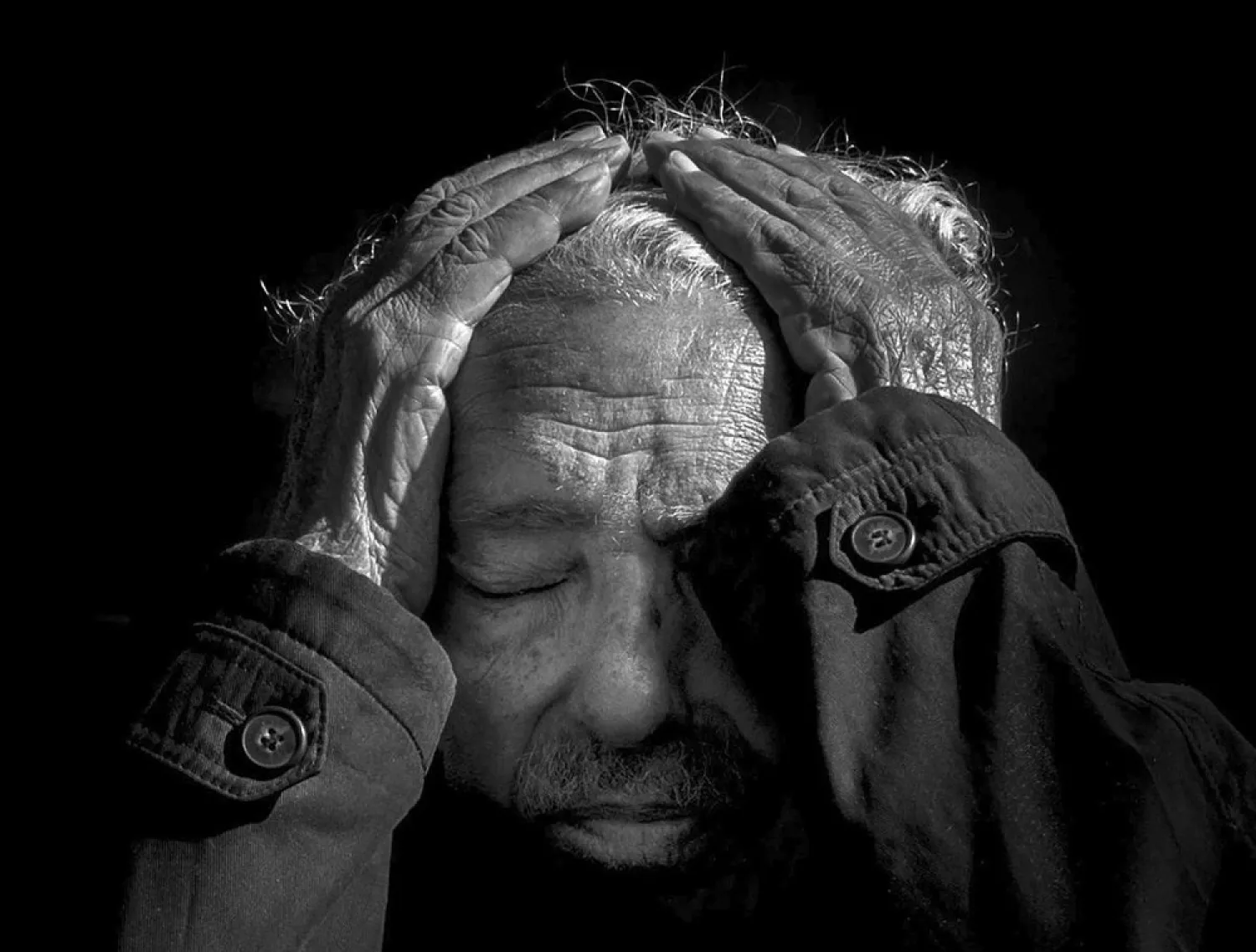

Egyptian Acclaimed Sculptor Adam Henein Dies at 91

This May 10, 2019, photo taken by Aalam Wassef shows acclaimed Egyptian artist Adam Henein at home in Cairo, Egypt. (AP)
TT

Egyptian Acclaimed Sculptor Adam Henein Dies at 91

This May 10, 2019, photo taken by Aalam Wassef shows acclaimed Egyptian artist Adam Henein at home in Cairo, Egypt. (AP)

Acclaimed Egyptian artist Adam Henein, who joined ancient pharaonic themes with sleek modernism in sculptures that often portrayed birds and other animals, died Friday, his family said. He was 91.

Henein recently suffered from age-related health complications and was taken to a hospital in Cairo where he died, said Essam Darwish, deputy director of Henein’s foundation.

Henein was born in 1929 in Cairo to a family of silversmiths and jewelry makers from the southern province of Assiout. He often said that a visit as a child to the Egyptian Museum was a turning point in his life. At the age of eight, he modeled a clay figure of the ancient Egyptian pharaoh Akhenaton, setting himself on the path toward his sculpting career.

He was also entranced by birds and flight, which would become a frequent theme of his work.

“I used to wake up and run to the windows and watch for a long time the birds,” he said in a documentary produced by the Bibliotheca Alexandrina. “It transports you to another place, another language, another world.”

He often featured birds, cats and dogs, which were all popular in ancient Egyptian art, in sculptures that were non-traditional, bold and smooth, in strong geometric forms, sometimes small, sometimes monumental. He also depicted people from Egypt’s working class, particular from the southern city of Aswan, a traditional village figures. In the early 2000s, he produced a large statue of Egypt’s and Arab world’s iconic singer Umm Kulthum.

Hanein was also deeply rooted in traditional Egyptian materials, often using granite and bronze in his sculptures and papyrus and natural oxides found in Egypt in his painting.

He received a Bachelor of Arts from Cairo’s School of Fine Arts in Cairo in 1953, before enrolling at Munich’s Academy of Fine Arts. In the 1960s, he emerged as one of Egypt’s preeminent sculptors, spending much of his time in the onetime pharaonic capital of Luxor, absorbing the ancient heritage. He and his wife, anthropologist Afaf el-Deeb, later moved to Paris, where he spent more than two decades and built an international reputation.

After returning to Egypt in the 1990s, Henein led the restoration of the famed Sphinx of Giza, work that won him a national decoration. In the southern city of Aswan, he founded an annual sculpture symposium that draws artists from around the world.

He also turned his home in Giza into a museum of his work. In its garden is a sort of ark carrying many of his animal sculptures.

“Art is a major blessing from God to humans,” he said in the documentary. It “makes a person educate themselves and react to art, changing their feelings and ideas.”



Residents in Australia’s Victoria State Urged to Evacuate as Bushfire Rages

This undated handout image received on December 26, 2024 from the State Control Center of the Victoria Emergency Services shows officials on a road near a bushfire in the Grampians National Park in Australia's Victoria state. (Handout / State Control Center of the Victoria Emergency Services / AFP)
TT

Residents in Australia’s Victoria State Urged to Evacuate as Bushfire Rages

This undated handout image received on December 26, 2024 from the State Control Center of the Victoria Emergency Services shows officials on a road near a bushfire in the Grampians National Park in Australia's Victoria state. (Handout / State Control Center of the Victoria Emergency Services / AFP)

An ‌out-of-control bushfire in Australia's Victoria state prompted an evacuation alert for residents near a remote mining settlement, authorities said on Saturday.

The alert, at the highest emergency rating, was for the area surrounding the A1 Mine Settlement in the Gaffney's Creek region, about 50 km (31 miles) ‌northeast of ‌state capital Melbourne.

"Leaving immediately is ‌the ⁠safest option, before ⁠conditions become too dangerous," Victoria Emergency said on its website, adding that the fire was not yet controlled.

Mountainous terrain was making it difficult for firefighters to battle ⁠the blaze from the ‌ground, the ‌Australian Broadcasting Corp. reported.

Since the 1860s gold ‌has been mined in the sparsely-populated ‌area, which is also popular with campers and tourists.

Three other bushfires were burning on Saturday at watch and act ‌level, the second highest danger rating, Victoria Emergency said.

In January, ⁠thousands ⁠of firefighters battled bushfires in Australia's southeast that razed homes, cut power to thousands of homes and burned swathes of bushland. They were the worst fires to hit the southeast since the Black Summer blazes of 2019-2020 that destroyed an area the size of Türkiye and killed 33 people.


Galapagos Park Releases 158 Juvenile Hybrid Tortoises on Floreana to Restore the Ecosystem

 Juvenile giant tortoises are loaded onto a boat on Santa Cruz Island for transport to Floreana Island for release as part of a project to reintroduce the Floreana giant tortoise to its native island in the Galapagos Islands, Ecuador, Thursday, Feb. 19, 2026. (AP Photo/Dolores Ochoa)
Juvenile giant tortoises are loaded onto a boat on Santa Cruz Island for transport to Floreana Island for release as part of a project to reintroduce the Floreana giant tortoise to its native island in the Galapagos Islands, Ecuador, Thursday, Feb. 19, 2026. (AP Photo/Dolores Ochoa)
TT

Galapagos Park Releases 158 Juvenile Hybrid Tortoises on Floreana to Restore the Ecosystem

 Juvenile giant tortoises are loaded onto a boat on Santa Cruz Island for transport to Floreana Island for release as part of a project to reintroduce the Floreana giant tortoise to its native island in the Galapagos Islands, Ecuador, Thursday, Feb. 19, 2026. (AP Photo/Dolores Ochoa)
Juvenile giant tortoises are loaded onto a boat on Santa Cruz Island for transport to Floreana Island for release as part of a project to reintroduce the Floreana giant tortoise to its native island in the Galapagos Islands, Ecuador, Thursday, Feb. 19, 2026. (AP Photo/Dolores Ochoa)

Nearly 150 years after the last giant tortoises were removed from Floreana Island in Ecuador’s Galapagos archipelago, the species made a comeback Friday, when dozens of juvenile hybrids were released to begin restoring the island’s depleted ecosystem.

The 158 newcomers, aged 8 to 13, have begun exploring the habitat they are destined to reshape over the coming years. Their release was perfectly timed with the arrival of the season’s first winter rains.

“They are large enough to be released and can defend themselves against introduced animals such as rats and cats,” said Fredy Villalba, director of the Galapagos National Park breeding center on Santa Cruz Island, noting that the best specimens with the strongest lineage were selected specifically for Floreana.

These released juvenile specimens, out of a total of 700 planned for Floreana, will be introduced gradually. According to Christian Sevilla, director of ecosystems of the Galapagos National Park, they carry between 40% and 80% of the genetic makeup of the Chelonoidis niger —a species that has been extinct for 150 years.

The lineage of these hybrids traces back to Wolf Volcano on Isabela Island, a discovery that still puzzles scientists today. By selecting adults with the strongest genetic makeup, said Sevilla, the breeding program aims to gradually bring the extinct Floreana species back to its former purity.

Two centuries ago, Floreana was home to approximately 20,000 giant tortoises. However, whaling, a devastating fire, and relentless human exploitation eventually led to their complete extinction on the island.

“In genetic terms, reintroducing a species to that island with a significant genetic component of the original species is vital,” biologist Washington Tapia told The Associated Press.

Tapia, a researcher and director of Biodiversa-Consultores — a firm specializing in the Galapagos Islands — emphasized that this process is about more than just numbers; it is about restoring a lost lineage.

Floreana, an island spanning approximately 173 square kilometers (67 square miles), is a volcanic landmass and the southernmost point of the Galapagos archipelago. Situated in the middle of the Pacific Ocean — roughly 1,000 kilometers (621 miles) from the mainland coast — it remains a remote and vital ecological site.

The tortoises reintroduced to Floreana will share their territory with a diverse population of nearly 200 people alongside flamingos, iguanas, penguins, sea gulls and hawks. However, they must also contend with introduced plant species such as blackberry and guava, as well as animals like rats, cats, pigs and donkeys. These non-native species, introduced by human activity, represent potential threats to the island’s newest inhabitants.

Floreana resident Verónica Mora described the release of the turtles as a dream come true. “We are seeing the reality of a project that began several years ago,” she said, adding that the community feels immense pride in the return of the giant tortoises.

The United Nations designated the Galapagos Islands as a Natural World Heritage Site in 1978. This honor recognizes the islands’ unique abundance of terrestrial and marine species found nowhere else on the planet.


Austria Turns Hitler’s Home into a Police Station

Workers are finishing works at the birth house of former German dictator Adolf Hitler that is turned into a police station, pictured on February 17, 2026 in Braunau am Inn, Austria. (AFP)
TT

Austria Turns Hitler’s Home into a Police Station

Workers are finishing works at the birth house of former German dictator Adolf Hitler that is turned into a police station, pictured on February 17, 2026 in Braunau am Inn, Austria. (AFP)

Turning the house where Adolf Hitler was born into a police station has raised mixed emotions in his Austrian hometown.

"It's a double-edged sword," said Sibylle Treiblmaier, outside the house in the town of Braunau am Inn on the border with Germany.

While it might discourage far-right extremists from gathering at the site, it could have "been used better or differently", the 53-year-old office assistant told AFP.

The government wants to "neutralize" the site and passed a law in 2016 to take control of the dilapidated building from its private owner.

Austria -- which was annexed by Hitler's Germany in 1938 -- has repeatedly been criticized in the past for not fully acknowledging its responsibility in the Holocaust.

The far-right Freedom Party, founded by former Nazis, is ahead in the polls after getting the most votes in a national election for the first time in 2024, though it failed to form a government.

Last year, two streets in Braunau am Inn commemorating Nazis were renamed after years of complaints by activists.

- 'Problematic' -

The house where Hitler was born on April 20, 1889, and lived for a short period of his early life, is right in the center of town on a narrow shop-lined street.

A memorial stone in front reads: "For Peace, Freedom and Democracy. Never Again Fascism. Millions of Dead Warn."

When AFP visited this week, workers were putting the finishing touches to the renovated facade.

Officers are scheduled to move in during "the second quarter of 2026", the interior ministry said.

But for author Ludwig Laher, a member of the Mauthausen Committee Austria that represents Holocaust victims, "a police station is problematic, as the police... are obliged, in every political system, to protect what the state wants".

An earlier idea to turn the house into a place where people would come together to discuss peace-building had "received a lot of support", he told AFP.

Jasmin Stadler, a 34-year-old shop owner and Braunau native, said it would have been interesting to put Hitler's birth in the house in a "historic context", explaining more about the house.

She also slammed the 20-million-euro ($24-million) cost of the rebuild.

- 'Bit of calm' -

But others are in favor of the redesign of the house, which many years ago was rented by the interior ministry and housed a center for people with disabilities before it fell into disrepair.

Wolfgang Leithner, a 57-year-old electrical engineer, said turning it into a police station would "hopefully bring a bit of calm", avoiding it becoming a shrine for far-right extremists.

"It makes sense to use the building and give it to the police, to the public authorities," he said.

The office of Braunau's conservative mayor declined an AFP request for comment.

Throughout Austria, debate on how to address the country's Holocaust history has repeatedly flared.

Some 65,000 Austrian Jews were killed and 130,000 forced into exile during Nazi rule.