


Exclusive - Lebanese Residing in Israel: Collaborators or Victims of Govt. Negligence?

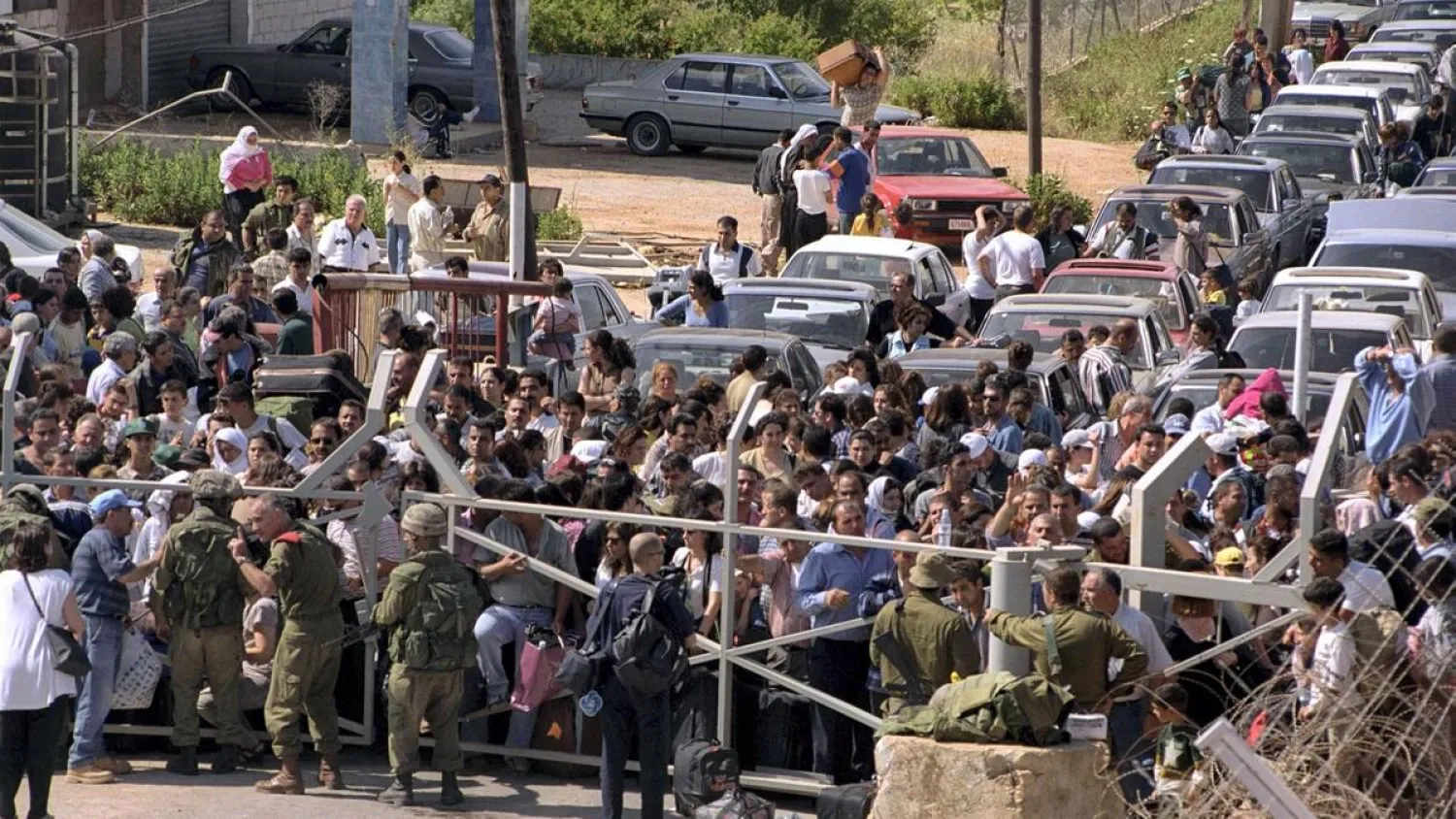
Lebanese refugees, many of them relatives of fighters with the South Lebanon Army, wait to enter Israel after the Israeli withdrawal from Lebanon on May 23, 2000. (Getty Images)
TT

Exclusive - Lebanese Residing in Israel: Collaborators or Victims of Govt. Negligence?

Lebanese refugees, many of them relatives of fighters with the South Lebanon Army, wait to enter Israel after the Israeli withdrawal from Lebanon on May 23, 2000. (Getty Images)

Rajaa Beshara, a resident of the Deir Mimas village in Lebanon’s southern Merjeyoun province, says the South Lebanon Army (SLA) killed her brother in the early 1980s because he was active in resisting Israeli occupation of the South.

He helped men who refused mandatory military conscription in the SLA, which is why the Israelis killed him, she told Asharq Al-Awsat. They booby-trapped the area around his corpse to prevent anyone from burying it.

“They broke my mother’s heart,” she recalled. It took them three days to find a way to retrieve his body.

A native of the town of Qlayaa revealed to Asharq Al-Awsat that his aunt used to work as a servant since she was 13-years-old in order to raise money to pay for her siblings’ education. She married a military officer at 16. He was killed by Israeli strikes against Palestinians in southern Lebanon. No one but an Israeli family would take her in, so she worked for them during the 1980s, he said on condition of anonymity.

“Now she is labeled as an agent and collaborator.”

The issue of Lebanese collaborators with Israel during its occupation of the South, which started after its 1982 invasion of Lebanon, has returned to the spotlight as debate rages over an amnesty law. One of its articles calls for pardoning people who did not collaborate with Israel’s military, including families of SLA members. The article stipulates that those seeking to return to Lebanon must abandon their other (Israeli) nationality. Many Lebanese fled to Israel on the eve of the May 25, 2000 liberation out of fear of persecution.

The SLA was formed in Marjeyoun in 1976 by Saad Haddad, a Lebanese army defector. In 1984, another defector, Antoine Lahd assumed command. He killed and tortured Lebanese and Palestinians and received military and logistic support from the Israeli Defense Ministry.

No official figures exist over the number of Lebanese who fled to Israel in 2000. They are estimated at 8,000, while those still in Israel are estimated at around 3,000-3,500. The others have immigrated to other countries. Some refuse to return to Lebanon after they obtained Israeli citizenship and integrated in its society and even served in its military. Other were even born and raised in Israel and know no other home.

The Qlayaa resident spoke of a family that fled to Israel and how one of its children, a seven-year-old at the time, could not tolerate living there. He snuck back into Lebanon and lived with his relatives. When he became an adult, he was able to restore his family home where he now lives.

Rajaa said that talk of the amnesty takes her back to 1976 when Haddad formed the Free Lebanon Army, which later became the SLA, under the claim of “protecting Christians and Palestinians.”

“The Israelis at the time tried to appear as though they harbored good intentions. They even opened the border to the Lebanese, claiming to help them,” she added, criticizing leftist, nationalist and Palestinian parties for failing to realize the Israelis’ real intentions of exploiting the poor in areas that were neglected by the state.

Some of the poor saw no other way to earn a living but through working for Israel for good pay, she revealed. The SLA had imposed mandatory conscription for all youths regardless of their sect.

Francois al-Hajj, a Rmeish native who would later rise up the ranks and become a prominent Lebanese army officer, refused to enlist and collaborate with the enemy. He fled to Beirut. He would later be assassinated for his role in commanding battles in the northern Nahr al-Bared camp in 2007.

Other families were not as lucky and did not have the luxury of being able to flee to Beirut, said Rajaa. They were forced to stay in the South and their sons ended up working for Israel.

She said the label of “collaborator” should not be generalized to everyone who was forced to work for Israel. She recalled how a guard at Khiyam prison was kind to the inmates and smuggled food to them. When the South was liberated, the freed inmates even visited his house and promised that his wife would be unharmed. The guard ended up in prison for his role. The former inmates even visited him in prison to thank him for his kindness.

“I don’t know how someone who fled to an enemy country could be included in an amnesty…. The law is being used for sectarian and electoral purposes,” she charged.

The Qlayaa resident agreed with Rajaa in that the amnesty law is vague on the concept of treason, specifically towards those who chose to commit their crimes. Those people should be heavily punished. As for the poor, they were forced to join the SLA and work in Israel. They should be helped and rehabilitated, he suggested.


A Wave of Executions Is Feared in Iran After 3 Young Men Were Hanged This Week

In this image from video circulating on social media, protesters dance and cheer around a bonfire as they take to the streets of Tehran, Iran, on Jan. 9, 2026. (UGC via AP, File)
TT

A Wave of Executions Is Feared in Iran After 3 Young Men Were Hanged This Week

In this image from video circulating on social media, protesters dance and cheer around a bonfire as they take to the streets of Tehran, Iran, on Jan. 9, 2026. (UGC via AP, File)

A 19-year-old star wrestler and two other young men were hanged in Iran this week, raising alarm among rights groups that a wave of executions may be underway as authorities facing relentless attacks from the US and Israel seek to squelch public dissent.

The three men are the first to be executed from among the tens of thousands who were arrested during a January crackdown on nationwide protests. Rights groups say more than 100 others could face death sentences.

The wrestler, Saleh Mohammadi, was hanged early Thursday morning — along with Mehdi Qasemi and Saeed Davoudi — in Qom, just south of the capital, Tehran, according to state media. They had been sentenced on charges of "moharabeh," or "waging war against God," for allegedly killing two police officers during protests in the city.

Amnesty International said the convictions of the three, and of others arrested during the protests, came in "grossly unfair trials" that used confessions extracted by torture.

The executions were "intended to instill fear in society and deter new protests" amid the US-Israeli war on Iran, said Mahmood Amiry-Moghaddam, director of Iran Human Rights, an Oslo-based group that has documented detentions.

Amiry-Moghaddam said he worries many more "executions of protesters and political prisoners may be imminent."

At least 27 arrested during protests face death sentences

Amiry-Moghaddam said his group has documented at least 27 death sentences that have been issued against people arrested during the protests. Another 100 face charges that carry the death penalty, and Iranian state media have aired hundreds of forced confessions to crimes punishable by death, he said.

Nationwide protests that began in late December peaked in the first week of January, prompting the deadliest crackdown by Iranian security forces since the Islamic Republic took power in 1979.

A complete death toll has been hard to gauge because of internet restrictions by authorities. The US-based Human Rights Activists New Agency, which relies on a network of contacts inside Iran, said it confirmed that more than 7,000 were killed and that it was investigating thousands more. It said over 50,000 were arrested in just over six weeks. The government acknowledged more than 3,000 were killed.

At the height of the protests, Iranian authorities signaled that fast trials and executions lay ahead.

At the time, US President Donald Trump suggested military action might be an option to stop the deadly crackdown. But he soon announced that he learned that plans for executions were halted, signaling that a military operation was no longer on the table.

Just a month later, Israel and the US launched an intense airstrike campaign against Iran, pounding military installations and targeting the top political and security leadership of Iran. The security agencies believed to be responsible for the deadly crackdown on protesters are also being targeted.

War has not stopped Iran's crackdown on dissent

Despite the war, Iranian authorities have kept up the crackdown on dissent. Authorities say scores have been detained since the war began on Feb. 28, including some who took part in the January protests.

Because of Iran’s internet blackout, there have been scant details about the three men executed Thursday. Amiry-Moghaddam said Davoudi was born on March 20, 2004, meaning he was executed a day before his 22nd birthday. Qasemi’s age was not known, he said.

Mohammadi appeared to be a standout in wrestling, a sport that is wildly popular in Iran. In 2024, he won a bronze medal at an international youth freestyle wrestling tournament in the Russian city of Krasnoyarsk.

On his Instagram account, Mohammadi posted photos and videos of his matches and his workouts, along with inspirational "no-pain-no-gain" messages. In his last post in late December, he posted a video of himself in the gym and wrote: "We endured beyond our imagination. Back again #bodybuilding #training #wrestling."

"He was full of energy," said Shiva Amelirad, an Iranian teacher living in Toronto who spoke with Mohammadi in 2022 while he was still in high school.

Amelirad said Mohammadi had participated in anti-government protests that erupted earlier that year when Mahsa Amini died in police custody after being detained for not wearing her headscarf properly. Those demonstrations were also met with a heavy crackdown by authorities.

She said Mohammadi told her that workouts and eating ice cream were his only ways "to forget all this catastrophe that we are facing."

"He always tried to show that he was happy," said Amelirad.

Rights groups say theocracy has forced confessions from protesters

Mohammadi, Qasemi and Davoudi were arrested in Qom on Jan. 15, according to multiple human rights groups. The circumstances of their arrests are not known, and it is not clear if they knew each other beforehand.

They were charged in the killing of a police officer on Jan. 8 and convicted in early February, according to Amnesty and Iran Human Rights.

During his detention, Mohammadi was beaten and one of his hands broken, Amnesty said in a Feb. 19 open letter to Iran’s judiciary criticizing the prosecution of dozens of arrested protesters. Amnesty said Mohammadi denied the charges and retracted his confessions in court, saying they were extracted under torture.

"Authorities have systematically subjected those arrested in connection to the protests to enforced disappearance, incommunicado detention, torture to extract forced ‘confessions,’" Amnesty said in the letter.

Mizan, the Iranian judiciary’s official news agency, announced the execution of the three on Thursday, showing video of them sitting in prison uniforms in court. It said they had confessed to killing two police officers with "knives and swords," and showed video of them allegedly reenacting the killings for judicial officials.

Amiry-Moghaddam, of Iran Human Rights, said the Iranian regime is struggling for its survival "and is well aware that the main threat to its existence comes not from external actors, but from the Iranian people demanding fundamental change."


Trump’s Iran War Rattles US Swing Voters Ahead of Midterms

US President Donald Trump (R), with Secretary of State Marco Rubio (L), responds to a question from the news media as he walks to board Marine One on the South Lawn of the White House in Washington, DC, USA, 20 March 2026. (EPA)
TT

Trump’s Iran War Rattles US Swing Voters Ahead of Midterms

US President Donald Trump (R), with Secretary of State Marco Rubio (L), responds to a question from the news media as he walks to board Marine One on the South Lawn of the White House in Washington, DC, USA, 20 March 2026. (EPA)

Donald Trump's war with Iran is weighing on independent US voters, a crucial bloc likely to determine if the president's Republican Party maintains control of Congress in the November midterm elections.

At a breakfast diner in Pennsylvania, a swing state where voters often shift between parties, there was a mix of anger and confusion over the new conflict.

"Trump's just miring us in another Iraq, Vietnam situation," said retired postal worker Jolene Lloyd, 65, referencing the two prolonged wars often seen as failures for the United States.

Lloyd has never voted for Trump, but has previously split her ticket between parties.

Not this year -- in November, she will only support Democrats.

Republicans only narrowly control Congress -- where every seat is up in the House and about one-third of the Senate -- so even a small loss of voters could spell trouble.

The midterm contests will determine whether Trump governs with a cooperative Congress or faces a Democratic majority empowered to block legislation and launch investigations.

With the cost of living already front of mind for many voters, any price increases over the Iran war are sure to feature in Democratic campaign attacks.

"Gas prices are obviously skyrocketing... It's a total mess," said Lloyd, nursing a coffee as she watched the morning news.

Independent voters oppose US military action against Iran by 60 to 31 percent, according to a recent Quinnipiac University survey.

That division was clear when AFP visited Levittown, a blue-collar area on the outskirts of Philadelphia lined with car dealerships and auto repair shops.

- 'A little scary' -

Next to Lloyd sat welder Vince Lucisano, who voted for Trump in 2024 and said he sees Iran as a threat to the US.

"I'm fine with it as long as there's not boots on the ground. Then I'll be a little more like invested and worried about it," he said.

"We need to just handle it and basically put Iran in their place. Once it becomes a full-blown war, then it gets a little scary," added the 42-year-old.

Lucisano, who wore a hoodie reading "Don't let the hard days win," said he still planned to vote Republican in November despite misgivings about Trump's spending on foreign policy.

"The guy who ran on 'America First' is dumping billions overseas. We're not putting America first there, bud," Lucisano said.

The Quinnipiac University poll found that 71 percent of independents think the Trump administration has not provided a clear explanation of the reasons behind US intervention in Iran.

Analysts say that vague messaging could hurt Trump's Republicans in the midterms.

Christopher Borick, director of the Muhlenberg College Institute of Public Opinion in Pennsylvania, noted that the conflict comes on top of existing concerns about affordability and immigration.

"The administration's struggles in delivering a compelling and clear case for the military actions in Iran and the simultaneous exacerbating effects on the cost of living in the US have only added to the Republicans' tedious position among independents," he said.

- 'Cracking a few eggs'

Bobby Marozzi, an employee at the diner, said he admires Trump for acting to stop Iran from having nuclear weapons, even if he was unsure how military action will benefit Americans long-term.

"If Trump is coming out and saying we have to sacrifice in order to have a better future, I would buy into that 100 percent," the 37-year-old said.

"If it's high gas prices and high groceries that we have to sacrifice for the next four years, it's OK so long as the Trump administration is going to get something done."

Marozzi, who declined to share his voting record over privacy concerns, explained that he can empathize with a no pain, no gain mentality.

"We have a saying in the breakfast business that you can't make an omelet without cracking a few eggs, you know?" he said.

For Jolene Lloyd, the retiree and a regular at Marozzi's restaurant, her message on the Iran war was far less compromising.

"We need to stop," she said.


US, Israel Tactics Diverge on Iran as Trump's Goals Still 'Fuzzy'

Trump, emboldened by his January operation in Venezuela, has held out hope for working with a figure within the Iranian republic -- while Israel has openly declared it will kill any high-ranking Iranian official it sees. Jim WATSON / AFP
TT

US, Israel Tactics Diverge on Iran as Trump's Goals Still 'Fuzzy'

Trump, emboldened by his January operation in Venezuela, has held out hope for working with a figure within the Iranian republic -- while Israel has openly declared it will kill any high-ranking Iranian official it sees. Jim WATSON / AFP

US President Donald Trump and Israeli Prime Minister Benjamin Netanyahu both praise their relationship as excellent, but after three weeks of attacking Iran, their tactics are increasingly diverging -- the result, some experts say, of Trump's ill-defined goals.

Trump said Thursday that he told Netanyahu not to attack Iran's gas fields after an Israeli strike prompted Tehran to retaliate against a major energy hub in Qatar, sending global prices soaring further.

Earlier this month, the United States voiced unease after Israel bombed fuel depots around Tehran, smothering the city of 10 million people with toxic black smoke.

Trump, emboldened by his January operation in Venezuela, has held out hope for working with a figure within the Iranian republic -- while Israel has openly declared it will kill any high-ranking Iranian official it sees.

"The objectives that have been laid out by the president are different from the objectives that have been laid out by the Israelis," Tulsi Gabbard, Trump's director of national intelligence, acknowledged in a congressional hearing this week.

Netanyahu, after the public reproach on the gas fields attack, publicly hailed Trump at a news conference late Thursday, saying that no "two leaders have been as coordinated."

"He's the leader. I'm, you know, his ally," Netanyahu said.

- 'Fuzzy' Trump goal -

But Netanyahu has been far more clear than Trump on what he wants in Iran.

Netanyahu has long described Iran's cleric-run government as the top enemy and has vowed to topple or at least crush it.

"Israel wants some sort of regime change whereas the United States is fuzzy and unclear about what the end state is," said Brian Katulis, a senior fellow at the Middle East Institute in Washington.

Trump has spoken in glowing terms about tactical military successes but also faces mounting pressure at home unlike Netanyahu.

The war is unpopular with the US public, including parts of Trump's base, and has led to higher gas prices for consumers and turbulence on markets months ahead of congressional elections.

Trump also has a close relationship with Gulf Arab states, longtime allies that serve as bases for US troops and are softer targets for Iran than Israel.

Netanyahu, Israel's longest-serving leader, also faces elections this year, in which he is expected to highlight his support from Trump.

Katulis noted that Trump has not hesitated to pressure Israel before -- forcing a ceasefire in Gaza last year after Israel attacked Hamas leaders in Qatar, and angrily demanding that Israel hold fire on Iran last year after he announced a truce.

"It's not unimaginable that Trump sees the cost of this war getting too high and hindering his domestic agenda," Katulis said.

"I don't think Israel under Netanyahu is going to ignore Trump but that would require Trump actually articulating some sort of soft landing."

- New dynamic for Israel -

The conflict marks a watershed for Israel in fighting a war as part of an alliance. In the two wars against Iraq, the United States tried hard to keep Israel out, fearing its presence would alienate Arab allies.

Yossi Mekelberg, a Middle East expert at London-based think tank Chatham House, said that Israel and the United States started with an aim of regime change before encountering the heavy counter-attack by Iran.

"When things go wonderfully well, everyone is happy, you know -- they all praise each other," he said.

"If it starts going really wrong, and we know that Trump is not the sentimental type, then the blame starts flying," he said.

Robert Malley, who negotiated with Iran under former president Joe Biden, said that both Israel and Iran had clear goals, with Israel wanting to sow the Iranian government's collapse and Tehran seeking to survive and to externalize the costs of the war.

The unpredictable actor is Trump, who has said both that the war will be short or will intensify and sees world affairs in deeply personal terms, particularly on whether he can claim victory.

"He's offered a series of shifting goals, not just day by day but often hour by hour," said Malley, now a senior fellow at the Yale Jackson School of Global Affairs.

"In some ways, you need to be more of a psychologist than a policy analyst to be able to understand where we're going," he said.
