


Bundesliga May Have Pressing Problems but It's at the Tactical Forefront

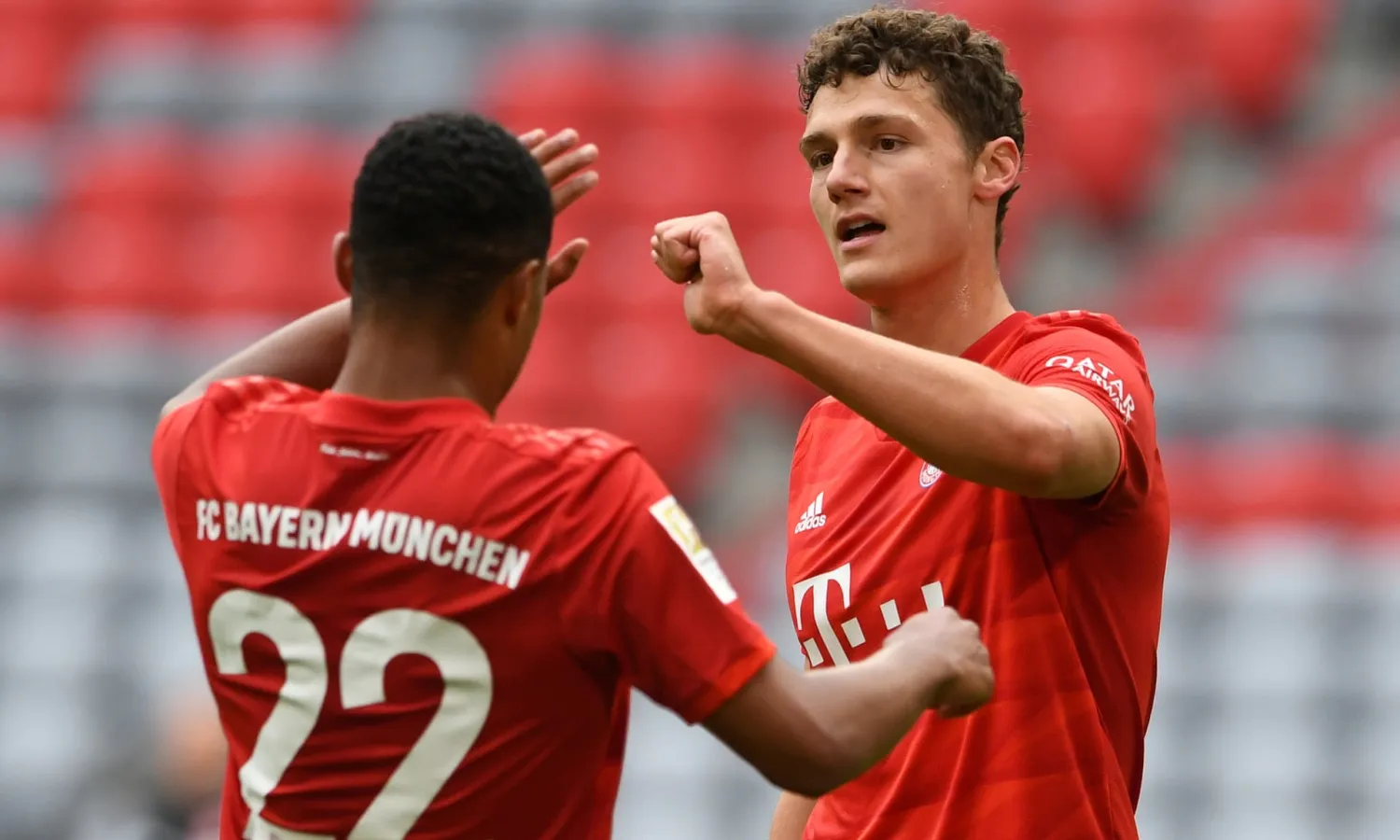
Following their heavy defeat of Borussia Dortmund, Bayern dished out the same treatment to Fortuna Düsseldorf on Saturday. Photograph: Reuters
TT

Bundesliga May Have Pressing Problems but It's at the Tactical Forefront

Following their heavy defeat of Borussia Dortmund, Bayern dished out the same treatment to Fortuna Düsseldorf on Saturday. Photograph: Reuters

All sporting events have their myths, the useful narratives hung on them as the flags are lowered on the final day and we have to work out what the past month, all that effort, all that emotion, all that money, was for. Remember how the 2012 Olympics in London brought us together as an open, multicultural nation inspired to a more active future? The 2006 World Cup, we were told, was about the patriotic celebration of a new Germany. And perhaps it was.

However immersion in the Bundesliga over the past three weeks suggests the most tangible legacy was the wholesale adoption of pressing.

It is hard to believe that even 20 years ago Germany was a footballing culture skeptical of pressing. That when the then Hoffenheim manager Ralf Rangnick tried to explain zonal marking on television he was dismissed as a boffinish crank. That the grand old men of German punditry insisted the game was all about character.

Then, as the national team of Jürgen Klinsmann and Jogi Löw reached the semi-final playing bright modern football and Jürgen Klopp explained it all on TV, the nation underwent mass revelation.

German football presses now with a convert’s zeal, to the extent that much tactical discussion focuses on variations of pressing. At Borussia Dortmund, Lucien Favre’s style is broadly accepted. What is questioned is whether he has the psychological edge in the biggest matches, a return of the concerns of the old-school pundits within a context that takes pressing as a given.

It’s not only pioneers such as RB Leipzig’s Julian Nagelsmann and Borussia Mönchengladbach’s Marco Rose, whose side are in action on Sunday, along with Borussia Dortmund. Every game is highly percussive and attacking. Bayern Munich’s victory over Dortmund on Tuesday was not only a tense title decider, it was also an overtly modern game of exceptional quality.

German coaches, or those with Bundesliga experience, seem the most forward-thinking and innovative in the world. Klopp is at the forefront of that. Liverpool’s victory in the Champions League last season confirmed the pre-eminence of that style of play at elite level.

Of course, it’s a little more complex than that. If they need to, Liverpool – or Bayern, or Dortmund, or Leipzig – are capable of holding possession. Pep Guardiola’s sides have always pressed and countered and the Manchester City manager himself has become more direct over the past decade. But still, the basic principle remains: Klopp would never talk, as Guardiola has, of how it takes 15 passes – if an immediate counter isn’t on – for his side to set itself.

And so one of the basic dialectics that seems to govern tactical evolution – attack v defense, individuality v collective organization, possession v position, and, here, physique v technique – swung back again. How else, after all, could a deft touch, precision passing, and astute movement be overcome but by devising a means of playing harder and faster (and smarter) to win the ball back?

International teams almost never have time to gain those levels of mutual understanding
Which is fine for the club game. But to press like Liverpool, Leipzig, Dortmund or Gladbach is very difficult, if not impossible, without regular drilling. It’s been notable since the resumption how defenses in the Bundesliga have struggled, as if the COVID lay-off and subsequent restrictions on training have disrupted their coherence and they’re having to refamiliarise themselves with the organization that is usually almost instinctive.

International teams almost never have time to gain those levels of mutual understanding, which is why club and international football increasingly seem different games. That perhaps explains how Portugal were able to win the Euros and France the World Cup without aggressive pressing and without adopting a particularly complex pattern of attacking play.

“Football is constantly evolving,” Gérard Houllier says in Matt Spiro’s new book, Sacré Bleu. “Spain had a philosophy that worked. In 2014, Germany took the best out of the Spanish possession game, and they added in their own physical, powerful qualities. France added speed. Back when Spain dominated, we thought you needed 70% of the possession to win, but France showed you can be dangerous with only 30%.”

Spain in 2010, with a side drawn largely from Barcelona, played a pragmatic variant of guardiolista football, one that used possession as a tool of attrition. Germany in 2014, with a side drawn largely from Bayern, arguably weren’t quite as good as they had been four years earlier when Spain had ground them down in the semi-final, but were highly effective at counterattacking (Löw feels almost old-fashioned by modern German standards). France’s success in 2018 was largely the result of a solid defense (despite the chaotic 4-3 win over Argentina and the 4-2 victory in the final) and the lighting pace of Kylian Mbappé.

Whether that constitutes evolution is debatable. That France side had no basis at one club and was not in any sense a reinterpretation of a pre-existing style for international football. Didier Deschamps’s achievement, as Spiro’s book makes clear, was to rebuild after the disgrace of the player rebellion in 2010 and Laurent Blanc’s subsequent gaffes, fostering a cohesive squad with genuine spirit.

In part, that was achieved by jettisoning various members of the talented but troublesome Génération 87, players such as Karim Benzema, Hatem Ben Arfa, Samir Nasri, and Jérémy Ménez, something that wasn’t necessarily an issue of character. “We did too much technique with them,” Houllier suggests. “We needed to adjust our training methods, become more like the Spanish by focusing more on collective training exercises and collective play.”

And that, perhaps, is the greatest change over the past 10-15 years. At its best, football has become more team-based, both from an attacking and a defensive point of view. That is the essence of both Guardiola’s work on positioning and Klopp’s pressing strategies. But still, Deschamps’s success came with nothing more complex than basic counterattacking.

There is no discernible French school. It is not insignificant that the only French manager in one of Europe’s top four leagues is Zinedine Zidane (which is still one more than there are English managers working at elite foreign clubs).

Germany may have gone out in the first round of the last World Cup but the Bundesliga represents the avant-garde. Watch Rose’s Gladbach or Favre’s Dortmund on Sunday afternoon: that is modern football.

(The Guardian)


Hospital: Vonn Had Surgery on Broken Leg from Olympics Crash

This handout video grab from IOC/OBS shows US Lindsey Vonn crashing during the women's downhill event at the Milano Cortina 2026 Winter Olympic Games on February 8, 2026. (Photo by Handout / various sources / AFP)
TT

Hospital: Vonn Had Surgery on Broken Leg from Olympics Crash

This handout video grab from IOC/OBS shows US Lindsey Vonn crashing during the women's downhill event at the Milano Cortina 2026 Winter Olympic Games on February 8, 2026. (Photo by Handout / various sources / AFP)

Lindsey Vonn had surgery on a fracture of her left leg following the American's heavy fall in the Winter Olympics downhill, the hospital said in a statement given to Italian media on Sunday.

"In the afternoon, (Vonn) underwent orthopedic surgery to stabilize a fracture of the left leg," the Ca' Foncello hospital in Treviso said.

Vonn, 41, was flown to Treviso after she was strapped into a medical stretcher and winched off the sunlit Olimpia delle Tofane piste in Cortina d'Ampezzo.

Vonn, whose battle to reach the start line despite the serious injury to her left knee dominated the opening days of the Milano Cortina Olympics, saw her unlikely quest halted in screaming agony on the snow.

Wearing bib number 13 and with a brace on the left knee she ⁠injured in a crash at Crans Montana on January 30, Vonn looked pumped up at the start gate.

She tapped her ski poles before setting off in typically aggressive fashion down one of her favorite pistes on a mountain that has rewarded her in the past.

The 2010 gold medalist, the second most successful female World Cup skier of all time with 84 wins, appeared to clip the fourth gate with her shoulder, losing control and being launched into the air.

She then barreled off the course at high speed before coming to rest in a crumpled heap.

Vonn could be heard screaming on television coverage as fans and teammates gasped in horror before a shocked hush fell on the packed finish area.

She was quickly surrounded by several medics and officials before a yellow Falco 2 ⁠Alpine rescue helicopter arrived and winched her away on an orange stretcher.


Meloni Condemns 'Enemies of Italy' after Clashes in Olympics Host City Milan

Demonstrators hold smoke flares during a protest against the environmental, economic and social impact of the Milano-Cortina 2026 Winter Olympics in Milan, Italy, February 7, 2026. REUTERS/Kevin Coombs
TT

Meloni Condemns 'Enemies of Italy' after Clashes in Olympics Host City Milan

Demonstrators hold smoke flares during a protest against the environmental, economic and social impact of the Milano-Cortina 2026 Winter Olympics in Milan, Italy, February 7, 2026. REUTERS/Kevin Coombs

Italian Prime Minister Giorgia Meloni has condemned anti-Olympics protesters as "enemies of Italy" after violence on the fringes of a demonstration in Milan on Saturday night and sabotage attacks on the national rail network.

The incidents happened on the first full day of competition in the Winter Games that Milan, Italy's financial capital, is hosting with the Alpine town of Cortina d'Ampezzo.

Meloni praised the thousands of Italians who she said were working to make the Games run smoothly and present a positive face of Italy.

"Then ⁠there are those who are enemies of Italy and Italians, demonstrating 'against the Olympics' and ensuring that these images are broadcast on television screens around the world. After others cut the railway cables to prevent trains from departing," she wrote on Instagram on Sunday.

A group of around 100 protesters ⁠threw firecrackers, smoke bombs and bottles at police after breaking away from the main body of a demonstration in Milan.

An estimated 10,000 people had taken to the city's streets in a protest over housing costs and environmental concerns linked to the Games.

Police used water cannon to restore order and detained six people.

Also on Saturday, authorities said saboteurs had damaged rail infrastructure near the northern Italian city of Bologna, disrupting train journeys.

Police reported three separate ⁠incidents at different locations, which caused delays of up to 2-1/2 hours for high-speed, Intercity and regional services.

No one has claimed responsibility for the damage.

"Once again, solidarity with the police, the city of Milan, and all those who will see their work undermined by these gangs of criminals," added Meloni, who heads a right-wing coalition.

The Italian police have been given new arrest powers after violence last weekend at a protest by the hard-left in the city of Turin, in which more than 100 police officers were injured.


Liverpool New Signing Jacquet Suffers 'Serious' Injury

Soccer Football - Ligue 1 - RC Lens v Stade Rennes - Stade Bollaert-Delelis, Lens, France - February 7, 2026  Stade Rennes' Jeremy Jacquet in action REUTERS/Benoit Tessier
Soccer Football - Ligue 1 - RC Lens v Stade Rennes - Stade Bollaert-Delelis, Lens, France - February 7, 2026 Stade Rennes' Jeremy Jacquet in action REUTERS/Benoit Tessier
TT

Liverpool New Signing Jacquet Suffers 'Serious' Injury

Soccer Football - Ligue 1 - RC Lens v Stade Rennes - Stade Bollaert-Delelis, Lens, France - February 7, 2026  Stade Rennes' Jeremy Jacquet in action REUTERS/Benoit Tessier
Soccer Football - Ligue 1 - RC Lens v Stade Rennes - Stade Bollaert-Delelis, Lens, France - February 7, 2026 Stade Rennes' Jeremy Jacquet in action REUTERS/Benoit Tessier

Liverpool's new signing Jeremy Jacquet suffered a "serious" shoulder injury while playing for Rennes in their 3-1 Ligue 1 defeat at RC Lens on Saturday, casting doubt over the defender’s availability ahead of his summer move to Anfield.

Jacquet fell awkwardly in the second half of the ⁠French league match and appeared in agony as he left the pitch.

"For Jeremy, it's his shoulder, and for Abdelhamid (Ait Boudlal, another Rennes player injured in the ⁠same match) it's muscular," Rennes head coach Habib Beye told reporters after the match.

"We'll have time to see, but it's definitely quite serious for both of them."
Liverpool agreed a 60-million-pound ($80-million) deal for Jacquet on Monday, but the 20-year-old defender will stay with ⁠the French club until the end of the season.

Liverpool, provisionally sixth in the Premier League table, will face Manchester City on Sunday with four defenders - Giovanni Leoni, Joe Gomez, Jeremie Frimpong and Conor Bradley - sidelined due to injuries.
