


Africa Starts Opening Airspace Even as COVID-19 Cases Climb

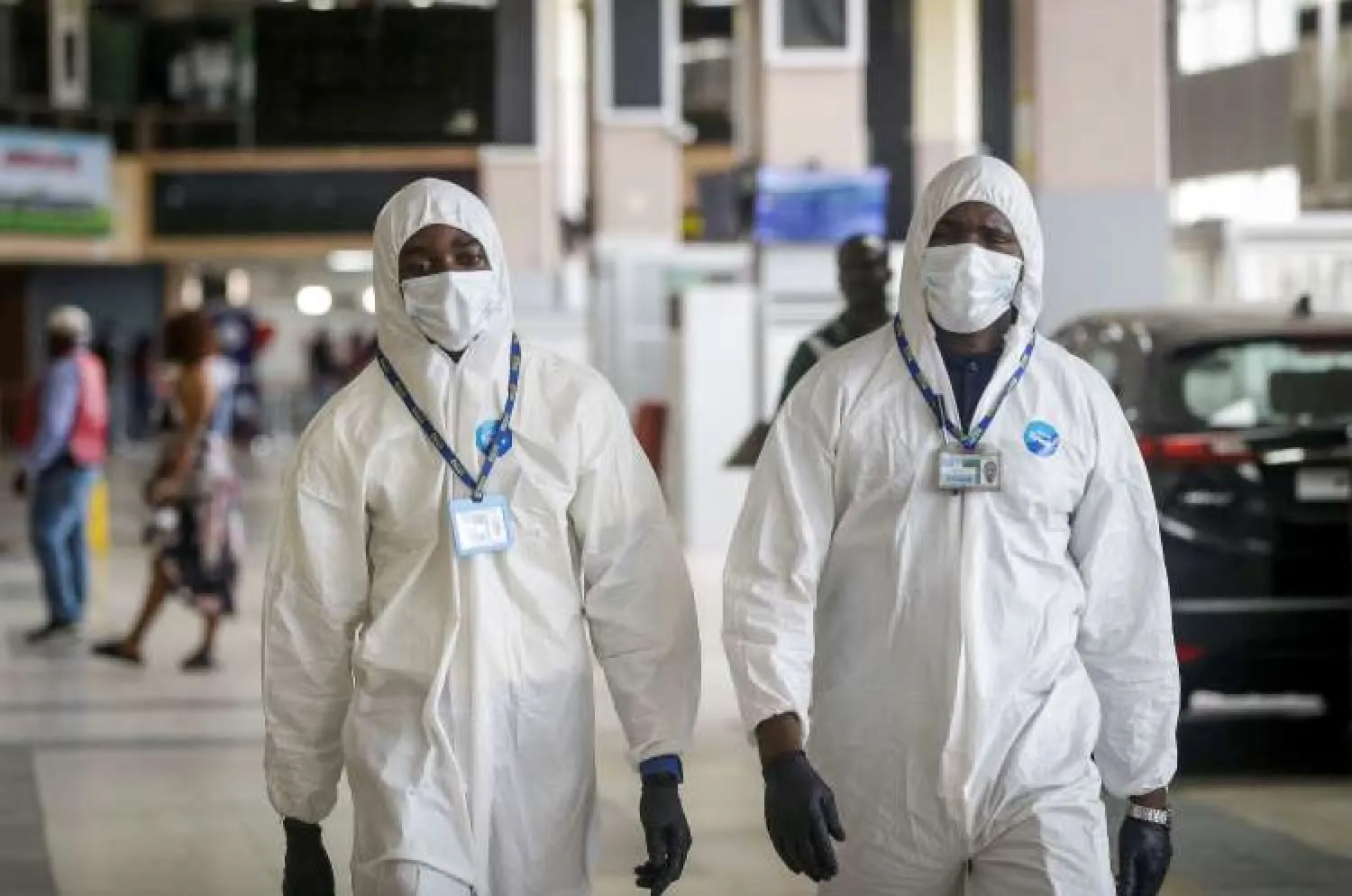
In this Tuesday, April 7, 2020 file photo, Nigerian aviation workers wear protective clothing as US citizens queue to check in and be repatriated aboard an evacuation flight arranged by the US embassy and chartered with Delta Air Lines, at the Murtala Mohammed International Airport in Lagos, Nigeria. (AP Photo/Sunday Alamba, File)
TT

Africa Starts Opening Airspace Even as COVID-19 Cases Climb

In this Tuesday, April 7, 2020 file photo, Nigerian aviation workers wear protective clothing as US citizens queue to check in and be repatriated aboard an evacuation flight arranged by the US embassy and chartered with Delta Air Lines, at the Murtala Mohammed International Airport in Lagos, Nigeria. (AP Photo/Sunday Alamba, File)

As COVID-19 cases surged in many parts of the world, the island nation of the Seychelles was looking good: 70-plus straight days without a single infection. Then the planes arrived.

Two chartered Air Seychelles flights carrying more than 200 passengers also brought the coronavirus. A few tested positive. Then, between June 24 and 30, the country´s confirmed cases shot from 11 to 81.

Now the Indian Ocean nation has delayed reopening for commercial flights for its lucrative tourism industry until Aug. 1, if all goes well.

African nations face a difficult choice as infections are rapidly rising: Welcome the international flights that originally brought COVID-19 to the ill-prepared continent, or further hurt their economies and restrict a lifeline for badly needed humanitarian aid.

"This is a very important moment," the World Health Organization´s Africa chief, Matshidiso Moeti, told reporters on Thursday, a day after Egypt reopened its airports for the first time in more than three months.

Other countries are preparing to follow. That´s even as Africa had more than 463,000 confirmed virus cases as of Sunday and South Africa, its most developed economy, already struggles to care for COVID-19 patients.

But Africa's economies are sick, too, its officials say. The continent faces its first recession in a quarter-century and has lost nearly $55 billion in the travel and tourism sectors in the past three months, the African Union says. Airlines alone have lost about $8 billion and some might not survive.

Most of Africa´s 54 countries closed their airspace to ward off the pandemic. That bought time to prepare, but it also hurt efforts to deliver life-saving medical supplies such as vaccines against other diseases. Shipments of personal protective gear and coronavirus testing materials, both in short supply, have been delayed.

"Many governments have decided travel needs to resume," the WHO's Africa chief said.

Africa has seen far fewer flights than other regions during the pandemic. Sometimes the entire West and Central African region saw just a single daily departure, according to International Civil Aviation Organization data.

While Asia, Europe and North America averaged several hundred departures a day from international airports, the African continent averaged a couple or few score daily.

Last week, the number of global flights jumped significantly. In the three-day period between June 30 and July 2, the daily number of departures increased from 3,960 to 6,508 as countries loosened restrictions, the data show.

African nations want to join the crowd. Senegal´s president has said international flights will begin on July 15. The 15-member Economic Community of West African States is expected to reopen its airspace on July 21. Nigeria has said domestic flights resume on July 8 and Rwanda on Aug. 1.

Kenya Airways wants to resume international flights. South Africa and Somalia are open for domestic ones, and Cameroon, Equatorial Guinea, Tanzania, and Zambia now have commercial flights. Tanzania opened its skies weeks ago, hoping for a tourism boost despite widespread concern it´s hiding the extent of infections. It hasn´t updated case numbers since April.

"It´s good to be back!" Africa´s largest carrier, Ethiopian Airlines, declared late last month. After scrambling to revamp its services for cargo and repatriation flights in the past few months, it now wants to play a leading role in "the new normal."

That means face masks are mandatory on board. But the WHO´s Africa chief hopes to see all airlines do more.

"Physical distancing should be encouraged by leaving seats vacant," Moeti said. And she suggested that "when we see a flare-up that is unacceptable" in virus cases, the loosening of travel restrictions could be reversed.

The WHO recommends that countries look at whether the need to fight widespread virus transmission outweighs the economic benefits of opening borders. "It is also crucial to determine whether the health system can cope with a spike in imported cases," it says.

Regional leaders of the International Air Transport Association and Airports Council International are ready to go. In an open letter to African ministers last month, they welcomed global guidelines developed by the ICAO for the return to travel after the aviation industry´s "biggest challenge of its history."

They also urged African countries to "identify every opportunity where travel restrictions could be lifted ... as soon as the epidemiological situation allows for it."

As the continent slowly takes flight, some European nations and others are limiting entry to people from countries they feel are doing a good job of containing the virus. African nations can seize the moment and do more tourism at home, Amani Abou-Zeid, AU commissioner for infrastructure and energy, told reporters last week.

"This is an opportunity to encourage Africans to see Africa," she said.

Not always. The 70 recently infected people in the Seychelles, all crew members from West African countries meant to work on tuna fishing vessels, were isolated on boats in a special quarantine zone in the harbor in the capital.



China Vows ‘Resolute Response’ to Any Reckless Acts After Japan Election

 Japan's Prime Minister Sanae Takaichi, leader of the ruling Liberal Democratic Party (LDP), arrives at the Prime Minister's office after her party's historic election win in Sunday's poll in Tokyo, Japan, February 9, 2026. (Reuters)
Japan's Prime Minister Sanae Takaichi, leader of the ruling Liberal Democratic Party (LDP), arrives at the Prime Minister's office after her party's historic election win in Sunday's poll in Tokyo, Japan, February 9, 2026. (Reuters)
TT

China Vows ‘Resolute Response’ to Any Reckless Acts After Japan Election

 Japan's Prime Minister Sanae Takaichi, leader of the ruling Liberal Democratic Party (LDP), arrives at the Prime Minister's office after her party's historic election win in Sunday's poll in Tokyo, Japan, February 9, 2026. (Reuters)
Japan's Prime Minister Sanae Takaichi, leader of the ruling Liberal Democratic Party (LDP), arrives at the Prime Minister's office after her party's historic election win in Sunday's poll in Tokyo, Japan, February 9, 2026. (Reuters)

Beijing warned Tokyo on Monday that reckless actions would be met with a "resolute response", a day after Japan's Prime Minister Sanae Takaichi, who is viewed as critical of China, won a landslide election.

China and Japan have been locked in a spat over comments by Takaichi in November that Tokyo could intervene militarily in any attack on self-ruled Taiwan.

China claims the democratic island as part of its territory and has not ruled out force to annex it.

A spokesman for China's foreign ministry on Monday urged Japan to retract the comments and warned of consequences for any rash actions.

"If the far-right forces in Japan misjudge the situation and act recklessly, they will inevitably face resistance from the Japanese people and a resolute response from the international community," spokesman Lin Jian told a regular news conference.

"We once again urge the Japanese side to retract the erroneous remarks made by Takaichi regarding Taiwan and demonstrate basic sincerity in safeguarding the political foundation of China-Japan relations, through concrete actions," he said.

In the wake of Takaichi's comments in November, China has discouraged its nationals from travelling to Japan, citing deteriorating public security and criminal acts against Chinese nationals in the country.

In the latest escalation of the row in December, Chinese military aircraft locked radar onto Japanese jets, prompting Tokyo to summon Beijing's ambassador.

Beijing also reportedly choked off exports to Japan of rare-earth products crucial for making everything from electric cars to missiles.

And last month, two popular pandas departed Tokyo for China, leaving Japan without any of the beloved bears for the first time in 50 years.


Russia's FSB Says Ukraine's SBU Was behind Assassination Attempt on Top General

In this image made from video and provided by the Russian Defense Ministry Press Service, on June 23, 2023, Lt. Gen. Vladimir Alexeyev speaks to servicemen in an undisclosed location. (Russian Defense Ministry Press Service via AP)
TT

Russia's FSB Says Ukraine's SBU Was behind Assassination Attempt on Top General

In this image made from video and provided by the Russian Defense Ministry Press Service, on June 23, 2023, Lt. Gen. Vladimir Alexeyev speaks to servicemen in an undisclosed location. (Russian Defense Ministry Press Service via AP)

Russia's Federal Security Service said on Monday that the men suspected of shooting one of the country's most senior military intelligence officer had confessed that they were carrying out orders from the Security Service of Ukraine (SBU).

Ukraine has denied any involvement in Friday's attempted assassination of Lieutenant General Vladimir Alexeyev, deputy head of Russia's ‌GRU military ‌intelligence service. Alexeyev has regained ‌consciousness ⁠after surgery, reported Reuters.

Russia ‌said that the suspected shooter, a Ukrainian-born Russian citizen named by Moscow as Lyubomir Korba, had been questioned after he was extradited from Dubai. A suspected accomplice, Viktor Vasin, has also been questioned.

The FSB said in ⁠a statement that both Korba and Vasin had "confessed their ‌guilt" and given details ‍of the shooting which ‍they said was "committed on behalf of ‍the Security Service of Ukraine."

The FSB did not provide any evidence that Reuters was able to immediately verify. It was not possible to contact the men while they were in detention in Russia. The SBU could ⁠not be reached for immediate comment on the FSB statement.

The FSB said Korba was recruited by the SBU in August 2025 in Ternopil, western Ukraine, underwent training in Kyiv and was paid monthly in crypto-currency. For killing Alexeyev, Korba was promised $30,000 by the SBU, the FSB said.

The FSB said Polish intelligence was involved in his recruitment. ‌Poland could not be reached for immediate comment.


Venezuela's Machado Says Ally 'Kidnapped' after His Release

Venezuelan political leader Juan Pablo Guanipa gestures after their release outside Zona 7 prison in Caracas on February 8, 2026.  (Photo by Juan BARRETO / AFP)
Venezuelan political leader Juan Pablo Guanipa gestures after their release outside Zona 7 prison in Caracas on February 8, 2026. (Photo by Juan BARRETO / AFP)
TT

Venezuela's Machado Says Ally 'Kidnapped' after His Release

Venezuelan political leader Juan Pablo Guanipa gestures after their release outside Zona 7 prison in Caracas on February 8, 2026.  (Photo by Juan BARRETO / AFP)
Venezuelan political leader Juan Pablo Guanipa gestures after their release outside Zona 7 prison in Caracas on February 8, 2026. (Photo by Juan BARRETO / AFP)

Venezuela's Nobel peace laureate Maria Corina Machado said on Monday that armed men "kidnapped" a close ally shortly after his release by authorities, following ex-leader Nicolas Maduro's capture.

The country's Public Prosecutor's Office confirmed later that same day that former National Assembly vice president Juan Pablo Guanipa, 61, was again taken into custody and to be put under house arrest, arguing that he violated the conditions of his release.

Guanipa would be placed under house arrest "in order to safeguard the criminal process," the office said in a statement on Monday. The conditions of Guanipa's release have yet to be made public.

Machado claimed that her close ally had been "kidnapped" in the capital Caracas by armed men "dressed in civilian clothes" who took him away by force.

"We demand his immediate release," she wrote on social media platform X.

The arrest came after his release from prison on Sunday along with two other opposition figures, and as lawmakers prepared to vote Tuesday on a historic amnesty law covering charges used to lock up dissidents in almost three decades of socialist rule, reported AFP.

Shortly after his release, Guanipa visited several detention centers in Caracas, where he met with relatives of political prisoners and spoke to the press.

Guanipa had appeared earlier Sunday in a video posted on his X account, showing what looked like his release papers.

"Here we are, being released," Guanipa said in the video, adding that he had spent "10 months in hiding, almost nine months detained here" in Caracas.

- 'Let's go to an electoral process' -

Speaking to AFP later on Sunday, he had called on the government to respect the 2024 presidential election, which opposition candidate Edmundo Gonzalez Urrutia was widely considered to have won. Maduro claimed victory and remained in power till January.

"Let's respect it. That's the basic thing, that's the logical thing. Oh, you don't want to respect it? Then let's go to an electoral process," Guanipa said.

The opposition ally of Machado was arrested in May 2025, in connection with an alleged conspiracy to undermine legislative and regional elections that were boycotted by the opposition.

He was charged with terrorism, money laundering and incitement to violence and hatred.

Guanipa had been in hiding prior to his arrest. He was last seen in public in January 2025, when he accompanied Machado to an anti-Maduro rally.

Following Maduro's capture by US special forces on January 3, authorities have started to slowly release political prisoners. Rights groups estimate that around 700 people are still waiting to be freed.

A former Machado legal advisor, Perkins Rocha, was also freed on Sunday. So was Freddy Superlano, who once won a gubernatorial election in Barinas, a city that is the home turf of the iconic late socialist leader Hugo Chavez.

"We hugged at home," Rocha's wife Maria Constanza Cipriani wrote on X, with a photo of them.

Machado, who was awarded the 2025 Nobel Peace Prize for her efforts to advance democracy in Venezuela, had initially celebrated Guanipa's release.

"My dear Juan Pablo, counting down the minutes until I can hug you! You are a hero, and history will ALWAYS recognize it. Freedom for ALL political prisoners!!" she wrote on X on Sunday.

NGO Foro Penal said it had confirmed the release of 35 prisoners on Sunday. It said that since January 8 nearly 400 people arrested for political reasons have been freed thus far.

Lawmakers gave their initial backing to a draft amnesty last week which covered the types of crimes used to lock up dissidents during 27 years of socialist rule.

But Venezuela's largest opposition coalition denounced "serious omissions" in the proposed amnesty measures on Friday.

Meanwhile, relatives of prisoners are growing increasingly impatient for their loved ones to be freed.

Acting president Delcy Rodriguez, who was Maduro's vice president, is pushing the amnesty bill as a milestone on the path to reconciliation.

Rodriguez took power in Venezuela with the blessing of US President Donald Trump, who is eyeing American access to what are the world's largest proven oil reserves.

As part of its reforms, Rodriguez's government has taken steps towards opening up the oil industry and restoring diplomatic ties with Washington, which were severed by Maduro in 2019.