

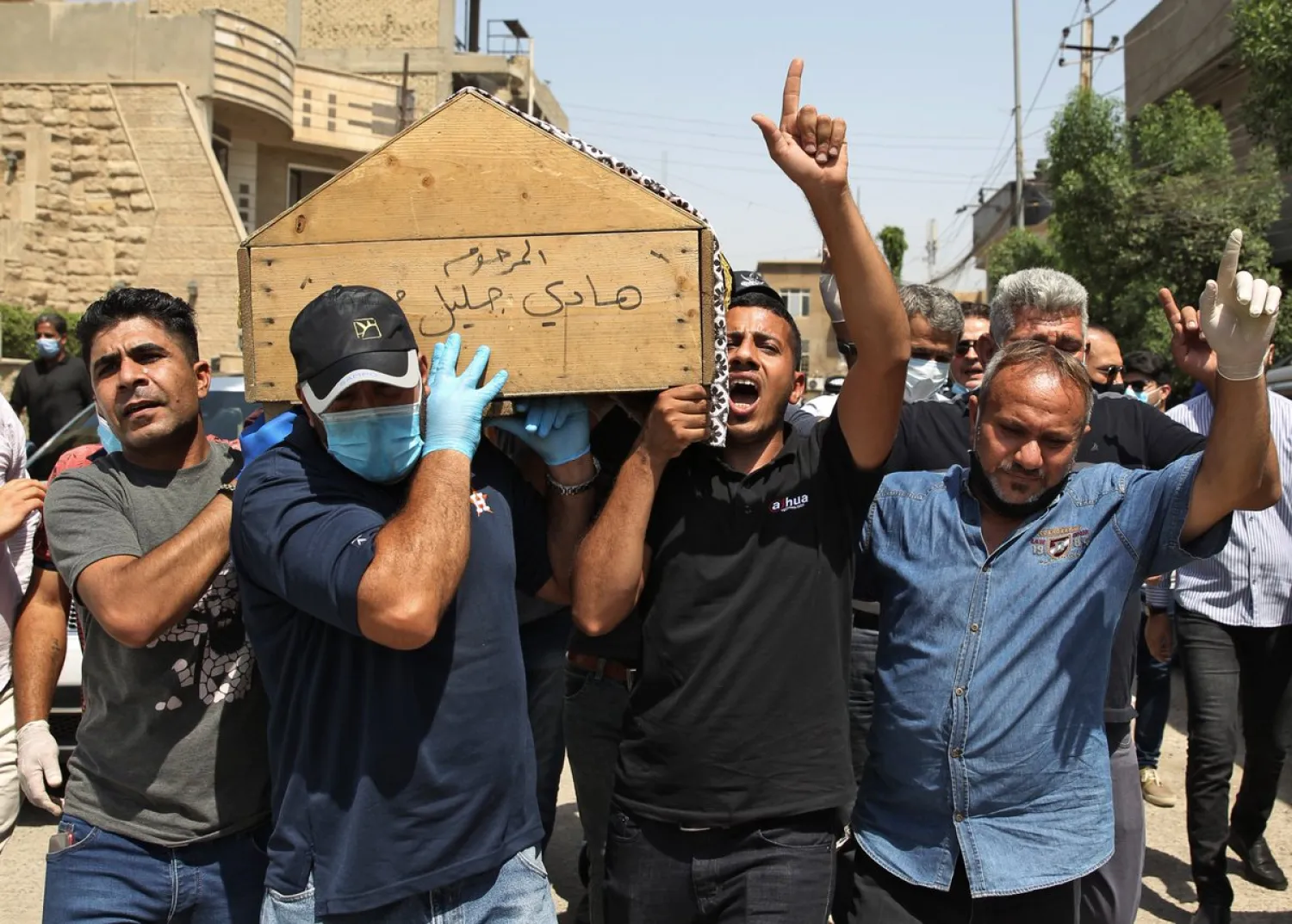

Killing of Iraq's Hashemi Stirs Fear of New Violent Phase

Mourners carry the coffin of Iraqi security expert Hisham al-Hashemi, who was shot dead outside his house in the Iraqi capital | AFP
TT

Killing of Iraq's Hashemi Stirs Fear of New Violent Phase

Mourners carry the coffin of Iraqi security expert Hisham al-Hashemi, who was shot dead outside his house in the Iraqi capital | AFP

The killing of security expert Hisham al-Hashemi has stirred fears Iraq is entering a dark and violent phase, as boiling tensions between pro-Iran factions and the government reach new heights.

Hashemi, 47, was gunned down outside his home in east Baghdad late Monday by masked assailants on motorcycles.

While the perpetrators remain on the run, experts say the death signals a dramatic turn for political violence brewing since mass protests erupted in October.

"Armed forces of various affiliations have killed protesters and others willing to publicly criticize the government and armed forces with impunity," said Belkis Wille of Human Rights Watch.

"But killing someone of his stature smacks of a country where some groups have become so emboldened by the complete impunity for serious abuses, that they can kill anyone they want to without paying a price," he said.

Over the course of years, Hashemi had developed a vast network encompassing top decision-makers, former militants, and rival political parties, often mediating among them.

His exceptional access had granted him a level of protection, those close to him said, but the balance started to tip in October.

His support for popular protests against a government seen as too close to Iran infuriated Tehran-backed factions in Iraq's Hashed al-Shaabi (Popular Mobilization Forces) military network.

Hashemi skirted threats to mediate between protesters and senior government officials, even as activists were fatally shot outside their homes and dozens more abducted.

"The parameters changed starting in October. There was a new modus operandi, and a shift in the confrontation with pro-Iran factions," said Adel Bakawan, an Iraqi expert who knew Hashemi.

- 'Won't be the last' -

Other experts say the real turning point was in January, when a US strike on Baghdad killed Iranian General Qasem Soleimani and Hashed deputy head Abu Mahdi al-Muhandis.

Hardline factions within the Hashed, particularly those close to Iran like Kataeb Hezbollah, vowed revenge against both the US and its allies inside Iraq, whatever the cost.

As someone with close ties to foreign governments, Hashemi was seen as a potential target, and he left Baghdad for a few days in late January, he told AFP at the time.

"Hisham was aware that things had shifted," said Renad Mansour, a researcher at London-based Chatham House who worked with Hashemi for years.

"The killing of Abu Mahdi unleashed all of these groups that he had been trying to control and centralize. We're still feeling the shock waves," he said.

Hashed al-Shaabi itself published a statement mourning Hashemi's murder.

"We demand security forces follow up on this crime and catch the terrorist group that assassinated Hashemi," it said.

Within the network, Kataeb Hezbollah has accused then-spy chief Mustafa al-Kadhimi of complicity in the deadly strike and deeply opposed his rise to Iraq's premiership in May.

Hashemi had advised Kadhimi for years, a relationship that put the expert in "danger" when the former intelligence head became premier, those close to him said.

In recent weeks, Hashemi had been particularly critical of rogue elements of the Hashed and had received threats from at least two hardline factions, his associates said. His family, meanwhile, said he had been threatened by ISIS.

"For the first time since 2003, there is a sacred alliance between the government and an influential group of intellectuals. Now, people who are both symbols of the protests and the government are being targeted," said Bakawan, who knew Hashemi personally.

"This may be the first prominent figure killed but it won't be the last. There are other names on this blacklist," he added.

- 'Suicidal mission' -

Kadhimi has pledged to hold Hashemi's killers to account, and swiftly sacked the police chief in the Baghdad district where the expert was killed.

But there is little hope for real accountability.

Less than two weeks ago, Kadhimi ordered the arrests of Kataeb Hezbollah fighters who were allegedly preparing a rocket attack on Baghdad's high-security Green Zone, home to the US embassy and other foreign missions.

But within days, all but one of those detained were released and their faction even pledged court action against Kadhimi.

Hashemi's killing appears to be a new challenge, said Iraqi politician Raed Fahmi.

"This is a political assassination that represents both the silencing of freedom of speech, and a challenge to the government, its prime minister and any reform plan," he said.

Other Iraqi activists told AFP they had long feared being targeted for speaking out against Iran-backed groups.

"This could have been any one of us. Our friends have already been notified to leave immediately," said Omar Mohammad, a historian who documented atrocities in Mosul under IS.

"If Kadhimi will not take a strong step, civil life in Iraq will vanish. But I'm afraid he won't do it. It's a suicidal mission," he told AFP.



US, Qatar, Egypt, Türkiye, Urge Restraint in Gaza

Members of the Palestinian Civil Defense remove the rubble of a destroyed home as they search for the bodies of Palestinians killed during the conflict in Khan Younis, southern Gaza Strip, 20 December 2025. (EPA)
TT

US, Qatar, Egypt, Türkiye, Urge Restraint in Gaza

Members of the Palestinian Civil Defense remove the rubble of a destroyed home as they search for the bodies of Palestinians killed during the conflict in Khan Younis, southern Gaza Strip, 20 December 2025. (EPA)

The United States was joined Saturday by Qatar, Egypt and Türkiye in urging parties in the Gaza ceasefire to uphold their obligations and exercise restraint, the chief US envoy said after talks in Miami.

Top officials from each nation met with Steve Witkoff, President Donald Trump's special envoy, to review the first stage of the ceasefire that came into effect on October 10.

"We reaffirm our full commitment to the entirety of the President’s 20-point peace plan and call on all parties to uphold their obligations, exercise restraint, and cooperate with monitoring arrangements," said a statement posted by Witkoff on X.

Their meeting came amid continuing strains on the agreement.

Gaza's civil defense said six people were killed Friday in Israeli shelling of a shelter. That brought to 400 the number of Palestinians killed by Israeli fire since the deal took effect.

Israel has also repeatedly accused Hamas of violating the truce, with the military reporting of its three soldiers killed in the territory since October.

Saturday's statement cited progress yielded in the first stage of the peace agreement, including expanded humanitarian assistance, return of hostage bodies, partial force withdrawals and a reduction in hostilities.

It called for "the near-term establishment and operationalization" of a transitional administration which is due to happen in the second phase of the agreement, and said consultations would continue in the coming weeks over its implementation.

Under the deal's terms, Israel is supposed to withdraw from its positions in Gaza, an interim authority is to govern the Palestinian territory instead of Hamas, and an international stabilization force is to be deployed.

On Friday, US Secretary of State Marco Rubio expressed hope that countries would contribute troops for the stabilization force, but also urged the disarmament of Hamas, warning the process would unravel unless that happened.


Lebanese Deputy PM to Asharq Al-Awsat: No Political Negotiations with Israel

Smoke rises from the site of a series of Israeli airstrikes that targeted the outskirts of the southern Lebanese village of al-Katrani on December 18, 2025. (AFP)
TT

Lebanese Deputy PM to Asharq Al-Awsat: No Political Negotiations with Israel

Smoke rises from the site of a series of Israeli airstrikes that targeted the outskirts of the southern Lebanese village of al-Katrani on December 18, 2025. (AFP)

Lebanon’s Deputy Prime Minister Tarek Mitri denied on Saturday that the appointment of civilian negotiators between Lebanon and Israel means that political negotiations have been launched between the two neighbors.

He told Asharq Al-Awsat that the negotiating team is primarily tasked with ensuring that the Lebanese army carries out Lebanon’s part of the ceasefire with Israel.

The army is close to completing the first phase of the agreement to impose state monopoly over arms in southern Lebanon, he added.

Other phases of the deal will follow to cover the whole of Lebanon.

Mitri added that attention must be focused on not giving Israel excuses to attack Lebanon, meaning Lebanon must meet its ceasefire obligations.

He warned, however, that Israel "could expand its military operations in Lebanon with or without excuses."

He noted that the United States appears to be pressuring Israel against launching a new war against Lebanon.

Lebanon is close to completing the disarmament of Hezbollah south of the Litani River, Prime Minister Nawaf Salam said on Saturday, as the country races to fulfil a key demand of its ceasefire with Israel before a year-end deadline.

The US-backed ceasefire, agreed in November 2024, ended more than a year of fighting between Israel and Hezbollah and required the disarmament of the Iran-aligned group, starting in areas south of the river adjacent to Israel.

Lebanese authorities, ‌led by President ‌Joseph Aoun and Salam, tasked the Lebanese ‌army ⁠on August ‌5 with devising a plan to establish a state monopoly on arms by the end of the year.

"Prime Minister Salam affirmed that the first phase of the weapons consolidation plan related to the area south of the Litani River is only days away from completion," a statement from his ⁠office said.

"The state is ready to move on to the second ‌phase - namely (confiscating weapons) north of the ‍Litani River - based on the ‍plan prepared by the Lebanese army pursuant to ‍a mandate from the government," Salam added.

The statement came after Salam held talks with Simon Karam, Lebanon's top civilian negotiator on a committee overseeing the Hezbollah-Israel truce.

Since the ceasefire, the sides have regularly accused each other of violations, with Israel questioning the Lebanese army's efforts to disarm Hezbollah. ⁠Israeli warplanes have increasingly targeted Hezbollah in southern Lebanon and even in the capital.

Israel has publicly urged Lebanese authorities to fulfil the conditions of the truce, saying it will act "as ‌necessary" if Lebanon fails to take steps against Hezbollah, which has refused to disarm.


Lebanese PM to Asharq Al-Awsat: 2nd Phase of Disarmament to Begin Soon Covering Regions between Litani, Awali

Prime Minister Nawaf Salam and ambassador Simon Karam meet on Saturday. (PM's office)
TT

Lebanese PM to Asharq Al-Awsat: 2nd Phase of Disarmament to Begin Soon Covering Regions between Litani, Awali

Prime Minister Nawaf Salam and ambassador Simon Karam meet on Saturday. (PM's office)

Lebanon would have completed the first phase of the army’s plan to impose state monopoly over arms, or the disarmament of Hezbollah, by the end of the year.

Prime Minister Nawaf Salam’s office confirmed on Saturday that the first phase was close to completion.

“The first phase of the weapons consolidation plan related to the area south of the Litani River is only days away from completion,” it said.

“The state is ready to move on to the second ‌phase - namely (confiscating weapons) north of the ‍Litani River - based on the ‍plan prepared by the Lebanese army pursuant to ‍a mandate from the government,” Salam added.

The cabinet will meet at the beginning of the new year after the first phase is completed.

Salam, meanwhile, told Asharq Al-Awsat that the second phase of the disarmament will cover the areas between the Litani and Awali Rivers to its north.

The third phase will cover Beirut and Mount Lebanon and the fourth covers the Bekaa followed by remaining regions.

Lebanese sources said the army has completed most of its report on its disarmament efforts south of the Litani. It has completed the confiscation and destruction of thousands of tons of ammunition and military gear. It has discovered around a hundred military tunnels in the region.

As it stands, the army is unlikely to ask for an extension of the deadline to complete the first phase by the end of the year. It may ask for a “technical” extension for a few weeks if necessary.

Salam refused to go into the details of the government’s next step after it receives the army’s detailed report on the disarmament south of the Litani.

“The military has succeeded in imposing complete state authority over the regions from south of the Litani to the southern border, except for the areas occupied by Israel and from where it should withdraw without delay,” the PM told Asharq Al-Awsat.

He confirmed that the government will convene at the beginning of the year to assess the first phase of the disarmament, stressing that Israel must take reciprocal steps, such as ceasing its violations of the ceasefire.

This will not prevent Lebanon from moving on to the second phase of implementing state monopoly over arms, he revealed.

Progress hinges of Hezbollah’s cooperation with Lebanon’s efforts to limit possession of weapons to the state and move towards activating state institutions in the South and kick off the reconstruction process with the help of Lebanon’s friends, he added.

“Imposing state monopoly over weapons is a Lebanese need before it is an international one,” he declared.

Everyone should be concerned with facilitating the process to end the cycle of violence, he urged.

Salam met on Saturday with Simon Karam, Lebanon's top civilian negotiator on the Mechanism committee overseeing the Hezbollah-Israel truce.

Karam briefed Salam on the latest meeting of the Mechanism.

Hezbollah continues to resist calls to disarm, saying the ceasefire with Israel does not cover areas north of the Litani. Party officials continue to tie disarmament to Israel’s withdrawal from regions it occupies in the South.