


Erdogan Says Hagia Sophia to Be Reopened for Muslim Worship

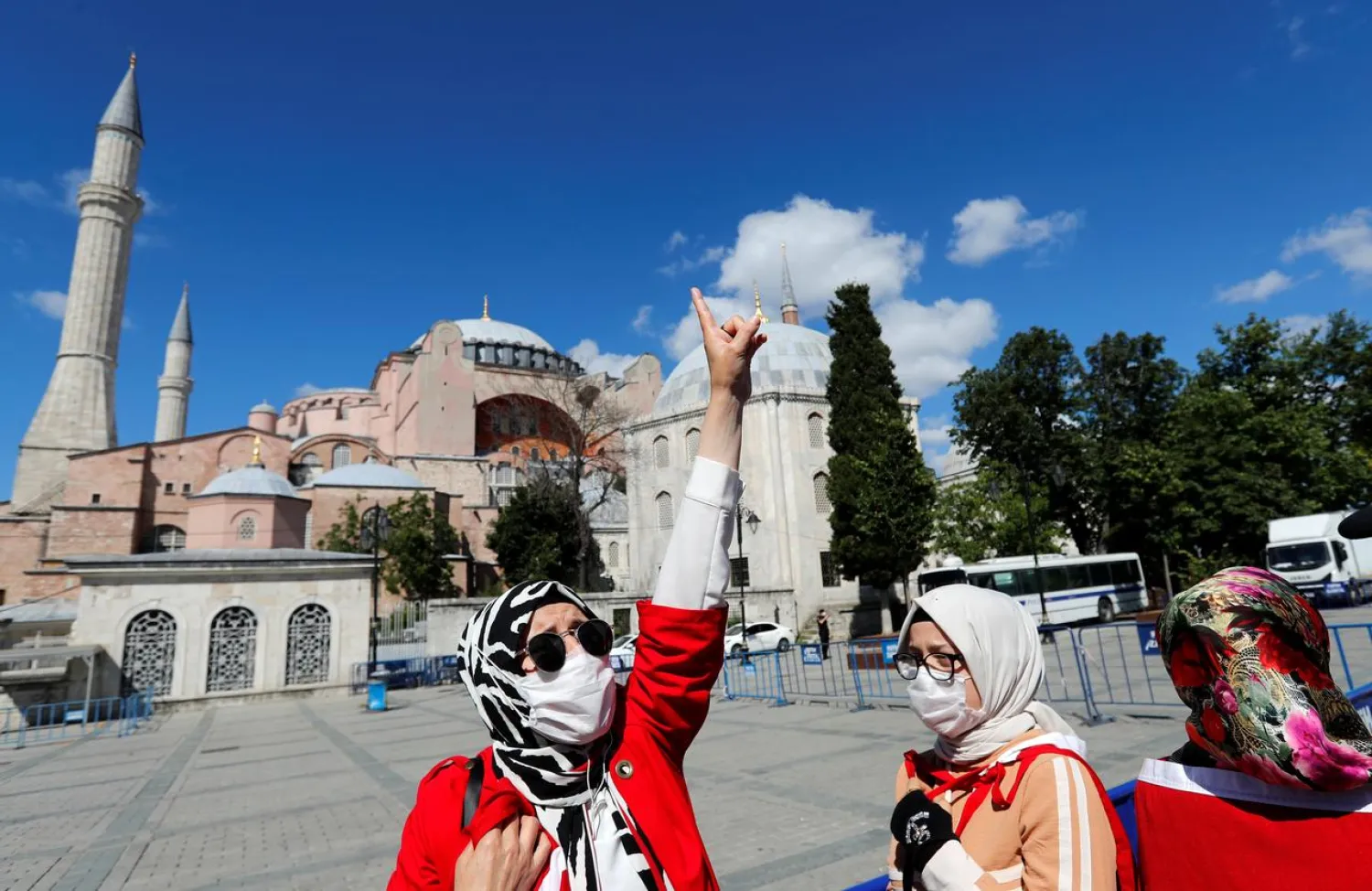
A woman gestures in front of the Hagia Sophia after a court decision that paves the way for it to be converted from a museum back into a mosque, in Istanbul, Turkey, July 10, 2020. (Reuters)
TT

Erdogan Says Hagia Sophia to Be Reopened for Muslim Worship

A woman gestures in front of the Hagia Sophia after a court decision that paves the way for it to be converted from a museum back into a mosque, in Istanbul, Turkey, July 10, 2020. (Reuters)

Turkish President Recep Tayyip Erdogan announced Friday that the Hagia Sophia, one of the architectural wonders of the world, would be reopened for Muslim worship, sparking fury in the Christian community and neighboring Greece.

His declaration came after a top Turkish court revoked the sixth-century Byzantine monument's status as a museum, clearing the way for it to be turned back into a mosque.

The UNESCO World Heritage site in historic Istanbul, a magnet for tourists worldwide, was first constructed as a cathedral in the Christian Byzantine Empire but was converted into a mosque after the Ottoman conquest of Constantinople in 1453.

The Council of State, Turkey's highest administrative court, unanimously cancelled a 1934 cabinet decision and said Hagia Sophia was registered as a mosque in its property deeds, in its detailed reasoning seen by AFP.

The landmark ruling will inflame tensions not just with the West and Turkey's historic foe Greece but also Russia, with which Erdogan has forged an increasingly close partnership in recent years.

Greece branded the move by Muslim-majority Turkey an "open provocation to the civilized world".

"The nationalism displayed by Erdogan... takes his country back six centuries," Culture Minister Lina Mendoni said in a statement.

The Russian Orthodox Church was equally scathing.

"The concern of millions of Christians were not heard," Church spokesman Vladimir Legoida told Interfax news agency.

The decision "shows that all pleas regarding the need to handle the situation extremely delicately were ignored," he said.

The UN cultural agency UNESCO earlier Friday had warned Turkey against converting Hagia Sophia, urging dialogue before any decision was taken.

The United States has also urged against altering its status.

Hagia Sophia, which stands opposite the impressive Sultanahmet Mosque -- often called the Blue Mosque, has been a museum since 1935 and open to believers of all faiths.

Transforming it from a mosque was a key reform under the new republic born out of the ashes of the Ottoman Empire.

Sharing a presidential decree which named Hagia Sophia as a "mosque", Erdogan announced its administration would be handed over to Turkey's religious affairs directorate known as Diyanet.

"May we be blessed," he commented. The decree was published on the official gazette.

Erdogan has in recent years placed great emphasis on the battles which resulted in the defeat of Byzantium by the Ottomans, with lavish celebrations held every year to mark the conquest.

Muslim clerics have occasionally recited prayers in the museum on key anniversaries or religious holidays.

"The decision is intended to score points with Erdogan´s pious and nationalist constituents," said Anthony Skinner of the risk assessment firm Verisk Maplecroft.

"Hagia Sophia is arguably the most conspicuous symbol of Turkey's Ottoman past -- one which Erdogan is leveraging to strengthen his base while snubbing domestic and foreign rivals," he told AFP.

‘Chains broken’
A few hundreds of Turks carrying Turkish flags gathered outside Hagia Sophia shouting "Chains broken, Hagia Sophia reopened".

Police heightened security measures around the building, according to AFP journalists.

"It's been a dream since we were kids," said Erdal Gencler, an Istanbul resident.

"(Hagia Sophia) finds its true purpose again. We are very excited, proud, and hopeful that there will be beautiful services here," he added.

Fatma, a woman with tearful eyes, said: "Of course I am crying. (Hagia Sophia) belongs to us."

Ahead of the court decision, Justice Minister Abdulhamit Gul shared a picture of Hagia Sophia on his official Twitter account, with a message: "Have a good Friday."

Finance Minister Berat Albayrak, Erdogan's son-in-law, tweeted that Hagia Sophia would be reopened to Muslim worship "sooner or later", referring to a quote from Turkish poet Necip Fazil Kisakurek.

The Council of State had on July 2 debated the case brought by a Turkish group -- the Association for the Protection of Historic Monuments and the Environment, which demanded Hagia Sophia be reopened for Muslim prayers.

Since 2005, there have been several attempts to change the building's status. In 2018, the Constitutional Court rejected one application.

Despite occasional protests outside the site by Islamic groups, Turkish authorities had until now kept the building as a museum.



NGO Slams Greek Shippers over Deliveries to Israel

A boy rides his bicycle past an Israel flag on Yom Kippur in Tel Aviv, Israel October 12, 2024. (Reuters)
TT

NGO Slams Greek Shippers over Deliveries to Israel

A boy rides his bicycle past an Israel flag on Yom Kippur in Tel Aviv, Israel October 12, 2024. (Reuters)

A pro-Palestinian campaign group on Monday accused Greek shipping firms of transporting oil and military equipment to Israel that helps its war in Gaza, in some cases breaching a Turkish embargo on trade with Israel.

The "No Harbour for Genocide" group called on Greek authorities to investigate and sanction firms running vessels that "turned off their tracking signals and listed false end-destinations before arriving at Israeli ports" to avoid detection.

The group released a report that said between May 2024 and December 2025 at least 57 "covert crude oil shipments" took about 47 million barrels of oil from Turkey to Israel "in violation of Turkey's trade embargo on Israel" since May 2024.

It said some of the oil was being refined into "fuel for the Israeli air force and fuel for military vehicles and tanks".

The report named a number of firms involved in "the shipment of both energy products and military cargo to Israel" that made them "a critical enabler of Israel's genocide and illegal occupation of Palestine, as well as its escalating aggression across the region".

Israel denies that its actions in the Gaza conflict since the October 7, 2023 Hamas attacks amount to genocide.

The Union of Greek Shipowners did not immediately comment on the report, AFP reported.

Greek firms run one of the world's biggest shipping fleets and the industry accounts for about eight percent of Greece's gross domestic product.


Israel Defense Minister Says Struck Iran's Largest Petrochemical Facility

A satellite image shows a closer view of the Natanz Nuclear Facility with new building damage, amid the US-Israeli conflict with Iran, near Natanz, Iran, March 2, 2026. (Vantor/Handout via Reuters)
TT

Israel Defense Minister Says Struck Iran's Largest Petrochemical Facility

A satellite image shows a closer view of the Natanz Nuclear Facility with new building damage, amid the US-Israeli conflict with Iran, near Natanz, Iran, March 2, 2026. (Vantor/Handout via Reuters)

Defense Minister Israel Katz said Monday that Israel had conducted a "powerful strike" on Iran's largest petrochemical complex, after Iranian media reported multiple explosions at the site.

The military "just carried out a powerful strike on Iran's largest petrochemical facility, located in Asaluyeh -- a central target responsible for about 50 percent of the country's petrochemical production", Katz said in a video statement.

Israel carried out a similar strike on the Mahshahr Petrochemical Special Zone in southwest Khuzestan province on Saturday, a local Iranian official said, adding that five people were killed, AFP reported.

"At this point, the two facilities, which together account for roughly 85 percent of Iran's petrochemical exports, have been taken out of operation and are no longer functioning," Katz said.

"This represents a severe economic blow amounting to tens of billions of dollars to the Iranian regime."

Israel also carried out strikes last month on gas facilities at the South Pars Special Economic Zone in Asaluyeh.

The South Pars/North Dome mega-field -- the largest known natural gas reserve in the world -- is shared between Iran and Qatar.

In recent days, Israel has targeted key industrial sectors as part of the ongoing military campaign against Iran.

On Friday, Israeli Prime Minister Benjamin Netanyahu said Israeli strikes had destroyed around 70 percent of Iran's steel production capacity, significantly undermining Tehran's ability to manufacture weapons.

Steel is a strategically important material used in industrial and military production, including for missiles, drones and ships.

Katz said he and Netanyahu had ordered the military "to continue striking with full force Iran's national infrastructure".


Israel Says to Boost Production of Arrow Missile Interceptors

Emergency personnel carry a body at the site of a projectile impact, as the US-Israeli conflict with Iran continues, in Haifa, Israel, April 6, 2026. REUTERS/Shir Torem
TT

Israel Says to Boost Production of Arrow Missile Interceptors

Emergency personnel carry a body at the site of a projectile impact, as the US-Israeli conflict with Iran continues, in Haifa, Israel, April 6, 2026. REUTERS/Shir Torem

Israel's defense ministry on Monday said it plans to accelerate production of Arrow missile interceptors, as it fights a war with Iran.

The announcement came after questions emerged in the international media over how long Israel's interceptor stocks would last, with some analysts pointing to shortages of Arrow interceptors in particular.

Israel has a multi-layered air defense array, with a variety of systems intercepting threats at different altitudes.

The top tier consists of the anti-ballistic missile Arrow systems, with Arrow 2 operating both within the Earth's atmosphere and in space and Arrow 3 intercepting above the Earth's atmosphere.

"The Ministerial Committee for Procurement has approved the Israel Ministry of Defense (IMOD) plan for a major additional acceleration of Arrow interceptor production," AFP quoted a defense ministry statement as saying.

It added that the plan would enable "a significant increase in both the production rate and stockpile of Arrow interceptors as part of preparations for the evolving campaign".

Defense Minister Israel Katz was quoted in the statement as saying that "Israel has sufficient interceptors to protect its citizens, and this initiative is designed to ensure continued freedom of action and the sustained operational endurance we require."

Each Arrow 2 interceptor costs an estimated $1.5 million, with Arrow 3s around $2 million.